The best bouillabaisse we ever had — a meal that defined the dish
Marseille: Mediterranean food tour
On writing about specific meals
We do not usually name specific restaurants in editorial pieces. Our reasoning is practical: restaurants change — chefs leave, ownership transfers, quality dips, or the opposite happens. A specific recommendation in a story written in October 2019 has a limited shelf life as a practical guide.
So let us say this: we ate bouillabaisse at a Charte de la Bouillabaisse restaurant near the Vallon des Auffes, on a weekday evening in October 2019. The restaurant has been around for decades, the reservation was made two days in advance by phone, and the maitre d’ who took our coats had clearly been taking coats in that room for a very long time. The restaurant is the kind of place where the fixtures are unchanged from 1975 and nobody finds this a problem.
The details of the meal are what we want to write about. Not as a guide — see our proper bouillabaisse guide for that — but as a story about what a dish can be when it is done correctly.
| At a glance | |
|---|---|
| Where | A Charte de la Bouillabaisse restaurant near Vallon des Auffes, Marseille |
| Cost | Around EUR 55–85 per person at Charte restaurants (was approximately EUR 65 in 2019) |
| Time needed | A full, unhurried evening — do not book it as a quick dinner |
| Getting there | The Vallon des Auffes area is a short taxi or Corniche tram ride from the Vieux-Port |
| Best time | October, for the shoulder-season calm and the light described below |
What arrived first
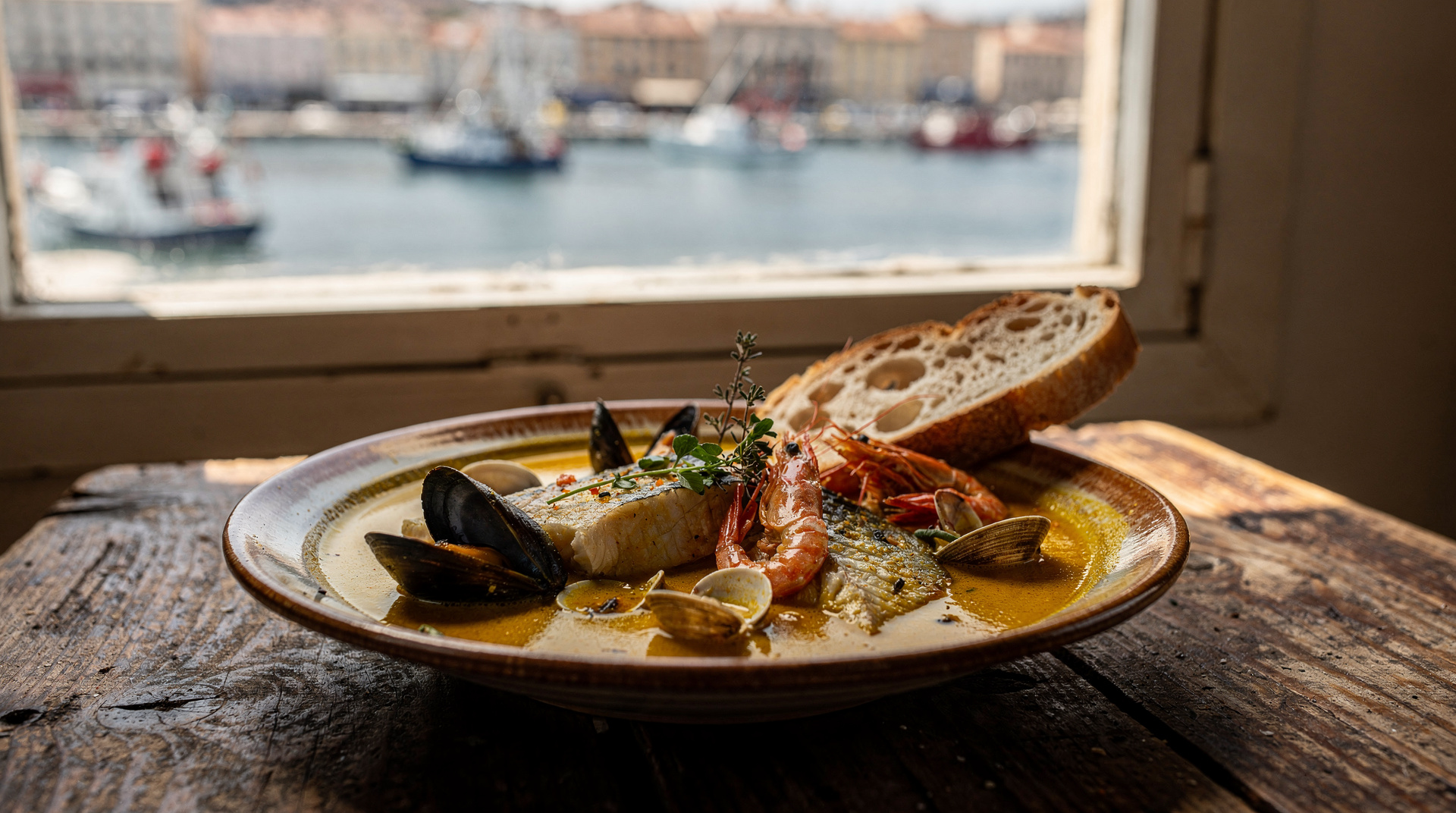
The first course arrived in a deep terracotta bowl: the broth. Saffron-coloured, clear despite its intensity, with a surface that caught the light from the candle. The smell reached us before the bowl touched the table — fish stock and saffron and something herbaceous underneath, fennel perhaps. A small side bowl held the rouille, deep orange and dense with garlic and saffron. A basket of toasted bread, rubbed with garlic while still warm. A saucer of grated gruyère.
The ritual, which the waiter walked us through without condescension, was this: a piece of toast in the bowl, a spoonful of rouille on the toast, broth poured over. The rouille dissolves into the broth, releasing garlic and saffron in a secondary wave. The toast softens but does not disintegrate immediately. You eat this slowly.
We had both ordered bouillabaisse before. At tourist restaurants, at decent bistros in Paris that offered it as a weekly special, once in Lyon where someone on the menu committee had made an optimistic decision. None of those preparations had anything to do with what was in front of us. The broth tasted of something specific and irreducible — not “fish” in the generic sense, but rascasse and grondin and saint-pierre and whatever else had gone into the pot that morning, with the identities of each fish preserved somehow in the collective flavour.
What arrived second
The second course came in two stages. First, a platter of the fish: a rascasse (whole, then partially filleted at the table), a section of baudroie (monkfish), a piece of saint-pierre, a length of congre (conger eel). Then a small pot of additional broth for pouring. Then silence while we figured out what to eat first.
The rascasse is the essential bouillabaisse fish — its collagen gives the broth its body and it is not optional under the Charte. The flesh is firm and white and breaks in clean flakes. The conger eel, which we had been uncertain about, was revelatory: deeply flavoured, more robust than the other fish, holding its own against the broth. The monkfish was excellent. The saint-pierre was delicate enough to eat without additional sauce.
We ate more slowly than was probably necessary. The restaurant was not full — October in Marseille is shoulder season, and the dining room was perhaps half occupied. Nobody was hurrying us. The candle burned down about an inch. We ate the rest of the rouille-toast with extra broth and did not feel remotely apologetic about it.
What the dish taught us
Bouillabaisse is not a fish stew. This is the thing we understood by the end of that meal. A fish stew is a procedure. Bouillabaisse is an argument — specifically, a Marseillais argument about what the sea adjacent to this particular city can produce, and about the precise combination of rock fish, saffron, fennel, and technique that has been refined over generations of fishing families who needed to make something good from the fish the fishmongers would not buy.
The Charte restaurants are the endpoint of that refinement process, and the EUR 65 price per person (approximately) in 2019 reflected the ingredient cost, the labour, and the fact that you were eating the conclusion of a very long argument. This is not expensive in the way that unnecessary luxury is expensive. This is expensive in the way that genuine craft is expensive.
The broader point about Marseille food
There is an honest conversation to be had about whether Marseille’s food reputation has caught up with its reality. In 2019, the answer was yes and no. The bouillabaisse at the Charte restaurants was exactly as good as its reputation. The broader restaurant scene, particularly around Cours Julien and the Noailles market, was genuinely excellent and largely unrecognised outside of France. The tourist-trap version of Marseille food — the quayside sandwich boards with “authentic” bouillabaisse at a third of the price — remained as dishonest as it had always been.
The honest approach, then as now, is to eat the real thing once (budget for it, book in advance, give it the evening it deserves) and then spend the rest of your time in the city eating at the excellent market counters and neighbourhood restaurants where the food is honest and the prices are not calibrated to tourists. The Vieux-Port area is not where you go for that; the streets a few blocks back from the tourist quais are.
October is the right month
One more observation, unrelated to the meal itself but connected to its quality: October in Marseille is close to perfect. The summer crowds are gone. The Mistral has not yet settled into its winter pattern. The sea is still warm enough to swim. The light has changed from summer gold to something softer and more precise — the kind of light that makes limestone buildings look like they are glowing from inside.
We made our reservation in October because it was available, not because we had strategically chosen the season. But walking back from the restaurant to our hotel, past the Vieux-Port in the October night, the water black and the reflections of the port lights stretching across it, we thought: this is the right time to be here. It has remained our preferred month for Marseille since.
For the practical guide to bouillabaisse — which restaurants to book, what to expect, how to avoid the tourist versions — our definitive bouillabaisse guide has everything you need. The best time to visit Marseille guide makes the case for spring and autumn in detail. The how Marseille changed us piece is the longer reflection on what the city has meant over years of returning.
What the Charte de la Bouillabaisse actually guarantees
The Charte is not a marketing label; it is a set of rules a restaurant signs up to, covering the minimum number of fish species (rascasse is mandatory), the fact the fish must be freshly caught rather than frozen, table-side presentation of the whole fish before filleting, and the two-course serving order described above. A handful of restaurants across Marseille hold it. Booking one of them, rather than trusting a menu board, is the only reliable way to know you are getting the real dish — our bouillabaisse tourist trap guide goes through how to spot the fakes before you sit down.
Where this fits with the rest of Marseille’s food scene
That evening did not exist in isolation. The excellent, unpretentious food we found around Cours Julien and the Noailles market in the same years is part of the same city, and arguably a more honest everyday reflection of it than a single formal dinner. If bouillabaisse is the argument Marseille makes about its relationship to the sea, the market counters are the argument it makes about the rest of its table. Both are worth your time, in different registers.
Frequently asked questions about best bouillabaisse we ever had — a meal that defined the dish
What is the Charte de la Bouillabaisse? It is a formal charter that a small number of Marseille restaurants sign, guaranteeing fresh (not frozen) fish including mandatory rascasse, table-side presentation, and the traditional two-course serving order — the only reliable signal that a bouillabaisse is the genuine dish.
Why is real bouillabaisse so expensive? Charte restaurants charge around EUR 55–85 per person because the fish must be freshly caught that day, the preparation is labour-intensive, and the minimum fish species required (including rascasse) are not cheap or always easy to source.
Top experiences
Bookable activities with verified prices and instant confirmation on GetYourGuide.