Camargue
Camargue guide — white horses, pink flamingos, black bulls, Saintes-Maries-de-la-Mer, Aigues-Mortes, horseback rides, and the mosquito reality.
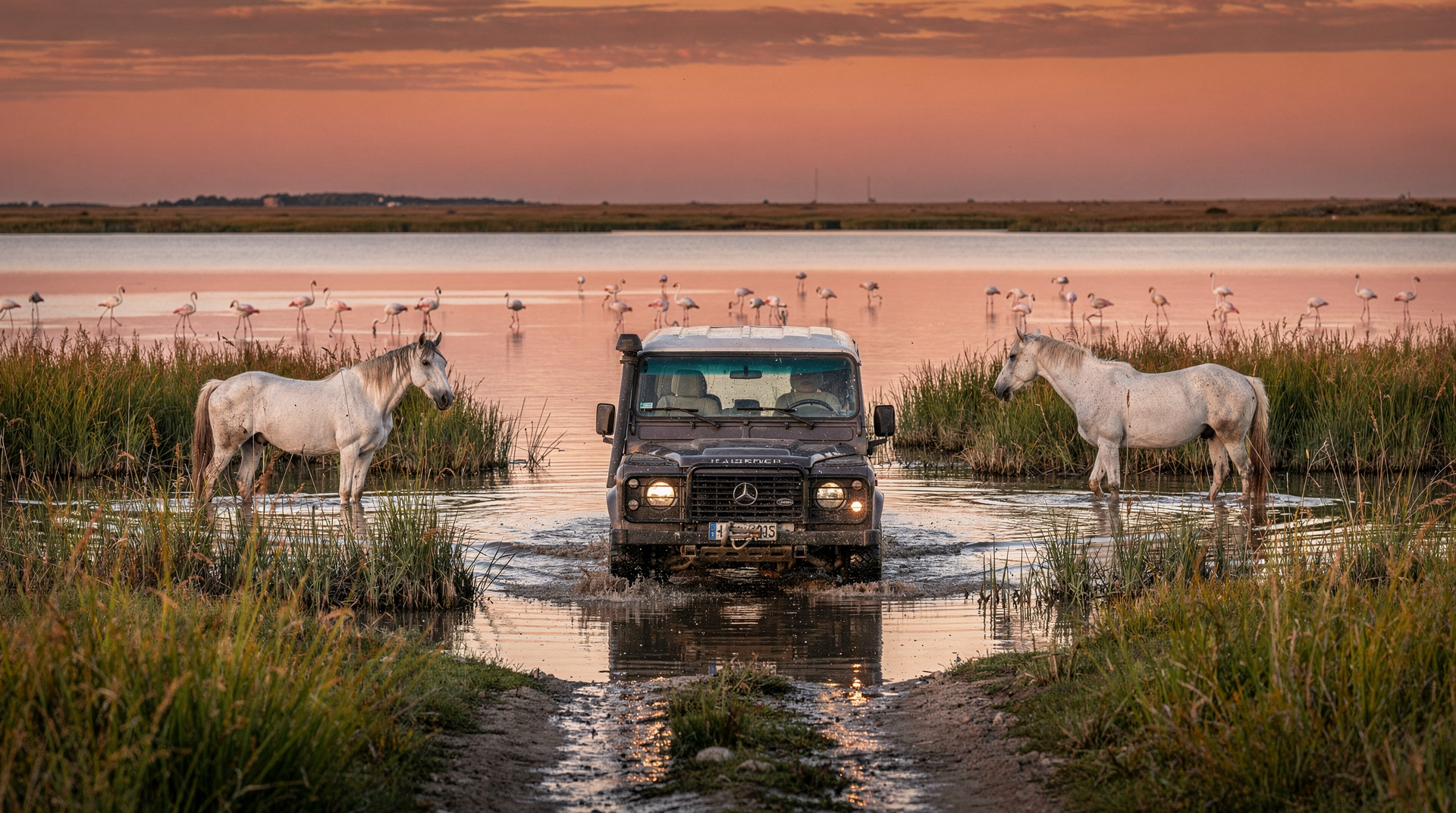
Camargue: 4x4 safari from Saintes-Maries-de-la-Mer
Quick facts
- Distance from Marseille
- ~1 h 30 by car to Saintes-Maries-de-la-Mer
- Best base
- Arles (40 min from Saintes-Maries) or stay in Saintes-Maries itself
- Must-see wildlife
- Flamingos at Étang du Vaccarès; white horses and black bulls year-round
- Pont de Gau bird park
- EUR 9 adult; open daily year-round
- Mosquitoes
- May–September: take repellent seriously. Autumn is better.
The delta that defies easy categorisation
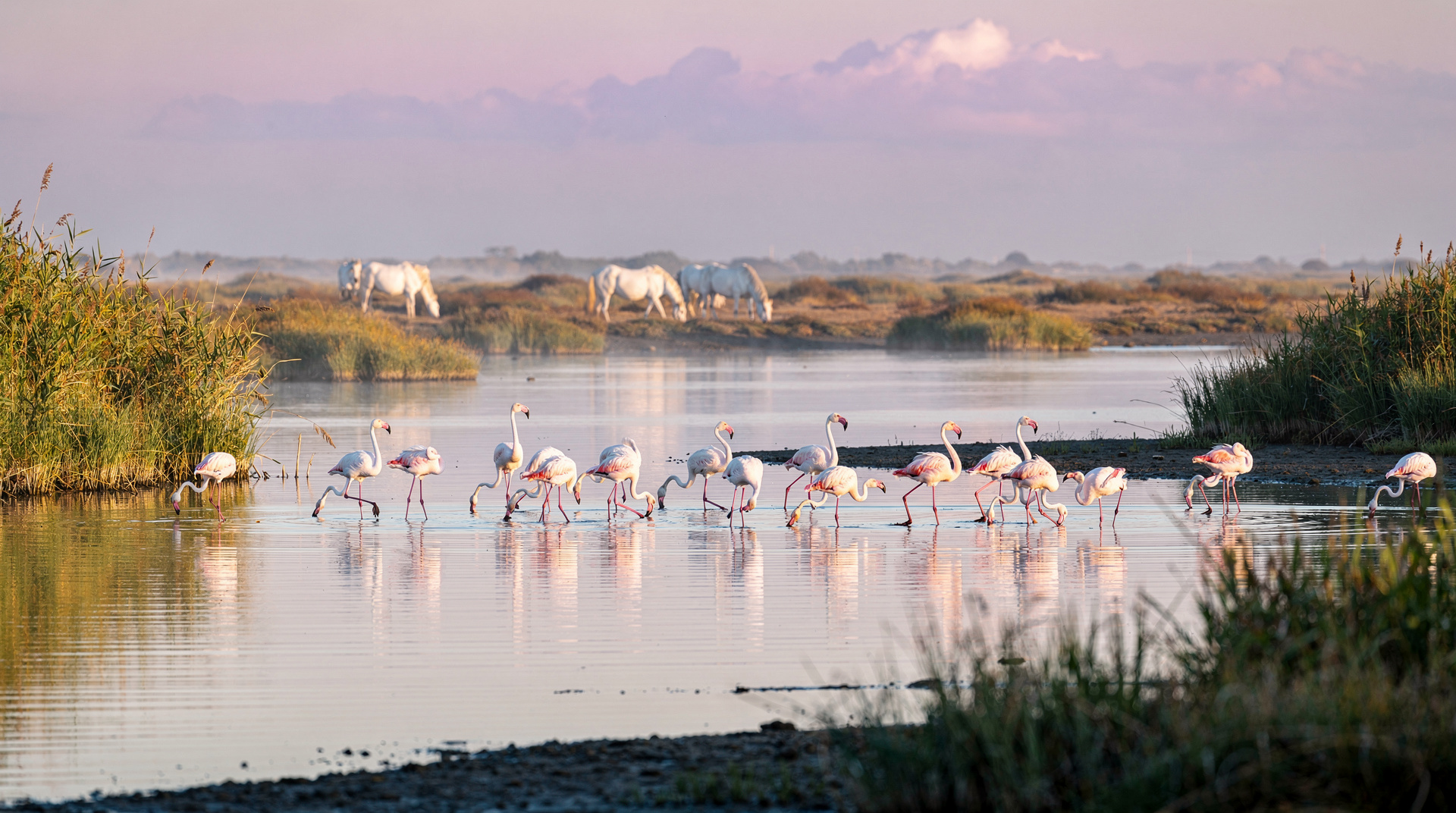
The Camargue is not straightforwardly beautiful. It is flat, windswept, and in summer, mosquito-ridden in a way that casual guidebook coverage consistently underplays. The horizon here is the line between salt marsh and sky, broken by the occasional stand of tamarisks, a flamingo flock standing in pink formation on a lagoon, or a group of white Camargue horses grazing in water to their knees.
This is the largest river delta in Western Europe — the Rhône splits into two arms (the Grand Rhône and the Petit Rhône) and fans out across roughly 930 square kilometres of wetland, salt flat, rice paddy, and lagoon before reaching the Mediterranean. It sits between Arles to the north, Aigues-Mortes to the west, and the coast to the south. The Camargue Regional Nature Park protects the core of this territory; the area around the Étang du Vaccarès (the central lagoon) is a strict nature reserve with no public access.
Coming here expecting a pretty drive is a mistake. Coming here prepared for genuine wildness — strange light, big skies, wildlife encounters that feel genuinely unscripted — is a different experience entirely.
Getting here from Marseille
The Camargue requires a car or an organised tour. There is no practical public transport from Marseille to Saintes-Maries-de-la-Mer or the bird park.
By car: From Marseille to Saintes-Maries-de-la-Mer is approximately 1 hour 30 via the A54 and D570. From Arles to Saintes-Maries is 40 minutes via the D570 — making Arles a useful transit point if you are coming by train.
By organised tour: Multiple operators run combined Arles + Camargue or Avignon + Camargue day tours. These handle transport and typically include either the Pont de Gau bird park or a guided 4x4 safari (or both). They are the practical option from Marseille without a car.
Allow a full day. The distance between the north (Arles) and south (Saintes-Maries) of the Camargue is 40 km, and the interesting sites are spread across the territory.
The animals: what you will realistically see
Flamingos: The Camargue has the largest flamingo colony in Western Europe — up to 30,000 birds breed here. They are most easily spotted at the Pont de Gau bird park (north of Saintes-Maries) and around the edges of the Étang du Vaccarès. In spring (April–June) and autumn (September–October), populations peak. In July–August they are present but often retreating to less accessible areas of the delta. A guided 4x4 safari gives better access than road-side viewing.
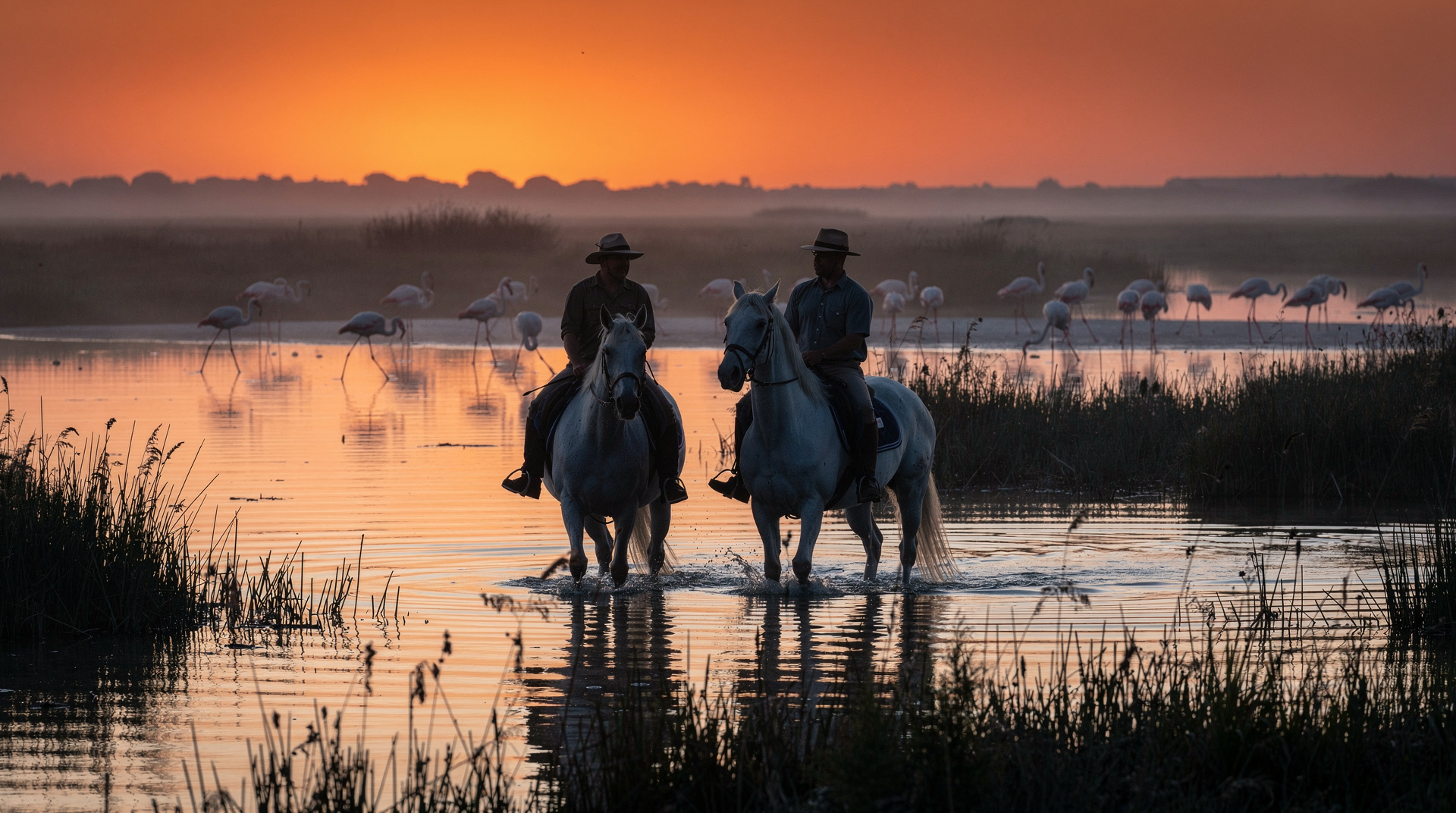
White horses: The Camargue horse — a grey-white breed native to the delta — is genuinely wild in some herds, managed and semi-wild in others. You see them throughout the delta, especially along the D36 between Arles and Saintes-Maries, often standing in shallow water. On a horseback ride, you move through the landscape on Camargue horses — a different relationship with the terrain than a vehicle allows.
Black bulls: The Camargue black bull (taureau de Camargue) is the working cattle of the gardians (the Camargue cowboys). Herds roam across the salt marshes; encounters along the road are common. They are not the fighting bulls of the arena — a different breed — but they are large and occasionally uninterested in your presence. Give them space.
Birds: Beyond flamingos, the Camargue is one of the most important bird migration corridors in Europe. Egrets, herons, marsh harriers, avocets, black-winged stilts, hoopoes, bee-eaters, and numerous wader species are visible depending on season. The Pont de Gau bird park is the most accessible observation point, with 6 km of trails through the habitats.
Pont de Gau bird park
The Parc Ornithologique du Pont de Gau, 4 km north of Saintes-Maries on the D570, is the easiest and most rewarding single stop in the Camargue for wildlife. The 6-km trail through lagoons, reed beds, and open water puts you within 10–20 metres of flamingos, herons, and waders without requiring a safari vehicle or prior ornithological knowledge.
Entry EUR 9 adult, EUR 4 child (4–12). Open daily year-round — 9:00 to sunset April through September; 10:00 to sunset October through March. No booking required. The best time to arrive is early morning for the best light and bird activity.
Saintes-Maries-de-la-Mer
The town at the southern tip of the Camargue is the pilgrimage destination of the Western Roma and Romanies. The legend: after the Crucifixion, Mary Magdalene, Mary Salome, Mary Jacobe, and their companions arrived here by boat from the Holy Land, bringing Christianity to Provence. Mary Salome and Mary Jacobe are held to be buried beneath the 9th-century fortified Romanesque church that dominates the village.
The Romani pilgrimage is held each year in late May (around the 24th and 25th) — thousands of Roma from across Europe converge on the town to venerate Sara la Kali, the patron saint of the Roma, whose statue is carried in procession to the sea. The ceremony is one of the most atmospheric and genuinely important cultural events in Provence, and not the folkloric tourist display some coverage implies. If your dates coincide, arrive early and observe respectfully.
The church itself is worth visiting regardless of pilgrimage timing. The crypt contains the reliquary of Sara, permanently hung with votive offerings and ex-votos. The upper chapel has the reliquary of Mary Salome and Mary Jacobe. Climb to the roof terrace for the Camargue panorama — flat delta in every direction to the horizon. Free entry; the roof climb has a small fee.
Outside of pilgrimage season, Saintes-Maries is a modest seaside town whose economy runs on tourism, with a beach, restaurants, and a marina. The beach is long and sandy (a rarity in Provence), sheltered by the dunes, and rarely overcrowded outside July–August. In summer the town fills completely; parking is restricted; access roads become slow. In May, June, September, and October it is an easy and pleasant place.
Aigues-Mortes: the walled city
Aigues-Mortes stands on the western edge of the Camargue, 30 km from Saintes-Maries across the salt flats. The medieval walled city was built by Louis IX of France (Saint Louis) in the 13th century as France’s Mediterranean port — from here he departed for the Seventh and Eighth Crusades. When Montpellier and Marseille became French, the city lost its maritime purpose and remained frozen in its 13th-century form.
The ramparts are almost entirely intact and walkable in their complete circuit — 1.6 km, with towers at intervals. The Tour de Constance, the cylindrical tower at the northwest corner, held Huguenot prisoners for decades and has the most interesting interior of any tower in the wall. Combined ticket for the ramparts and Tour de Constance: around EUR 11–13 adult (verify at the ticket desk; prices vary by season). Children under 18 and EU citizens 18–25 free.
The town inside the walls is a small grid of medieval streets with cafés, restaurants, and shops — pleasant for 90 minutes but compact. The main visual experience is the ramparts and the towers, not the interior.
The pink salt lakes: The salines (salt production lagoons) around Aigues-Mortes turn vivid pink in late summer due to the algae Dunaliella salina. The best months are August–September. The salt company (Salins du Midi) operates a guided tour of the salt works; flamingos frequent the edges of the salines throughout the season.
Horseback rides in the Camargue
Riding through the Camargue on a Camargue horse — white, compact, adapted to the wet terrain — is the most atmospheric way to experience the delta. Multiple operators around Saintes-Maries offer 1-hour, 2-hour, and half-day rides through marshes, sand dunes, and beaches. No prior riding experience is required for the shorter rides.
Prices vary by operator and duration. A 2-hour ride typically costs EUR 40–60 per person. The rides that include beach access and time in the water (horses wade naturally) are the most memorable. Advance booking is strongly recommended in summer. Several operators require a minimum weight or age for shorter rides with children.
The mosquito reality
In May, June, July, August, and early September, the Camargue has mosquitoes. Not incidental mosquitoes — the kind that make standing still outdoors without insect repellent actively unpleasant. This is a fact that deserves honest acknowledgement before you plan a sunset walk through the marshes.
Practical guidance:
- Bring DEET-based repellent (30–50% concentration). Apply before leaving the car.
- Mosquitoes are most active at dawn, dusk, and after rain — midday visits are less problematic.
- In a 4x4 safari vehicle with windows closed, this is not an issue.
- Autumn (October–November) is significantly better. Spring (April–May) is a reasonable compromise.
- The coastal areas (Saintes-Maries beach, the sea edge) have fewer mosquitoes than the interior marshes.
This is not a reason to avoid the Camargue — it is a reason to visit correctly equipped.
Planning the day trip from Marseille
A realistic single-day Camargue loop from Marseille by car:
- 08:00 depart Marseille, arrive Pont de Gau bird park by 09:30
- 09:30–11:30 bird park (2 hours)
- 11:30–12:15 drive to Saintes-Maries, park on the outskirts
- 12:15–13:30 lunch, visit the church
- 13:30–16:00 horseback ride or 4x4 safari (book in advance)
- 16:00–17:00 drive to Aigues-Mortes (optional; 30 min west)
- 17:00–18:00 walk the ramparts or return to Marseille
Return from Saintes-Maries to Marseille: around 1 hour 30. Total road time is real — this is a full day’s commitment. If you have access to Arles as an overnight base, the Camargue day becomes much less rushed.
For detailed timing and Camargue access options, see our Camargue day trip guide and the Arles guide for the city closest to the delta.
Frequently asked questions about the Camargue
Do you need a car to visit the Camargue?
Practically speaking, yes. Public transport from Marseille or Arles to Saintes-Maries-de-la-Mer exists in the form of infrequent buses from Arles, but schedules are limited and do not support a full day of wildlife exploration. Organised tours from Marseille, Arles, or Avignon are the practical alternative if you have no car.
When is the best time to see flamingos in the Camargue?
April through October the flamingos are present in large numbers at Pont de Gau and around the Étang du Vaccarès. March and November you can still see flamingos but fewer. December through February they may have partially migrated. Spring (April–May) offers the bonus of breeding displays. Avoid expecting a guaranteed sighting — the birds move around the delta based on water levels and food.
What is the Romani pilgrimage at Saintes-Maries-de-la-Mer?
On 24–25 May each year, thousands of Roma from across Europe converge on Saintes-Maries to venerate Sara la Kali, the patron saint of the Roma, whose relics are held in the church crypt. The statue of Sara is carried in a procession through the town to the sea, where it is blessed. The ceremony is a living religious event — not a tourist spectacle — and is attended primarily by the Roma community. Visitors are welcome as respectful observers.
Is the Camargue suitable for families?
Yes, with some planning. The Pont de Gau bird park works well for all ages (short trails, close wildlife). A 4x4 safari is adventure-appropriate for children over 5–6. Horseback rides are possible for older children depending on operator. The beach at Saintes-Maries is family-friendly (flat sand, gentle gradient). The mosquito situation means you need repellent for children — use age-appropriate formulations.
Can you combine Arles and the Camargue in one day?
Yes. Arles is 40 minutes north of Saintes-Maries. A morning in Arles (amphitheatre, Van Gogh trail, market on Saturdays) followed by an afternoon in the Camargue (Pont de Gau and Saintes-Maries) is the classic combination and fits comfortably in a day with a car. This is how to structure the trip from Marseille if you want to cover both. See our day trips from Marseille guide.
Practical information for the Camargue
Essential equipment:
- Insect repellent (DEET, 30–50% concentration) — non-negotiable from May through September
- Water shoes or sandals (sandy and rocky beaches, shallow wading)
- Sun protection (the flat delta has no shade in most open areas)
- Binoculars (greatly improve bird observation at Pont de Gau and from the road)
What to bring for a 4x4 safari: Most operators provide open-sided vehicles; bring a light jacket for the evening safari departures, and a dust layer for dry summer conditions.
Roads and navigation: The D570 from Arles to Saintes-Maries is the main axis. The D37 toward the Étang du Vaccarès runs east from the D570 and gives access to the nature reserve border — you can observe the lagoon from the road without entering the reserve itself. The D36b along the Grand Rhône bank toward the eastern Camargue (Salin-de-Giraud, the Étang de Beauduc) requires more time but reaches less-visited sections of the delta.
Saintes-Maries-de-la-Mer practicalities: The town has a tourist office, restaurants, a large supermarket at the entrance, several hotels and gîtes, and basic services. Parking: the main car parks are at the town entrance on the D570; a free shuttle runs to the village centre in summer. Reserve accommodation well in advance for May Pilgrimage weekend (24–25 May) and for July–August generally.
Photography: The golden hour (the 90 minutes after sunrise and before sunset) transforms the Camargue light. The flat terrain and long horizons mean the sky dominates. Early morning at Pont de Gau — when the flamingos are active in the low slant light — is the most rewarding photographic moment.
Rice and the Camargue
The southern Camargue around Salin-de-Giraud and the Étang de Berre is the most important rice-growing area in France. Camargue rice (primarily long-grain; also a red variety) is grown on approximately 20,000 hectares of paddy field converted from former marshland. The rice cultivation supports the local economy and maintains the managed wetland ecosystem that the flamingos and other birds depend on.
Camargue rice is sold at markets throughout the region and is one of the honest food souvenirs of the area — a product with a direct connection to the landscape you are visiting. The red Camargue rice (riz rouge) is particularly distinctive — nutty, slightly chewy, and marketed internationally but best bought directly at a local producer in the delta.
Salt and the salines
The Salins du Midi — the commercial salt-production operations at Salin-de-Giraud and around Aigues-Mortes — are as much a part of the Camargue landscape as the flamingos. The salines cover roughly 11,000 hectares, making them one of the largest salt-production operations in France.
The process: seawater is pumped into a series of shallow lagoons (camelles) where solar evaporation concentrates the brine progressively. The salt crystallises in the final pans (tables salantes) and is harvested in September. The pink colour visible in late summer comes from the algae Dunaliella salina and the halophilic archaea that thrive in the concentrated brine — a biological indicator of salinity that turns the lagoons progressively pinker as evaporation advances.
Fleur de sel de Camargue: The premium salt product — a fine, delicate crust that forms on the surface of the brine and is harvested by hand — is among the most highly regarded in France. It is available at farm shops throughout the delta and at most Provence markets. Bought at a salines producer, it is considerably cheaper than the gourmet food shop price and more genuine.
The guided salines tour: The Salines du Midi operate guided tours of the salt-production process in summer. The tour includes the evaporation lagoons, the flamingo observation platforms (flamingos nest in the salines margins), and the harvest machinery. A genuine industrial landscape that is also one of the most visually striking in the Camargue.
Camargue horses: deeper context
The Camargue horse is one of the oldest breeds in Europe — possibly descended from prehistoric horses that roamed the delta before the Roman period. DNA analysis suggests a connection to ancient Iberian and Scandinavian breeds, with no clear domestication link to the main European horse populations. They have been in the delta so long that they are considered indigenous rather than introduced.
The breed is compact (14–15 hands), grey-white at maturity (born dark grey, lightening through life), and adapted to the wet, saltmarsh terrain — their hooves are proportionally wider than mainland breeds, and they wade through shallow water naturally. The gardians manage the semi-wild herds on horseback; roundups (ferrades, when foals are branded) are held in spring and are open to visitors at some manades (Camargue horse farms).
A manade visit — seeing the working relationship between gardians and horses at an active farm — gives context that a roadside sighting or even a guided ride does not fully provide. Several manades around Saintes-Maries and Arles offer visiting hours; enquire through the Arles tourist office for the current season’s options.
Combining the Camargue with the rest of Provence
The Camargue works best as one contrasting chapter in a longer trip rather than a stand-alone destination. Its flat wetlands make a deliberate counterpoint to the hill villages and limestone landscapes found elsewhere in the region, so pairing it with places that look and feel different is the easiest way to get variety from your days.
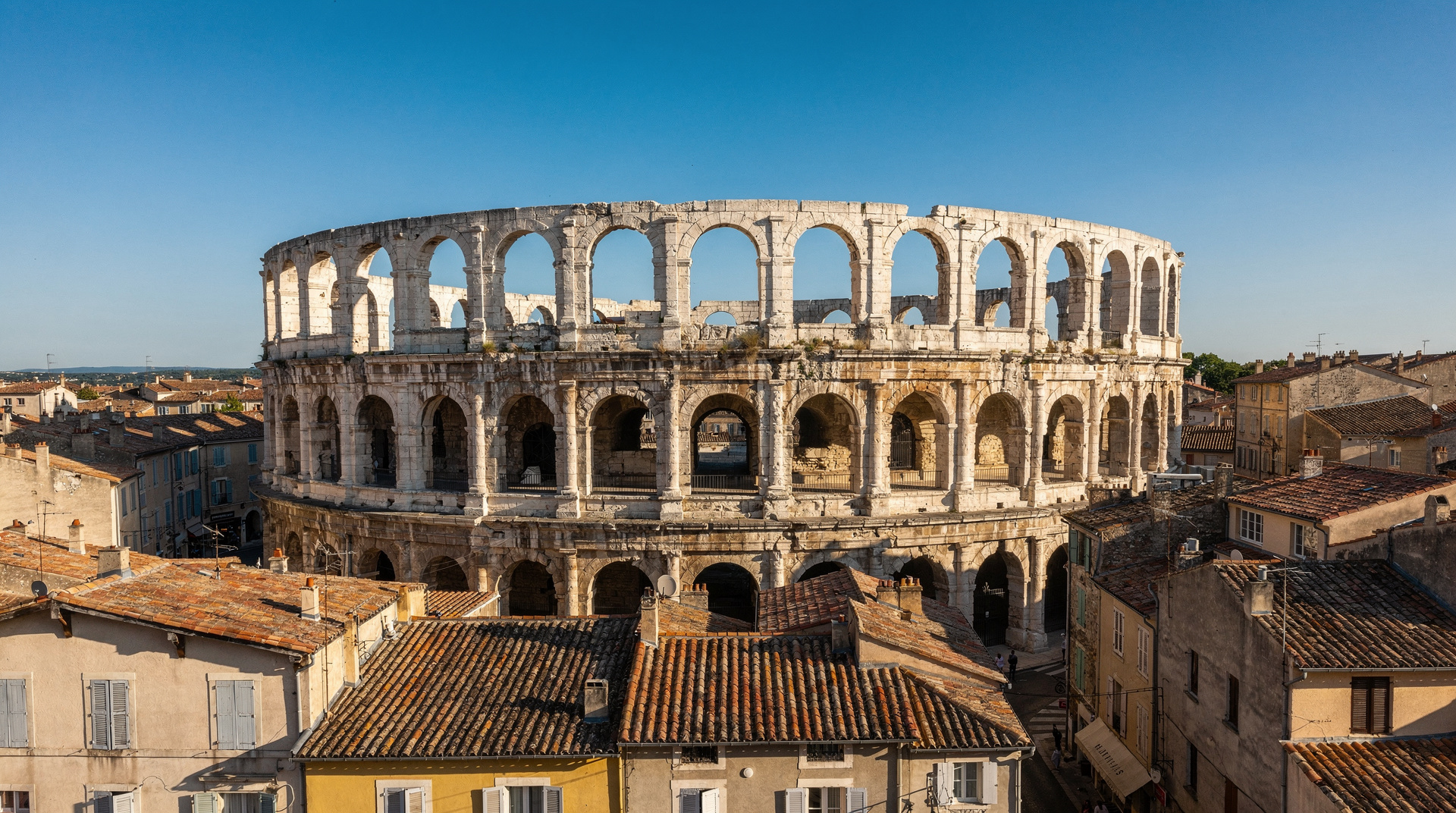
Arles is the natural neighbour, and our Arles day trip guide and the Roman monuments of Arles show what to fit into the morning before heading south to the delta. If the art side of the town appeals, Van Gogh in Arles is a good companion read.
Travellers who want a hilltop contrast can look at Les Baux-de-Provence and Saint-Rémy-de-Provence, covered together in the Les Baux and Saint-Rémy day trip guide. For a Roman landmark in a very different setting, the Pont du Gard is another option from the same side of the region.
If you are weighing the Camargue against other outings, the Avignon guide and our Provence road trip itinerary show how it can slot into a longer loop. Anyone without a car should read do you need a car in Provence before deciding between a self-drive day and a guided tour. For a personal account of the delta on horseback, see our blog piece on a Camargue horseback day, and for the wider picture of how long the region deserves, why Provence needs more than a day.
Top experiences
Bookable activities with verified prices and instant confirmation on GetYourGuide.