Bouillabaisse in Marseille: the definitive honest guide
Marseille: walking food tour with tastings
Where should I eat bouillabaisse in Marseille and what will it cost?
Stick to the six Charte de la Bouillabaisse-signed restaurants — Le Miramar, Chez Fonfon, Chez Michel, and others. Budget EUR 55–85 per person. Book 24 hours ahead. Cheaper versions near the Vieux-Port tourist strip are not worth it.
The dish Marseille built its reputation on
Bouillabaisse is not a simple fish soup. It is a specific dish with a documented history, a formal charter governing its preparation, a two-course ritual service, and a price that reflects genuine Mediterranean fish purchased that morning from the Quai du Port fish market. Understanding what separates the real thing from the tourist trap version is the most important knowledge you can carry into Marseille’s restaurant scene.
This guide gives you the honest picture: which restaurants sign the Charte, what you will pay, what to expect at the table, and what to do if the budget does not stretch to EUR 70 per person.
At a glance
| Cost | Around EUR 53-85 per person at a Charter restaurant; EUR 5-8 for market fish soup |
| Time needed | 1.5-2 hours for the full two-course service |
| Where | Charter restaurants cluster around the Vieux-Port and Vallon des Auffes |
| Book ahead | Yes, at minimum 24 hours (48h recommended, essential May-September) |
| Best season for the fish | Winter and early spring, when rockfish are fattest, though it’s served year-round |
The Charte de la Bouillabaisse
In 1980, 17 restaurateurs from Marseille, Cassis, and Martigues signed the Charte de la Bouillabaisse to combat the proliferation of restaurants serving inferior versions under the bouillabaisse name. The charter established precise rules: the fish must be Mediterranean and fresh (no frozen), the minimum species count is four, the broth and fish must be served separately, rouille and gruyère are mandatory accompaniments, and no lobster may be included.
The Charte also specifies which fish count toward the minimum: rascasse (scorpionfish), grondin (red gurnard), saint-pierre (John Dory), baudroie (monkfish), vive (weever fish), galinette, and congre (conger eel) are the traditional roster. The rascasse is not negotiable — its collagen gives the broth its distinctive body and the dish would be something else without it.
Today six restaurants in Marseille hold the Charte designation. These are the only addresses where you are guaranteed the full ritual.
The Charter restaurants
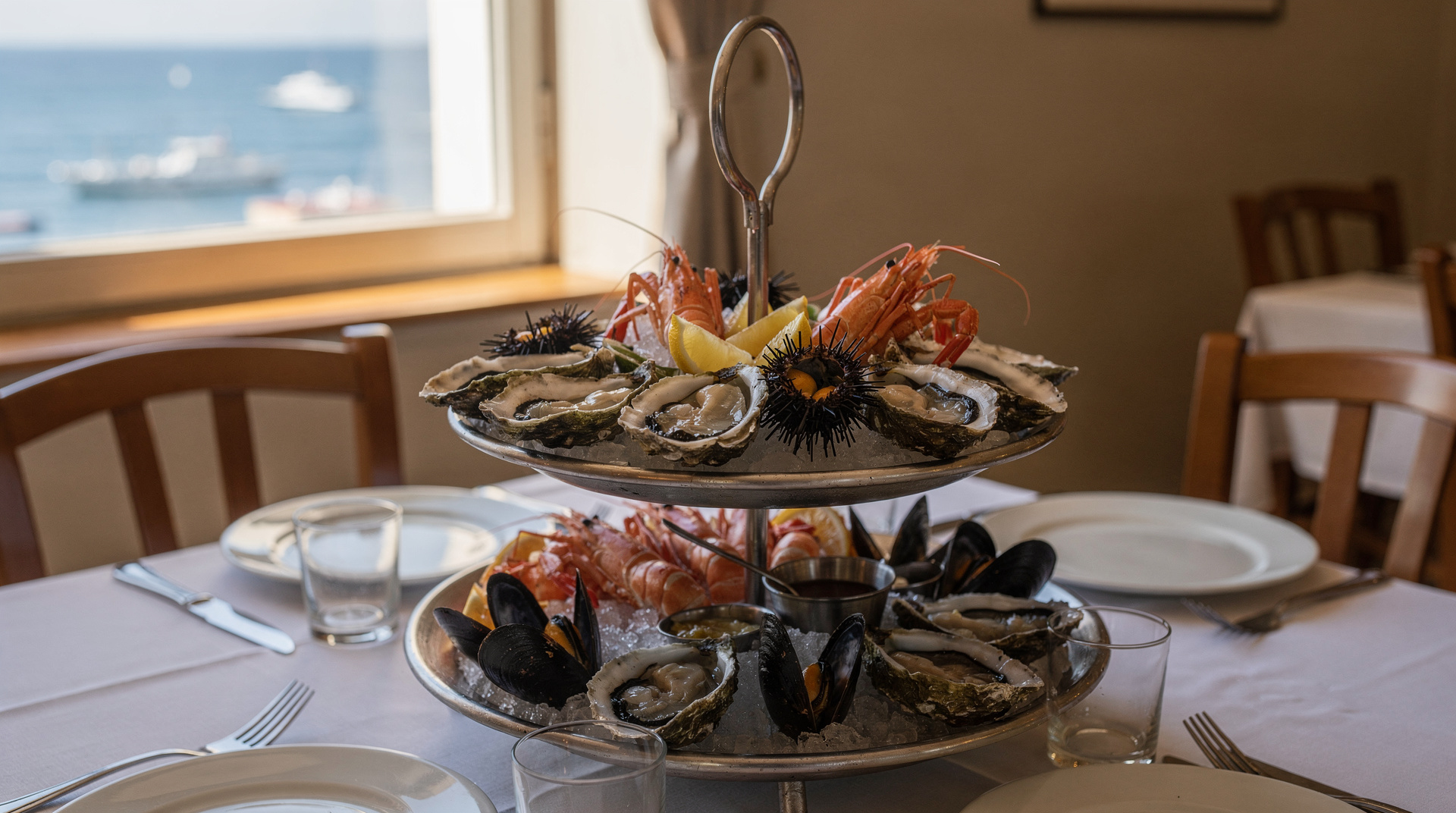
Le Miramar — Quai du Port, 2nd arrondissement, on the Vieux-Port’s northern quai. Founded in 1965, Le Miramar is one of the original Charte signatories and the restaurant most associated internationally with the canonical bouillabaisse. The dining room faces the harbour. The bouillabaisse is prepared from fish purchased that morning at the fish market 200 metres away. Prices: EUR 75–85 per person. Reservations: book at minimum 24 hours in advance, preferably 48 hours for weekend dining.
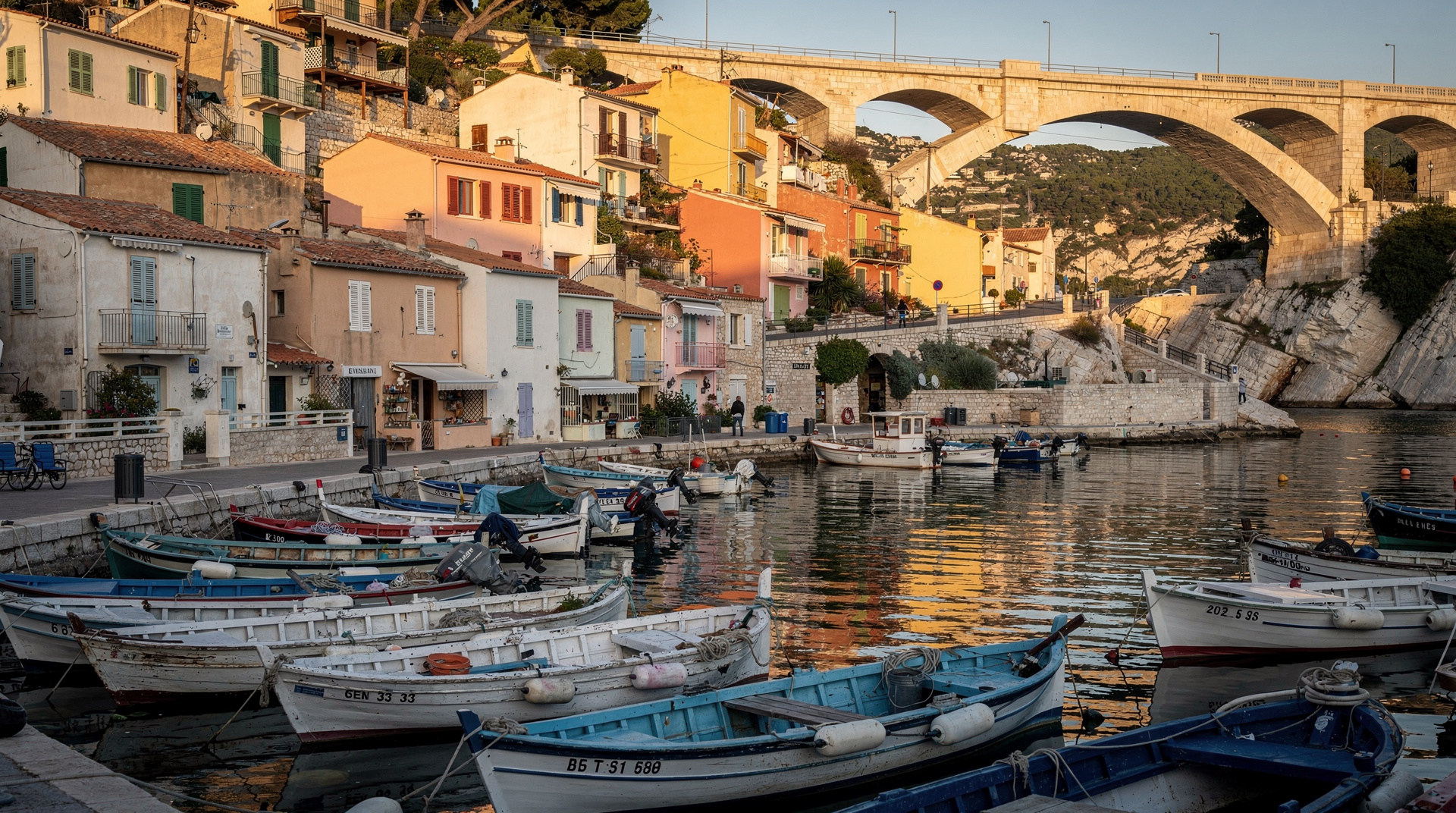
Chez Fonfon — Vallon des Auffes, 7th arrondissement. The Vallon des Auffes is a small fishing harbour tucked below the Corniche, reached by a staircase from the main road. Chez Fonfon has operated there for four generations, and the location — seven tables facing the miniature harbour, fishing nets hanging from the walls — gives it an atmosphere that Le Miramar’s quayside setting cannot replicate. The bouillabaisse costs EUR 53, slightly below Le Miramar’s price point and representing the best value among Charter restaurants. Lunch service is typically quieter than dinner. Book 24–48 hours ahead.
Chez Michel — Boulevard des Catalans, 7th arrondissement. Family-run since 1946, located on the Plage des Catalans with a terrace facing the sea. Chez Michel has appeared in the Michelin Guide and is among the most reservation-difficult Charter restaurants — with only two tables dedicated to bouillabaisse service per day, booking is essential and sometimes requires planning days in advance. This scarcity is not theatrics; it reflects genuine preparation constraints.
Chez Madie Les Galinettes — Quai du Port, 2nd arrondissement. On the same northern quai as Le Miramar, Chez Madie offers a slightly more informal setting with the same Charte commitment. The bouillabaisse is served with tableside fish filleting and the full rouille ritual. Prices: approximately EUR 53 per person.
The remaining two Charter signatories rotate periodically as the charter’s restaurant membership changes — the six confirmed in 2026 may be verified on the Marseille Tourism website or by calling the restaurants directly.
The four-course service ritual
Understanding what will happen at your table is half the experience. A proper bouillabaisse service unfolds as follows:
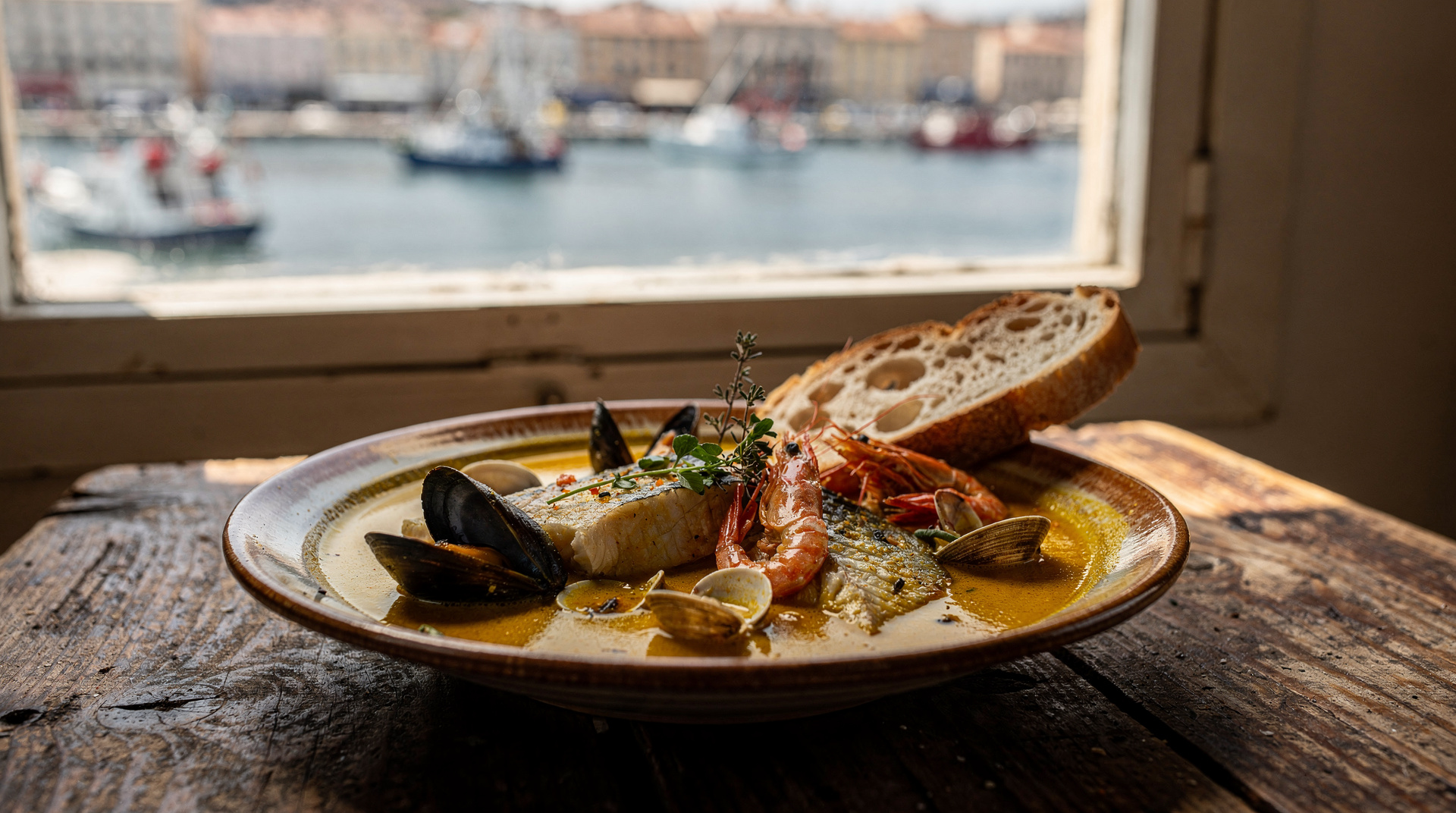
First: the broth arrives. A deep golden liquid — saffron-coloured, perfumed with fennel, tomato, and the fish gelatin released during hours of simmering — is brought to the table in a large tureen alongside toasted rounds of bread, a pot of rouille, and grated gruyère. You ladle broth into your bowl, spread rouille on the bread, float the bread in the broth, add gruyère. This is the first course.
Then: the fish arrives. The whole fish used in the preparation are brought to the table on a platter — you see what went into your stew. A member of staff fillets the fish at your table, placing portions in your bowl (which still contains some broth). The flesh is tender from slow poaching, the flavours absorbed from the broth. You continue with rouille and bread as accompaniments.
The process takes 45 minutes to an hour for the full service. This is not a meal to rush. Charter restaurants are not receptive to guests who order bouillabaisse and then check their phones waiting for a quick turnover.
Why the price is what it is
Visitors sometimes baulk at EUR 65–85 per person and assume they are being charged a tourist premium. They are not, or not primarily. The price reflects three realities:
The fish cost. A proper bouillabaisse requires approximately 400–500 grams of fresh Mediterranean fish per person, purchased that morning at market prices. Rascasse, vive, and saint-pierre are not cheap fish even at the source. The rockfish used in bouillabaisse is not the same product as farmed salmon.
The preparation time. The broth is started hours before service, often the previous evening. The fish is cleaned, the vegetables are prepared, the saffron and olive oil are added in sequence. Charter preparation is labour-intensive in a way that reheating a commercial fish stock is not.
The service labour. Tableside filleting, rouille preparation, two-course service — this is not bistro-pace service. You are paying for the full performance.
The honest comparison: bouillabaisse at EUR 70 at a Charter restaurant versus a three-course dinner at EUR 35 somewhere else. Neither is objectively better value — they are different experiences.
What to avoid
The tourist-trap version is identifiable by several markers:
- Menus offering bouillabaisse at EUR 25–35 near the Quai des Belges or the ferry dock
- Restaurants that do not require advance booking (“we always have bouillabaisse available”)
- Versions that arrive as a single bowl with the fish already in the broth, no tableside service
- Broth that is dark orange-red rather than golden-saffron
- No rouille served in a separate pot, or rouille that tastes like garlic mayonnaise from a jar
These tell you the broth is not made from fresh rockfish simmered for hours. It may still taste acceptable — a decent commercial fish soup is not inedible — but it is not bouillabaisse in any meaningful sense.
The fish market alternative
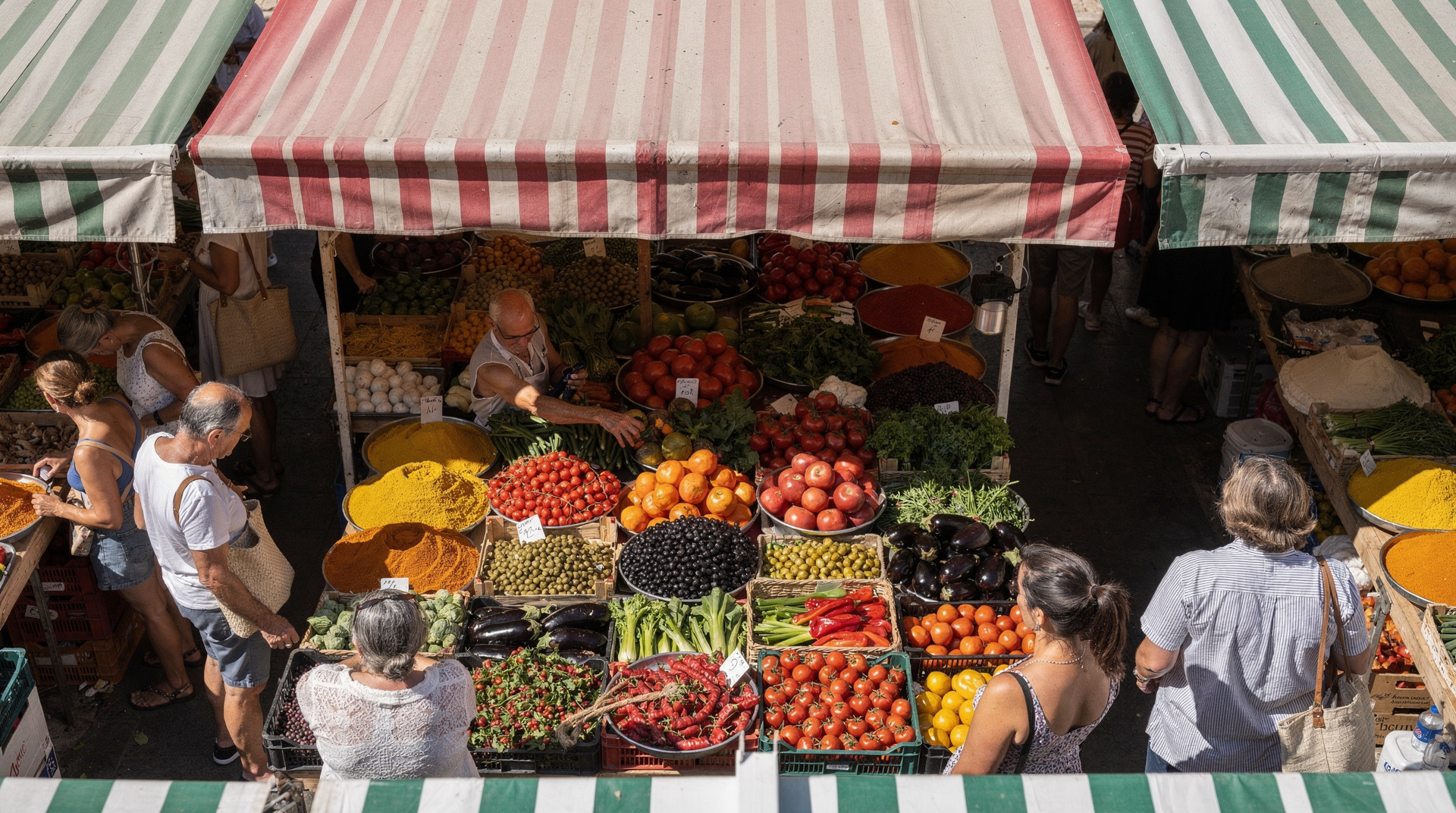
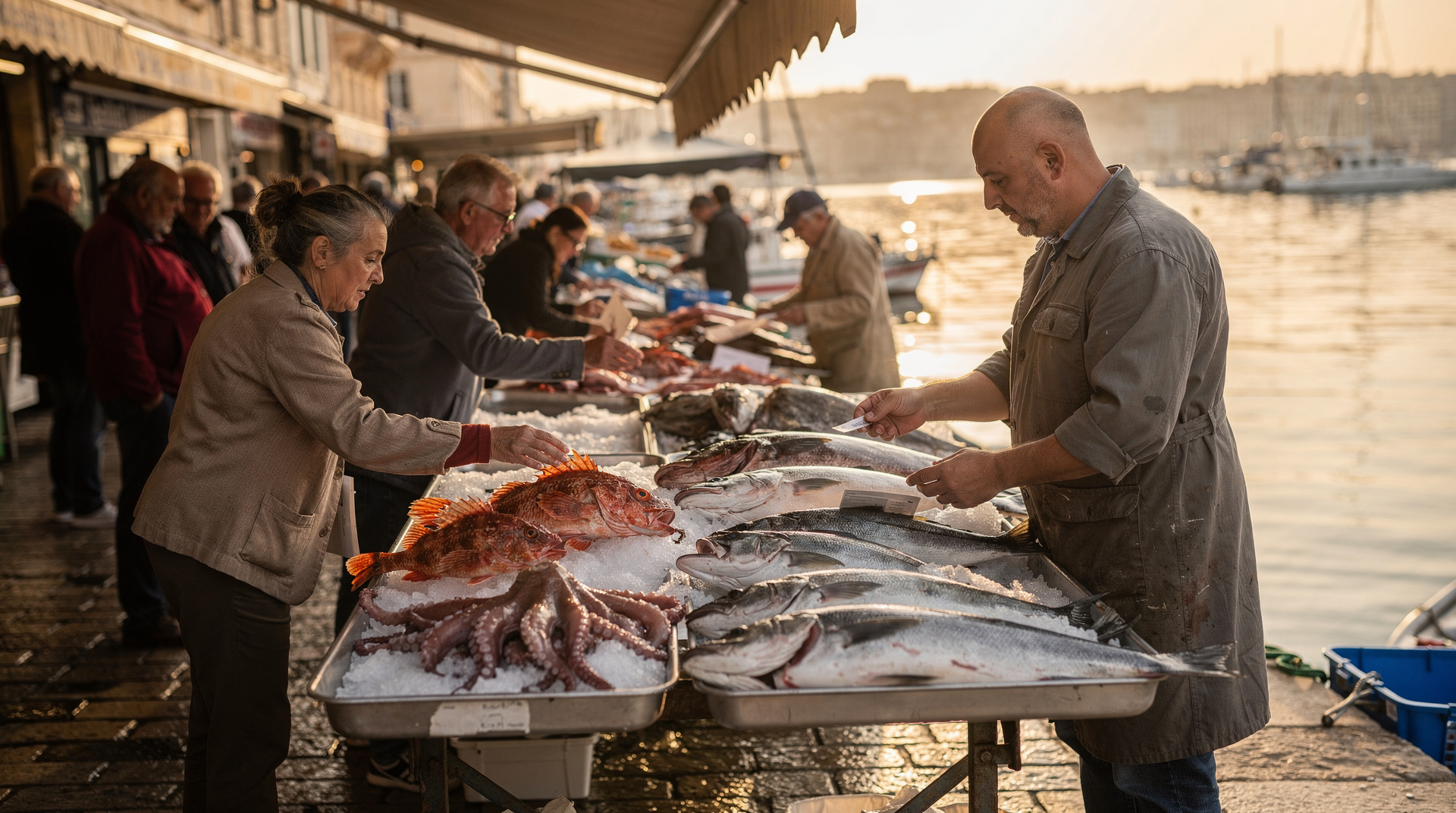
If the budget does not stretch to a Charter restaurant, or if you are visiting on a day when reservations are impossible to secure, the morning fish market at Quai des Belges (Vieux-Port, open daily until approximately noon) sells fish soup (soupe de poisson) made from the same rockfish scraps that the Charter restaurants use for their stock. This is EUR 5–8 per container, served with croutons and rouille, and it is the authentic street-food version of the same flavour tradition. This is not a consolation prize — it is what Marseille fishermen have eaten for breakfast for centuries.
Booking logistics
Le Miramar: Call or email 24–48 hours ahead. Lunch and dinner service. Closed Sunday evening and Monday.
Chez Fonfon: Call or email 24–48 hours ahead. Lunch and dinner. Reservations strongly recommended year-round; essential May–September. The small size of the dining room (around 30 covers) means they fill quickly.
Chez Michel: Call 24–48 hours ahead, or several days in advance for weekend lunch in season. Two bouillabaisse tables per service — this is the most reservation-constrained of the Charter restaurants.
Chez Madie: Call or email 24 hours ahead. Slightly more capacity than Chez Michel.
The rouille question
Rouille (literally “rust”) is the essential condiment without which bouillabaisse is incomplete. It is a Provençal emulsion of olive oil, egg yolk, saffron, garlic, and sometimes red chilli — closer in texture to an aioli than to a sauce. The colour is orange-rust, hence the name. Spread it on toasted bread rounds, float them in the broth, add gruyère. Do this.
Some restaurants serve rouille that is genuinely homemade and excellent; others use a commercial preparation. At Charter restaurants, the rouille is made in-house. You will be able to tell the difference immediately: good rouille has a specific warmth, a garlic edge, and a saffron depth that no commercial equivalent replicates.
Seasonality and the best fish
Bouillabaisse is available year-round at Charter restaurants, but the quality of the fish varies by season. Winter and early spring (December through March) are considered prime for rockfish — the rascasse is particularly fat and flavourful in the cold water months. Summer fish are leaner and the sea is warmer. This does not make summer bouillabaisse inferior, but connoisseurs prefer the winter version.
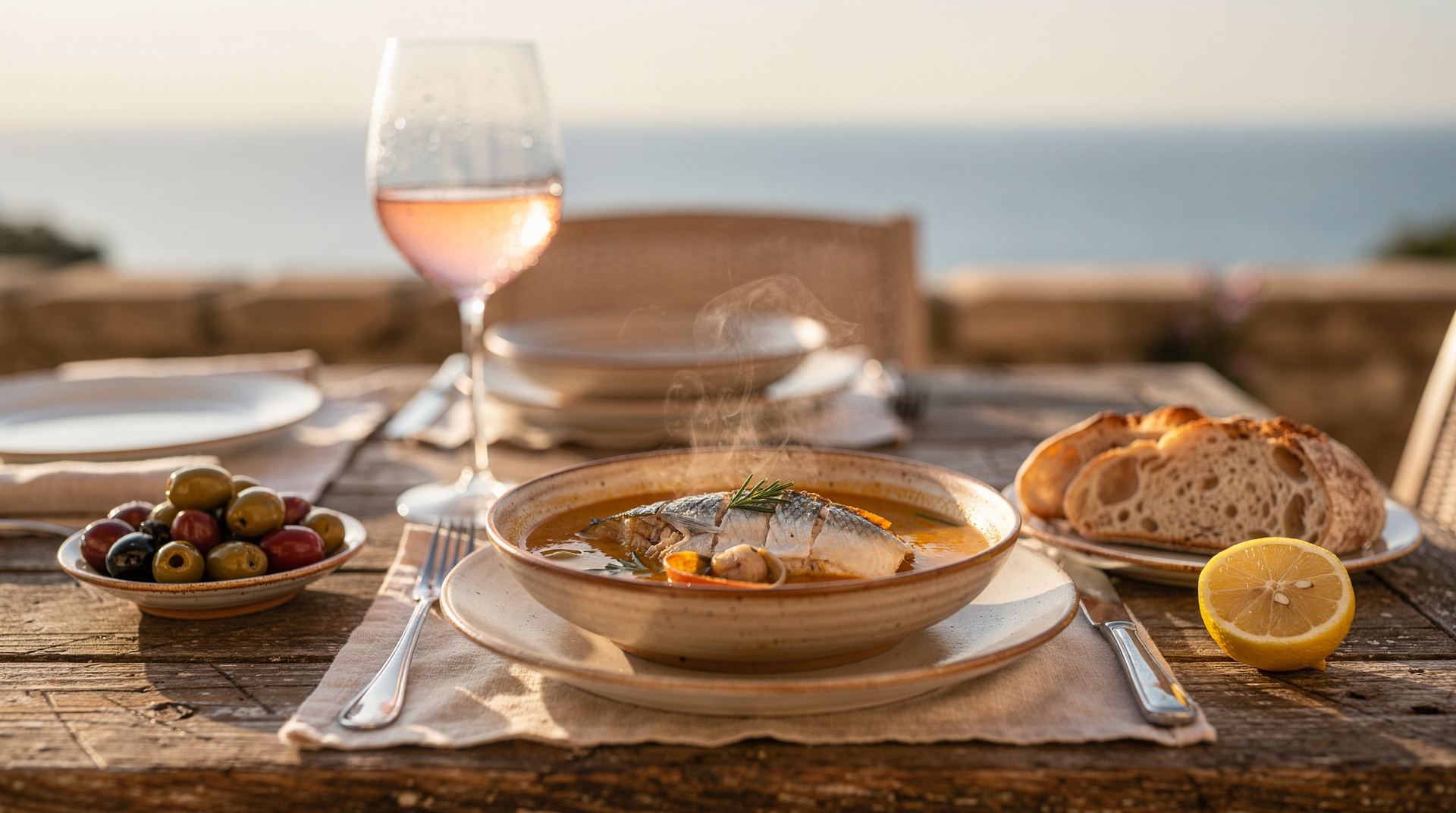
The very best moment: a cold October or November day at Chez Fonfon, facing the Vallon des Auffes harbour, with a glass of AOC Cassis blanc and a bowl of the golden broth arriving steaming.
Pairing with wine
The traditional pairing is a white wine from the Cassis appellation — Marsanne and Clairette-based, dry and mineral, with enough acidity to cut through the saffron-rich broth. Cassis blanc is specifically described in local tradition as the natural complement to bouillabaisse, and this is one case where the cliché reflects genuine taste harmony.
At Charter restaurants, the wine list will include Cassis AOC whites alongside Provence rosé and Bandol whites. The house recommendation is worth following — these restaurants have been pairing the same dish with local wine for decades. Budget EUR 30–50 for a bottle of decent Cassis blanc or Bandol blanc.
Practical logistics
Location of Charter restaurants:
- Le Miramar and Chez Madie: Vieux-Port area, easily reached by foot from anywhere in the centre
- Chez Fonfon: Vallon des Auffes — take bus 83 from Vieux-Port (10 minutes) or taxi (5 minutes, EUR 8–10)
- Chez Michel: Catalans beach — bus 83 from Vieux-Port (15 minutes) or taxi
Time needed: Allow 1.5–2 hours for the full bouillabaisse experience. This is not a quick lunch.
Dress code: Smart casual is sufficient at all Charter restaurants. Jackets are not required but torn shorts and flip-flops will receive looks.
Groups: Most Charter restaurants accommodate tables of 4–8. For larger groups (10+), discuss with the restaurant when booking — preparation quantities affect logistics.
For the broader Marseille food scene beyond bouillabaisse, see our best restaurants in Marseille guide and the seafood guide. For the fish market where the morning begins for Charter chefs, see the Marseille markets guide. For the neighbourhood where Chez Fonfon lives, see our Vallon des Auffes guide.
If you’re weighing whether it’s worth the price at all
The debate over whether bouillabaisse is a genuine culinary tradition or an overpriced tourist ritual comes up often enough that we cover it separately in bouillabaisse: tourist trap or tradition? — worth reading before you commit EUR 70+ per person. For the wider food-tour context, our Marseille food tour guide and the best bouillabaisse we ever had first-hand account both add perspective beyond this guide’s restaurant list.
Building a meal and a day around it
Because the full service is unhurried, bouillabaisse works best as the anchor of a day rather than a stop squeezed between sights. Plan the rest around it: a morning walk through Le Panier or along the quays, the long lunch, then something gentle in the afternoon. Our Marseille food tour guide and the Provençal cuisine explained guide help place the dish among the other local specialities worth tasting.
If the dish is part of a short stay, the Marseille food and wine weekend itinerary shows how a formal seafood lunch fits between other meals, and Marseille in one day is useful if you only have a single day and must choose where the long lunch goes. For the practical side of reaching Chez Fonfon or Chez Michel, see getting around Marseille.
Finally, if you want to compare bouillabaisse with other seafood in the city, the Marseille tourist traps guide explains which quayside menus to skip, and Vieux-Port area guide covers the harbour where several Charter restaurants sit.
Frequently asked questions about Bouillabaisse in Marseille
What exactly is bouillabaisse?
Bouillabaisse is a Provençal fish stew made from at least four types of Mediterranean rockfish — typically rascasse (scorpionfish), grondin (gurnet), saint-pierre (John Dory), and congre (conger eel) — simmered with saffron, olive oil, fennel, and tomato. The Charte restaurants serve it in two courses: the broth with rouille and gruyère first, then the fish presented whole and filleted at your table.How much does a real bouillabaisse cost in Marseille?
At a Charte de la Bouillabaisse restaurant, expect EUR 55–85 per person in 2026. The price reflects the fish (bought that morning at the Quai du Port market), the labour-intensive preparation, and the formal two-course service. Versions at EUR 25–35 at tourist-strip restaurants are a different dish — often frozen fish, no rouille ritual, no tableside service.Do I need to book in advance for bouillabaisse?
Yes — always, at Charter restaurants. Most require a reservation 24 hours in advance because the preparation begins the night before with fresh fish purchased at the morning market. Showing up without a reservation is almost certain to mean no bouillabaisse. Book by phone or email the day before at minimum.What is the Charte de la Bouillabaisse?
The Charte de la Bouillabaisse is a charter established in 1980 by 17 Marseille restaurateurs to define and protect the authentic recipe. It specifies the permitted fish species (all Mediterranean, no lobster or shellfish in the main stew), the two-course service ritual, the mandatory accompaniments (rouille, gruyère, toasted bread), and the requirement for live or fresh-caught fish. The charter has since been signed by six restaurants in Marseille.Can I eat bouillabaisse at a lower price?
Yes, with a clear understanding of what you are getting. The version available at EUR 25–35 at quayside restaurants is technically a fish soup with similar flavours — sometimes decent, often made from industrial fish stock. Chez Fonfon offers a simplified 'bouillabaisse de Fonfon' at EUR 53 that represents the authentic recipe at a slightly more accessible price point. There is no shame in the fish soup at the morning market quai either — it is a genuine Marseille experience at EUR 5–8 per bowl.What fish go into a proper bouillabaisse?
The Charte requires a minimum of four Mediterranean fish species. The traditional roster includes rascasse (scorpionfish — the essential base), grondin (gurnet/red gurnard), saint-pierre (John Dory), vive (weever), baudroie (monkfish), and congre (conger eel). The rascasse is non-negotiable — its gelatin gives the broth its characteristic body. No lobster, no mussels, no shrimp in the main stew (though some restaurants serve shellfish as a separate starter).Is there a vegetarian alternative to bouillabaisse in Marseille?
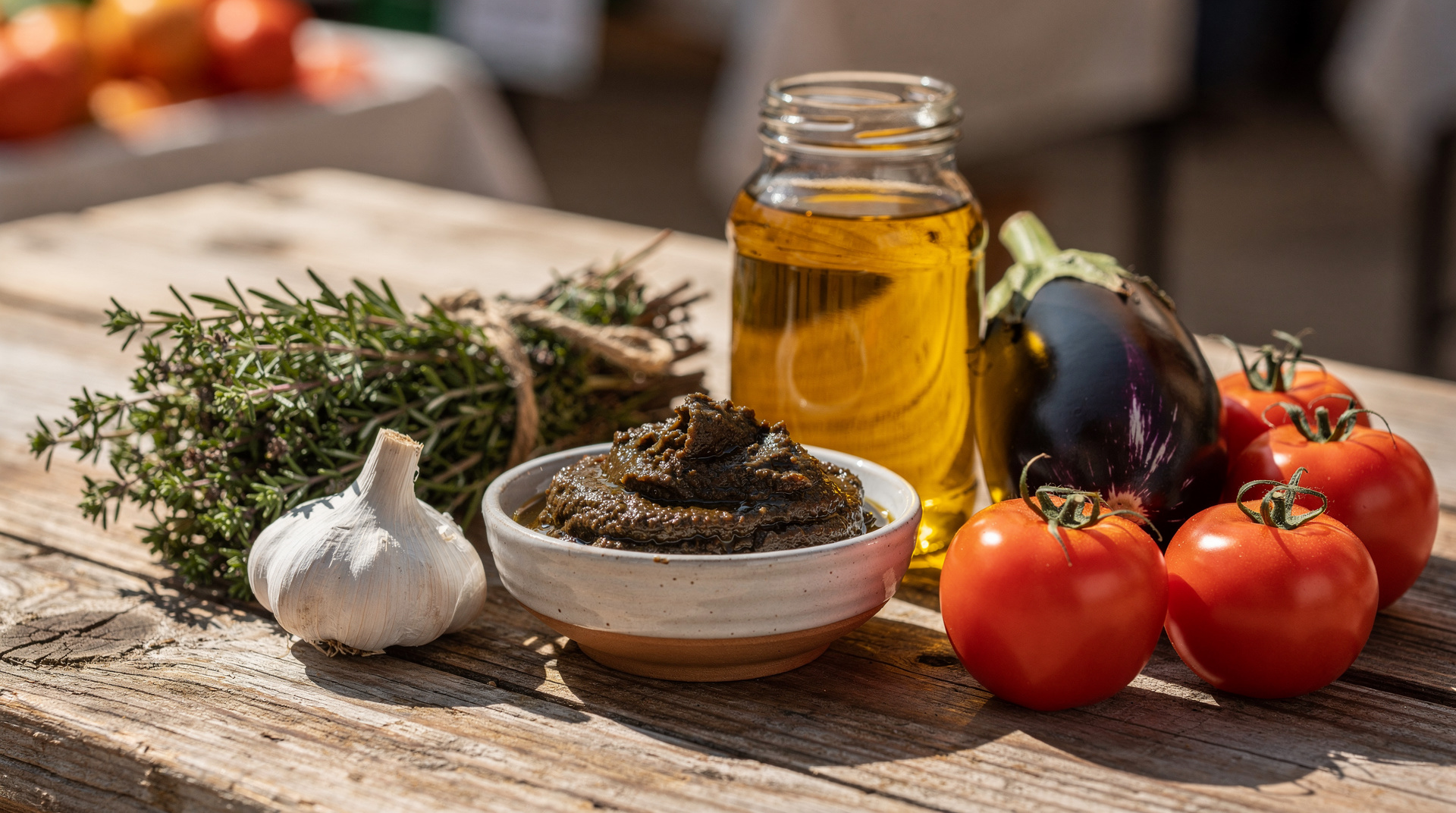
Not at the Charter restaurants — bouillabaisse is inherently a fish dish. For vegetarians, panisses, tapenade, and Provençal vegetables offer genuinely excellent alternatives. See our vegetarian Marseille guide for specific recommendations.Is bouillabaisse the same as fish soup?
No, though they share a family tree. Soupe de poisson is a blended, sieved fish broth without the tableside fish course — cheap, authentic, and sold across Marseille markets for around EUR 5-8. Bouillabaisse is the formal two-course version with whole fish filleted at the table, governed by the Charte and priced accordingly.Is bouillabaisse worth the price for a first-time visitor?
For most first-time visitors, yes — once, at a Charter restaurant, as a deliberate experience rather than a routine meal. If budget is the main constraint, the market fish soup covered above delivers the same flavour tradition for a fraction of the price without the full ritual.
Top experiences
Bookable activities with verified prices and instant confirmation on GetYourGuide.