Notre-Dame de la Garde guide: Marseille's Bonne Mère
Marseille: Notre-Dame de la Garde 2-hour segway tour
Duration: 2 hours
Is Notre-Dame de la Garde worth visiting and how do I get there?
Absolutely — it is free to enter, open daily 7:00–19:00 (20:00 in summer), and offers the best panoramic views in Marseille. Walk 35–40 min from the Vieux-Port via Endoume, or take bus 60. The petit train (EUR 8–12) is fine but overpriced for what it is.
| At a glance | |
|---|---|
| Where | 162m hilltop above the Vieux-Port, southern Marseille |
| Cost | Free entry to the basilica; getting there ranges from EUR 1.70 (bus) to EUR 8–12 (petit train or taxi) |
| Time needed | Around 1 hour inside plus the parvis; add 35–40 min each way if walking |
| Getting there | Walk via Endoume (35–40 min), bus 60, petit train, or taxi |
| Best time | Before 10:00 for the clearest views and smallest crowds |
Why the Bonne Mère matters
Notre-Dame de la Garde is the hill, the basilica, the gold Virgin, and the panorama — but it is also something harder to describe: it is the point from which Marseille understands itself. Marseillais who would never call themselves religious refer to the basilica by its affectionate nickname, the Bonne Mère, the Good Mother, with a warmth that has nothing to do with doctrine. She looks over the city. She always has.
The hill stands 162 metres above sea level — the highest natural point in Marseille — and from its parvis, the panorama is one of the most complete urban views in France. West, the Bay of Marseille opens to the horizon. South-west, the Frioul archipelago and the tiny rocky silhouette of the Château d’If island. East, the white limestone ridges of the Calanques running toward Cassis. On a clear morning, the distant Alps appear above the northern haze.
Entry is free. It has always been free.
The architecture: Romano-Byzantine and deliberately magnificent
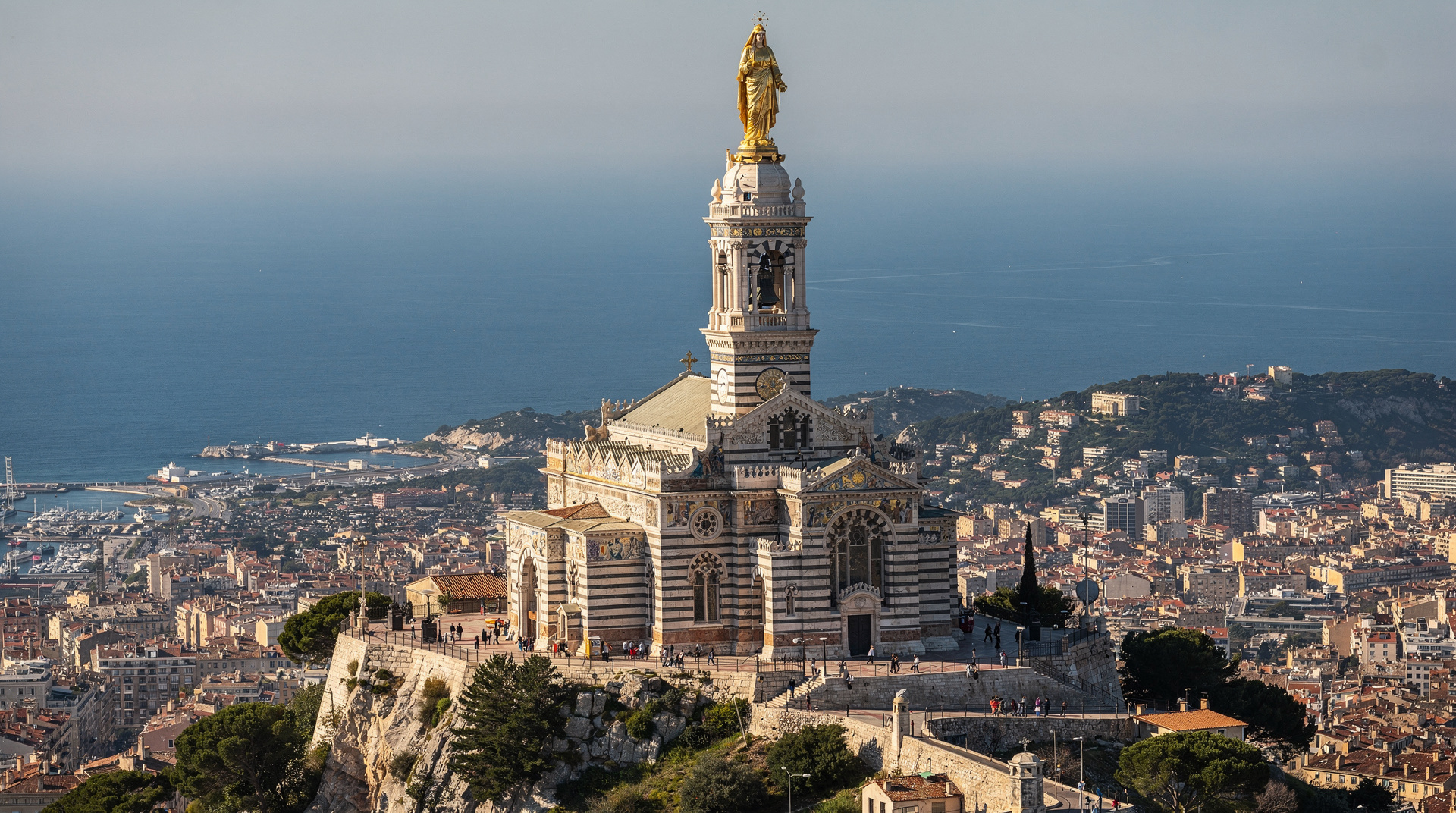
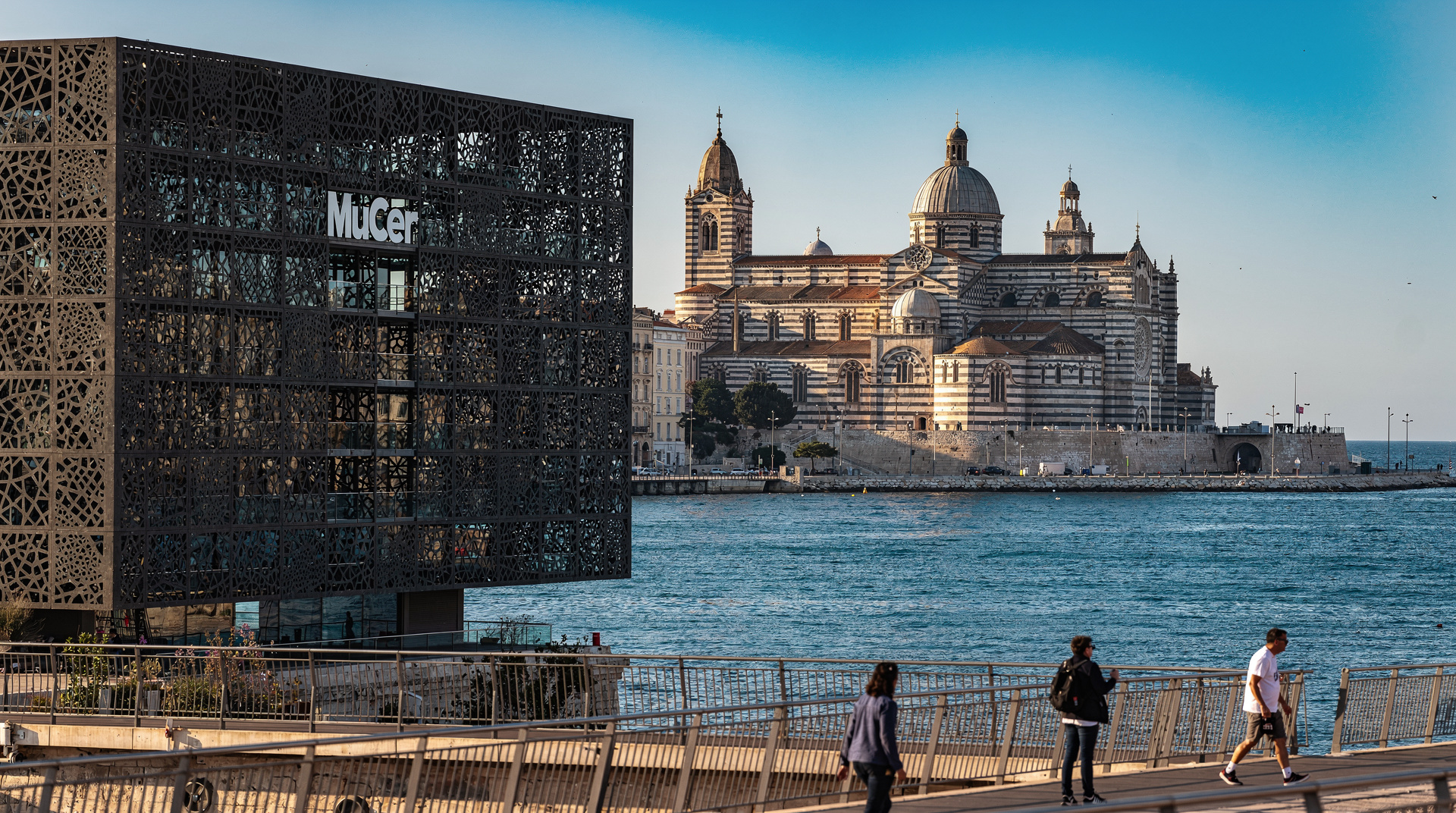
The basilica was built between 1853 and 1864 under architect Henri-Jacques Espérandieu, who also built Marseille’s Palais Longchamp. The style is Romano-Byzantine — an ecclesiastical fashion of the French 19th century that looked simultaneously toward early Roman Christian basilicas and the coloured mosaic traditions of Constantinople.
The exterior uses alternating courses of cream Provence limestone and the distinctive green-tinged stone from Cassis — giving the lower church a striped quality that immediately sets it apart from any northern French church. The upper basilica, the belfry, and the square tower are in the same material vocabulary, though progressively more elaborate.
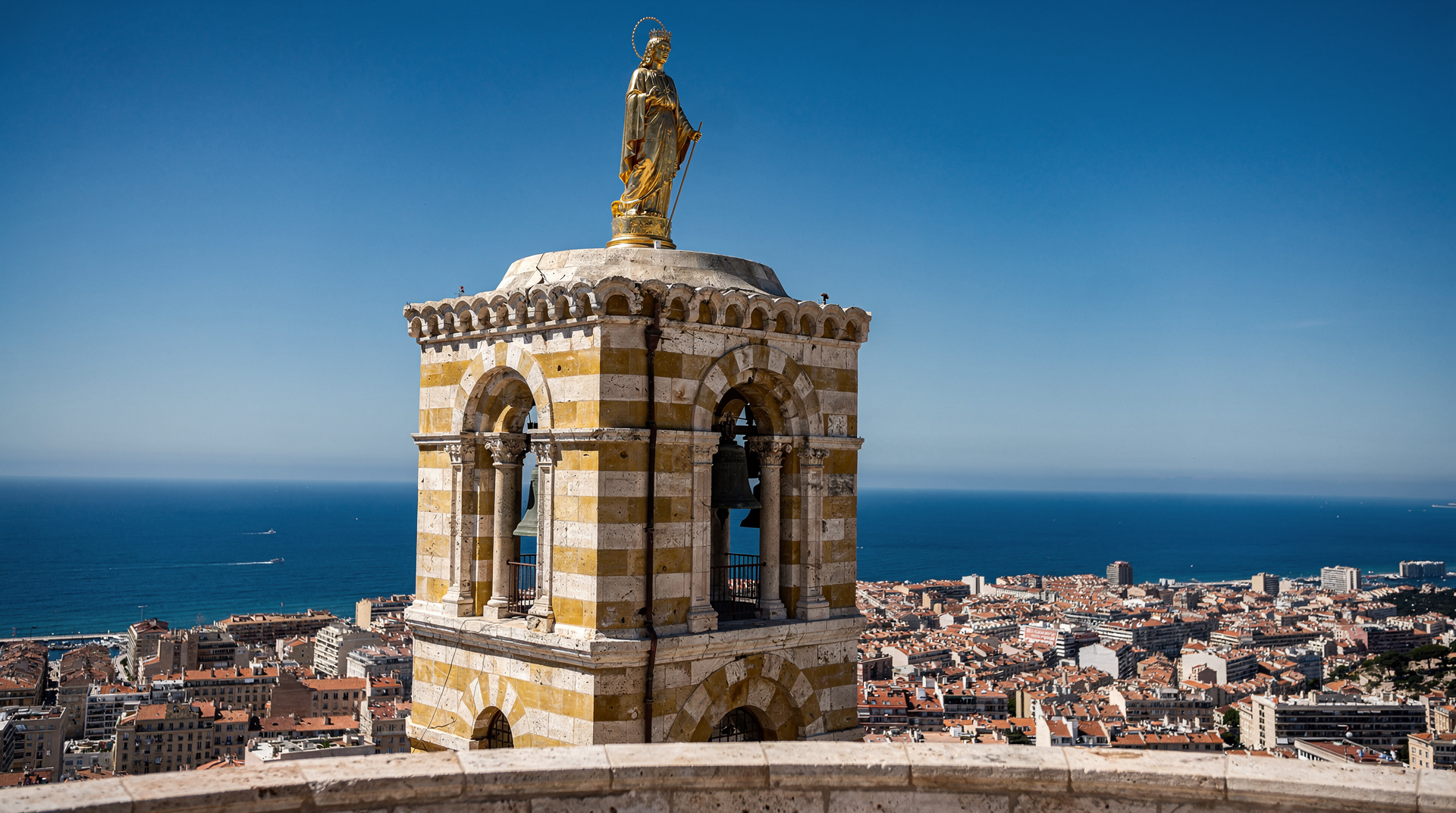
At the summit of the tower, above the belfry, stands a 12.5-metre stone pedestal supporting the gilded copper statue of the Virgin Mary and Child. The Madonna measures 11.2 metres — taller than many houses — and is visible from ships at sea, from the Calanques ridgeline, and from almost any elevated point in the city. She is not subtle. She is not meant to be.
Inside the basilica
The interior rewards slow attention. The ceiling vaults are painted deep cobalt blue with gold stars — Byzantine influence made very literal. The walls and arches carry mosaics depicting scriptural scenes and Provençal maritime subjects. The gold mosaic tesserae catch natural light differently as the sun moves across the building; the late afternoon western light tends to produce the most visually striking illumination inside.
The ex-votos
The most moving part of the basilica is not the architecture but the ex-votos — the offerings hung in thanksgiving by sailors, fishermen, their families, and survivors of disasters of every kind. The tradition runs from the 1860s to the present day. The walls carry:
- Handmade paintings depicting ships in storms with the basilica visible on the hill above — the view that returning sailors actually had
- Model ships suspended from the vaulting (some extraordinarily detailed, some simple wood constructions)
- Photographs of road accident scenes with “Merci” inscribed beneath them
- Plaques recording medical recoveries, survival of wars, impossible escapes
- Letters, drawings, and testimonies in multiple languages
These are not decorations. They are records of real events, real gratitude, and real faith placed on these walls over 160 years. They constitute one of the most honest and moving collections of folk devotion in any church in France.
The crypt
Below the main basilica, the Crypte is carved directly into the limestone rock and contains the original altar from the earlier chapel. It is cooler than the upper church, almost always quieter, and worth visiting if only for the contrast with the ornate basilica above. The architecture of the crypt reads as much as medieval fortification as religious space — because it was. The hill has been a military position for centuries before and alongside its religious function.
Getting there: the honest comparison
Walking (recommended)
From the south shore of the Vieux-Port (Quai de Rive Neuve), the walk takes about 35–40 minutes at a steady pace. The route goes through the Endoume neighbourhood — one of the most pleasant residential areas of Marseille that visitors rarely see — with tree-lined streets, local cafés, and the sense of a city that functions independently of its tourist trade.
The ascent itself is genuinely steep for the final 15 minutes. Comfortable footwear is necessary. Carry water in summer.
Alternative walking approach: from the Corniche south, take Rue Monseigneur Delay directly uphill — a steeper but more direct route of about 25 minutes from the waterfront.
Bus 60
Departs from the Vieux-Port area and stops at the Notre-Dame de la Garde terminus, from which the basilica is a 5-minute walk uphill. Runs every 10–20 minutes. A single RTM ticket is EUR 1.70. This is the most cost-effective motorised option.
Le Petit Train
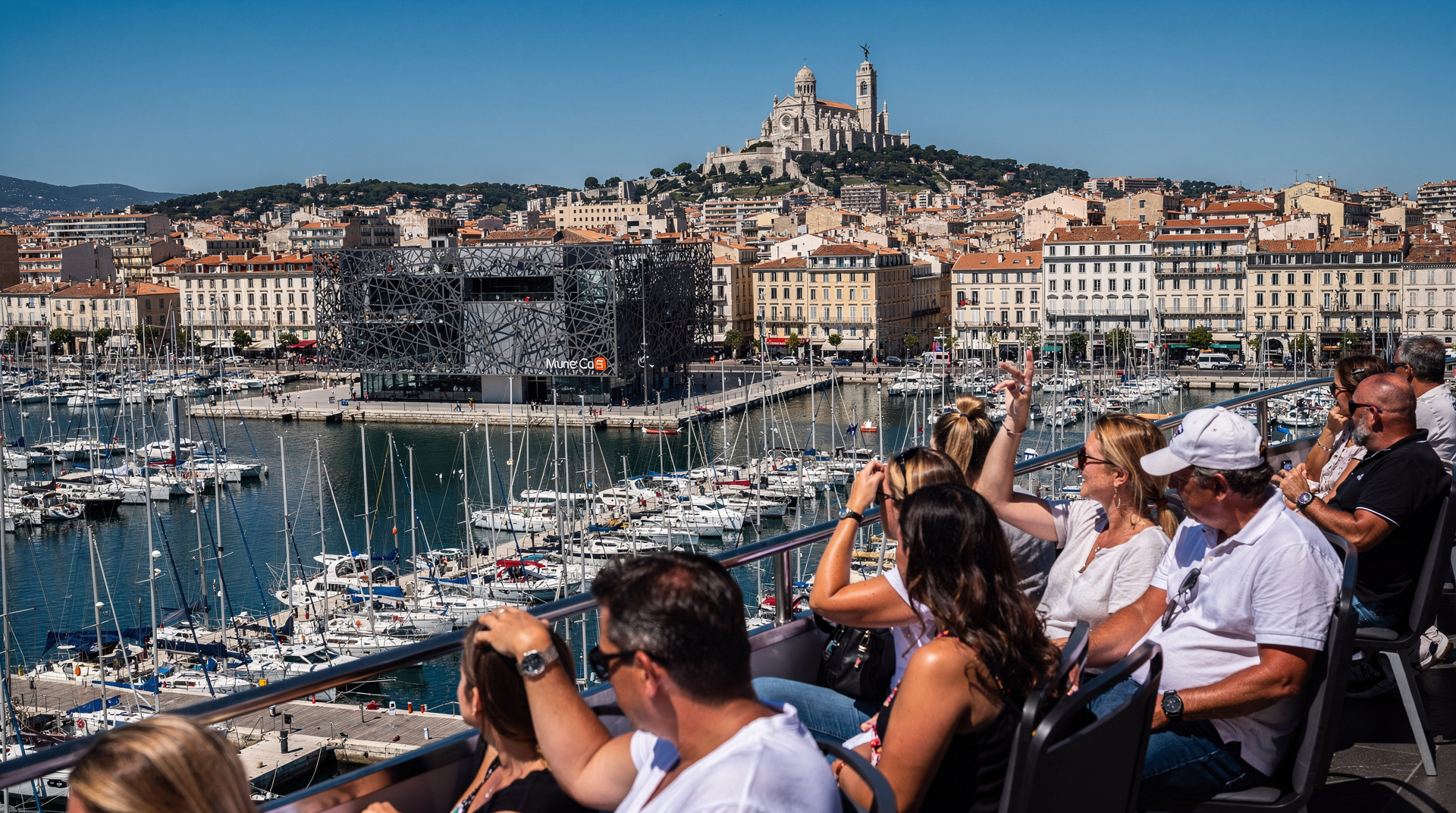
The tourist petit train departs from the Quai des Belges at the Vieux-Port on Circuit 1, climbs to the basilica, and returns via Le Panier. The full circuit takes about 45 minutes and costs approximately EUR 8–12 per adult.
Honest verdict: The petit train is functional and enjoyable but clearly overpriced for what it delivers. You are paying for transport, not for a guided experience — the commentary is minimal. For families with young children or visitors with mobility limitations who cannot manage the uphill walk, it is genuinely useful. For everyone else, the bus or the walk offer far better value.
Taxi or ride-share
Around EUR 8–12 from the Vieux-Port. Efficient if time is short.
Segway tour
The 2-hour segway tour (see above) covers Notre-Dame de la Garde and several other major sites. A reasonable option for visitors who want to cover ground efficiently.
The panorama: what you are looking at
Standing on the parvis — the terrace that surrounds the basilica — the view divides into clear sectors:
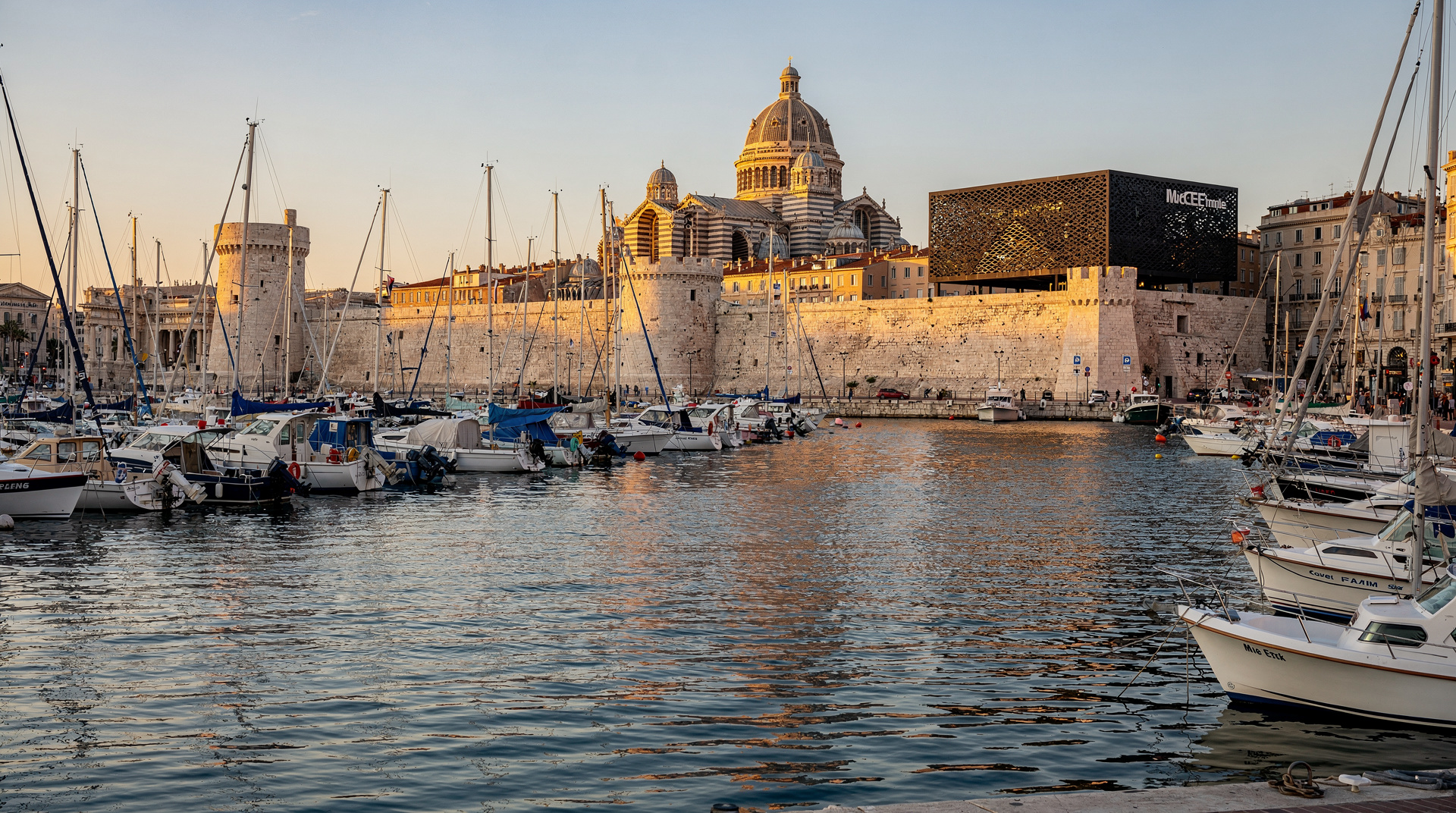
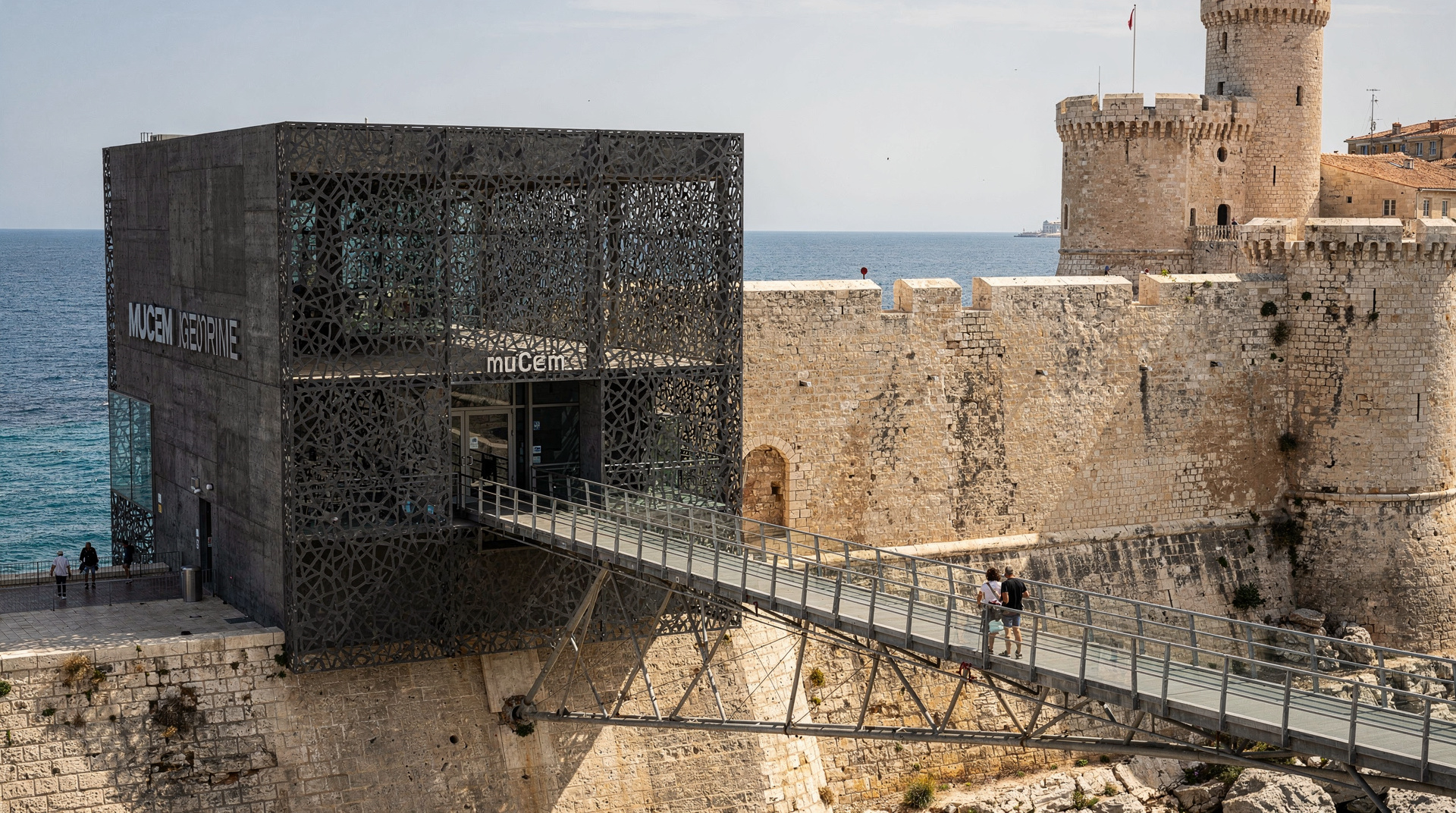
West and north-west: The Vieux-Port below, the MuCEM and Fort Saint-Jean at the J4, the Joliette port infrastructure and container cranes, the Cap Couronne headland beyond. The city’s entire westward face is visible at once.
South-west: The Bay of Marseille in full. The flat plateau of the Île Ratonneau (Frioul) is the most prominent island, with Île Pomègues behind it. To the right, the smaller and more dramatic rocky profile of the Île d’If with its fortress.
South: The Corniche runs along the coastline from below Notre-Dame toward the Prado beaches and, beyond them, the southern arrondissements and eventually the industrial port at Fos-sur-Mer.
East: The white limestone ridgeline of the Calanques national park begins to the south-east and runs toward the coast. On clear mornings, the distinctive red-orange profile of Cap Canaille above Cassis — the tallest coastal cliff in France at about 400 metres — is visible to the south-east.
North: The urban sprawl of Marseille extends northward. The Étoile limestone chain closes the northern horizon.
Morning offers the clearest visibility. By afternoon, haze often reduces the range of what you can see toward the Calanques and the sea.
The WW2 bullet holes and wartime history
During the German occupation of Marseille (November 1942 – August 1944), the basilica tower was occupied as a German observation post — the 162-metre vantage point made it militarily obvious. The Liberation of Marseille in August 1944 brought fierce fighting across the city, and the hill saw direct combat.
The bullet and shell impact marks on the south exterior wall of the basilica near the entrance have been deliberately left unrepaired. This was a conscious decision — unlike the post-war restoration of the mosaics and the gold Madonna (which was damaged and replaced), the exterior war damage was kept visible as a physical record of what happened here and of the Marseillais who died in the liberation fighting.
The ex-votos inside include offerings from the liberation period — families giving thanks for survived fighting, photographs of resistance members, plaques for the liberated city.
Historical context: the hill before the basilica
The religious and military history of the hill predates the current basilica by centuries. A medieval chapel dedicated to Notre-Dame existed here from the 13th century — the first documented reference is from 1214. A military fortification was built around and incorporating the chapel in the 16th century, serving as a royal garrison and prison. This fortified complex became known as the Château de la Garde.
When Henri-Jacques Espérandieu began designing the new basilica in the 1850s, he incorporated the medieval and Renaissance-era fortification walls into the structure rather than demolishing them. The crypt is built within these older walls. This layering — medieval fortification, Renaissance additions, 19th-century neo-Byzantine basilica — is physically readable in the stonework of the lower levels for visitors who look carefully.
The Bonne Mère in Marseille’s identity
The relationship between the basilica and the city transcends religion in a way that is difficult to find elsewhere in France. Olympique de Marseille football players have historically made pilgrimages to Notre-Dame de la Garde before Champions League matches. The club’s supporters — among the most passionate in European football — include the basilica in their iconography alongside the Vieux-Port and the Stade Vélodrome.
Marseille fire brigades, lifeboat crews, and naval units have long-standing ex-voto traditions here. The port community — fishermen, dock workers, sailors — has maintained the connection between the hill and the sea for as long as the chapel has existed.
For visitors, the practical implication is this: Notre-Dame de la Garde is not a tourist attraction with a historical plaque. It is a living institution that has meaning for the people of Marseille and receives genuine devotional visitors alongside tourists throughout the day. The experience of being in the basilica when a local family comes to light candles in front of one of the side chapels is something that no photograph can convey.
Combining Notre-Dame de la Garde with a full day
The basilica pairs most naturally with:
Morning: Vieux-Port fish market (9:00–10:00), walk uphill through Endoume to the basilica (arrive 10:30), spend 1 hour inside and on the parvis, descend south via the Corniche route.
Afternoon continuation: The descent south leads to the Vallon des Auffes — a tiny working fishing harbour tucked beneath the Corniche, one of the most photogenic spots in the city — and then the Corniche Kennedy along the coast, the Prado beaches, and eventually back to the Vieux-Port by bus or tram.
This walk, from the basilica summit to the Vallon des Auffes to the Vieux-Port by the coastal route, covers about 5 kilometres and 2–2.5 hours with stops. It is one of the most satisfying urban walks in Marseille.
For a full day in the city combining Notre-Dame, MuCEM, Le Panier, and the waterfront, see our three-day planning guide or how many days in Marseille guide.
Practical tips for visiting
Photography: Permitted throughout the basilica. Be discreet near people who are praying — and there will be people praying at any given moment. No flash photography in the nave.
Facilities: The esplanade has a small café and a gift shop. There are no facilities inside the basilica itself.
Parking: Limited and usually congested on the approach road. Use public transport.
Dress code: The basilica requires covered shoulders and knees in the nave — standard European church etiquette. There is no strict enforcement but it is a functioning place of worship and the basic respect is appropriate.
Crowding: July and August are the busiest periods, particularly from 11:00 to 14:00. Arriving before 10:00 or after 16:00 gives a considerably quieter experience.
Children: The wide parvis and exterior terraces are genuinely good spaces for children. The mosaics and the ex-voto ship models are usually engaging for children who are given the right context for what they are looking at.
Comparing your options to reach the summit
| Option | Cost | Time | Best for |
|---|---|---|---|
| Walk via Endoume | Free | 35–40 min | Fit visitors who want the local-neighbourhood experience |
| Bus 60 | EUR 1.70 | 15–20 min plus 5 min walk | Budget-conscious visitors, no mobility issues |
| Petit train | EUR 8–12 | 45 min round trip | Families with young children, mobility limitations, cruise time limits |
| Taxi/ride-share | EUR 8–12 | 10–15 min | Time-pressed visitors |
Nearby: extending the visit
The basilica’s hilltop position makes it a natural anchor for a longer walk rather than a standalone stop. South and downhill, the route toward the Vallon des Auffes is one of the most rewarding coastal walks in the city, continuing along the Corniche and Prado beaches. If you’re combining the visit with the rest of central Marseille, the Le Panier quarter and the Vieux-Port area are both within range of a single day, and the best time to visit guide can help time a trip around clearer skies for the panorama.
Frequently asked questions about Notre-Dame de la Garde guide
How much does it cost to visit Notre-Dame de la Garde?
Entry to the basilica is completely free. It has always been free and requires no advance booking or timed entry. The only cost is getting there — bus 60 is EUR 1.70, the petit train is EUR 8–12, a taxi is EUR 8–12 from the Vieux-Port.What are the opening hours of Notre-Dame de la Garde?
The basilica is open daily from 7:00 to 19:00, extended to 20:00 in summer (approximately June to September). It is open every day of the year including public holidays.Is the petit train to Notre-Dame de la Garde worth it?
For most adults in good health, no — it is noticeably overpriced at EUR 8–12 for what is essentially a slow drive up a road you could walk. The value is real for: families with young children who cannot manage the 40-minute uphill walk, visitors with mobility limitations, and cruise visitors with strict time limits. If you can walk, walk — you see more and the route through Endoume is pleasant.What are the WW2 bullet holes at Notre-Dame de la Garde?
During the Liberation of Marseille in August 1944, German forces had occupied the basilica tower as an observation post. The liberation fighting left bullet and shell damage on the south exterior wall near the entrance. These have been deliberately left unrepaired as a memorial to the liberation and to the Marseillais who died in it.What is the best time of day to visit Notre-Dame de la Garde?
Morning for the clearest views — the Mediterranean haze builds through the day and can reduce visibility toward the Calanques and Cassis by mid-afternoon. Late afternoon, the western sun lights the gold Madonna beautifully, but the sea views are hazier. Arrive before 10:00 for the best experience.Can I combine Notre-Dame de la Garde with other sights?
Yes easily. Walking down from the basilica south and west leads you to the Corniche and Vallon des Auffes in about 25–30 minutes — one of the best continuous walks in Marseille. You can then follow the Corniche north back to the Vieux-Port. A morning at the Vieux-Port, uphill through Endoume to the basilica, then south to the Corniche and back covers the best of central Marseille in one day.Can I go inside the tower or climb up to the statue of the Virgin?
No — the tower and the platform beneath the gilded statue are not open to visitors; the statue is 11.2 metres tall and sits atop a 12.5-metre pedestal purely as an exterior feature. The interior visit is limited to the basilica, the crypt, and the surrounding parvis, which is where the panoramic views are enjoyed from.
Top experiences
Bookable activities with verified prices and instant confirmation on GetYourGuide.