Notre-Dame de la Garde, Marseille
Visit Notre-Dame de la Garde — Marseille's Romano-Byzantine basilica, gold Madonna, and the best panoramic views in the city. Free entry.
Marseille: Notre-Dame de la Garde 2-hour segway tour
Duration: 2 hours
Quick facts
- Entry
- Free (basilica open daily 7:00–19:00, until 20:00 summer)
- Altitude
- 162 metres above sea level
- Gold Madonna height
- 11.2 metres (on top of the tower)
- Getting there
- Walk 40 min uphill; bus 60; petit train from Vieux-Port; taxi
- Distance from Vieux-Port
- 2 km
At a glance
| Where | Hilltop above the Vieux-Port, Marseille’s 6th/7th arrondissement border |
| Cost | Free to enter the basilica; petit train around EUR 12–15, taxi around EUR 8–12 |
| Time needed | Around 1–1.5 hours on site, 2–3 hours including travel |
| Getting there | Walk (35–40 min uphill), bus 60, petit train, or taxi |
| Best time | Morning for clear views; late afternoon for warm light inside |
The city’s watchful landmark
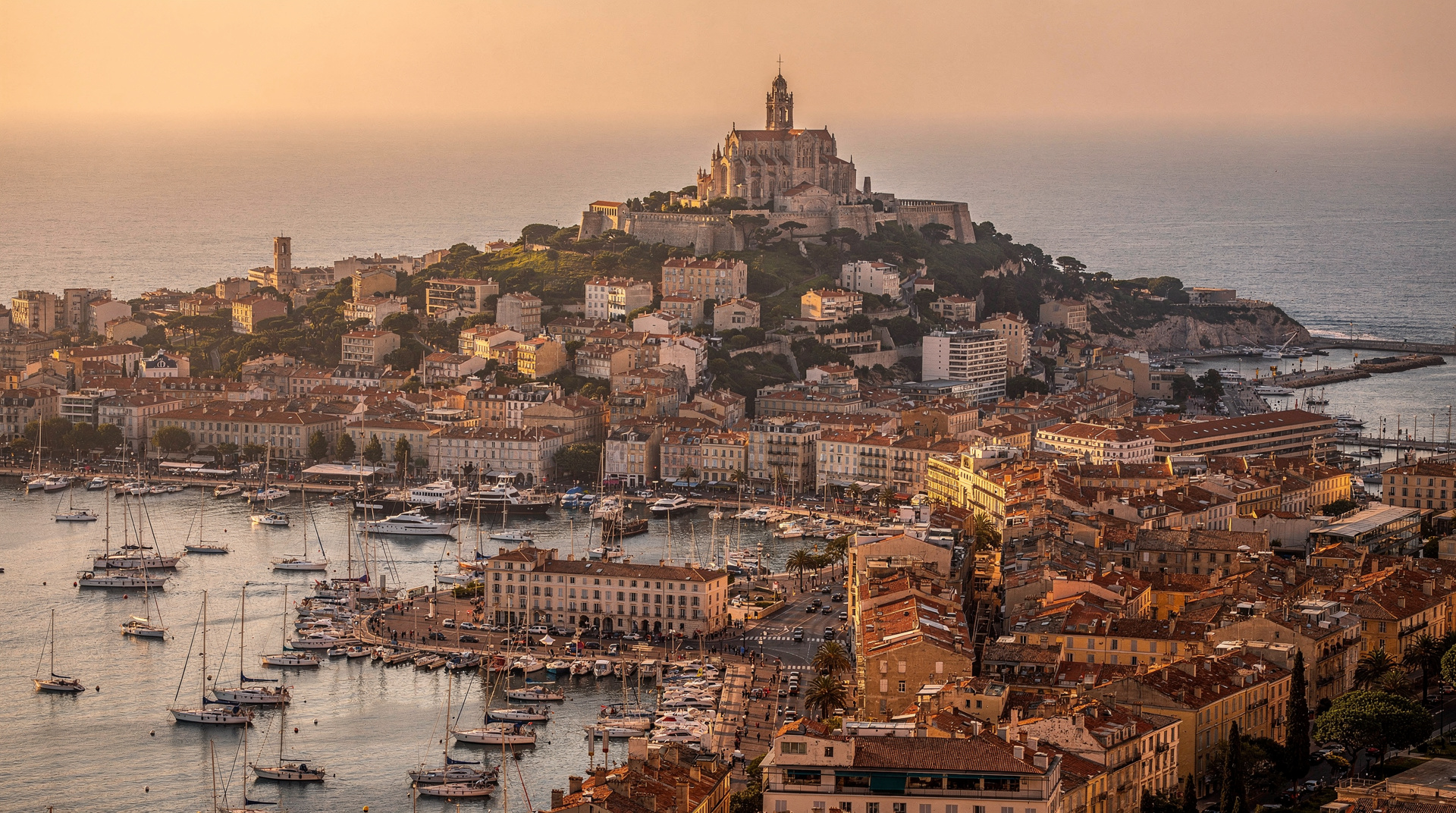
Notre-Dame de la Garde stands on the highest natural point in Marseille — a limestone outcrop 162 metres above sea level — and has been watching over the city and its harbour since the 19th century. Marseillais call her the Bonne Mère, the Good Mother, and the relationship between the city and this basilica is more personal than touristic. Sailors’ families come here to pray before voyages and to give thanks after returns. Fishermen hang model boats from the vaulted ceiling. Firefighters, lifeboat crews, and ordinary residents climb the hill to light candles and sit quietly in a way that is not performative but genuine.
For visitors, it delivers what very few urban viewpoints can: a 360-degree panorama encompassing the entire Bay of Marseille, the Frioul archipelago, the white limestone ridges of the Calanques to the east, the urban sprawl of the city below, and on a clear morning, the silhouette of the Alps above the haze to the north.
The architecture: Romano-Byzantine in pink and white
The current basilica was built between 1853 and 1864 on the site of an older chapel, under the direction of architect Henri-Jacques Espérandieu. The style is Romano-Byzantine — a 19th-century French ecclesiastical fashion that drew simultaneously on early Christian Roman basilicas and the colourful mosaic tradition of Constantinople. The result is distinctive and, in its Marseille context, exactly right.
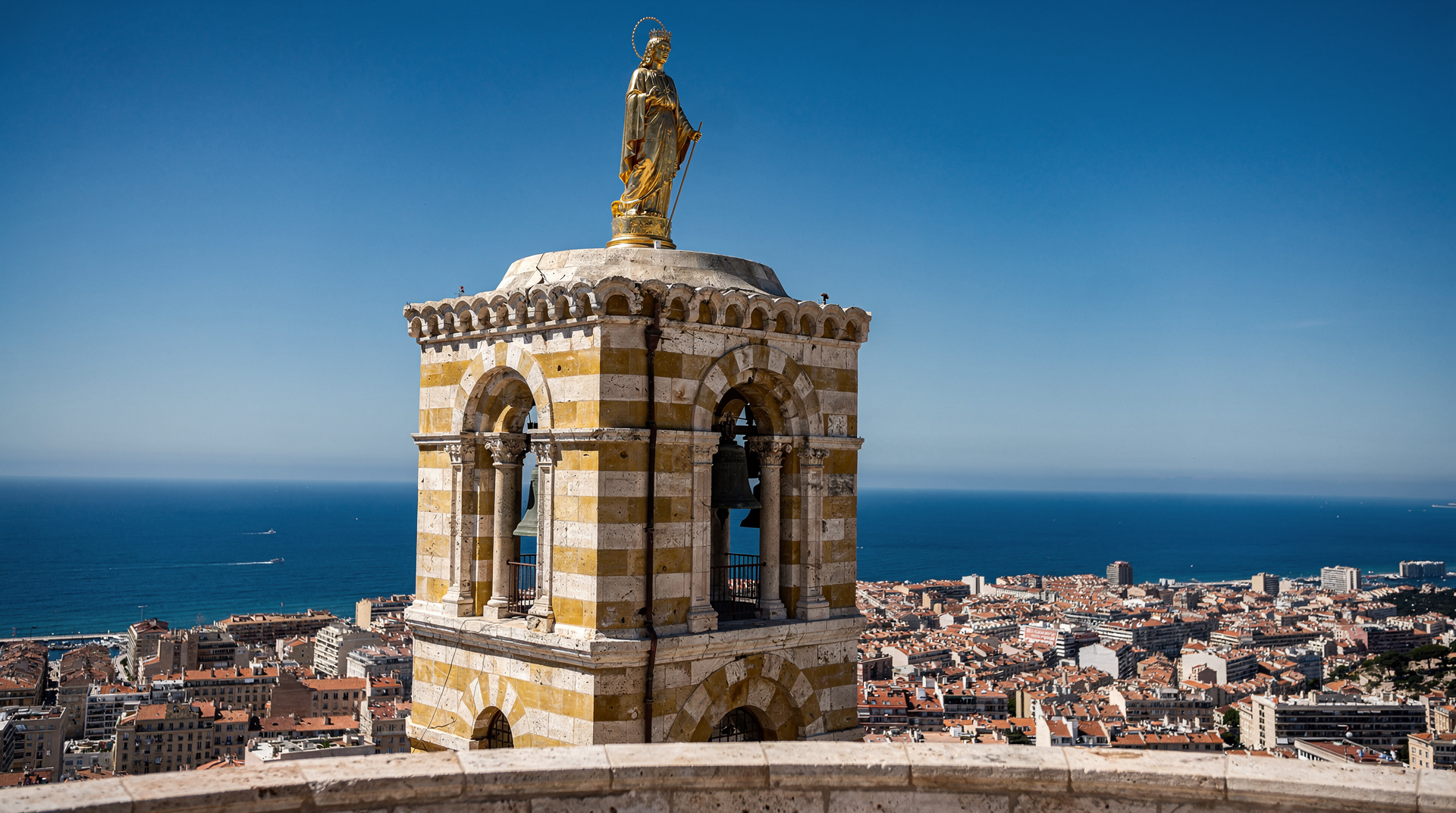
The exterior is built in alternating bands of cream limestone and green-tinged stone from Cassis, giving the lower church a striped quality. The upper basilica — the proper church — sits atop a massive rectangular tower, and above that stands the belfry, topped by a 12.5-metre tower supporting an 11.2-metre gilded copper statue of the Virgin Mary carrying the Christ child. The gold Madonna, as she is commonly known, is visible from a considerable distance at sea and from most elevated points in the city.
Inside, the basilica is covered in mosaics depicting scenes from scripture and from Provençal maritime life. The ceiling vaults are a deep cobalt blue with gold stars. The ex-votos — the offerings hung by sailors, fishermen, and the families of the saved — cover sections of the walls and are an extraordinary document of devotion: model ships, paintings, photographs, plaques, medals, and written testimonies dating back to the 1860s. These are not decorations. They are records of real events.
The lower church (the Crypte) is carved directly into the rock and contains the original altar. It is cooler than the upper basilica and almost always quieter.
Entry and visiting practicalities
The basilica is free to enter and open every day from 7:00 to 19:00 (to 20:00 from June to September). There are no timed entry slots or advance tickets required.
Photography is permitted throughout — be respectful of people who are there to pray, which in Marseille is a significant proportion of any morning crowd.
The basilica has no café or refreshment facilities on site. If you are walking up, take water, especially in summer.
Getting there: the four options
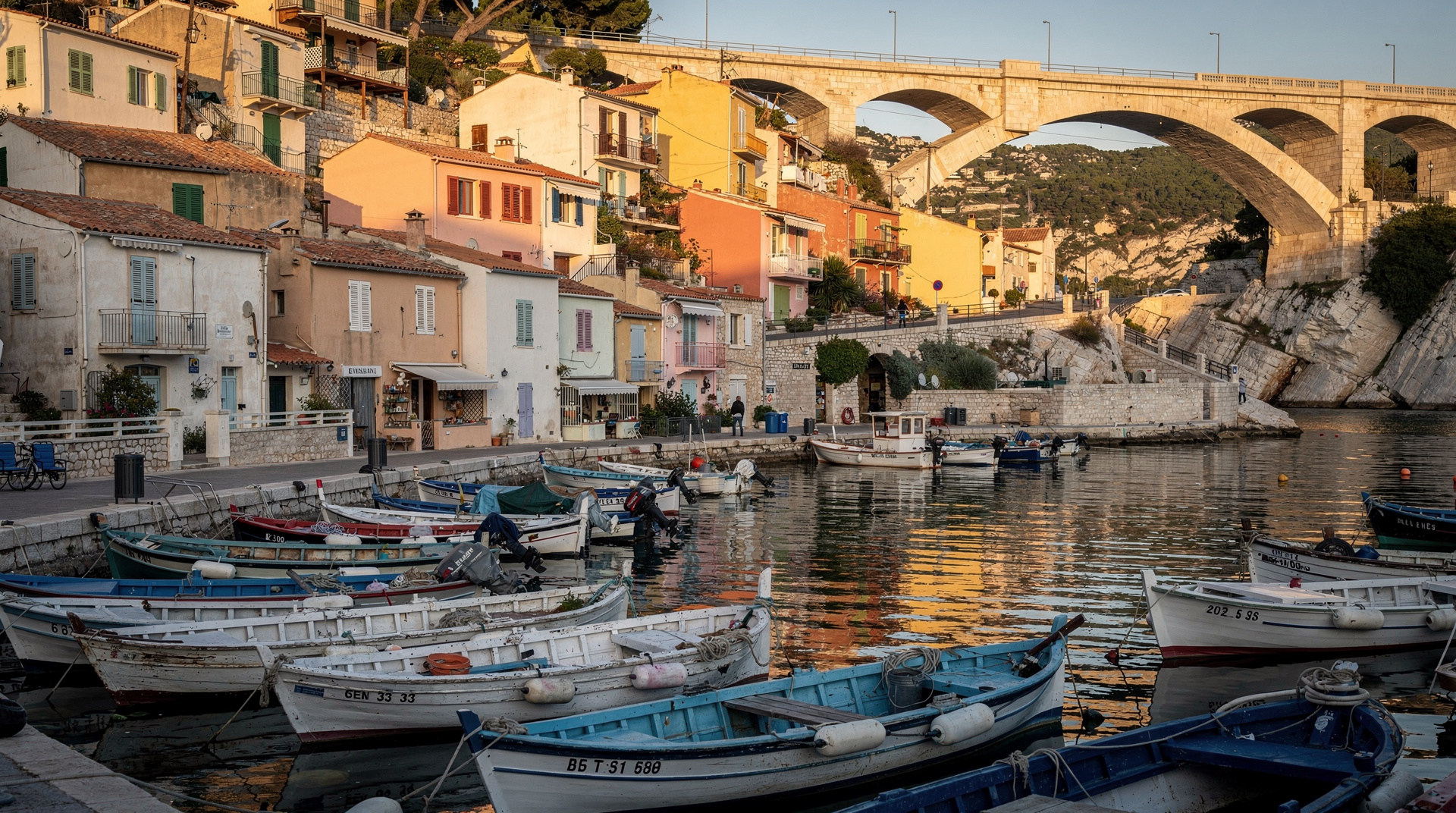
Walk: From the Quai de Rive Neuve (south shore of the Vieux-Port), the walk takes roughly 35–40 minutes at a steady pace. The route goes through the Endoume neighbourhood via Rue Caisserie and then uphill — some sections are steep. The walk is scenic and passes the Vallon des Auffes if you take the coastal route via the Corniche. From the opposite direction, the Rue Monseigneur Delay gives a direct ascent.
Bus 60: Departs from the Vieux-Port area and stops at the Notre-Dame de la Garde terminus, from which the basilica is a 5-minute walk. Runs every 10–20 minutes. A single ticket on the RTM network costs 1.70 EUR.
Le Petit Train: The tourist petit train departs the Quai des Belges (Vieux-Port) on Circuit 1 and climbs to the basilica, returning via Le Panier. The full circuit takes about 45 minutes. Cost is approximately 12–15 EUR per adult. This is efficient and entirely legitimate if walking uphill is difficult or time is short. The “is the petit train worth it?” debate in Marseille tends to be snobbish — for families with small children, mobility-limited visitors, or cruise passengers with limited time, it is entirely practical.
Taxi or ride-share: Around 8–12 EUR from the Vieux-Port for a private car. Useful if time is tight; the driver can wait while you visit.
Segway: The 2-hour segway tour covers Notre-Dame de la Garde and several other key sites. A decent way to cover ground efficiently if you are comfortable on a segway.
The panorama: what you are actually looking at
From the parvis (the terrace around the basilica), the view divides clearly:
West: The Bay of Marseille opens toward the horizon. The Frioul archipelago is clearly visible — the flat island of Ratonneau closest, with Pomègues behind it, and the tiny rocky outcrop of Château d’If island to the right.
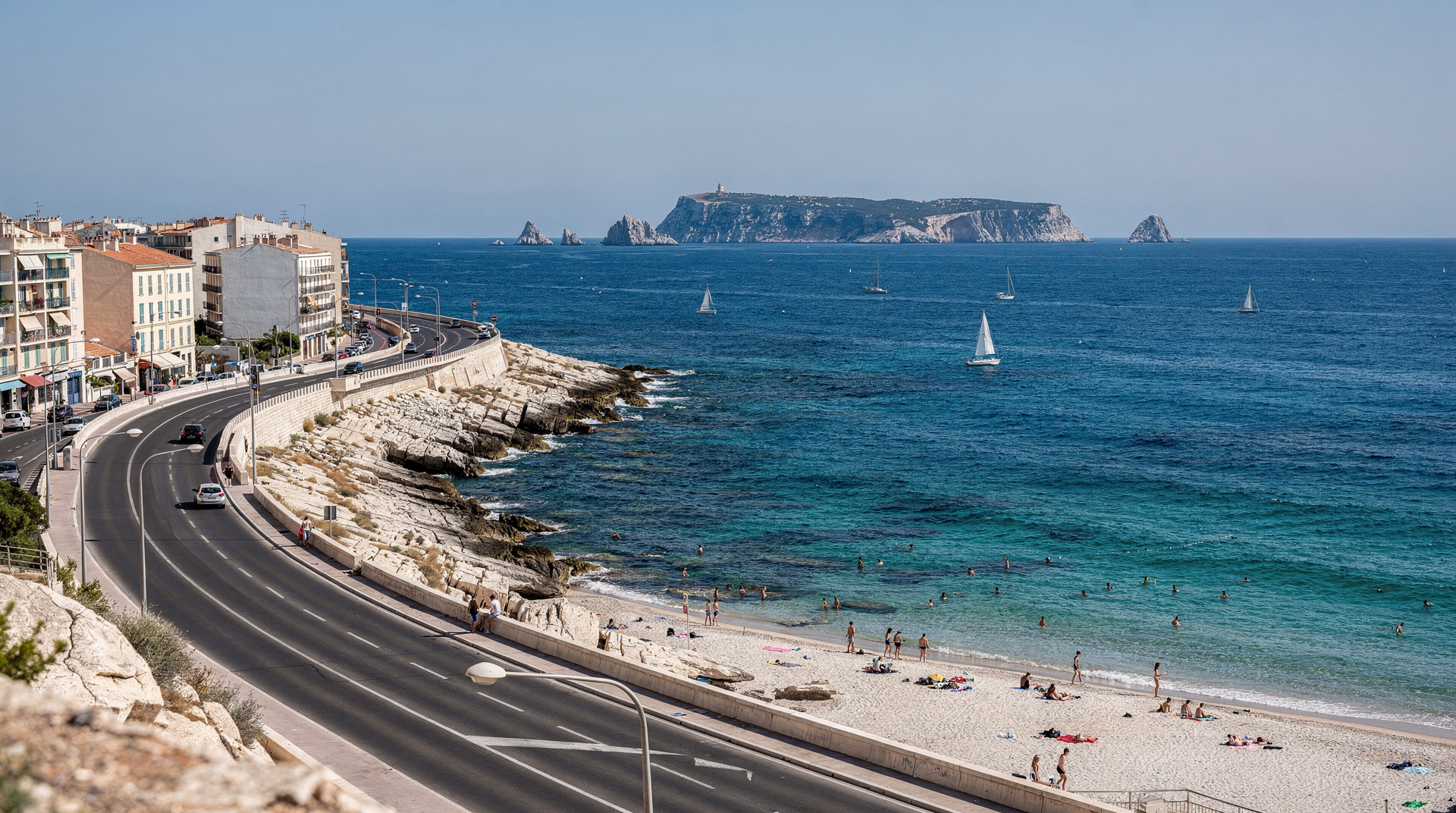
South-west: The Corniche runs along the coast, with the Prado beaches visible as a ribbon of yellow between city and sea.
North: The city spreads out in its full complexity — the Joliette container port, the industrial zone, and beyond the urban limits, the limestone hills of the Étoile chain.
East: The Calanques ridgeline marks the beginning of the national park. On a clear morning you can pick out the white cliffs above Sormiou and the start of the coastal escarpment that runs all the way to Cassis.
South-east: Cap Canaille — the distinctive red-orange cliff above Cassis, the tallest coastal cliff in France at approximately 400 metres — is visible on clear days.
Arrive in the morning for the best light and visibility. Afternoon haze over the sea reduces the range of what you can see, particularly toward the Calanques.
Connecting Notre-Dame de la Garde to the rest of the day
Notre-Dame de la Garde pairs naturally with:
- A morning fish market walk at the Vieux-Port, followed by an uphill walk through Endoume to the basilica — gives you a full morning before lunch
- The Corniche and Vallon des Auffes below, which you can reach by descending the south slope of the hill
- A hop-on hop-off bus if you want to continue directly to other city sites without committing to more walking
For a structured half-day that combines Notre-Dame, the Vieux-Port, and Le Panier, see our Marseille for first-timers guide.
The Bonne Mère in Marseille identity
Notre-Dame de la Garde is not merely a tourist sight. It is the symbol of Marseille in a way that transcends religion — the city’s secular patron in all but name. Marseillais who would never describe themselves as religious still call her “la Bonne Mère” with genuine affection, and her image appears on everything from street tiles to football scarves (Olympique de Marseille players have historically prayed here before important matches).
The bells of Notre-Dame de la Garde have rung across Marseille since the basilica’s completion in 1864. During the Second World War, the basilica was occupied by German forces who used the tower as an observation post — the bullet holes from the Liberation of Marseille in August 1944 are still visible on the south exterior wall near the entrance, deliberately left unrepaired as a memorial.
The ex-voto tradition — the offerings hung in thanks for survival or miraculous intervention — is not a tourist phenomenon. Many offerings are recent: photographs of car accident scenes with “Merci” inscribed below, paintings depicting boat disasters avoided, testimonies from families whose relatives returned from illness or war. The most moving section is usually the oldest material, 19th-century marine paintings showing ships in storms with the basilica visible on the hill above — the same view that sailors would have had returning to port.
What to expect on arrival
The approach road to the basilica is narrow and parking is limited — a reason to use public transport or the petit train. The esplanade in front of the basilica has a small gift shop, a café (useful, since there is nothing on the summit otherwise), and the starting point for the panoramic views.
Inside, allow your eyes to adjust to the lower light before moving around. The mosaics are the primary visual experience — the gold tesserae catch available light differently at different times of day. Late afternoon, when the western sun angles into the nave, tends to be the most visually striking time inside the building.
There are usually a handful of people praying at any given time — be quietly respectful of the working religious environment, particularly in the apse and before the main altar.
Historical military significance
Before the basilica, the hill was a strategic position in the city’s defences. A medieval chapel dedicated to Notre-Dame was built here in 1214. A military fortification replaced and incorporated it in the 16th century — the Château de la Garde, which was used as a prison and garrison until the 19th century. The current basilica was constructed between 1853 and 1864, incorporating part of the old fortification into its structure (the crypt is built directly within the medieval and Renaissance-era walls). The military fortification mixes with the religious building in the stonework of the lower level in ways that are architecturally readable on close inspection.
Combining Notre-Dame de la Garde with the Corniche
The south slope of Notre-Dame de la Garde descends toward the Endoume neighbourhood and the Corniche. Walking down (rather than taking the bus) reveals a residential part of Marseille that most visitors do not see: the Roucas-Blanc and Malmousque districts, with their 19th-century villas and narrow streets overlooking the sea. The descent to the Corniche takes about 25–30 minutes and deposits you near the Vallon des Auffes. This walk, from the basilica summit to the Vallon des Auffes to the Vieux-Port, is one of the best continuous walking routes in Marseille — about 4 kilometres and 2 hours with stops.
Visiting with limited mobility or small children
The petit train and bus 60 both stop within a short, level walk of the basilica entrance, which makes Notre-Dame de la Garde one of the more accessible hilltop sights in Marseille compared with, say, a Calanques hike. Once inside, the nave is level throughout; the lower Crypte has a short flight of steps. Strollers can be brought up on the petit train and left near the entrance — there is no dedicated storage, but the esplanade is wide enough to park one out of the main foot traffic. For a broader look at family logistics across the city, see our Marseille with kids guide.
Frequently asked questions about Notre-Dame de la Garde, Marseille
Is Notre-Dame de la Garde worth the climb? Yes, for most first-time visitors — it is the single best panoramic viewpoint in Marseille and the interior mosaics and ex-votos are unlike anything else in the city. If the uphill walk is a concern, the petit train or bus 60 remove the effort entirely. See our Notre-Dame de la Garde guide for a fuller planning breakdown.
Can you see the Calanques from Notre-Dame de la Garde? On a clear morning, yes — the white cliffs above Sormiou and the start of the escarpment toward Cassis are visible to the east. Haze builds through the afternoon, so morning visits give the best range for anyone hoping to preview the Calanques National Park before heading there.
Top experiences
Bookable activities with verified prices and instant confirmation on GetYourGuide.