MuCEM guide: Marseille's museum of Mediterranean civilisations
Marseille: MuCEM skip-the-line entry ticket
What is MuCEM and is it worth visiting?
MuCEM is Marseille's landmark museum of European and Mediterranean civilisations, housed in Rudy Ricciotti's black concrete-lattice building on the J4 waterfront. Entry is EUR 11 (free first Sunday). Open Wed–Mon 11:00–19:00 (summer 10:00–20:00). It is THE cultural highlight of the city.
The building that changed Marseille
| At a glance | Details |
|---|---|
| Where | J4 waterfront, next to Fort Saint-Jean and the Vieux-Port |
| Cost | Around EUR 11 full price (free exterior, terraces, and fort gardens) |
| Time needed | Around 1 hour for the exterior only; 2.5–4 hours for a full visit |
| Getting there | Métro M2 to Joliette, or a 15–20 minute walk from the Vieux-Port |
| Best time | Midweek mornings, spring or September to avoid the worst of the crowds |
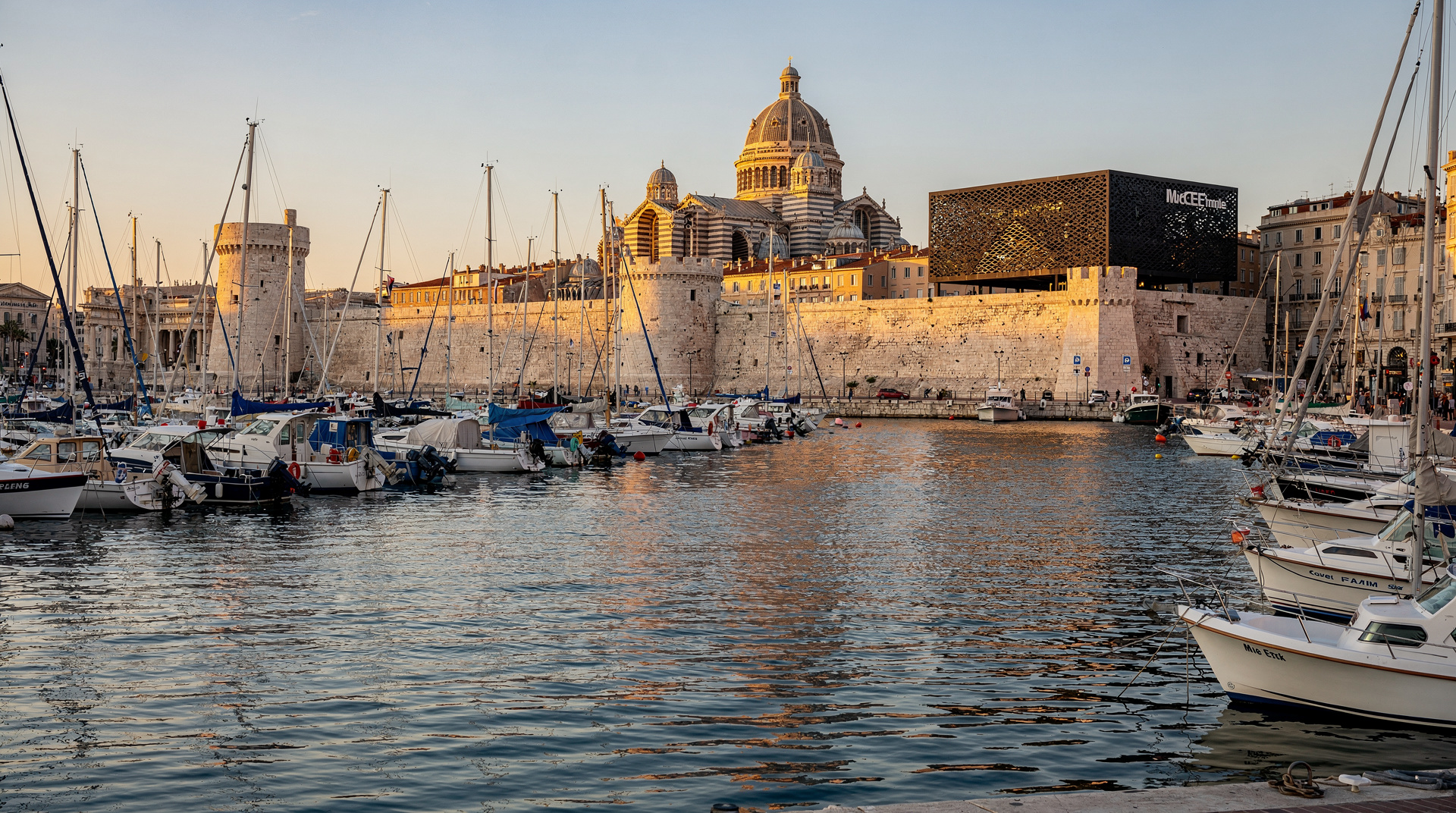
Before 2013, the J4 esplanade was a disused stretch of concrete between the cruise port and the old Fort Saint-Jean — spectacular in its setting, wasted in its use. Then MuCEM opened, and the waterfront became one of the most compelling public spaces in France.
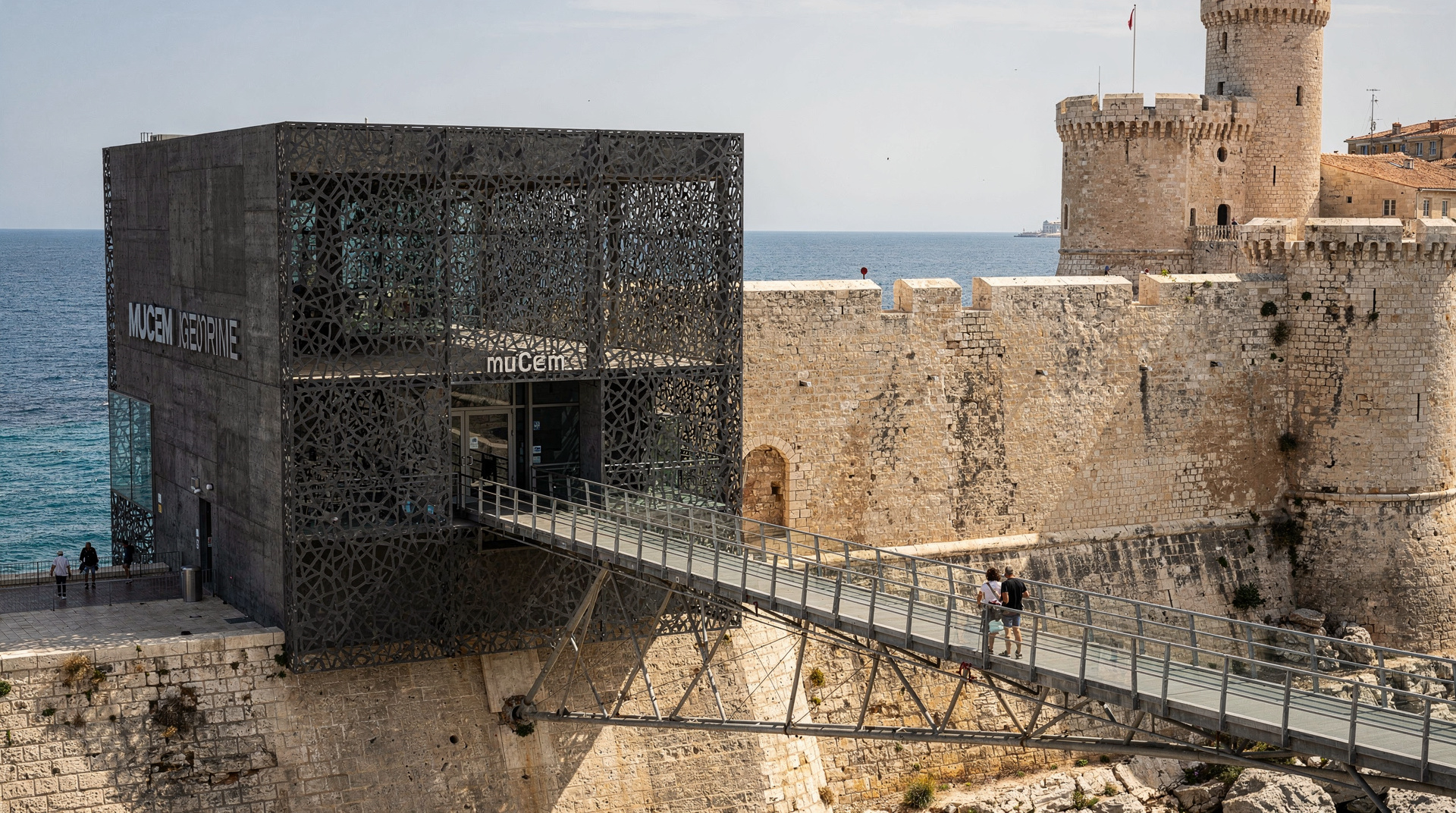
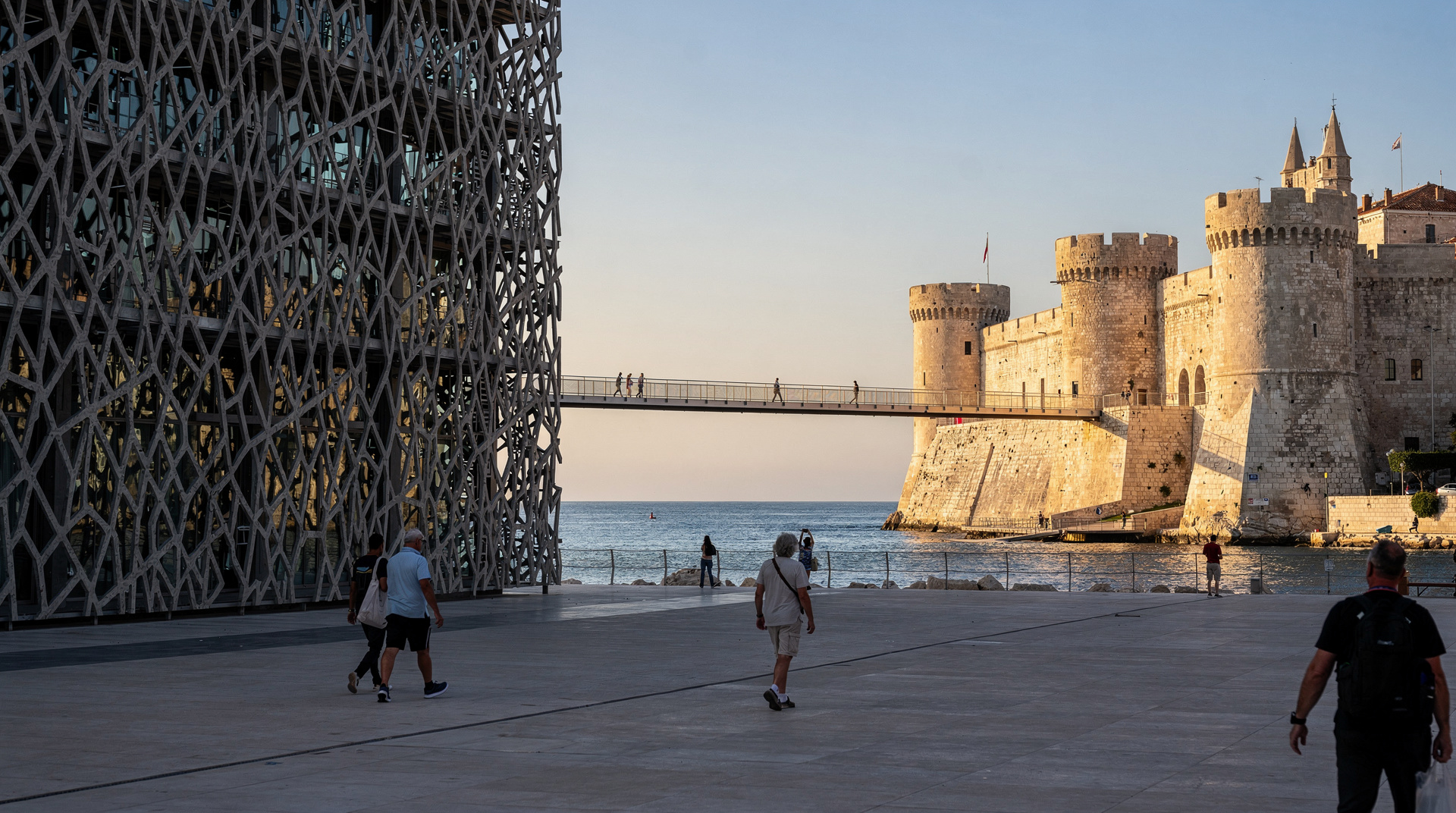
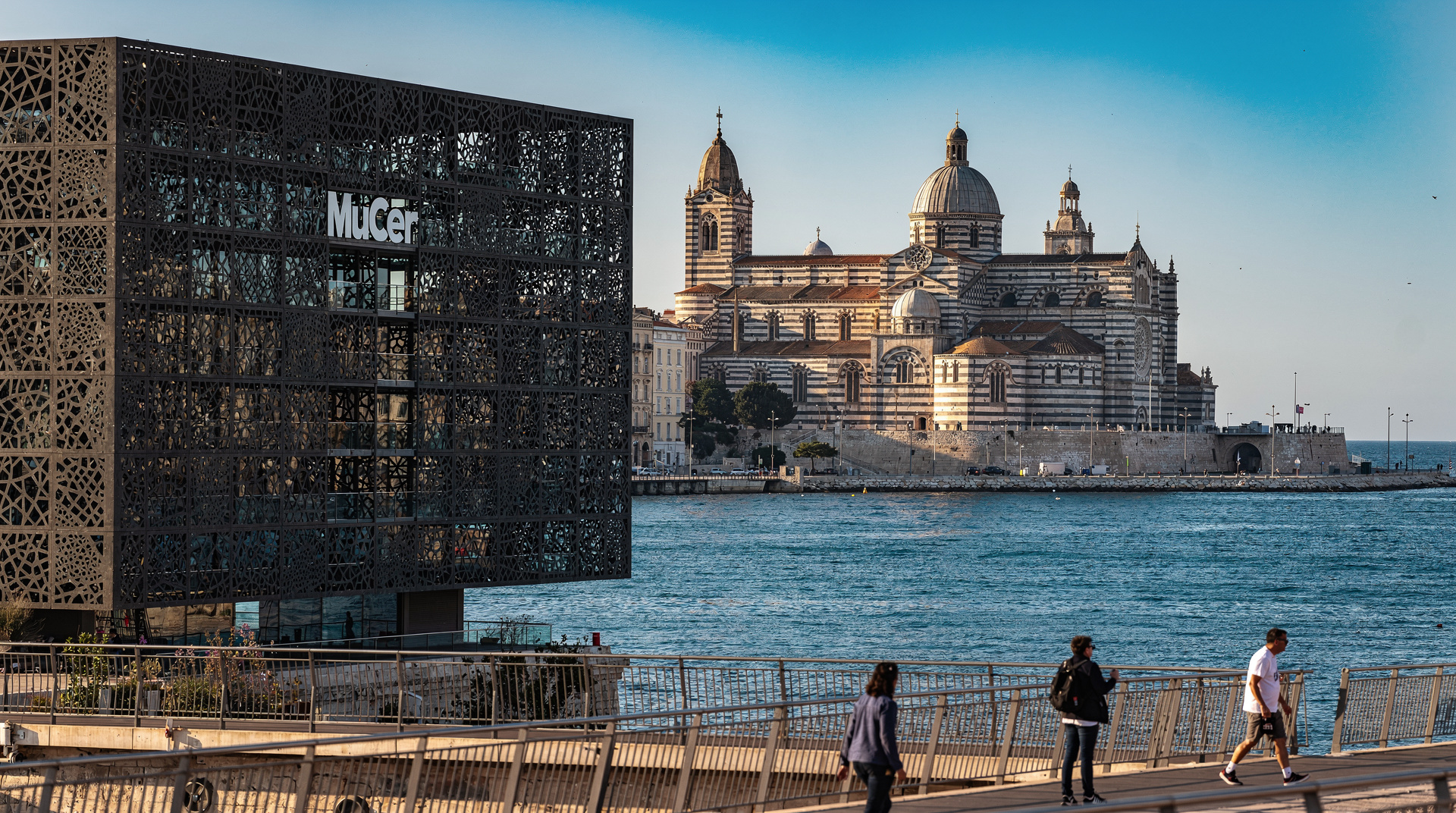
Architect Rudy Ricciotti’s building is wrapped in a cast concrete lattice — a geometric mesh of intersecting arabesques that filters Mediterranean light, casts shifting shadows across the floors, and reads completely differently at each time of day and season. At dawn it is almost white. In the afternoon it turns deep charcoal. At night, lit from within, it glows like an enormous lantern on the water. The structure is not a box with decoration added; the lattice is structural, load-bearing, integral to the building in the way Provence-born Ricciotti insisted it had to be.
The footbridge that connects MuCEM to the restored Fort Saint-Jean next door is one of the most satisfying short walks in the city. Below you, the sea. Ahead, the medieval fortifications. Behind, the concrete lattice. The walk takes about 90 seconds and changes your understanding of both buildings.
This is THE most important museum in Marseille. If you only have time for one cultural institution, this is the one.
What MuCEM actually is
MuCEM is the Musée des Civilisations de l’Europe et de la Méditerranée — a museum whose subject matter is the shared history, cultures, and daily life of the peoples who have lived around the Mediterranean basin and across Europe. It is not an art museum in the conventional sense. It is an anthropological, historical, and cultural institution whose permanent collection spans agricultural tools and devotional objects, cooking vessels and political posters, Provençal crèche figurines and Moroccan wedding jewellery — connecting them through the common thread of the Mediterranean experience.
The museum opened in June 2013 as the centrepiece of Marseille-Provence’s year as European Capital of Culture. In the twelve years since, it has become one of the most visited cultural institutions in France outside Paris — and arguably more interesting than many of them, because its subject matter is more honest about the complexity and hybridity of Mediterranean identity.
The permanent collection: Galerie de la Méditerranée
The main permanent gallery — the Galerie de la Méditerranée — occupies the lower levels of the J4 building and unfolds through four interconnected themes: the invention of agriculture, the monotheist religions and their intersections, the connected sea (trade, migration, exchange), and the individual within collective society.
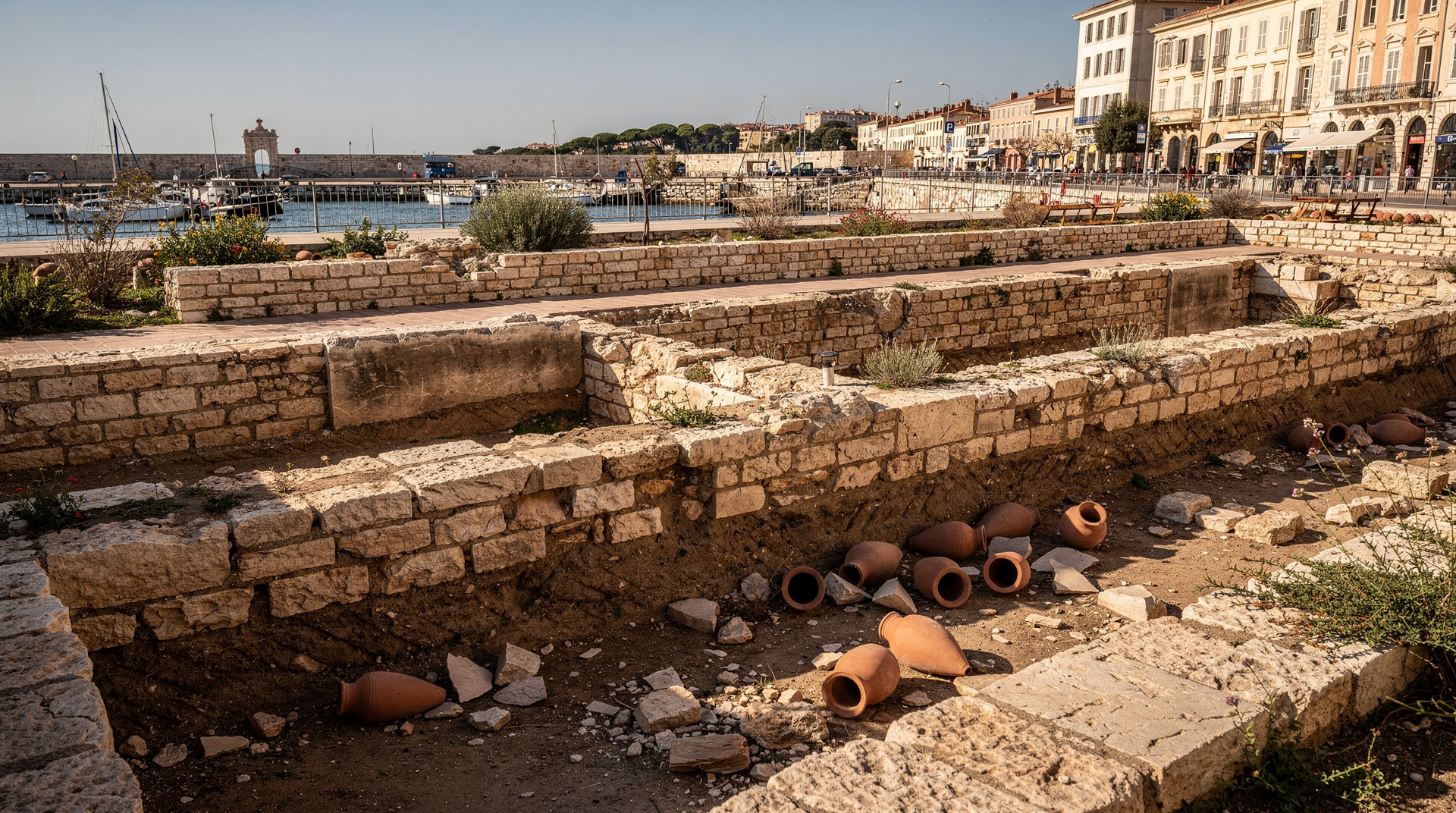
The exhibition design avoids the glass-case-with-label approach. Objects are presented in relation to each other — a Roman amphora next to an Ottoman copper pot next to a 20th-century Marseille soap mould — because the museum’s argument is that these connections are the Mediterranean story. The logic takes a room or two to register, but once it does, the collection becomes genuinely engaging.
Highlights of the permanent collection:
- A reconstructed Provençal farmhouse interior (17th–19th century) that shows everyday life before industrialisation
- The devotional objects section — ex-votos, votive offerings, and religious instruments from Jewish, Christian, and Islamic traditions displayed together without hierarchy
- The olive tree room, which opens the agriculture section with a 1,000-year-old olive trunk at its centre — an object of extraordinary presence
- The migration section, documenting the human movement that has always defined the Mediterranean, treated with nuance rather than sentimentality
Budget 90 minutes to 2 hours for the permanent collection if you engage seriously with it.
Temporary exhibitions in 2026
MuCEM programmes ambitious temporary exhibitions alongside its permanent collection. Currently showing:
Bonnes Mères (from March 2026): An exhibition exploring the figure of the mother across cultures and centuries — from the Bonne Mère of Marseille (Notre-Dame de la Garde) to maternal imagery in contemporary art and across Mediterranean societies. One of the more thematically ambitious shows MuCEM has organised.
Clement Cogitore · Ferdinandea, the ephemeral island (December 2025 – September 2026): Work by French artist and filmmaker Clement Cogitore, exploring the submerged volcanic island of Ferdinandea in the Sicily Channel — a geological formation that has appeared and disappeared several times in recorded history, and which different nations have claimed at different moments. A meditation on territory, identity, and the sea.
Mossi Traoré: Fashion in Unity (from May 2026): An exhibition centred on African fashion and textile culture, examining how dress functions as political and cultural expression across the Sahel and Mediterranean.
Check mucem.org for the complete current programme and any temporary exhibitions added after this review.
Fort Saint-Jean: the free half of your visit
The Fort Saint-Jean, connected to MuCEM by the footbridge, is itself a remarkable complex. The fortification was built in the 17th century by Louis XIV partly as a control point for the port and partly as a garrison capable of suppressing any Marseille uprising against royal authority — the city’s relationship with Paris has always been complicated.
The fort has been restored as a public garden, promenade, and cultural space. The gardens within the fortifications are planted with Mediterranean species — olives, figs, lavender, wild herbs — and offer some of the best views of the Vieux-Port, the J4, and the sea from any accessible point in the city.
The restored medieval tower (Tour du Roi René, 15th century) at the water’s edge can be seen from the footbridge. Access to the fort grounds is free during MuCEM’s opening hours.
Allow at least 30 minutes to walk the fort and take in the views before or after your museum visit.
Visiting practicalities
Entry: EUR 11 full price, EUR 7.50 reduced (students, under-26 EU nationals, over-65, unemployed). Free for under-18 and disabled visitors with companion. Free for everyone on the first Sunday of each month. Family ticket EUR 18 (up to 2 adults, 5 children).
Hours (2026):
- November–April: 11:00–18:00
- May–early July: 11:00–19:00
- July–early September: 10:00–20:00
- September–November: 11:00–19:00
- Closed Tuesdays year-round
Skip-the-line tickets: Essential in July and August. Book via the GYG link above or directly via mucem.org. The queue at peak times can be 30–45 minutes without advance booking.
The free areas: The rooftop terrace, the surrounding esplanades, the gardens, and the J4 promenade are accessible without a museum ticket during opening hours. If your visit is primarily architectural, you can walk the footbridge, explore the fort, and take in the building from outside without spending EUR 11.
Getting to MuCEM
By métro: Line M2 to Joliette station, then a 10-minute walk south along the esplanade toward the J4. This is the most direct route from central Marseille.
On foot from the Vieux-Port: Cross the Vieux-Port ferry (free, 5 minutes) to the north shore, then walk 15 minutes northwest toward the fort and J4 esplanade. The walk along the quai is pleasant.
On foot from Le Panier: Exit Le Panier at the Fort Saint-Jean side (15 minutes from the upper Panier) — you emerge directly at the fort and the footbridge.
By tram: T2 to Joliette.
Combining MuCEM with the rest of the J4 waterfront
The J4 waterfront around MuCEM is one of the more architecturally rich stretches in France. In a 500-metre radius you can see:
- MuCEM itself (Ricciotti, 2013)
- Fort Saint-Jean (17th century, restored 2013)
- Villa Méditerranée (Stefano Boeri, 2013) — a white cantilevered building immediately next to MuCEM, which now houses the Cosquer Méditerranée cave replica
- FRAC Provence-Alpes-Côte d’Azur (Kengo Kuma, 2013) — the regional contemporary art fund building nearby on the Joliette esplanade, with a distinctive façade of recycled glass tiles
- Les Docks — the 19th-century warehouse complex converted into offices, restaurants, and a hotel
A morning that begins at the fish market on the Vieux-Port, walks to MuCEM via Le Panier, includes two hours in the museum and the fort, and finishes with lunch on the J4 esplanade is one of the best possible Marseille days. Read our three-day planning guide for how to sequence this with the rest of the city.
MuCEM vs Marseille’s other museums: where it fits
For visitors deciding how to allocate limited museum time, MuCEM is the priority over the Musée d’Histoire de Marseille, the Musée Cantini, and the Palais Longchamp museums for most first-time visitors — its scope, ambition, and the free architectural elements make it the single highest-value cultural stop in the city.
The Musée d’Histoire de Marseille is the better choice for visitors specifically interested in Roman-era Marseille and the preserved ancient ship displayed in situ. The Cosquer Méditerranée replica next door, covering Paleolithic cave art, pairs naturally with a MuCEM visit and is often combined into the same half-day. See our complete museums guide for how to sequence more than one on a short trip.
Where to go before and after MuCEM
MuCEM sits at the meeting point of several of the city’s best-known areas, so it slots easily into a wider day. The Le Panier guide covers the old quarter you walk through on the way, and the Le Panier destination page gives more background on its streets. On the other side of the water, the Vieux-Port destination page is the natural starting or finishing point for a walk.
If the weather is poor, a museum day is a sensible plan, and our Marseille on a rainy day story shows how other visitors filled it. For a longer view of how to fit the museum into a trip, the Marseille in one day itinerary and the Marseille in two days itinerary both give a sense of pace. If you are new to the city, the Marseille for first-timers guide helps you decide what to prioritise, and the Cathédrale de la Major guide covers another landmark close to the waterfront.
Accessibility and practical comfort
MuCEM is fully step-free: lifts connect all levels of the J4 building, and the footbridge to Fort Saint-Jean has a gentle gradient suitable for wheelchairs and pushchairs. Disabled visitors and one companion receive free entry. The fort gardens have some uneven ground on the older stone paths, but the main circulation routes are paved and manageable. Water fountains are available near the entrance and in the fort gardens — useful in the July–August heat, when the exposed J4 esplanade offers little shade before mid-morning.
MuCEM for photographers and architecture fans
The building rewards a slow, deliberate visit for anyone interested in the architecture itself. The lattice casts its sharpest shadow patterns in the two hours after sunrise and the two hours before sunset — midday sun flattens the effect. The footbridge to Fort Saint-Jean is the single best vantage point for photographing the lattice against the sea, and the rooftop terrace gives an unobstructed view back over the Vieux-Port and Notre-Dame de la Garde on the hill above it. For a wider sense of how Ricciotti’s building fits into the city’s architectural story, see our Marseille architecture guide.
MuCEM and Marseille’s 2013 transformation
The European Capital of Culture year was a genuine turning point for Marseille’s relationship with its own image. The MuCEM, the FRAC, the Villa Méditerranée, the restored J4 esplanade, and the investment in Cours Julien’s cultural infrastructure all arrived within a short period and changed the conversation about what kind of city Marseille is.
This is worth understanding because MuCEM is not just a museum — it is a statement about Marseille’s identity as a Mediterranean city rather than a peripheral French one. The museum’s decision to take the entire Mediterranean basin as its subject matter, rather than a specifically French story, was deliberate and political. A city that has always been more comfortable facing the sea than looking north finally built an institution that faces south.
For the full history of how Marseille became what it is — from the Phocaean Greek founding through the 2013 reinvention — read our Marseille history guide.
Honest assessment
MuCEM is genuinely excellent and genuinely worth EUR 11. The building is extraordinary. The permanent collection is more interesting than its subject matter might initially suggest. The temporary exhibitions are consistently well-curated. The fort and gardens are among the best free public spaces in Marseille.
It is also demanding. The Galerie de la Méditerranée rewards attention and patience; visitors who walk through quickly in 30 minutes will take little away. Budget real time, bring genuine curiosity, and you will leave with a different understanding of both the Mediterranean and the city you are standing in.
For the broader Marseille museum landscape — MuCEM in context with Cantini, Longchamp, Vieille Charité, and Cosquer — see our complete Marseille museums guide.
Frequently asked questions about MuCEM guide
What does MuCEM stand for?
Musée des Civilisations de l'Europe et de la Méditerranée — Museum of European and Mediterranean Civilisations. It opened in 2013 as part of Marseille's European Capital of Culture programme.How much does MuCEM cost?
Full-price entry is EUR 11, reduced EUR 7.50 (students, under-26 EU residents, job-seekers). Free on the first Sunday of each month. A family ticket is EUR 18 for up to 2 adults and 5 children.Is MuCEM open on Monday?
No. MuCEM is closed on Tuesdays (not Mondays). It is open Wednesday through Monday. Seasonal hours: Nov–Apr 11:00–18:00; May–early Jul 11:00–19:00; Jul–Sep 10:00–20:00; Sep–Nov 11:00–19:00.Can I visit MuCEM without going inside?
Yes. The exterior terraces, gardens, and the footbridge connecting MuCEM to Fort Saint-Jean are free to access during opening hours. Many visitors come purely for the architecture and the sea views from the roof terrace, which is one of the best in the city.What is the best time to visit MuCEM?
Midweek mornings in May, June, or September. July and August are the busiest — book skip-the-line tickets in advance. The first Sunday of the month offers free entry but draws large crowds.Is Fort Saint-Jean included in the MuCEM ticket?
Access to the Fort Saint-Jean grounds and gardens is free. Specific areas within the fort may have ticketed components depending on the current programming. The footbridge connecting MuCEM to Fort Saint-Jean is a highlight in itself and free to walk.What exhibitions are currently showing at MuCEM?
As of May 2026: 'Bonnes Mères' (from March 2026, exploring maternal figures across cultures), 'Clement Cogitore · Ferdinandea' (until September 2026), and 'Mossi Traoré: Fashion in Unity' (from May 2026). Check mucem.org for the latest programme.Is the MuCEM permanent collection in English?
Yes. All permanent collection labels are in French and English. Most temporary exhibitions provide English translations, though the coverage varies. Audio guides are available in multiple languages.Can I eat at MuCEM?
There is a restaurant and café within the MuCEM complex, with outdoor seating on the terrace facing the sea. The food is decent and the setting is exceptional — one of the better museum café views in France. Expect a wait at peak lunch times.Is MuCEM good for children?
The permanent collection is dense for young children but the fort gardens and J4 esplanade provide excellent outdoor space. MuCEM runs specific family programmes and workshops; check the website for current activity programmes during your visit. The Cosquer cave replica next door at Villa Méditerranée is specifically excellent for children aged 8 and up.What is the difference between MuCEM and the Galerie de la Méditerranée?
The Galerie de la Méditerranée is the permanent collection space inside MuCEM. MuCEM as an institution also includes the Fort Saint-Jean, the rooftop terrace, the temporary exhibition galleries, the restaurant, and the programmes across all three sites. When you buy a ticket to MuCEM, you access the J4 building including the Galerie de la Méditerranée and the current temporary exhibitions.How long should I spend at MuCEM?
For the building exterior, fort, and gardens only: 1 hour. For the permanent collection only: 90 minutes to 2 hours. For permanent plus one temporary exhibition: 2.5 to 3 hours. A full MuCEM visit including the fort gardens is realistically 3 to 4 hours for visitors who engage seriously.
Top experiences
Bookable activities with verified prices and instant confirmation on GetYourGuide.