Sugiton calanque hike: the complete guide for 2026
Marseille: Calanques National Park guided hike
Duration: 5 hours
Do you need a reservation to visit Sugiton?
Yes — in 2026, reservation is mandatory on June 20–21 and every day June 27–August 30, plus September 5–6 and 12–13. It is free, made at calanques-parcnational.fr up to 3 days in advance. Fire closures cancel reservations without carryover.
Why Sugiton is regulated — and why that matters
| Where | Trailhead at Luminy campus, 9th arrondissement, southern Marseille |
| Cost | Free — the hike and the reservation both cost nothing |
| Time needed | Around 3–3.5 hours round trip including time at the calanque; 1.5–2 hours at the water alone |
| Getting there | Bus 21J or B1 from Castellane métro, around 30–35 min |
| Best time | April–May (no reservation needed, cooler, wildflowers) or an early-morning start June–September |
Sugiton is the closest major calanque to Marseille proper. The trail from Luminy, the university campus in the 9th arrondissement, descends to the water in under an hour. It is served by public bus. It is the first calanque most Marseille locals ever visit. And until the reservation system was introduced, it was being visited by so many people that the trails were deteriorating and the cove itself was overwhelmed on any sunny weekend between May and September.
The regulation is a rational response to a genuine problem. Sugiton holds roughly 400 visitors comfortably at the calanque at any one time. Without limits, it was receiving several times that number on peak days. The free reservation system — which has been refined annually since its introduction — is now one of the better-managed access systems in any French national park.
Understanding how it works in 2026 specifically is the first task before planning any Sugiton visit.
The 2026 reservation system: exact dates and rules
The mandatory reservation for Sugiton in 2026 applies on the following dates:
- June 20–21 (the first regulated weekend)
- Every day from June 27 through August 30
- September 5–6 (first September weekend)
- September 12–13 (second September weekend)
Outside these dates — including all weekdays in early and mid-June, and all of April and May — Sugiton can be visited without reservation. April and May are in fact the optimal Sugiton window: trails fully open, no reservation needed, comfortable temperatures.
How to make the reservation:
- Go to calanques-parcnational.fr (the official park website — not a third-party booking engine)
- The reservation portal opens 3 days before the date you want to visit, at 09:00 CET
- Reservations close at 18:00 the evening before the visit date
- The reservation is free, takes under 5 minutes, and covers a group of up to 5 people
- You receive a QR code confirmation by email — show it at the trailhead entry point
Capacity: 400 places per day are available.
Fire closure cancellations: If the Bouches-du-Rhône prefecture declares a red-level fire risk for the Calanques massif, all reservations for that day are automatically cancelled. The park does not carry reservations forward to another day — you will need to re-book. Always check calanques-parcnational.fr the morning of your visit before leaving for the trailhead.
Getting to the Luminy trailhead
The Luminy campus of Aix-Marseille University sits at the southern edge of the 9th arrondissement, directly on the boundary of the national park. It is the access point for Sugiton, Morgiou, and the eastern ridge trails.
By public bus (recommended):
- Bus 21J or B1 from Castellane métro station (lines 1 and 2 meet at Castellane)
- Alight at the last stop: “Luminy PN des Calanques”
- Journey approximately 30–35 minutes from Castellane
- Frequency approximately every 15–20 minutes during daytime
By car:
- Route de Luminy from the 9th arrondissement
- Free car park at the Luminy campus boundary
- The car park fills by 09:00 on any warm weekend between April and October — if you arrive at 10:00 in May, expect to find no space
- Bus is genuinely the better option for weekend visits
By taxi: From the Vieux-Port area, approximately 25 minutes and EUR 20–25.
The hike: step by step
Trailhead to the Sugiton plateau (15–20 minutes)
From the Luminy bus stop, pass the university gate and follow the signs for “Calanque de Sugiton.” The first section climbs gently through the garrigue on a wide, well-maintained path. You pass the boundary markers of the national park and the landscape opens — limestone scrub, rosemary and cistus in flower in spring, and the first views southwest toward the sea.
This section is the easiest part of the hike. It is also where you will be asked to show your QR code reservation (on regulated dates) by a park warden at the check point.
Plateau to the Sugiton viewpoint (15–20 minutes)
The path continues through the plateau toward the Sugiton ridge. Views extend south to the open sea. The walking is moderate — some rocky sections but nothing technical. On clear days the silhouette of the Frioul Islands and the Château d’If are visible offshore.
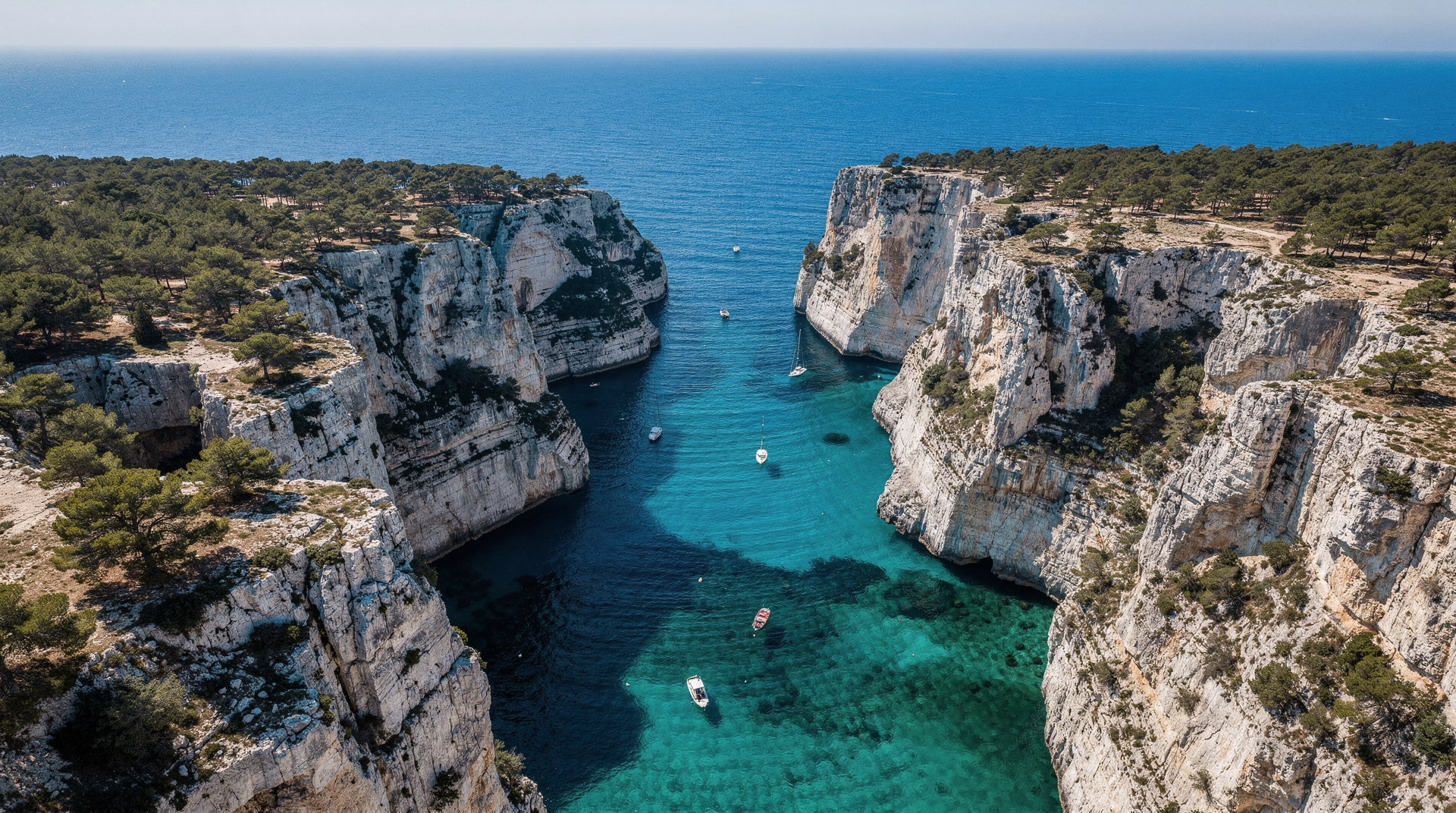
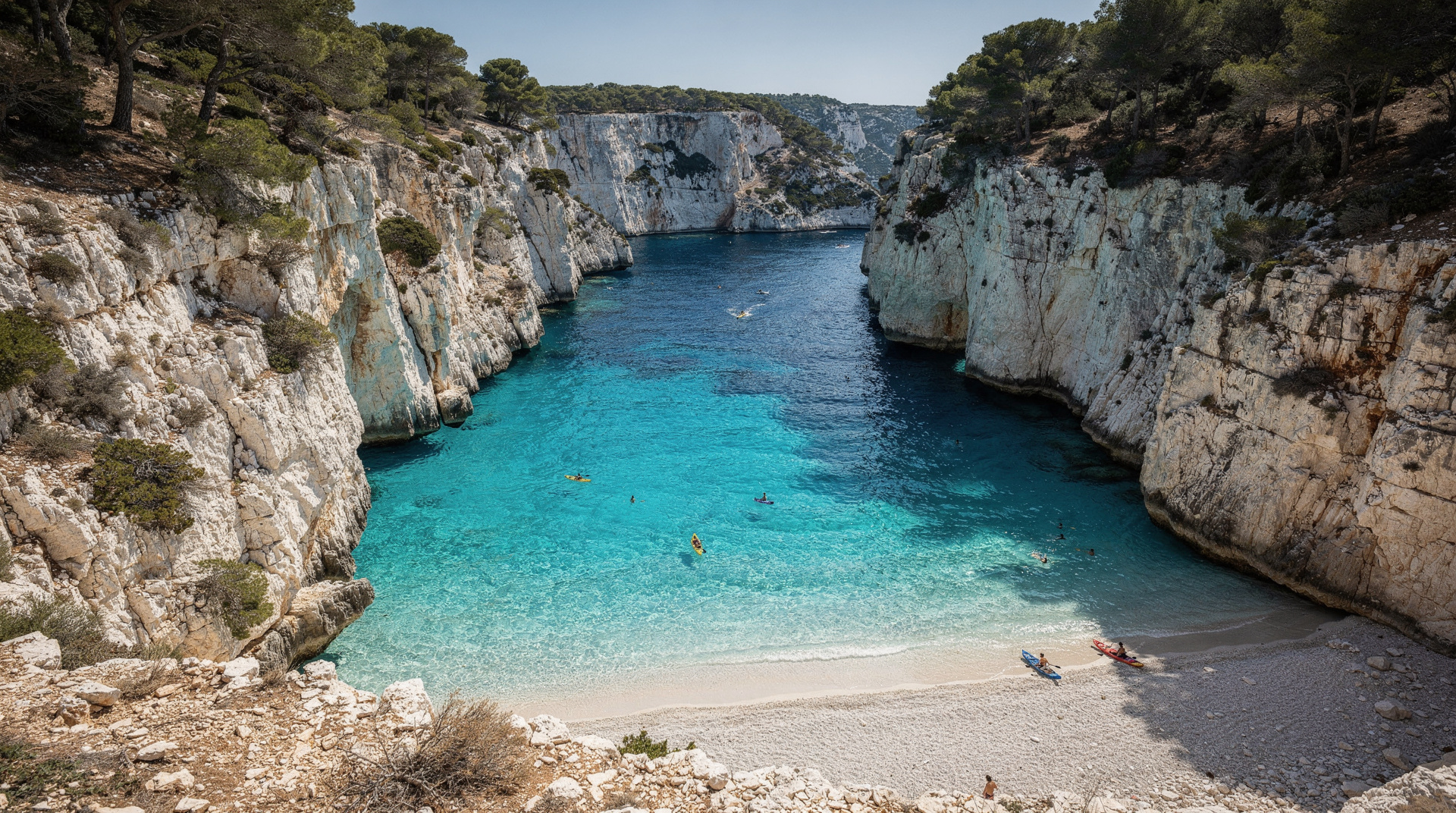
At the Sugiton viewpoint, the calanque reveals itself below: a narrow inlet between white limestone cliffs, the water a deep turquoise colour that reads as improbably vivid in photographs and equally improbably vivid in person. The width of the cove at sea level is perhaps 50 metres. The cliffs on either side reach 80–100 metres.
Descent to the calanque: the rope section (15–20 minutes)
The descent from the viewpoint to the water is the most demanding section of the route. The trail drops steeply down the western wall of the calanque on a series of rocky steps and ledges. Approximately two-thirds of the way down, the trail reaches a rope-aided section — a near-vertical descent of about 10 metres where a fixed rope allows you to lower yourself down the cliff face, hands on the rope, feet finding the rock holds.
This section is not dangerous for most adults of reasonable fitness, but it requires:
- Two hands free (no hiking poles, no bags strapped awkwardly)
- Closed-toe shoes with rubber grip (the rock is polished and can be damp)
- A head for exposure — the drop beside the rope is significant and looks more dramatic than it is
Take your time. The rope is maintained by the park and is robust. There is typically a short queue at this section on peak days.
After the rope section, the trail continues to the narrow pebble beach at sea level. Total descent time from the viewpoint: 15–20 minutes.
Descending to Sugiton with a child: Children aged 10 and above typically manage the rope section with an adult above or below to guide them. Children under 8 should not attempt this descent — the rope section is genuinely technical for young children. There is a viewpoint option (stop at the belvedere, admire the view, return without descending) which is appropriate for families with young children or those who prefer not to attempt the rope section.
At the calanque
The Sugiton cove at water level consists of a narrow pebble beach, flat rocks for sunbathing, and the sea. The water entry from the pebbles is direct — the depth drops quickly. Water clarity in summer is excellent (10–15 metres visibility in calm conditions). Sea temperature ranges from 18°C in late May to 24–26°C in August to 20–22°C in October.
Sea urchins coat the rocky bottom at Sugiton, particularly near the cliff base. Water shoes, fins, or careful entry from the pebble beach are essential. A sea urchin spine in an unprotected foot is a guaranteed way to cut short a pleasant day.
Swimming safety: Sugiton is open water with no lifeguards. The cove is sheltered from most swell, but conditions can change with wind direction. Do not swim out beyond the mouth of the calanque — the sea outside the cove can be rougher than conditions inside suggest. The water is deep (15–25 metres) within 20 metres of the beach — comfortable for confident swimmers.
Time at the calanque: Allow at least 1.5–2 hours — long enough to swim, eat, dry off, and not feel rushed. The light inside the cove is at its most dramatic in mid-morning when the sun angle illuminates the cliff walls from the west.
The return: harder than the descent
The return from Sugiton to Luminy reverses the route. The rope section must be climbed rather than descended — which most people find easier, as you are facing the rock and can see your handholds. The main challenge is the sustained uphill from sea level back to the plateau. Allow 1 hour 15 minutes to 1 hour 30 minutes for the return at a moderate pace, more if it is hot.
The key error: Misjudging the afternoon. Many hikers descend to Sugiton at 11:00, swim until 13:30, and start the return at 14:00. In late May, this means climbing the rocky trail in the hottest part of the day (14:00–16:00), having depleted most of their water during the morning. Bring more water than you think you need. Starting the return by 13:00 puts the uphill in a cooler window.
Summer alternatives when Sugiton is closed
When the Calanques are on orange or red fire-risk level, Sugiton is inaccessible on foot. The calanque itself is reachable by boat — tour operators from the Vieux-Port include Sugiton in their routes when sea access is permitted (note: even in red-alert conditions, landing at the calanque from a boat may be restricted; operators know the current rules).
The best summer alternatives to hiking Sugiton:
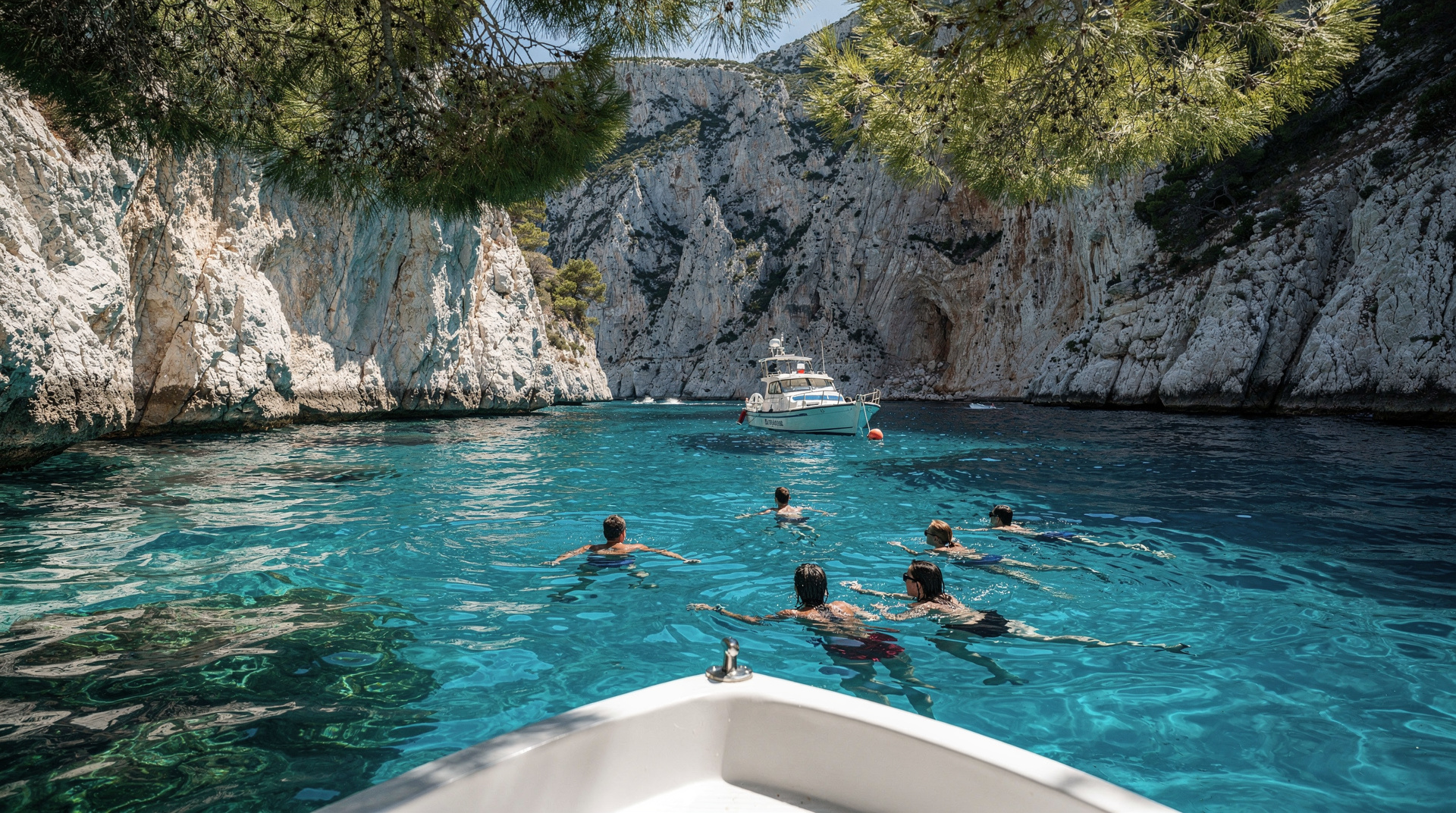
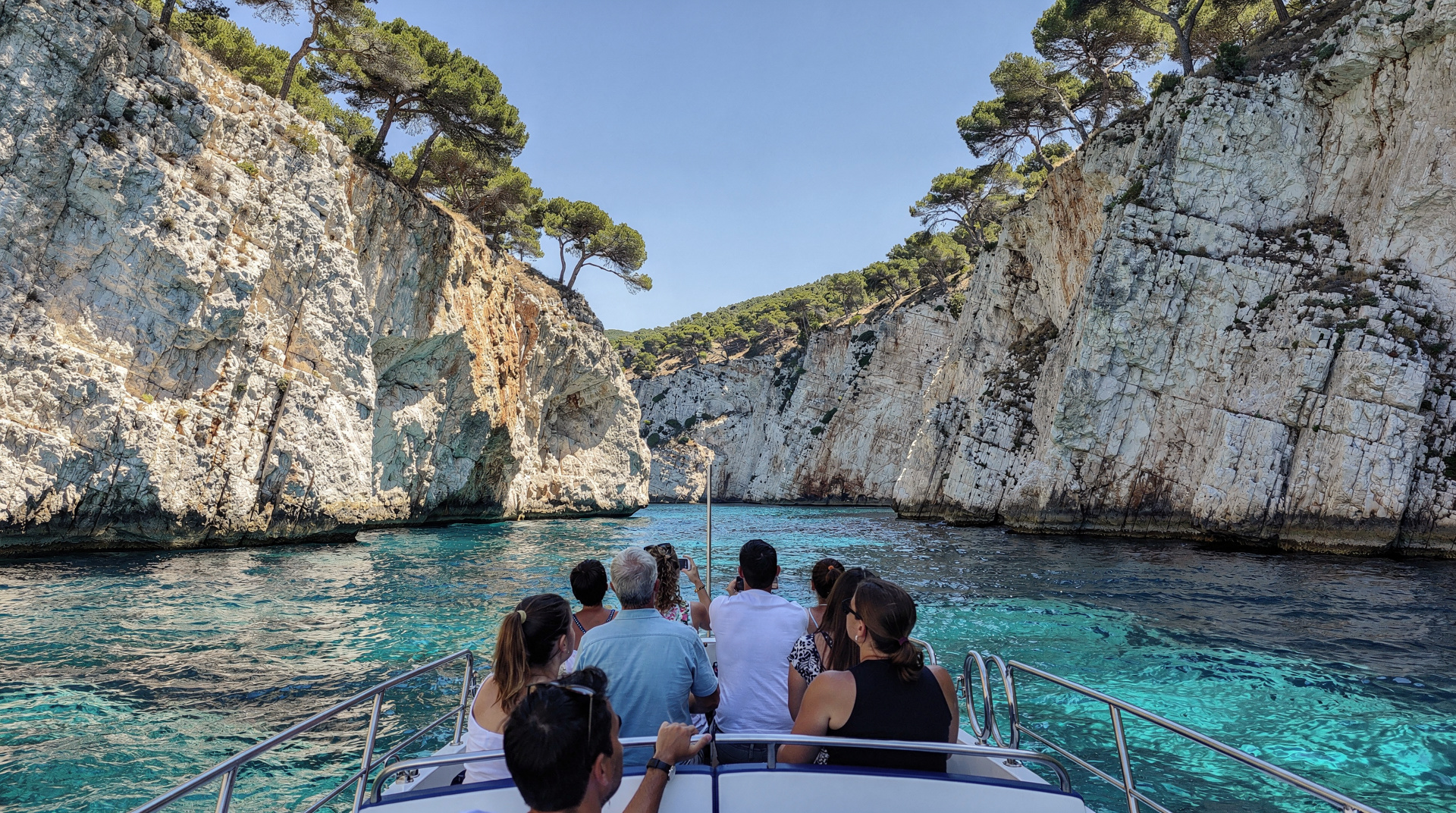
- Boat tour from Vieux-Port: Several operators include Sugiton among their calanque stops. The sea approach — entering the narrow inlet from the water — is a different and arguably more dramatic view than the trail descent. See the boat tour guide.
- Sugiton by kayak: Paddling from Les Goudes or Callelongue to Sugiton is a 2–3 hour trip each way along the coastline. Challenging and genuinely rewarding.
- Visit a Cassis-side calanque instead: Port-Miou, Port-Pin, and En-Vau (via kayak) remain accessible by sea regardless of terrestrial closure conditions. See the En-Vau guide.
The ecology of the Sugiton trail
The walk from Luminy to Sugiton passes through a representative section of Calanques garrigue — the low Mediterranean scrub adapted to thin limestone soil, summer drought, and intense sun. This is not scenic framing for the destination; it is the destination’s ecological context.
Spring wildflowers (April–May): The garrigue plateau shows a succession of flowers. White cistus (Cistus albidus and Cistus monspeliensis) opens simultaneously across wide sections, creating a briefly spectacular carpet of white against the grey-green of the surrounding scrub. Lavender and rosemary are in flower, generating the specific aromatic mix that the Calanques is famous for. Yellow Jerusalem sage (Phlomis fruticosa) along the path edges. Pink helianthemum on the most exposed limestone.
Bird life: The ridge between Luminy and the Sugiton viewpoint is active for raptors. Bonelli’s eagle (Aquila fasciata) is present in the Calanques massif — a medium-large eagle with a dark back and pale, streaked underparts. It has a distinctive fast, direct flight style. Peregrine falcons nest on the cliff faces. The blue rock thrush (Monticola solitarius) is the most commonly seen bird at the cliff edge — the male is a deep steel-blue with no other colour; it perches on exposed rocks and sings from cliff faces.
The limestone itself: The exposed limestone on the path sections shows the characteristic weathering of karst terrain — a network of small channels and pockets called lapiaz (or clint and grike) that form where slightly acidic rainwater dissolves the calcium carbonate. Walking on lapiaz requires attention — the irregular surface catches feet. The white sheen on the rock is partly organic (a thin biofilm of algae and bacteria that colonises the limestone surface) and partly the reflective mineral character of the stone itself.
Planning the Sugiton visit: the complete checklist
Before leaving:
- Check access status at calanques-parcnational.fr (after 18:00 the evening before)
- If June 20–August 30: have your QR code reservation ready on your phone
- Check the weather forecast: temperature, wind, rain
- Pack: 2L water minimum, food for the day, sunscreen, hat, hiking footwear, swimwear, towel, water shoes or fins, dry bag for phone
- Tell someone your planned route and expected return time
At Luminy:
- Arrive early (before 09:00 on weekends April–September)
- Check the trailhead information board for any specific day’s access notes
- Have QR code ready if required (warden checks at the plateau section)
On the trail:
- Monitor your water: you should have at least half your water supply remaining when you reach the viewpoint
- Don’t rush the rope section: take your time, let others ahead of you complete it before you start
- Assess: if it is past 14:00 and you haven’t reached the viewpoint, consider turning back
At the calanque:
- Allow 1.5–2 hours minimum
- Use water shoes at the entry — sea urchins
- Do not swim beyond the calanque mouth in any wind
- Start the return no later than 13:30 in summer
Frequently asked questions about the Sugiton hike
When exactly does the Sugiton reservation open each day?
The booking portal opens at 09:00 CET, 3 days before the target date. If you want to visit on a Saturday, the booking opens on the preceding Wednesday at 09:00. The portal can fill quickly for peak-season weekends — be ready at 09:00 if you have a specific date in mind.
What happens if I have a reservation but the calanque is closed for fire risk?
Your reservation is automatically cancelled. You will receive notification by email. You need to make a new reservation for a different date — the system does not automatically move your booking. Always check the access status at calanques-parcnational.fr on the morning of your visit before travelling to the trailhead.
Is there a direct path from Sugiton to Morgiou?
Yes — a ridge trail connects the two calanques in approximately 45 minutes. The path climbs from Sugiton back up to the plateau and traverses east before descending into Morgiou. This is a more serious undertaking than either calanque visited separately — total day from Luminy including both calanques and the return: 5–6 hours. See the Sormiou and Morgiou hike guide for the full route.
Is the rope section dangerous?
Not for most adults with reasonable fitness and proper footwear. It is a short section (approximately 10 metres of vertical descent) with a fixed rope. The rock is solid. It looks more alarming from above than it is in practice. If you are uncomfortable with exposure or have significant knee problems, the belvedere viewpoint is a valid stopping point.
Can I bring a dog to Sugiton?
Dogs are prohibited in the Calanques National Park on all trails during the summer fire-risk period (approximately June through September). Outside this period, dogs must be on a lead at all times. The park website specifies current restrictions.
Is there shade on the trail?
Minimal. The Luminy plateau section has sparse pine trees providing occasional shade. The descent to the calanque is exposed limestone. Pack a hat and sunscreen regardless of the season. In April and May, morning temperatures make the exposed sections comfortable; from June onward, start before 8:00 to complete the descent before the heat builds.
How does Sugiton compare to Sormiou or En-Vau for a first-timer?
Sugiton is the shortest and most accessible of the three from central Marseille — no car needed, under an hour of walking each way. Sormiou is similar in access but slightly longer and busier with boat traffic; En-Vau, reached from Cassis, has the most dramatic scenery but the longest approach. For a half-day first Calanques hike without a car, Sugiton is the practical starting point — see the which calanque to visit guide for a full comparison.
Combining Sugiton with the rest of your trip
Sugiton fits easily into a wider Calanques plan. If you are still deciding between coves, the best Calanques hikes by difficulty puts the Luminy trail in context, and the general hiking guide covers the basics that apply to every route. Travellers who want to avoid the busiest hours will find useful tactics in avoiding crowds in the Calanques, while the summer access rules explain how the regulated period works across the whole massif.
Starting from a different trailhead is also possible: the Calanques from Luminy guide describes the wider network of paths around the campus. If you would rather compare walking with going by sea, boat or hike lays out the trade-offs, and families can check the kid-friendly Calanques guide before deciding whether the rope section suits them.
Back in the city, the Marseille 3-day planning guide and the Calanques weekend itinerary show where a Sugiton morning can sit in a longer stay. For a quieter coastal alternative on the same side of Marseille, see the Sormiou and Morgiou destination page.
For the full Calanques context — access rules, boat alternatives, and the comparison of all Marseille-side calanques — read the Calanques National Park guide. For the broader summer access picture and fire closure system, see the Calanques hiking safety guide. For planning around Marseille, see Marseille in summer.
Top experiences
Bookable activities with verified prices and instant confirmation on GetYourGuide.