Marseille museums guide: the complete picture
Marseille: MuCEM skip-the-line entry ticket
Which museums in Marseille are worth visiting?
MuCEM is the standout — don't skip it for anything else. After MuCEM: Cosquer Méditerranée (cave replica, EUR 18), Musée d'Histoire de Marseille (Roman port, free), Vieille Charité (free permanent collections), and Cantini (modern art, free permanent). The City Pass (EUR 24/48h) covers MuCEM plus public transport.
Marseille’s museum landscape: better than the reputation suggests
For a long time, Marseille’s museums were the city’s best-kept secret — not because they were hidden, but because the city’s reputation as a destination of sun, sea, and port had crowded out everything else. The 2013 European Capital of Culture year changed that in a structural way: the MuCEM opened, the FRAC got its Kengo Kuma building, the Villa Méditerranée arrived, and the city’s existing museums began to receive the attention they had long deserved.
What Marseille has now is a museum landscape of genuine depth across different disciplines: Mediterranean civilisations (MuCEM), modern and contemporary art (Cantini, MAC), fine arts (Longchamp), Greco-Roman antiquities and city archaeology (Musée d’Histoire), folk devotion and colonial-era collections (Vieille Charité), prehistoric cave art (Cosquer Méditerranée), and the soap and industrial heritage of the city itself.
The outstanding fact is this: most of the permanent collections are free. Marseille operates a city-wide free permanent collection policy across its municipal museums. You can spend a full day in serious museum visits for the cost of a MuCEM ticket and lunch.
| At a glance | |
|---|---|
| Where | Mostly within walking distance of the Vieux-Port or Joliette |
| Cost | Free permanent collections at most municipal museums; MuCEM around EUR 11, Cosquer around EUR 18 |
| Time needed | Half a day for MuCEM alone; 2–3 days for a full museum circuit |
| Getting there | Métro M1/M2 (see our metro guide) |
| Best time | Weekday mornings; free-Sunday crowds are heaviest around midday |
Comparing Marseille’s key museums
| Museum | Entry (permanent collection) | Time to allow | Best for |
|---|---|---|---|
| MuCEM | Around EUR 11, free first Sunday | 2–3 hours | Architecture + Mediterranean culture, first-timers |
| Cosquer Méditerranée | Around EUR 18 | 2 hours | Prehistoric art, families with older children |
| Musée d’Histoire de Marseille | Free | 1.5 hours | Roman archaeology, history-minded visitors |
| Vieille Charité (MAM/MAAOA) | Free | 1–1.5 hours | Antiquities, Egyptian collection, Le Panier combination |
| Cantini | Free (paid for major temporary shows) | 1 hour | Modern/Surrealist art |
| Palais Longchamp | Around EUR 5 | 1 hour | 19th-century painting, the building and fountains themselves |
Museum days that overlap with the rest of your trip
Museum time doesn’t need to compete with the rest of a Marseille visit — several sit directly on routes you’ll already be walking. MuCEM and Cosquer share the J4 esplanade with the Le Panier approach; the Vieille Charité sits inside Le Panier itself, so a morning museum visit and a neighbourhood wander are the same walk. If you’re building a multi-day itinerary, our three-day Marseille itinerary sequences the major museums against the rest of the city, and the 3-day planning guide goes deeper on pacing.
MuCEM: the one you cannot skip
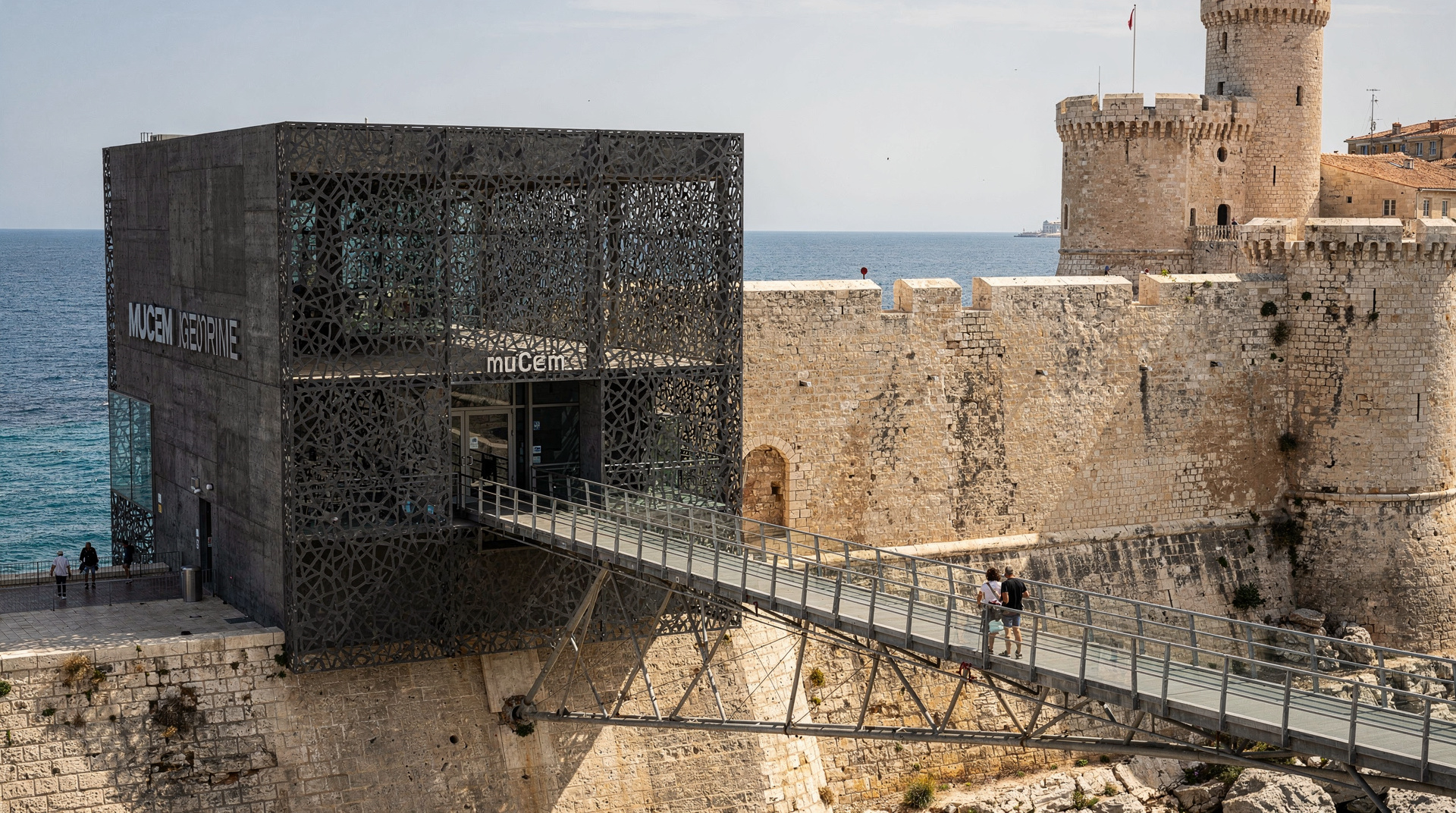
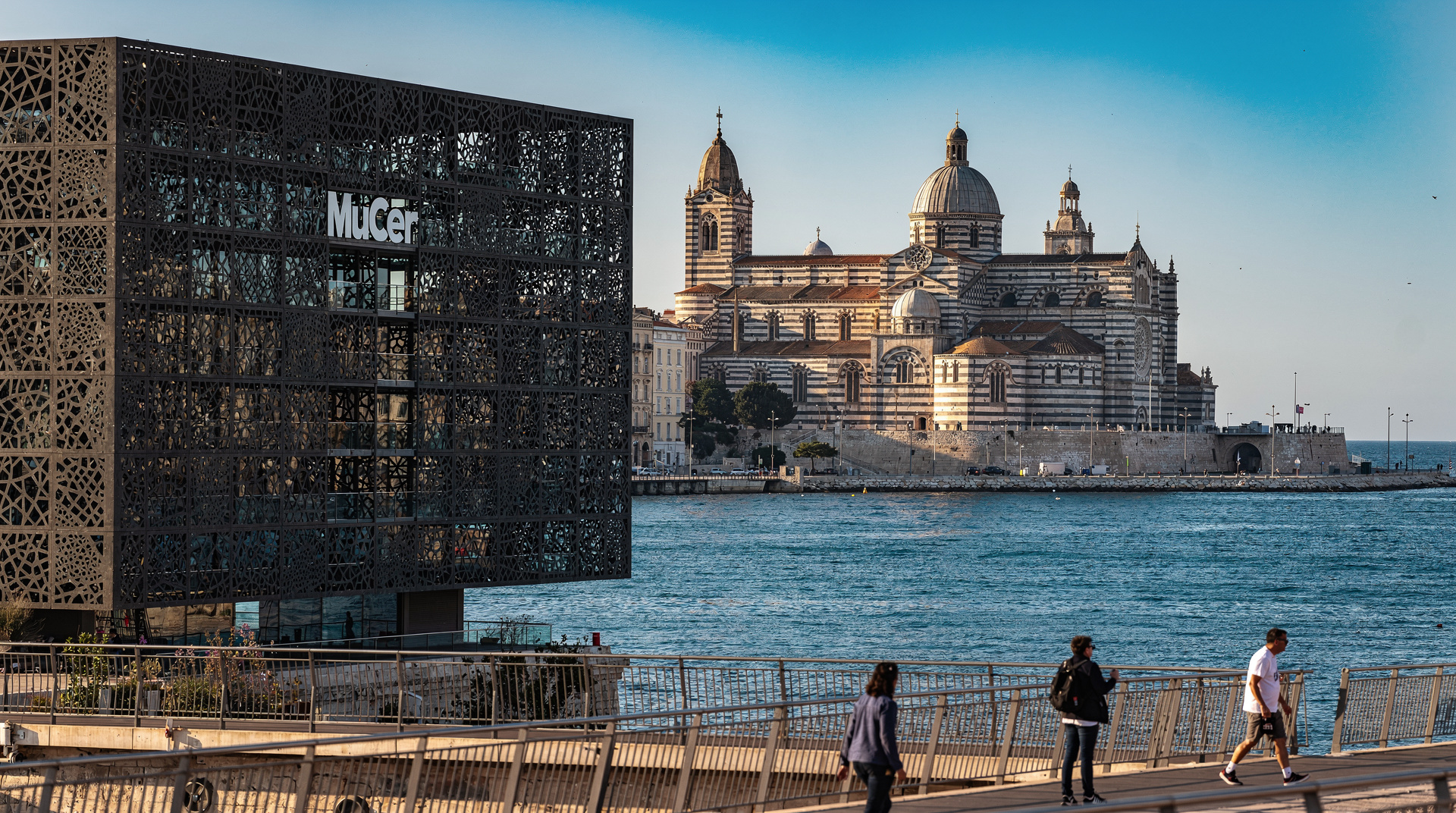
The Musée des Civilisations de l’Europe et de la Méditerranée, housed in Rudy Ricciotti’s laser-cut concrete lattice building on the J4 waterfront, is the flagship and the benchmark. The building is extraordinary; the permanent Galerie de la Méditerranée is ambitious and genuinely engaging; the temporary exhibitions are among the most thoughtfully curated in France outside Paris.
Entry: EUR 11 full, EUR 7.50 reduced. Free first Sunday of the month. Family ticket EUR 18. Hours: Wed–Mon 11:00–19:00 (summer 10:00–20:00). Closed Tuesdays. What not to miss: The fort gardens and footbridge are free. The rooftop terrace view. The ex-votos section of the permanent collection. Book ahead: Essential in July–August. The GYG skip-the-line ticket saves 30–45 minutes of queuing.
For the complete MuCEM guide, see our dedicated MuCEM guide.
Cosquer Méditerranée: the cave replica at Villa Méditerranée
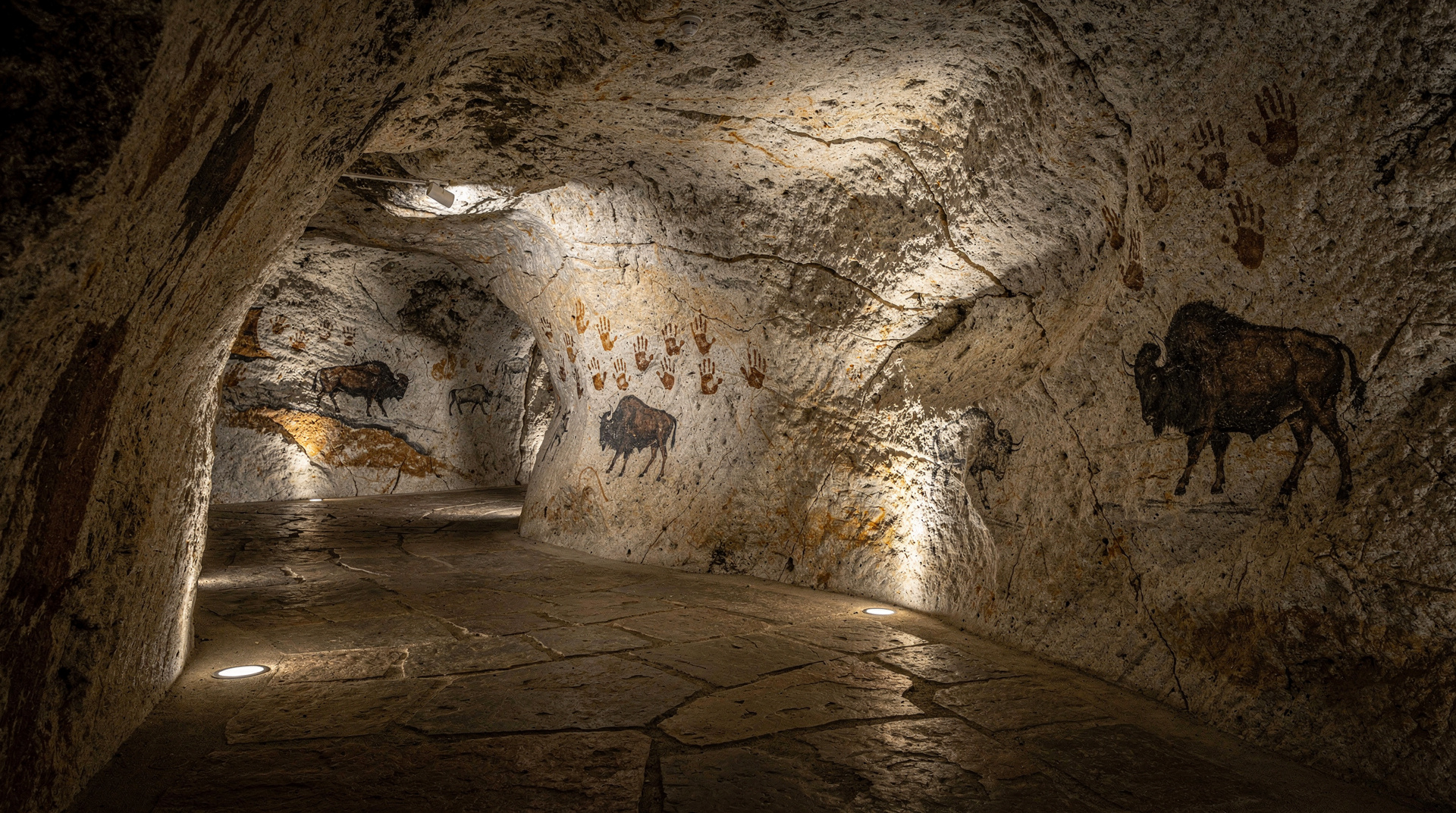
The original Cosquer Cave — discovered in 1985 by diver Henri Cosquer — is a Paleolithic site containing some of the oldest cave paintings in the world, created approximately 27,000 years ago. The entrance is now 37 metres underwater in the Cap Morgiou cliff face, reachable only by expert divers and inaccessible to visitors.
The Cosquer Méditerranée at the Villa Méditerranée next door to MuCEM is a full-scale facsimile — one of the most technically impressive cave replica projects in Europe. The reproduction includes some 500 engravings and paintings: horses, bison, ibex, deer, auks (seabirds), hand stencils, and geometric forms. The surrounding exhibition explains the original cave’s formation, the Paleolithic world of its creators, and the impact of rising sea levels that submerged the entrance around 10,000 BCE.
Entry (2026): EUR 18 adult, EUR 11 ages 10–17, EUR 6 ages 6–9, free under 6. The visit lasts approximately 2 hours including the cave replica and the surrounding Méditerranée gallery spaces.
Book in advance. Capacity is strictly limited and the site sells out weeks ahead in July and August. This is not a venue where you should expect to arrive and buy tickets on the day during summer.
Practical note: The Villa Méditerranée building is immediately adjacent to MuCEM — same esplanade, same J4 approach. Combining both in a single half-day is practical but genuinely tiring: MuCEM alone is 2–3 hours of serious museum time. Most visitors do better to dedicate separate half-days to each.
For the full Cosquer guide, see our Cosquer Méditerranée guide.
Musée d’Histoire de Marseille: the Roman port beneath the shopping centre
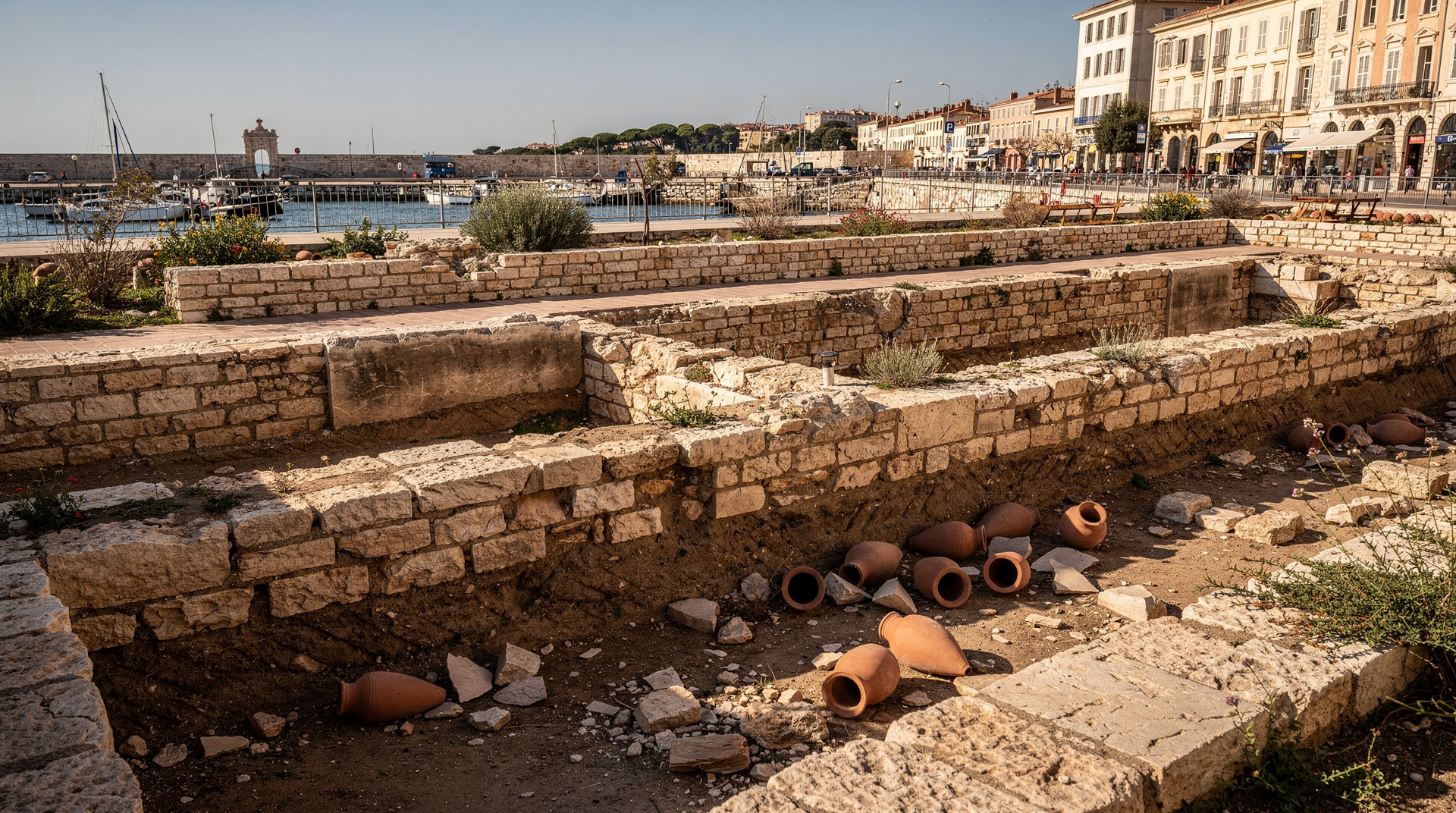
This is the museum with the most improbable setting in France. The Musée d’Histoire de Marseille is embedded inside the Centre Bourse shopping centre — take the escalators down through the ground floor retail and descend into what is, unexpectedly, one of the most important urban archaeology museums in southern France.
The museum sits directly above the excavations of the ancient Greek and Roman port of Massalia. Glass floors allow you to look down into the original harbourside: wooden dock pilings preserved in their original positions, the outlines of ancient warehouses, and — the centrepiece — the remains of a Roman merchant ship from the 3rd century CE, found during the shopping centre’s construction in 1967 and preserved in its entirety in a climate-controlled environment.
Entry: Free for the permanent collection. Temporary exhibitions may have admission charges. Hours: Tue–Sun 9:00–18:00. Closed Mondays. Worth it? Yes. The Roman ship alone is remarkable. The broader exhibition on Marseille from the Greek founding (~600 BCE) to the present is historically thorough, though the display design is somewhat dated. Allow 1.5 hours.
For the historical context of what the museum covers, see our Marseille history guide.
Centre de la Vieille Charité: Le Panier’s architectural centrepiece
The Vieille Charité is one of the finest 17th-century civic buildings in France. Architect Pierre Puget designed it in the 1670s as a hospice for Marseille’s poor population — a vast three-storey complex of arcaded pink Cassis stone surrounding a central courtyard with an oval-domed baroque chapel. It was used as a hospice, then as military barracks, and only restored to its current cultural use in the 1980s.
Today it houses:
- Musée d’Archéologie Méditerranéenne (MAM): One of the most important regional collections of Greco-Roman, Egyptian, and Near Eastern antiquities in France. The Egyptian collection is particularly strong, with mummies, canopic jars, and a substantial collection of objects from Roman-era Egypt. Free entry.
- Musée des Arts Africains, Océaniens et Amérindiens (MAAOA): A collection of African, Oceanic, and pre-Columbian American objects that was one of the most significant in France when assembled and remains historically important. Free entry.
- Temporary exhibitions: Variable admission; check the current programme.
Hours: Tue–Sun 9:00–18:00. Closed Mondays.
Honest verdict: If you only have time for one site and are choosing between Vieille Charité and MuCEM, choose MuCEM — it is more ambitious, more contemporary, and more directly relevant to Marseille. But the Vieille Charité courtyard alone is worth the walk through Le Panier to see it. The MAM Egyptian collection is excellent. The building is extraordinary.
The Vieille Charité is in Le Panier, 10 minutes uphill from the Vieux-Port. Combine it with a broader Le Panier walk and the MuCEM on the same morning.
Musée Cantini: modern art in the 6th
The Musée Cantini occupies a 17th-century baroque mansion in the 6th arrondissement — a neighbourhood of wide bourgeois boulevards south of the Vieux-Port. Its permanent collection covers modern and contemporary art from the early 20th century onward, with particular strength in Surrealism, Art Informel, and post-war French art. The Cantini has historical ties to the Surrealist movement: during WWII, Marseille was a refuge for artists and intellectuals fleeing occupied Europe, and the Cantini collection reflects that moment.
Current 2026 exhibition: From May 2026, the museum presents a major Alberto Giacometti retrospective — the first monographic show of Giacometti’s work in Marseille, organised in collaboration with the Fondation Giacometti in Paris.
Entry: Free for the permanent collection. Temporary exhibitions have variable admission (EUR 6 reduced, EUR 9 or EUR 12 full price depending on exhibition tier). Free first Sunday of the month. Hours: Tue–Sun 10:00–18:00. Closed Mondays. Location: 19 Rue Grignan, 6th arrondissement. Easy walk from the Vieux-Port or métro Estrangin-Préfecture (M1).
Musée des Beaux-Arts at the Palais Longchamp
The Palais Longchamp is one of Marseille’s most spectacular 19th-century buildings — a theatrical fountained complex built between 1862 and 1869 at the terminus of a water canal that supplied the city from the Durance river. The two curved wings house the Musée des Beaux-Arts on one side and the Muséum d’Histoire Naturelle on the other; a central cascade waterfall feeds the ornamental basin below.
The Beaux-Arts collection covers painting and sculpture from the 16th to 19th centuries, with an emphasis on Flemish masters, Italian baroque, and French academic art. It is not a world-class collection but it has genuine quality and the building is extraordinary.
Entry: EUR 5 full, EUR 3 reduced. Combined ticket with the Muséum d’Histoire Naturelle: EUR 9 / EUR 6. Free for the permanent collection first Sunday of the month. Hours: Tue–Sun 10:00–18:00. Closed Mondays. Getting there: Métro Cinq-Avenues – Longchamp (M1), or Tramway T1 Longchamp.
Honest verdict: The Longchamp palace is worth visiting for the building and its setting. The collection is solid but secondary. Come here if you are interested in 17th–19th century painting, if you want to combine with the natural history museum, or if the Palais Longchamp neighbourhood is already on your route.
Musée d’Art Contemporain (MAC): contemporary art on the Prado
The MAC — Marseille’s dedicated contemporary art museum — occupies a purpose-built space near the Prado beaches in the south of the city. Its permanent collection covers French and international contemporary art from the 1960s onward, with a strong showing of Arte Povera, Nouveau Réalisme, and support-surface painting. The MAC has been a significant institution in French contemporary art for decades.
Entry: Variable; check the MAC website for current exhibition pricing. Location: 69 Avenue d’Haïfa, 8th arrondissement. Take bus 23 from the Vieux-Port.
Honest positioning: The MAC is worth visiting for visitors specifically interested in contemporary art and willing to make the journey to the southern arrondissements. For most first-time visitors, the priority order would be MuCEM → Cantini → MAC.
MuSaMa: the Marseille soap museum
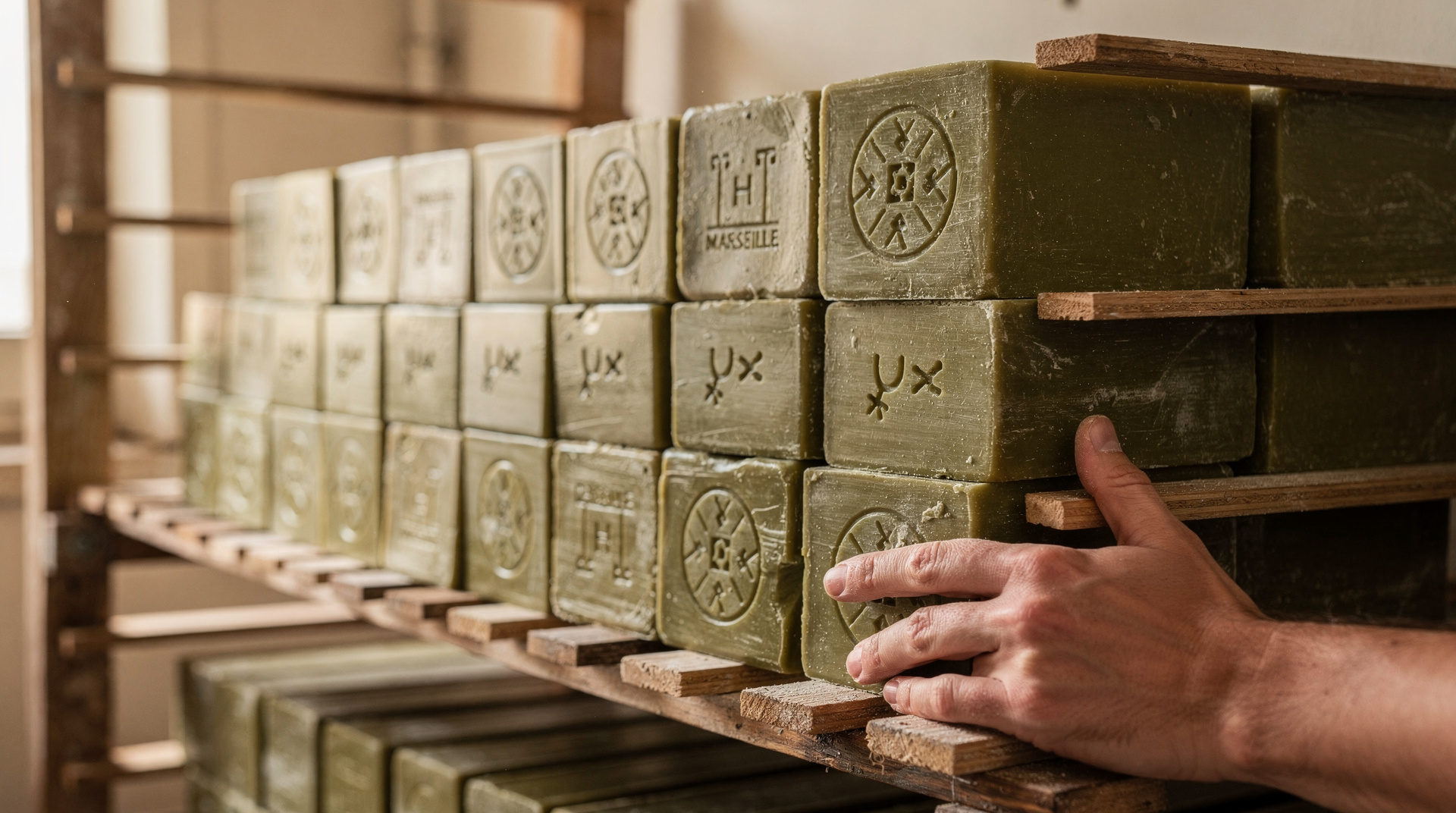
The MuSaMa (Musée du Savon de Marseille) in Le Panier offers a focused experience on the history and craft of savon de Marseille — the traditional vegetable-oil soap whose production in Marseille was codified by royal decree in 1688. The museum covers the chemistry and history of the soap industry, which employed thousands in Marseille at its 19th-century peak, and combines the educational visit with a hands-on soap workshop where visitors make a bar of traditional soap.
Entry: Paid; check the GYG link above for current pricing and workshop availability. Location: Le Panier district. Worth it? If you have children in the 8–14 range, or if you are genuinely interested in the industrial and artisan history of Marseille, yes. As a souvenir experience, it is one of the better ones in the city — you leave with something you made.
The Marseille City Pass: when it makes sense
The Marseille City Pass is offered for 24, 48, and 72 hours at EUR 24, EUR 31, and EUR 39 respectively. It includes:
- MuCEM entry
- Unlimited public transport (métro, tram, bus)
- Hop-on hop-off colorbüs circuit
- Boat trip to Château d’If or the Frioul Islands
- Tourist petit train circuit
- Various discounts and offers
Is it worth buying? For a 48- or 72-hour visit where you plan to use public transport extensively, visit MuCEM, and take the Frioul/Château d’If ferry, yes — the combined value of those individual purchases exceeds EUR 31–39 comfortably.
For a single day or visitors who intend to walk everywhere, it is less clear — calculate the individual costs of what you actually plan to do before buying. Buy it via the GYG link above for convenience.
Museum strategy for different visit lengths
One full day in Marseille: Start with MuCEM (3 hours including the fort gardens). Afternoon: your choice of Vieille Charité (in Le Panier, which you will pass through) or Cosquer Méditerranée (adjacent to MuCEM if you book ahead). Both the same day as MuCEM is genuinely tiring — prioritise over two days if possible.
Two to three days: Day 1: MuCEM + Fort Saint-Jean + Cosquer (if booked). Day 2: Le Panier (Vieille Charité) + Musée d’Histoire de Marseille. Day 3: Day trip (Arles, Aix, or the Calanques) or Cantini + Longchamp if you want more museum time.
Focused museum visit: If culture is your primary reason for being in Marseille, the above two-to-three-day structure covers the city’s best cultural institutions at a pace that allows genuine engagement with each. Book Cosquer Méditerranée well in advance whatever your plan.
For the broader cultural landscape of the city and the history that connects everything you will see, read our Marseille history guide before you go. For architecture specifically — MuCEM in its urban context — see our Marseille architecture guide. Getting between museums is straightforward on the métro — see our metro guide for the relevant stations.
Frequently asked questions about Marseille museums guide
Which Marseille museum should I prioritise if I only have time for one?
MuCEM, without question. It is the most architecturally extraordinary, the most intellectually ambitious, and the most relevant to understanding the city you are in. EUR 11 full price, free on the first Sunday of the month.What is covered by the Marseille City Pass?
The Marseille City Pass (EUR 24 for 24h, EUR 31 for 48h, EUR 39 for 72h) includes MuCEM entry, unlimited public transport, the hop-on hop-off bus circuit, a boat trip to Château d'If or the Frioul Islands, and the tourist petit train circuit. It is worth buying for a 2–3 day visit that includes MuCEM and the Frioul ferry.Are any Marseille museums free?
The permanent collections at Musée d'Histoire de Marseille, Musée Cantini, Musée des Beaux-Arts (Longchamp), Vieille Charité, and the Musée des Arts Africains are all free year-round. MuCEM is free on the first Sunday of the month. The Cosquer cave replica and temporary exhibitions at most city museums have admission charges.Is the Vieille Charité worth visiting?
The building — a 17th-century hospice with a beautiful arcaded courtyard in pink Cassis stone — is worth seeing regardless of the exhibitions. The free permanent collections (Mediterranean archaeology, African and Oceanic arts) are solid. If you are choosing between Vieille Charité and MuCEM with limited time, choose MuCEM.What is the Musée d'Histoire de Marseille?
Marseille's city history museum, located inside the Centre Bourse shopping centre — which feels incongruous but the museum itself is excellent. It sits above genuine Greco-Roman port excavations visible through glass floors, including the remains of a 3rd-century Roman merchant ship. Free entry for the permanent collection.Do I need to book Marseille museum tickets in advance?
For MuCEM and Cosquer Méditerranée, yes — especially July and August, when both can sell out days ahead. The free permanent-collection museums (Musée d'Histoire, Vieille Charité, Cantini, Longchamp) rarely need advance booking outside a major temporary exhibition opening.How much time should I budget for Marseille's museums overall?
MuCEM alone deserves half a day (2–3 hours plus the fort gardens). A realistic museum-focused visit is two to three days if you want MuCEM, Cosquer, Vieille Charité, and the Musée d'Histoire without rushing any of them.
Top experiences
Bookable activities with verified prices and instant confirmation on GetYourGuide.