Marseille pickpocket zones: the honest map for tourists
Marseille: guided tour in the heart of the city
Where do pickpockets operate in Marseille?
The five main hotspots are the Vieux-Port fish market (morning), Saint-Charles station steps, the Noailles market streets, the metro M1/M2 at door-closing moments, and the Vieux-Port on OM match evenings. The fish market at 08:00–10:00 is the single highest-density theft zone in the tourist circuit.
Why this guide exists
Most travel safety guides are vague — “be careful in crowded areas,” “keep your bag close.” This guide is specific. It names the locations, describes the techniques, and explains the counter-measures. The goal is to give you the same mental map that a Marseillais would have — not to frighten you, but to make you a harder target.
Marseille is not exceptionally dangerous for tourists. But it does have specific pickpocket hotspots that are predictable, consistent year after year, and manageable if you know where they are. The five zones below cover the vast majority of reported tourist theft incidents in the city.
At a glance
| Where | Fish market, Saint-Charles station steps, Noailles market, metro M1/M2, Vieux-Port on OM match evenings |
| Risk level | Low for violent crime, moderate for opportunistic theft in the five zones above |
| Time needed | A few minutes to read; the habits become automatic after your first day |
| Getting there | All five zones sit on or near the M1/M2 metro lines |
| Best time to be extra alert | Fish market 08:00–10:30; market/station peak hours; any OM home match evening |
Zone 1: The Vieux-Port fish market — 08:00 to 10:30
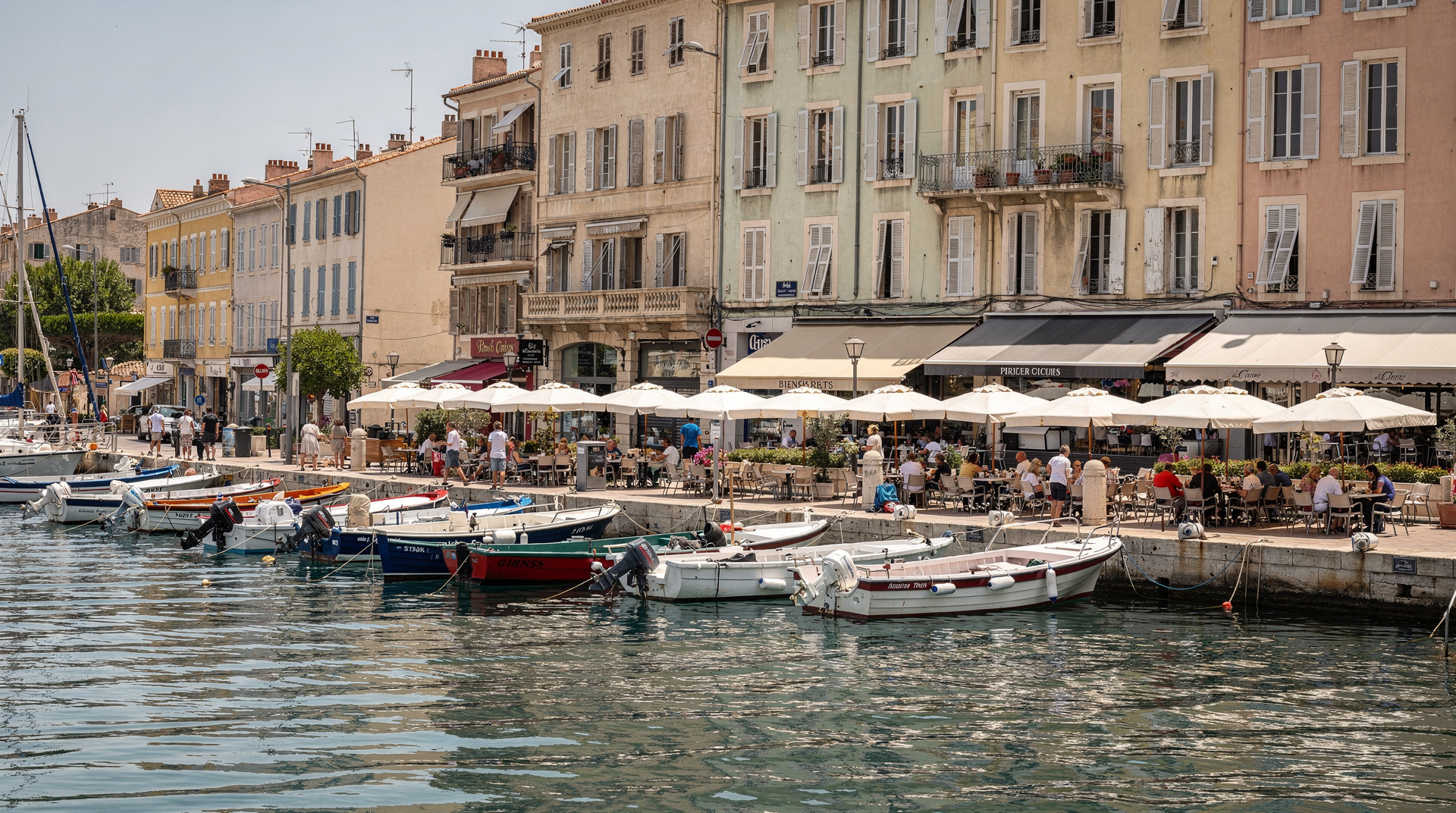
The fish market on the Quai des Belges is Marseille’s most photogenic morning activity. It is also the single highest-risk pickpocket zone in the tourist circuit. The combination of factors is near-perfect for theft: a very dense crowd, tourists holding phones aloft for photos, bags left open or dangling, and a lot of distraction from the sensory spectacle of live fish, shouting vendors, and locals moving with purpose.
How the technique works here: Most incidents at the fish market are classic two-person operations. One person creates a brief contact point — a question, a friendly comment about the fish, a brush past you — while a partner in the crush accesses your bag, back pocket, or dangling camera strap. The contact person moves on. The partner has already gone. You may not notice until 20 minutes later when you go to pay for coffee.
Counter-measures for the fish market:
- Wear your bag in front of your body, zipped closed, with your hand resting on it
- Keep your phone in an internal pocket; take photos by removing it briefly and returning it immediately, not by holding it at arm’s length for extended periods
- Do not carry a backpack with external pockets — or turn it to the front in dense sections
- Keep your wallet in a front trouser pocket or a security pouch under your clothing, not in your back pocket or an open bag
The fish market is worth visiting despite this — arrive between 08:00 and 09:00 for the best atmosphere, and simply apply these habits automatically.
The market sits at the heart of the harbour, so it pairs naturally with a slower look around the rest of the waterfront. Our Vieux-Port area guide and the Vieux-Port destination page cover what else is nearby, and walking on to Le Panier afterwards takes you into quieter streets where the crush of the market is behind you.
Zone 2: Saint-Charles station and the approach steps
The grand neoclassical staircase descending from Gare Saint-Charles to Boulevard d’Athènes is one of the most photographed views in Marseille. It is also where many visitors are most vulnerable, for a simple reason: people are arriving in a new city, carrying luggage, often with phones out for navigation or maps, and in a slightly disoriented state.
The approach zone extends beyond the steps. The streets immediately around Saint-Charles — particularly heading southwest toward the Belsunce neighbourhood along Boulevard d’Athènes and its side streets — are a consistent area of opportunistic theft. The concentration of new arrivals, the proximity to the Noailles market, and the volume of foot traffic creates conditions that favour working thieves.
Specific techniques at the station:
- Luggage-handling offers: someone helps you with your bag onto the escalator or steps and then walks briskly away with it. Never accept handling from a stranger who approaches you.
- Stationary distraction: you stop to check directions; someone approaches with a question; a second person accesses your bag.
- Phone navigation grab: your phone is visible at chest or face height while you navigate; a person running past takes it. This is the fastest technique and requires least accomplice coordination.
Counter-measures for the station:
- Download an offline map (Google Maps or Maps.me) before you travel so your phone is in your pocket and you consult it briefly rather than holding it continuously
- Keep luggage between your feet or between your legs when stationary — not beside you or behind you
- If you need to consult your phone or a printed map, step to the side of pedestrian flow and face a wall so your back and bag are not exposed
- On the steps themselves, keep a hand on your bag and move purposefully
If you are arriving by air rather than by train, the same arrival-day habits apply on the way into town; our airport to city guide explains the connection, and the guide to getting around Marseille helps you decide how to continue from the station once you have your bearings. Travellers coming in on the fast train from the capital will find the Paris to Marseille TGV guide useful for planning the arrival itself, so that you step onto the station steps with a destination already fixed rather than stopping to work it out in the crowd.
Zone 3: Noailles market — peak hours
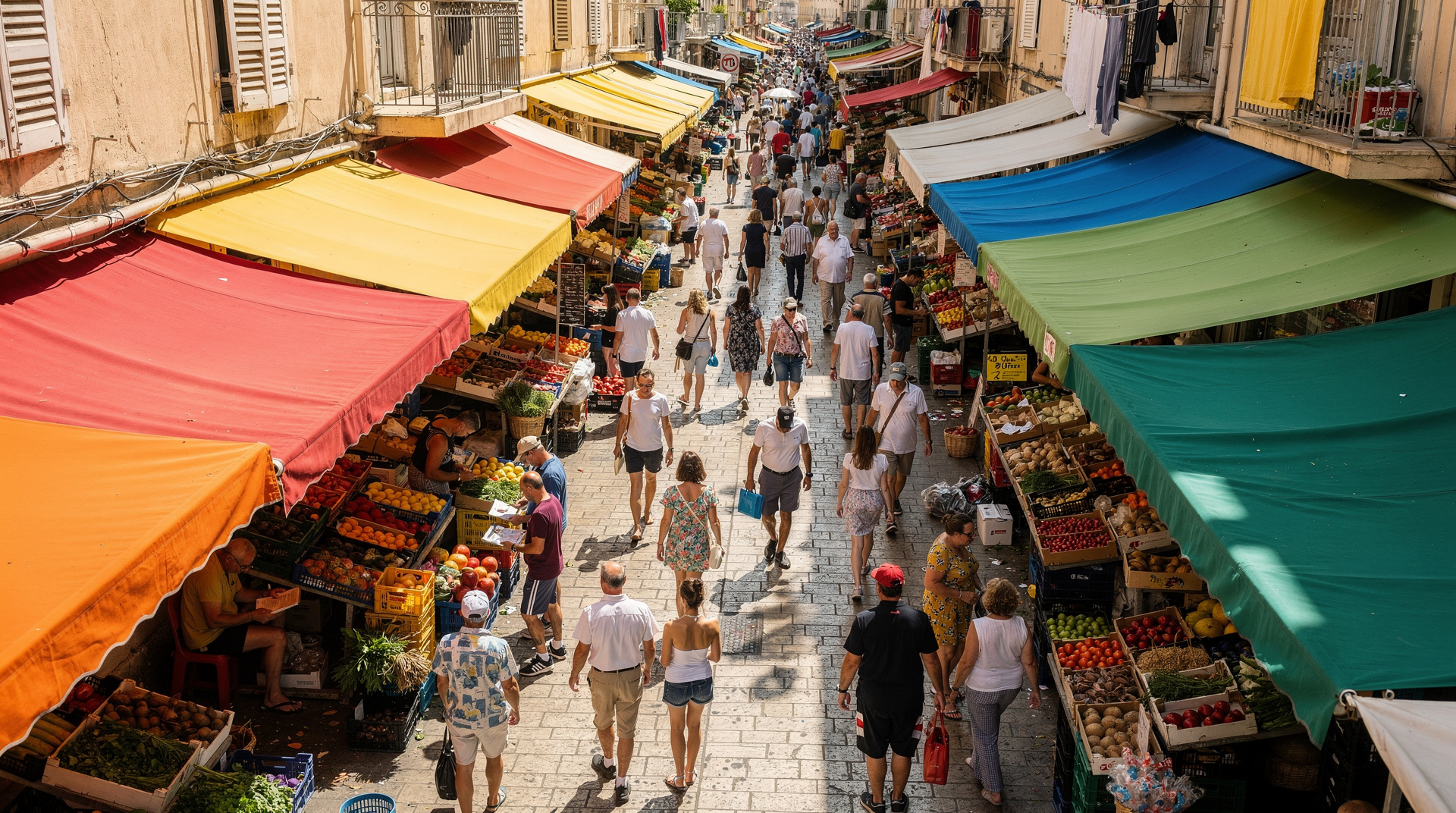
The Noailles area — the streets fanning out from the Marché des Capucins and the Rue Longue des Capucines — is the most ethnically mixed, vibrant, and densely peopled market zone in Marseille. It is a genuinely interesting place to spend an hour: the food is cheaper and more varied than anywhere in the tourist zone, and the atmosphere is emphatically not performing for visitors.
It is also, at peak hours (09:00–13:00 on weekdays, all morning on Saturdays), extremely crowded and a consistent pickpocket zone.
How it works in Noailles: The density of the crowd is the mechanism. There is no space to maintain the normal protective distance from strangers. In that density, a skilled pickpocket can access a bag or back pocket without any of the conventional distraction techniques — simply by being close enough. Shoulder bags with flap closures (not zips) are particularly vulnerable; backpacks turned to the back are highly exposed.
Counter-measures for Noailles:
- Zip all bags before entering market streets; hold your bag in front of you
- Leave most cash and all cards back at the accommodation; carry only what you need for market shopping in a front pocket
- Be aware of anyone who bumps into you — this is sometimes accidental (the crowd is genuinely dense) and sometimes deliberate. If someone bumps you and immediately starts apologising and checking if you are okay, check your own pockets while the conversation happens.
The Noailles market is recommended in our markets guide and genuinely worth visiting. The precautions above are straightforward once you understand the environment.
Zone 4: Metro M1 and M2 — the door-closing technique
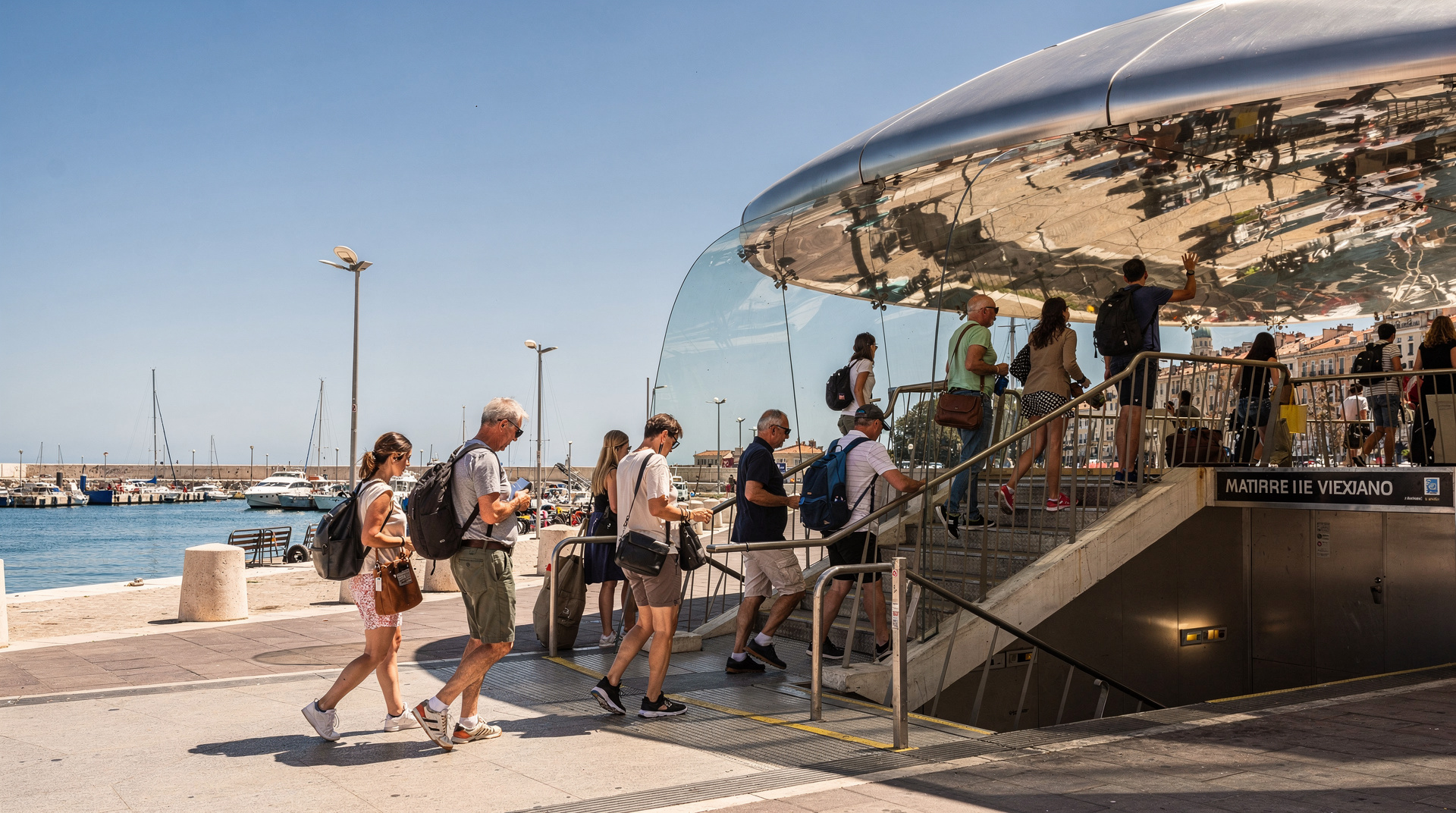
The Marseille metro is used by tourists primarily on M1 (Vieux-Port/Vieux-Port to Noailles, Saint-Charles, and Castellane) and M2 (Joliette, the ferry terminal area). It is efficient and straightforward. It is also the most commonly reported pickpocket environment in the city, with a specific technique that is worth understanding in detail because it is very predictable.
The door-closing technique: As the metro stops at a station, the doors open. Just before they close again, a person boards quickly beside you — typically pressing close in a way that feels like they are simply trying to fit on a busy train. At the exact moment the doors begin to close, they extract a phone from your jacket pocket, a wallet from your back pocket, or reach into an open crossbody bag. They step off as the doors close. You are on the moving train; they are on the platform.
This technique works specifically because of the brief, legitimate-seeming contact at door-closing time, and because the thief is gone before you can follow. It is reported consistently on M1 between Vieux-Port and Saint-Charles, and on M2 between Joliette and the Noailles/Belsunce–Charles Hamburger area.
Counter-measures on the metro:
- Put all valuables in zipped internal pockets before boarding — not in accessible jacket pockets, not in back trouser pockets
- If you have a crossbody bag, hold the bag body against your stomach while the train is loading
- Stand away from the doors during boarding; let people board around you and then position yourself in the middle of the carriage
- Trust the uncomfortable feeling if someone is pressing closer than the carriage density requires — step to the side; a genuinely crowding passenger will adjust, while one working a door-closing technique will follow your movement
The metro is useful and generally safe — the precautions are simple behavioural habits that become automatic after the first one or two rides.
Zone 5: Vieux-Port on OM match evenings
When Olympique de Marseille plays a home match at the Orange Vélodrome, the Vieux-Port fills with fans in a state of collective excitement. The pre-match gathering on the quais, and the post-match dispersion, creates conditions — very high crowd density, people in an emotionally activated state paying attention to each other and their phones rather than their bags — that favour opportunistic theft.
This is different from the other zones in one key way: it is intermittent and predictable. Check OM’s home match calendar (available via the official OM website) before your trip. If you are at the Vieux-Port on a match evening, apply the same precautions as for the fish market: bag zipped and in front, phone in a pocket.
The match-day Vieux-Port is also genuinely interesting to experience, even if you are not a football fan. The collective identity that OM activates in Marseille is a real part of the city’s character. Just be aware of your bag.
The stadium itself has its own page in the Stade Vélodrome destination guide, and the Marseille events calendar is a good place to see what else is happening in town during your dates, since big events of any kind bring the same crowd conditions.
Planning your trip around the hotspots
Knowing the five zones is most useful when you build it into your itinerary rather than treating it as a separate checklist. If you are still deciding how long to stay, the how many days in Marseille guide helps you size the trip, and the first-timers guide gives the wider orientation that this page deliberately leaves out. Visitors who prefer a ready-made structure can follow the Marseille in one day itinerary or the longer three-day itinerary and simply apply the habits above at the moments they pass through a hotspot.
Choosing where to sleep also changes your exposure. Staying close to a calmer area means fewer late walks through crowded streets, and the where to stay in Marseille guide compares the options. For a reading of how the city feels once you are settled in, the blog post first impressions of Marseille and the hidden gems of Marseille both show the quieter side of the city, away from the hotspots, while 25 things to know before visiting Marseille collects practical advice in the same spirit as this page.
What to carry — a practical kit
The most effective precautions:
A zipped crossbody bag worn across your body with the bag in front is the single most effective anti-pickpocket measure. The zip must close fully. Flap-only closures do not protect against skilled access in a crowd.
A money belt or neck pouch worn under your clothing is effective for passports, large amounts of cash, and backup cards. It is slightly inconvenient (you cannot access it in public without lifting your shirt) but eliminates the risk entirely for the items inside.
Splitting your cash: Carry only the cash you need for the immediate activity. Keep most of it in your accommodation. If you are pickpocketed, losing EUR 40 in your bag is manageable; losing EUR 200 and all your cards is not.
Phone habits: The specific habit of returning your phone to a zipped pocket immediately after each use — rather than holding it loosely or putting it in an outer jacket pocket — dramatically reduces phone theft risk. This applies everywhere in the city, not just in the hotspot zones.
What to do if you are pickpocketed
Report it. The nearest commissariat de police for most tourist-zone incidents is at 2 Rue Antoine Becker, 1st arrondissement, near the Vieux-Port. You will need to file a main courante (written report) for any insurance claim. Bring your passport.
Cancel cards immediately. French banks: call the number on the back of your card or use your bank’s app. Inform your home bank if foreign-issued cards are affected.
Assess what was taken. Passport theft is the most disruptive — contact your country’s consulate in Marseille or Aix-en-Provence for emergency travel document assistance.
For the broader safety picture — neighbourhood safety, night-time recommendations, and what the crime statistics actually mean — see our full safety guide. For the other tourist traps that are less about crime and more about being overcharged, see the tourist traps guide.
Zones where the risk is genuinely low
Not every crowded place in Marseille is a pickpocket zone. The Corniche walk, Vallon des Auffes, Notre-Dame de la Garde, and the interior of MuCEM are all busy with tourists but do not feature in reported theft patterns the way the five zones above do — there simply isn’t the same combination of density, distraction, and easy escape routes. Ordinary awareness is enough in these places; you do not need the heightened precautions described above. If you are weighing which neighbourhoods feel comfortable to walk generally, our neighbourhoods guide and safety guide cover that ground separately from pickpocket risk specifically.
Insurance and documentation
If you are travelling with valuables worth protecting, check your travel insurance policy’s theft clause before your trip — most require the police main courante filed within 24 hours and a list of stolen items with approximate values. Photographing your passport, cards, and any expensive electronics before you leave home makes both the police report and any insurance claim faster to file. This is a five-minute task worth doing before you land, not after something goes missing.
Frequently asked questions about Marseille pickpocket zones
Is pickpocketing common in Marseille?
More common than in most French cities, particularly in the five zones mapped here. Most incidents involve distraction followed by a swift extraction from an accessible bag or back pocket. The technique is predictable, which is why it is preventable. A zipped crossbody or money belt eliminates most risk entirely.What is the most common pickpocket technique in Marseille?
The most common is distract-and-grab: someone engages you briefly — asking for directions, offering a friendship bracelet, holding out a petition — while a partner reaches into your bag or back pocket. The second most common is the metro door technique: extraction at the exact moment doors close, so the person exits and you cannot follow. Both rely on open, accessible bags and phones held loosely.What bag is safe to use in Marseille?
A zipped crossbody bag worn in front of your body eliminates most pickpocket risk. Anti-theft bags with slash-proof straps and lockable zips add further protection. Backpacks are high-risk unless you remove them and wear them in front in crowded areas. Never use back trouser pockets for anything valuable.What scams should tourists watch for in Marseille?
Beyond pickpocketing: the friendship bracelet technique (someone ties a bracelet on your wrist and then demands payment); petition signers who hold a clipboard close while a partner reaches behind you; fake charity collectors (no registered charity operates this way in France). None of these are violence — they are soft-contact scams that work through distraction and social pressure.Is it safe to use my phone for maps in Marseille?
In open streets, yes. In the metro, in the Noailles market, or at the Vieux-Port fish market crowds, hold the phone at belt height rather than eye level, or use earphones and an offline downloaded map so you do not need to look at it continuously. The most common phone theft is a running pass-and-grab on busy streets — harder if your phone is not at eye level.Does pickpocketing get worse in summer?
Yes, noticeably. Crowd density at the fish market, on the metro, and around the Vieux-Port rises significantly from June through August, and higher density is the single biggest factor in pickpocket opportunity. The counter-measures on this page matter more, not less, during peak season.Are pickpockets in Marseille dangerous or violent?
Almost never. The overwhelming majority of incidents described here are non-confrontational — distraction and stealth rather than force. Bag-snatching with a shove does happen occasionally but is rare compared with the soft-contact techniques described in each zone above.
Top experiences
Bookable activities with verified prices and instant confirmation on GetYourGuide.