Kayaking the Calanques: sea kayak guide for Marseille and Cassis
Cassis: Calanques National Park sea-kayaking tour
Duration: 3-7 hours
Where is the best place to start a kayak tour of the Calanques?
Cassis for En-Vau and Port-Pin (the most dramatic calanques); Marseille for Sormiou and Morgiou; La Ciotat for eastern Calanques. Cassis gives you the best single-day experience if you can only choose one.
Why sea kayak is the best way into the Calanques
At a glance
| Where | Cassis (En-Vau, Port-Pin), La Ciotat (eastern Calanques), Marseille (Sormiou, Morgiou) |
| Cost | Around 55–65 EUR half-day, around 80–90 EUR full-day |
| Time needed | 3–4 hours half-day; 6–8 hours full-day |
| Best time | Summer mornings before 10:00–11:00, or September for calmer wind |
| Experience needed | None for guided half-day; basic water comfort for full-day |
There are three ways to see the Calanques: hiking in from the trailheads, taking a boat tour, or paddling. Hiking gives you the landscape from above; boat tours give you the view from the water but on someone else’s schedule. A kayak gives you both — the sea-level perspective, the freedom to linger, and access to small secondary inlets that no tour boat reaches.
Sea kayaking in the Calanques is also the access method least affected by summer fire closures. From July through August, most hiking trails into the massif are shut due to fire risk. Boat tours operate but on fixed routes. A kayak, guided or independent, can reach any calanque from the sea regardless of trail status. This makes summer — counterintuitively — a strong season for paddled access, even if wind management requires early morning starts.
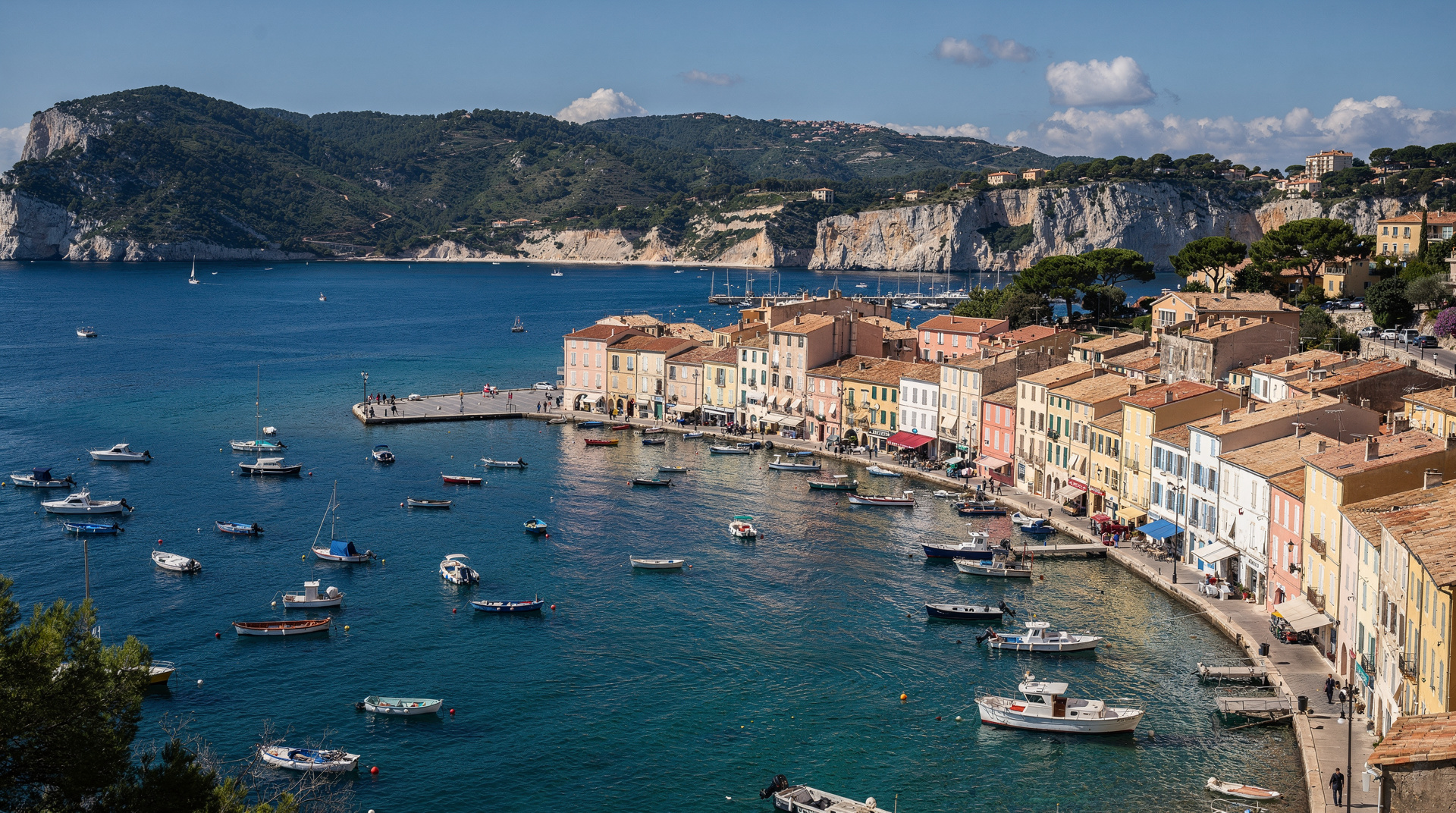
The Calanques coastline runs approximately 20 km between the southern edge of Marseille and the port of Cassis. The main departure points are Cassis (best for En-Vau and Port-Pin), La Ciotat (best for eastern Calanques and the Cap Canaille approach), and Marseille (Sormiou, Morgiou, and the Marseille-side calanques). Which you choose depends on what you want to see.
Departure from Cassis: the En-Vau route
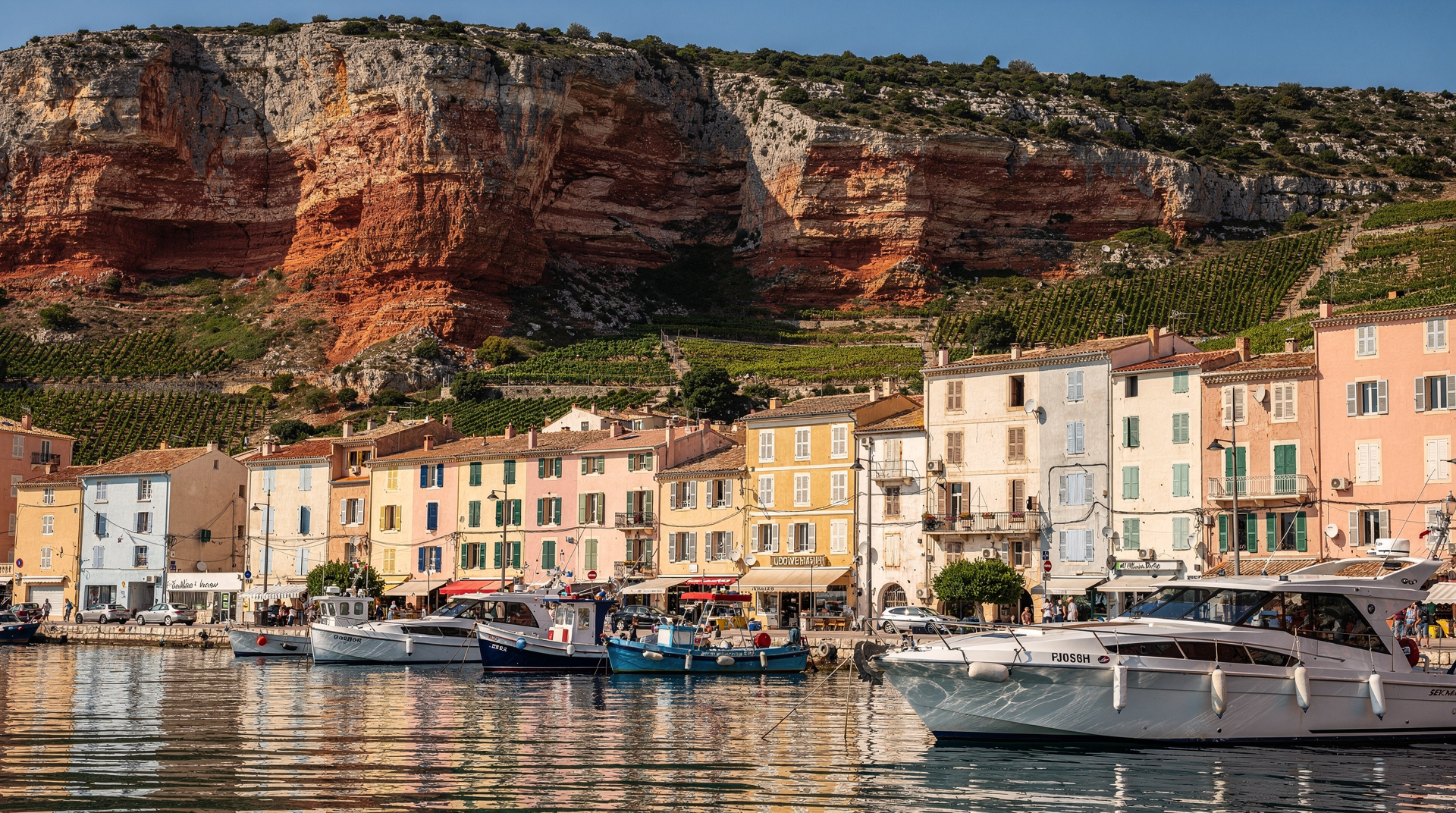
Cassis is the best base for a classic Calanques kayak day. Guided tours depart from the Cassis beach, directly adjacent to the port, and head west along the limestone coastline into the national park. The route passes Port-Miou (the large navigable calanque), continues to Port-Pin (the best swimming stop), and on a full-day tour reaches En-Vau — the centrepiece of the Calanques system.
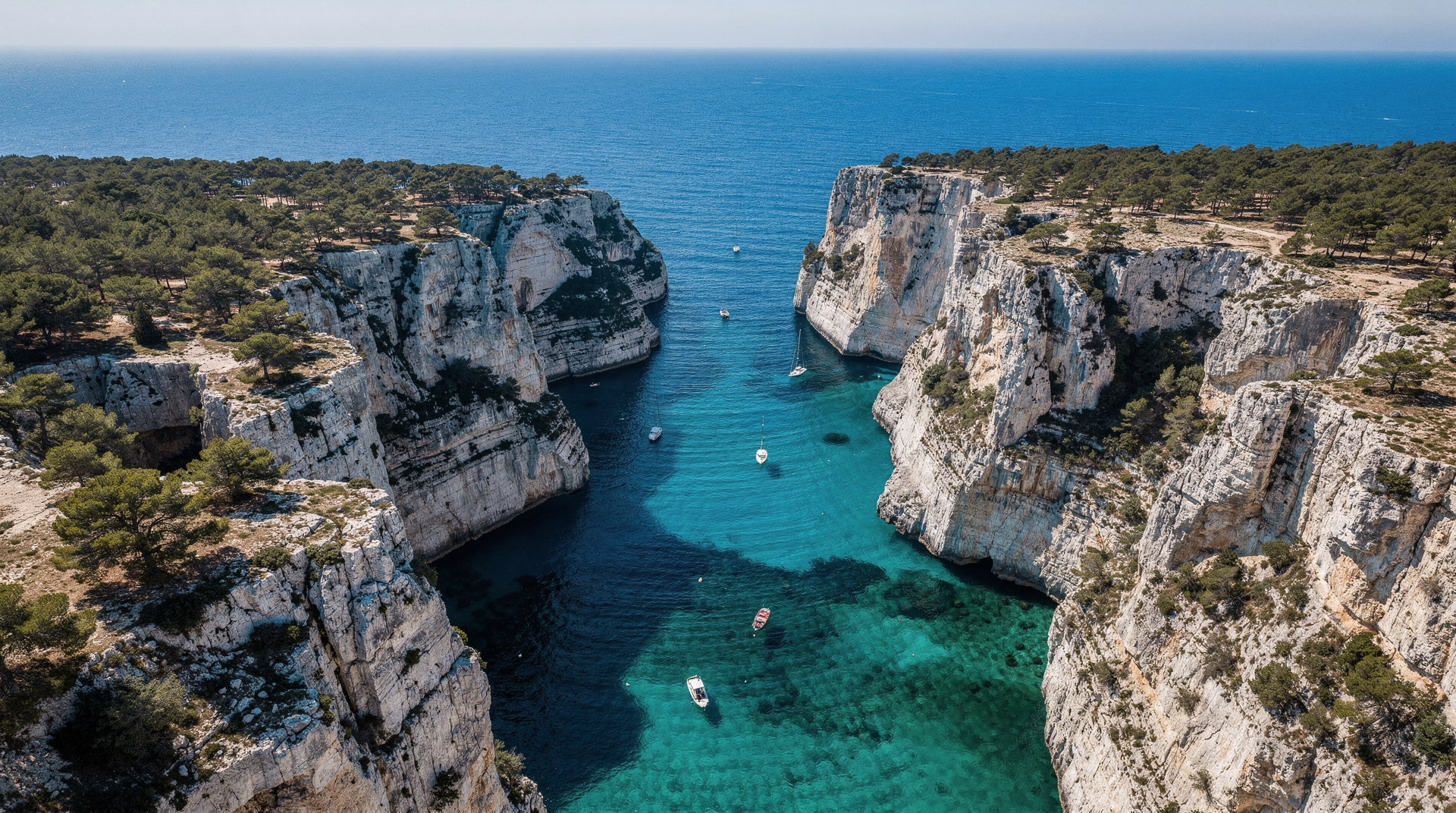
En-Vau from the water: Approaching En-Vau by kayak is one of the distinctly memorable experiences this coastline offers. The entrance narrows between vertical white cliffs that rise 150 metres directly from the water. The colour shift as you paddle deeper into the inlet — from bright Mediterranean blue to a deep turquoise-green — is not something photographs capture accurately. At the end of the inlet, a small pebble beach appears. You pull the kayak ashore, swim, eat lunch on the beach, and paddle out.
Half-day from Cassis: Covers Port-Miou and Port-Pin with a swim stop. 3–4 hours on the water. Suitable for beginners. Prices start around 55–65 EUR.
Full-day from Cassis: Reaches En-Vau, with lunch on the beach and extended exploration of Port-Pin. 6–7 hours on the water. Some paddling fitness required — the distances are manageable but consistent. Prices typically 80–90 EUR including picnic lunch.
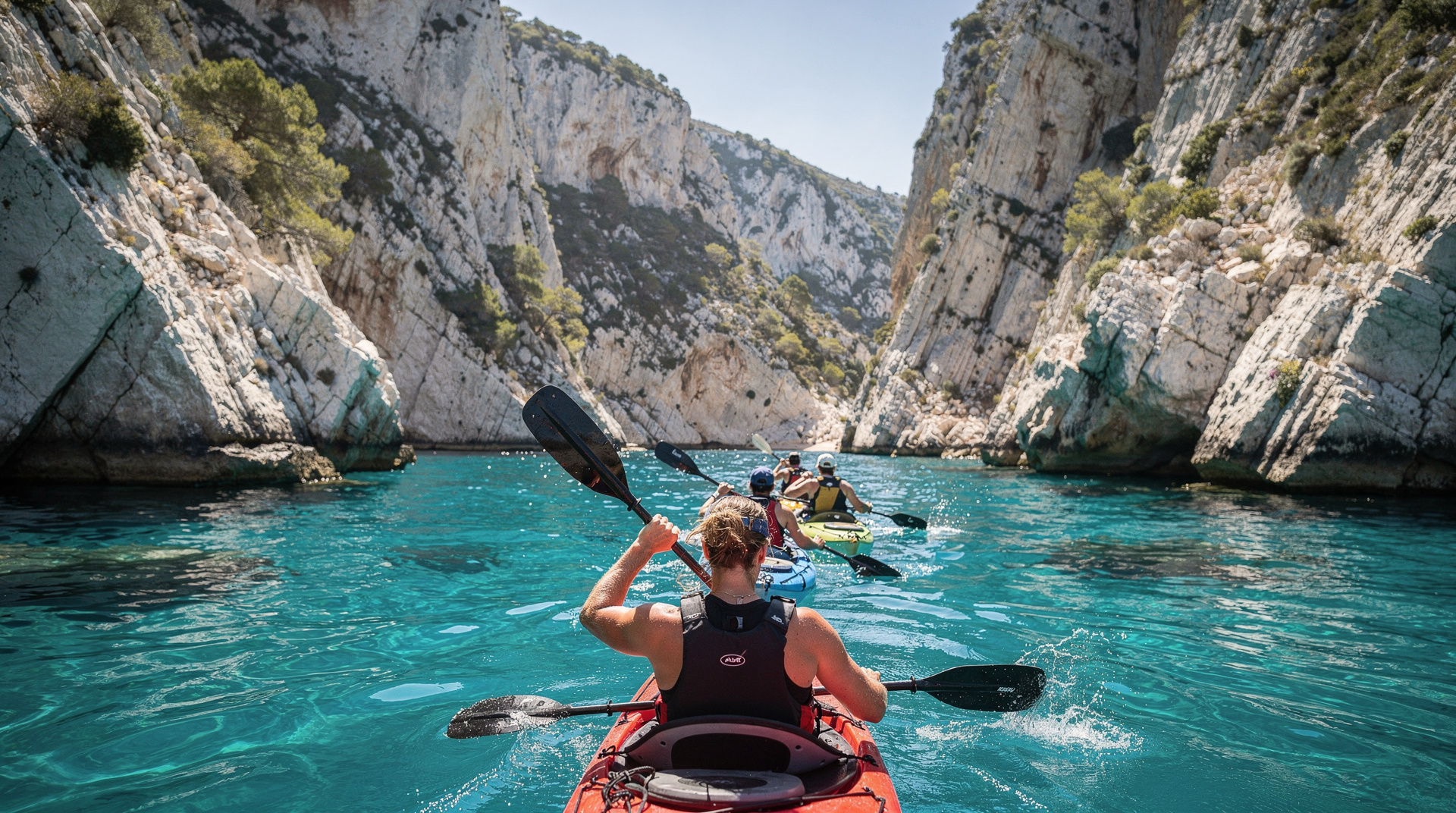
No prior kayaking experience is required for guided tours from Cassis. The guided format uses sit-on-top doubles that are extremely stable. The operator provides wetsuits or splash jackets on request, and all safety equipment.
Departure from La Ciotat: eastern Calanques and Cap Canaille
La Ciotat offers a different paddle — the eastern side of the Calanques system, with the dramatic orange-red cliff face of Cap Canaille as the dominant backdrop. Tours from La Ciotat head west toward En-Vau and the Calanques proper, or east along the Côte Bleue, depending on the operator’s route.
The La Ciotat departure is particularly scenic for those who want to see Cap Canaille from the sea. The 394-metre cliff face — the tallest coastal cliff in France — is dramatic from any viewpoint, but from water level the scale is visceral in a way the road-based viewpoints at the summit cannot replicate.
Tours from La Ciotat typically run half-day (3–4 hours, around 55–65 EUR) and full-day (6–7 hours, around 80–90 EUR). The same structure as Cassis applies: guided groups, sit-on-top equipment, no experience required for half-day, basic comfort on water preferred for full-day.
The Calanques morning snorkelling boat tours from La Ciotat complement a kayak day well — combining a morning on the water by kayak with a different sea-level perspective on the way back gives you a full day of coastal exploration. See our snorkelling guide for the La Ciotat boat tour options.
Departure from Marseille: Sormiou, Morgiou, and the Côte Bleue
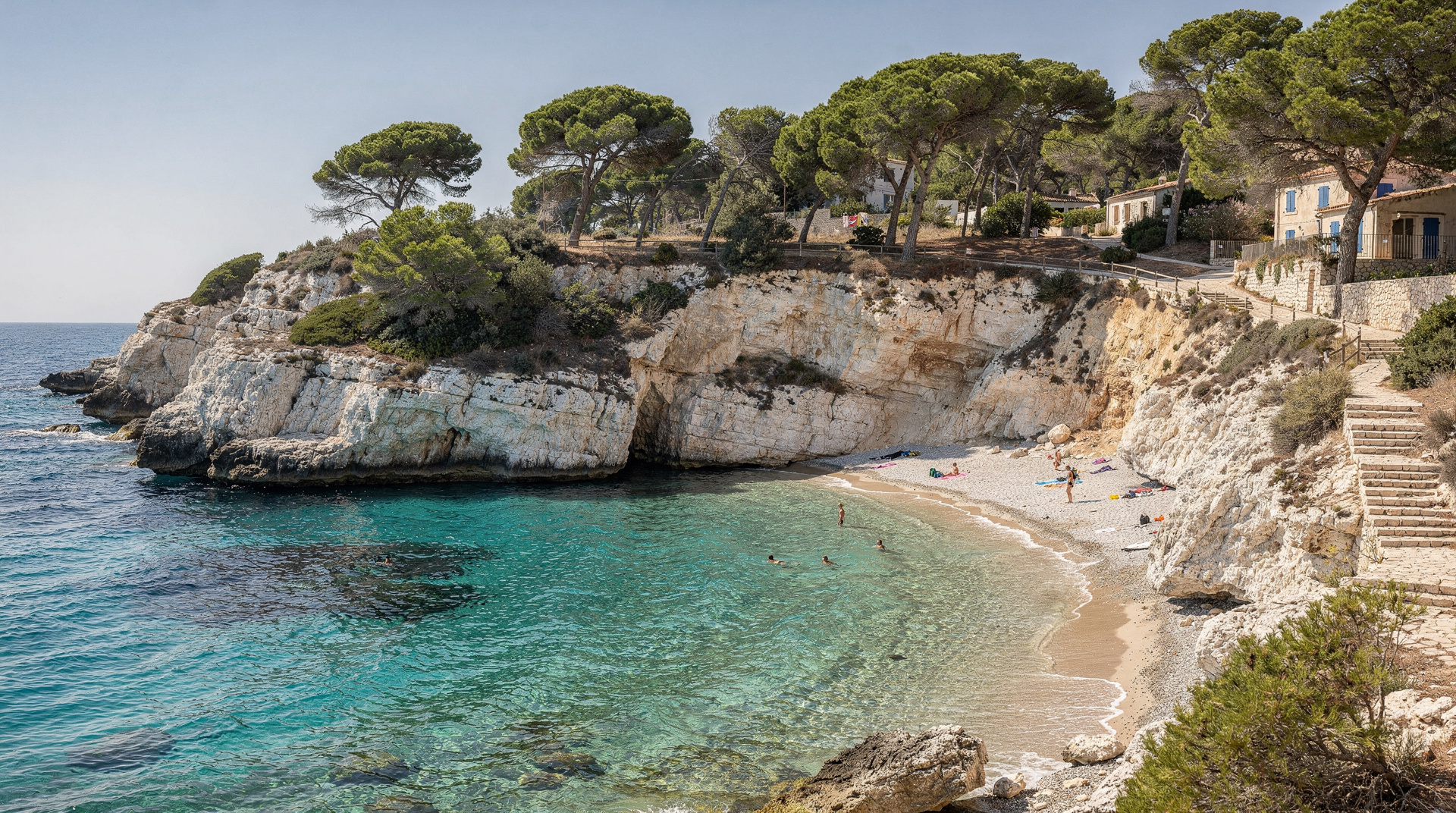
Guided sea kayak tours from Marseille depart from Pointe Rouge marina and head east toward the Marseille-side calanques: Sormiou, Morgiou, and the smaller inlets of the southern coastal section. These are different calanques from the Cassis side — broader, pebblier, less vertically dramatic — but the limestone scenery and water quality are equally impressive.
The Marseille departure also includes Côte Bleue half-day tours, which paddle west of the city into the Côte Bleue marine park — a different ecosystem with shallower water, smaller coves, and a less crowded experience than the main Calanques routes. Good option for those who want a kayak session without committing to the full Calanques distance.
For a guided Calanques kayak from the Marseille side, the sea kayak tour departing Marseille covers 2–3 Marseille-side calanques in a half-day format. The Côte Bleue tour specifically focuses on the marine park section northwest of the city.
Sit-on-top vs closed-deck: what the guides use and why
Most guided tours in the Calanques use sit-on-top kayaks, either single or double (tandem). Here is why:
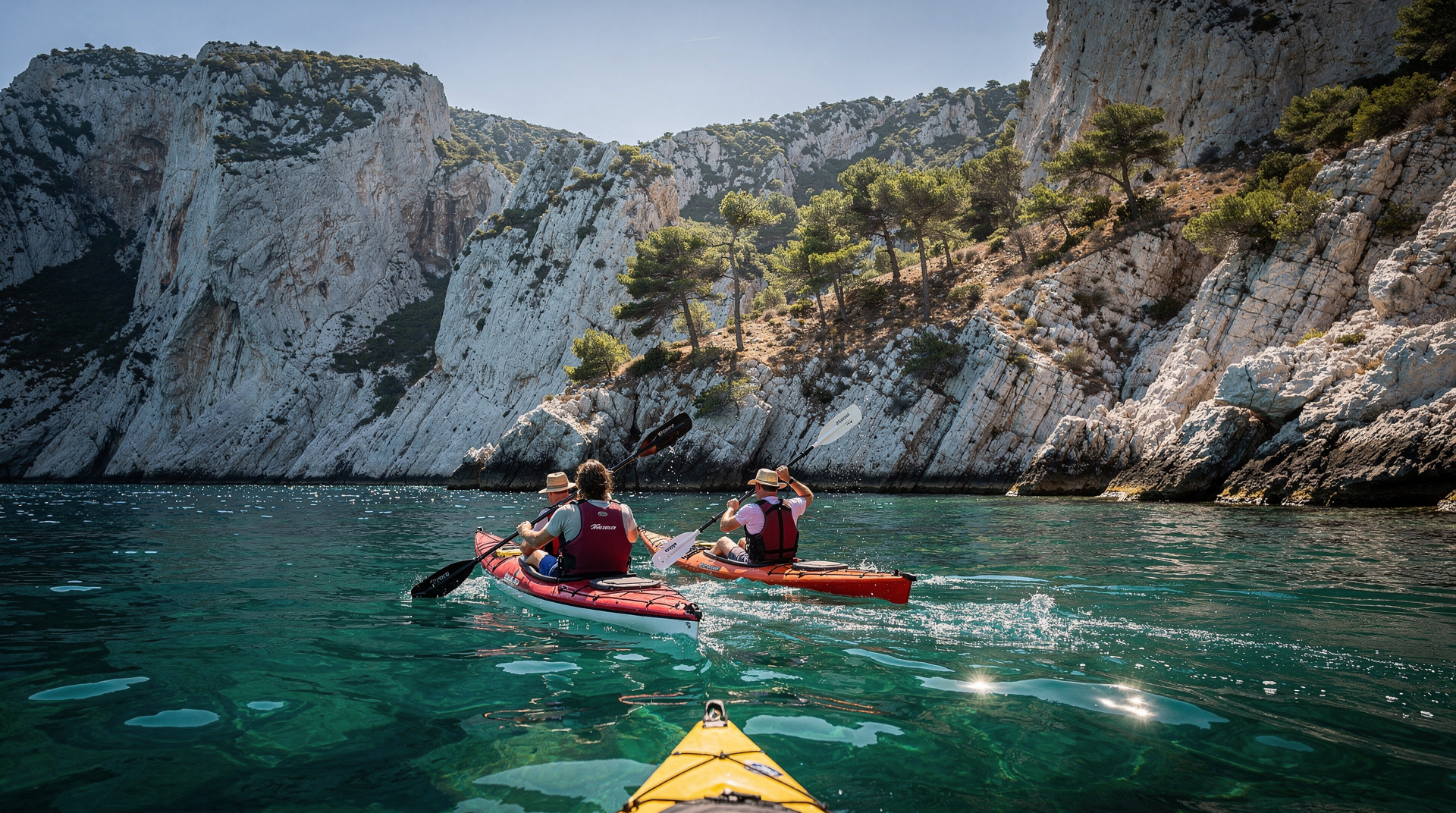
Sit-on-top (SOT) kayaks — platform-style, open design — are more stable in calm to moderate conditions, easier to re-enter after a capsize, and require no specialized skill. In the sheltered calanques and on calm Mediterranean mornings, they perform well. The limitation is that they are slower, wetter in chop, and less efficient over long distances. For beginners and family groups, they are the right choice.
Closed-deck (sea kayak) — traditional touring design — is faster, more efficient, and drier in rough water. They require the paddler to know a wet exit (escaping the kayak after a capsize) and perform a supported or independent rescue. In the Calanques, where conditions can shift quickly when the Mistral arrives, closed-deck kayaks handle the chop better. They are used on full-day and multi-day tours, and by experienced independent paddlers.
If you are booking a guided tour, the operator will provide appropriate equipment for your group and the planned route. Ask when booking if the tour uses singles or doubles — a double with a guide is the most stable option for complete beginners.
Independent paddling: rental vs guided
Guided tours are the right starting point for everyone unfamiliar with the coastline. The guides know the tides, wind windows, landing points, and hazard zones. They carry first aid equipment and know the protocol if a group member has difficulty. The guides also know which spots are worth spending time at — local knowledge that is not available from a map.
Independent kayak rental is available at some operators on the Cassis and Marseille coast. To paddle independently, you need demonstrable experience, familiarity with sea conditions and navigation, and ideally basic self-rescue skills. The Calanques coastline is exposed to rapid wind changes, particularly the Mistral which can go from flat calm to 40 kph in an hour. Paddling inside sheltered calanques is generally safe; paddling exposed headlands without experience is not.
Independent rentals from Cassis typically start at 25–40 EUR for a sit-on-top per half day. Closed-deck sea kayak rentals with experience requirement from around 40–60 EUR per day.
Wind and sea conditions: the honest picture
Summer mornings (before 10:00–11:00): Usually the calmest window. The sea breeze has not yet developed, the Mistral is typically quieter, and the light on the limestone cliffs is excellent. This is why reputable operators start at 08:00 or 09:00.
Summer afternoons: Sea breezes typically kick in from the southwest from 11:00–12:00 and can build to 15–25 kph by early afternoon. Paddling into the wind on the return journey is tiring for beginners. Good operators plan routes to paddle with the wind in the afternoon or return before conditions develop.
Mistral: The dominant wind of the region — northwest, typically arriving in 3-day or 6-day cycles. A strong Mistral (above 40 kph) makes all sea kayaking in the Calanques dangerous and operators will cancel or significantly shorten tours. A light Mistral (10–20 kph) creates chop on exposed sections but leaves the sheltered interior of the calanques calm.
Water temperature: May averages 17°C — manageable with a wetsuit provided by the operator, cold without. July–August averages 23–24°C — comfortable for swimming even without a wetsuit. September is often the best paddling month: 22–23°C water, reduced summer crowds, and more stable wind patterns than peak July.
Group sizes: what to look for
Maximum group size matters for the quality of the kayaking experience. Large commercial groups (15–20 paddlers) spend significant time waiting for slower participants and create a convoy effect that reduces the sense of exploration. Smaller groups (4–8) allow the guide to check in with everyone, make dynamic routing decisions, and move efficiently.
When booking, check the maximum group size. Most quality operators cap at 8–12 per guide. If a tour lists more than 12 per guide, the experience will be closer to a managed flotilla than a guided paddle.
Fitness requirements: realistic assessment
Half-day (3–4 hours, covering 8–12 km): Accessible to most adults with basic fitness. The pace is relaxed, stops are frequent, and the guide adjusts for the group’s speed. No specific preparation needed other than being able to sit in a kayak for an extended period without discomfort.
Full-day (6–8 hours, covering 16–20 km): Requires reasonable physical condition. You will paddle more sustained sections with fewer long stops. Core strength and shoulder endurance matter. If you have not done any paddling before, consider starting with a half-day to calibrate your stamina.
Children: Most operators accept children aged 8 and above in doubles with a parent. Check minimum age with the operator when booking. The Cassis half-day in calm conditions is suitable for older children with a supervising adult.
What to bring
- Swimwear — swimming stops are the highlight; wear a swimsuit under your paddling clothing
- Sun protection — reef-safe sunscreen (the marine reserve requires it), a hat, UV-protective shirt for arms
- Water — minimum 1.5 litres per person for a half-day, 2.5 litres for a full day; the sun reflecting off the water increases dehydration
- Light lunch or snacks — for half-day tours; full-day usually includes a guide-provided picnic
- Waterproof bag or dry bag — for phone, camera, keys; the operator may provide these, ask in advance
- Water shoes or sandals — rocky calanque beaches require footwear for landing and swimming exits
The operator provides: kayak, paddle, life vest, spray skirt or splash deck if applicable, wetsuit on request.
Departure points compared
| Departure | Best for | Half-day price | Full-day price |
|---|---|---|---|
| Cassis | En-Vau, Port-Pin — the classic route | Around 55–65 EUR | Around 80–90 EUR |
| La Ciotat | Cap Canaille cliff views, eastern Calanques | Around 55–65 EUR | Around 80–90 EUR |
| Marseille | Sormiou, Morgiou, Côte Bleue marine park | Around 50–65 EUR | Around 75–90 EUR |
Choosing your kayak day by priority
If your single priority is seeing En-Vau from the water, start in Cassis and book the full-day route — the half-day from Cassis stops short at Port-Pin. If you want the most dramatic cliff scenery with the least paddling distance, La Ciotat’s Cap Canaille route is hard to beat.
If you are staying in central Marseille without a car and want to avoid the Cassis train transfer, the Pointe Rouge departure covers Sormiou and Morgiou credibly, though these calanques are broader and less vertically dramatic than the Cassis side. For a full comparison of boat vs kayak vs hiking as access methods, see our boat vs hike guide and our roundup of which Calanque to visit.
Combining kayak with other Calanques activities
A kayak morning pairs naturally with an afternoon hike (in spring and autumn when trails are open) or a boat tour for a different perspective. From Cassis, the ferry to Marseille provides an alternative return route on multi-point days.
For the complete picture of Calanques access methods, see our Calanques National Park guide and the boat tour guide. For hiking from Cassis, the hiking guide covers the three-calanque trail from the village. For the Cassis side specifically, see the Cassis destination guide.
For those interested in stand-up paddleboarding rather than kayaking, see our SUP guide for the differences in technique, suitable conditions, and best routes.
Frequently asked questions about Kayaking the Calanques
Do I need kayaking experience to paddle the Calanques?
No — most guided tours are designed for beginners. Sit-on-top kayaks are stable and easy to handle. Guided half-day tours from Cassis or La Ciotat require no prior paddling experience. Full-day tours covering more exposed sections may ask for some basic comfort on water.Can I kayak the Calanques in summer when the hiking trails are closed?
Yes — sea access is never closed by fire risk. This is one of the key advantages of kayaking: July and August are busy months for guided tours precisely because it is the only way to reach several calanques when trails are shut. Book well in advance for July and August departures.What is the difference between a sit-on-top and a closed-deck kayak?
Sit-on-top kayaks are wider, more stable, and easier to re-enter if you fall off — ideal for beginners and calm Mediterranean conditions. Closed-deck kayaks are faster, drier in chop, and better for longer distances, but require a wet exit technique to capsize safely. Most guided tours use sit-on-top or double sit-on-top kayaks.How far is En-Vau from Cassis by kayak?
En-Vau is roughly 5–7 km from the Cassis beach, paddling west along the coast. In calm conditions, most guided groups cover it in 1.5–2 hours of paddling. Return is similar, making it a 3–4 hour on-water commitment for a half-day tour.What happens if the wind picks up during a kayak tour?
The Mistral and strong easterly winds (Levant) can make paddling difficult or dangerous. Reputable operators monitor weather forecasts and will shorten routes, return to sheltered sections, or cancel if conditions deteriorate beyond safe limits. Summer morning departures (before 09:00–10:00) usually see the calmest water before sea breezes develop.Is group size important for kayaking tours?
Yes. Tours with 4–8 paddlers are manageable and allow the guide to assist everyone easily. Larger groups (10–15+) spend more time waiting and less time paddling. Check group size limits when booking — smaller is better for the experience.Do I need kayaking experience to paddle the Calanques?
No — most guided tours are designed for beginners. Sit-on-top kayaks are stable and easy to handle. Guided half-day tours from Cassis or La Ciotat require no prior paddling experience. Full-day tours covering more exposed sections may ask for some basic comfort on water.Can I kayak the Calanques in summer when the hiking trails are closed?
Yes — sea access is never closed by fire risk. This is one of the key advantages of kayaking: July and August are busy months for guided tours precisely because it is the only way to reach several calanques when trails are shut. Book well in advance for July and August departures.What is the difference between a sit-on-top and a closed-deck kayak?
Sit-on-top kayaks are wider, more stable, and easier to re-enter if you fall off — ideal for beginners and calm Mediterranean conditions. Closed-deck kayaks are faster, drier in chop, and better for longer distances, but require a wet exit technique to capsize safely. Most guided tours use sit-on-top or double sit-on-top kayaks.How far is En-Vau from Cassis by kayak?
En-Vau is roughly 5–7 km from the Cassis beach, paddling west along the coast. In calm conditions, most guided groups cover it in 1.5–2 hours of paddling. Return is similar, making it a 3–4 hour on-water commitment for a half-day tour.What happens if the wind picks up during a kayak tour?
The Mistral and strong easterly winds (Levant) can make paddling difficult or dangerous. Reputable operators monitor weather forecasts and will shorten routes, return to sheltered sections, or cancel if conditions deteriorate beyond safe limits. Summer morning departures (before 09:00–10:00) usually see the calmest water before sea breezes develop.Is group size important for kayaking tours?
Yes. Tours with 4–8 paddlers are manageable and allow the guide to assist everyone easily. Larger groups (10–15+) spend more time waiting and less time paddling. Check group size limits when booking — smaller is better for the experience.
Top experiences
Bookable activities with verified prices and instant confirmation on GetYourGuide.