How to buy authentic savon de Marseille: the honest shopping guide
Marseille: MuSaMa soap museum and soap workshop
How do I buy authentic savon de Marseille?
Look for: cut from a large cube (not moulded into shapes), '72% huile végétale' stamped on the surface, made by one of the four traditional factories (Marius Fabre, Le Sérail, Le Fer à Cheval, Savonnerie du Midi). In the city, Le Sérail has a factory shop in the 3rd arrondissement. The decorative fish-shaped soaps in tourist markets are glycerin soap, not savon de Marseille.
The soap problem in Marseille’s tourist economy
Savon de Marseille may be the most widely counterfeited product in the city’s tourist economy. Walk through the Vieux-Port souvenir shops, the Le Panier boutiques, and the tourist markets, and you will see soap everywhere — displayed in baskets, wrapped in paper tied with ribbon, shaped like Provençal lavender bundles, little fish, olives, and decorative cubes in every pastel colour imaginable.
Almost none of it is savon de Marseille.
What you are mostly seeing is glycerin soap, or soap made from palm oil, sometimes produced in factories in Asia or eastern Europe, sometimes produced by small French artisans. It may smell like lavender and look Provençal. It may be labelled with Marseille references. It is not the traditional product that has been made in the Marseille area by the same industrial process for over three centuries.
This guide tells you what the real product is, why it looks different from what the tourist markets sell, and where to buy the genuine article.
| At a glance | |
|---|---|
| Where to buy | Le Sérail factory shop (3rd arrondissement, Marseille) or Marius Fabre in Salon-de-Provence |
| Cost | Around EUR 3–5 for a 300g block, EUR 7–12 for a 1 kg block, from a factory shop |
| Time needed | 10–15 minutes for the Le Sérail shop; a half-day round trip for the Marius Fabre factory and museum |
| Getting there | Le Sérail is near the Joliette tram stop; Marius Fabre is a roughly 40-minute drive or train-plus-taxi from Marseille |
| Best time | Any time of year; the Marius Fabre guided tours run more frequently in summer |
What authentic savon de Marseille actually is
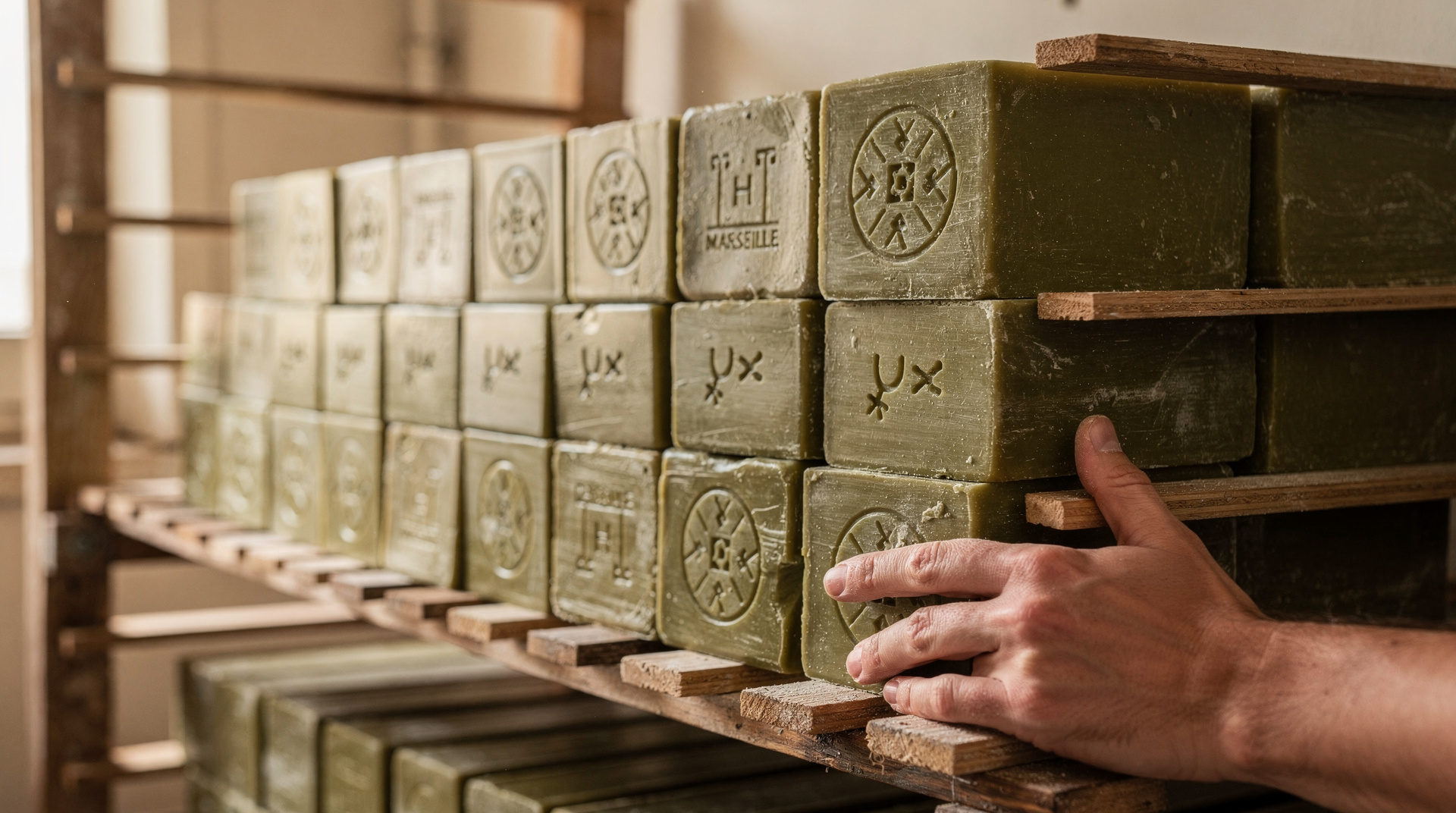
Traditional savon de Marseille is made by a process called the Marseille process or the hot process of saponification. Olive oil (or a mixture of olive oil and other vegetable oils), seawater, soda ash (sodium hydroxide), and salt are cooked in large cauldrons at high temperature for a process that takes several days. The resulting soap paste is poured into large rectangular moulds, cooled, cut into cubes, and stamped.
The defining characteristics:
72% vegetable oil content: This is the historical standard. The stamp on a genuine cube of savon de Marseille reads “72% d’huiles” or “72% huile végétale.” The traditional formulation used 72% olive oil by fatty acid content. Modern productions from the four genuine factories may use a blend of vegetable oils (palm kernel, coconut, or copra alongside olive), but the 72% standard applies. This percentage appears on the stamp — if there is no percentage stamp, be sceptical.
Cut from a large block, not moulded: Genuine savon de Marseille is manufactured in large rectangular blocks and cut into cubes or bars after cooling. It is green (from olive oil) or off-white (from copra/palm kernel). It has a stamped surface showing the factory name and the 72% marking. It is not shaped like a fish, a lavender sprig, or a Provençal scene. Moulded decorative shapes are invariably glycerin soaps made by a different process.
Made by the four genuine factories in the Marseille region:
- Savonnerie Marius Fabre — Salon-de-Provence (40 km from Marseille), founded 1900. The most visited factory with a museum and guided tours.
- Savonnerie Le Sérail — Marseille, 3rd arrondissement, founded 1949. One of the last to use the traditional cauldron process; has a factory shop.
- Savonnerie Le Fer à Cheval — Marseille, founded 1856. The oldest of the four surviving factories.
- Savonnerie du Midi (Maître Savon de Marseille) — Marseille. The fourth founding member of the UPSM (Union des Professionnels du Savon de Marseille), the professional body established in 2011 to defend and promote authentic savon de Marseille.
The UPSM logo: The Union des Professionnels du Savon de Marseille has a registered logo that appears on packaging from member factories. This logo confirms that the soap was made by one of the qualifying factories using traditional methods.
Why the tourist market version is usually fake
The tourist market economics are simple. A genuine 600g cube of savon de Marseille from a traditional factory costs around EUR 5–8. The decorative soaps in tourist shops are priced at EUR 6–15 for much smaller quantities — they are more expensive per gram than the real product, presented in more attractive packaging.
The economic logic for the merchant is obvious: decorative shaped soaps are more visually appealing to tourists who do not know what authentic savon de Marseille looks like. The profit margin is higher. And since there is no legal protection for the name “savon de Marseille” in France (the UPSM has lobbied for Protected Geographical Indication status but had not achieved it as of early 2026), the name can be applied to almost any soap produced in the region.
A soap labelled “savon de Marseille” in a Le Panier tourist shop may be:
- Genuine (if it comes from one of the four factories)
- A glycerin soap made in France but not by traditional Marseille process
- A product imported from outside France with Marseille branding
Without the cube format, the 72% stamp, and the UPSM logo, there is no guaranteed way to verify.
Where to buy genuine savon de Marseille
In Marseille:
Le Sérail factory shop: 50 Boulevard Anatole de la Forge, Marseille 3rd arrondissement (near the Joliette tram stop). This is the most accessible genuine factory retail outlet in the city itself. You can buy soap directly from one of the four traditional manufacturers, in the factory format (large cubes or cut blocks), at factory prices. Significantly cheaper than the tourist-zone boutiques.
The MuSaMa soap museum and workshop (in the Marseille tourist circuit — bookable via GetYourGuide): This museum and workshop in the city offers a background on the soap-making process and sells authentic products. The workshop element (making your own soap) is interesting for those who want the full experience rather than just buying the product.
Outside Marseille:
Savonnerie Marius Fabre — 148 Avenue Paul Bourret, Salon-de-Provence (40 km north of Marseille). The factory has a museum (admission EUR 3.50, free for children under 15), a factory shop selling the full range of Marius Fabre products, and guided tours on specific days (Tuesday, Thursday, and Saturday at 10:30; more frequent in summer). The factory has been producing soap since 1900 and remains family-owned. The museum is excellent — preserved stamping equipment, original packaging designs, and the full narrative of how savon de Marseille is made. Worth visiting if soap is important to you; the 40 km from Marseille is easily done as a half-day excursion.
What to look for when shopping (quick guide)
When buying soap in Marseille’s market or gift shops, apply this filter:
Accept: Large olive-green or off-white cube. Surface stamp reading “72% d’huiles” or “72% huile végétale”. Factory name stamp (Marius Fabre, Le Sérail, Fer à Cheval, or Savonnerie du Midi). UPSM logo on packaging.
Reject: Any decorative moulded shape. Any soap in bright colours (lavender purple, rose pink, sunflower yellow — these are added colorants, not natural). No percentage stamp on the surface. No factory name.
A note on price: Genuine savon de Marseille is inexpensive. A 300g block costs EUR 3–5 from a factory shop; a 1 kg block costs EUR 7–12. If you are paying EUR 10+ for a small fancy-packaged soap in a tourist boutique, you are almost certainly not buying savon de Marseille.
The Marseille soap: a practical souvenir
For all the caveats above, savon de Marseille from a genuine factory is an excellent souvenir. It lasts months of daily use, it is genuinely good soap (produced to a standard that has not changed in its essentials since the 17th century), and it is inexpensive. A 200g block of Marius Fabre olive oil soap is one of the best souvenir purchases available in the city — honest, useful, and genuinely from Marseille.
The factory shop version (large cut block, stamped, no decorative packaging) is the most authentic and the best value. If you want something more gift-ready, the factory shops also sell packaged versions in simple paper wrapping that are presentable without crossing into tourist-souvenir territory.
The soap-making process: why it looks the way it does
Understanding why authentic savon de Marseille is a simple brown-green cube — rather than a scented lavender oval or a miniature Provençal landscape — requires a brief understanding of how it is made.
The traditional Marseille process is a hot-process saponification in large cauldrons. Vegetable oil (historically olive oil; today the four factories use varying blends with the olive content maintained as a key element), water, sodium hydroxide (lye), and sea salt are combined and heated for several days at controlled temperature. The chemical reaction converts the oils into soap (fatty acid salts) and glycerin; the glycerin rises to the surface and is largely removed (in industrial glycerin soap production, the glycerin is retained, producing the translucent moulded bars you see in tourist markets).
The result is poured into large rectangular moulds — literally the size of swimming pools in the larger factories — and left to cool and harden. After several days, the hardened soap is cut into large cubes by mechanical cutters and each cube is stamped (by a wooden or metal stamp) with the factory name and the “72% d’huiles” mark.
This process produces soap in only one form: cut blocks and cubes. Moulded shapes are impossible because the hot-process soap is poured as liquid into flat moulds, not into decorative shapes. Any soap in a decorative shape was made by a cold-process or glycerin method — neither of which is the Marseille process.
The olive oil question
Traditional savon de Marseille used 100% olive oil — the “savon vert” (green soap) that is the oldest form. The green colour comes from the chlorophyll and other pigments present in cold-pressed olive oil. The soap turns darker green on the outside and paler inside when cut — this two-tone appearance is characteristic of genuine olive-oil savon de Marseille.
The “savon blanc” (white soap) variant uses coconut or palm kernel oil, which produces a whiter, milder soap. Both are legitimate traditional variants.
The four contemporary factories each produce their own formulations, varying the ratio of olive to other vegetable oils while maintaining the 72% fatty acid standard. Marius Fabre’s 100% olive oil soap is the most traditional formulation.
Why not 100% olive oil anymore? Primarily economics. Olive oil prices have risen substantially over the past three decades due to demand and periodic Mediterranean drought. The factories have adapted their formulations while defending the 72% fatty acid standard and the traditional process.
A note on “Marseille soap” vs “savon de Marseille”
“Savon de Marseille” as a term has no legal geographical protection in France (unlike, say, Roquefort cheese or Châteauneuf-du-Pape wine). This means any soap produced in the broader Marseille region can legally be labelled “savon de Marseille” regardless of whether it is made by the traditional process or composition.
The UPSM (Union des Professionnels du Savon de Marseille) has been lobbying for Protected Geographical Indication (PGI) status for the product since its founding in 2011. As of 2026, this protection had not been granted. In its absence, the only reliable indicators of genuine product are the factory stamps, the 72% marking, the cube format, and the UPSM logo on packaging.
The experience of visiting a factory
For visitors who want more than buying a bar of soap, the Marius Fabre factory in Salon-de-Provence offers a genuinely interesting experience. The factory has been in operation since 1900 and has preserved its historic equipment — large copper cauldrons, wooden stamp sets, early mechanical cutters, original packaging. The permanent exhibition covers the full history of savon de Marseille, from the medieval origins of Marseille soap-making through the 19th-century peak of hundreds of factories to the current four remaining producers.
The guided tour runs approximately 45 minutes and includes the working factory floor — you see the current production in operation alongside the historic displays. The factory shop sells the full range of products at factory prices, and the guided-tour ticket includes the museum. Tours run multiple times daily in summer.
For Le Sérail in Marseille itself, the factory shop is accessible without a tour; ring ahead if you want to discuss production or visit the production area.
For the broader context of tourist traps in Marseille (beyond soap), see our tourist traps guide. For Marseille’s markets in general, see our markets guide.
Pairing the soap shop with the rest of your visit
The Le Sérail factory shop sits close to the Joliette waterfront, which makes it easy to combine with a wider loop through Le Panier, the oldest district in the city, or a stop at the Vieux-Port before or after. If you are already planning a market morning, the Noailles market (covered in our markets guide) is a reasonable place to see the fake fish-shaped soaps up close so you know exactly what to avoid before heading to a genuine factory shop.
Travellers building a full day around Provençal crafts and produce sometimes add the Marius Fabre visit to a wider loop through Aix-en-Provence, since Salon-de-Provence sits roughly between the two. Check opening days before committing — the guided tours run on specific weekdays outside peak summer.
How much soap to bring home
A 300g block lasts a single household several months of daily hand and body use, so most visitors do not need to buy more than two or three blocks per person unless gifting. Because the soap is unscented or only lightly scented (depending on the factory and formulation), it also travels well in luggage without the risk of strong fragrance transfer that affects the decorative tourist-market soaps.
Frequently asked questions about How to buy authentic savon de Marseille
Is savon de Marseille the same as “Marseille soap” sold outside France? Not necessarily. Because the name has no legal geographical protection, soap labelled “Marseille soap” or “savon de Marseille” sold outside France (or even within France) may not be made by the traditional process. Look for the same indicators — cube format, 72% stamp, one of the four factory names — regardless of where you buy it.
Can I visit a soap factory without joining a tour? At Le Sérail in Marseille, yes — the factory shop is open to walk-in visitors without a booked tour, though ringing ahead helps if you want to see the production area. At Marius Fabre in Salon-de-Provence, the museum and shop are open to visitors, but seeing the working factory floor requires joining one of the scheduled guided tours.
Top experiences
Bookable activities with verified prices and instant confirmation on GetYourGuide.