Le Panier guide: Marseille's oldest quarter
Marseille: Le Panier district 2-hour guided walking tour
Duration: 2 hours
What is Le Panier and how do I visit it?
Le Panier is Marseille's oldest, highest neighbourhood — a maze of pastel-coloured lanes above the Vieux-Port. Walk uphill from the north quai (10 min), explore by foot with no real plan, visit the Vieille Charité, and allow 2–3 hours. Best in the morning light.
At a glance
| Where | Hill above the north quai of the Vieux-Port, Marseille |
| Cost | Free to walk; Vieille Charité courtyard is free, museum entry priced separately |
| Time needed | 2-3 hours for a proper walk, longer with the Vieille Charité museums |
| Getting there | 10-minute walk uphill from the Vieux-Port, or Joliette métro (M2) plus a 10-15 minute walk |
| Best time | Morning (8:00-11:00) for light and quiet lanes |
Marseille’s first neighbourhood
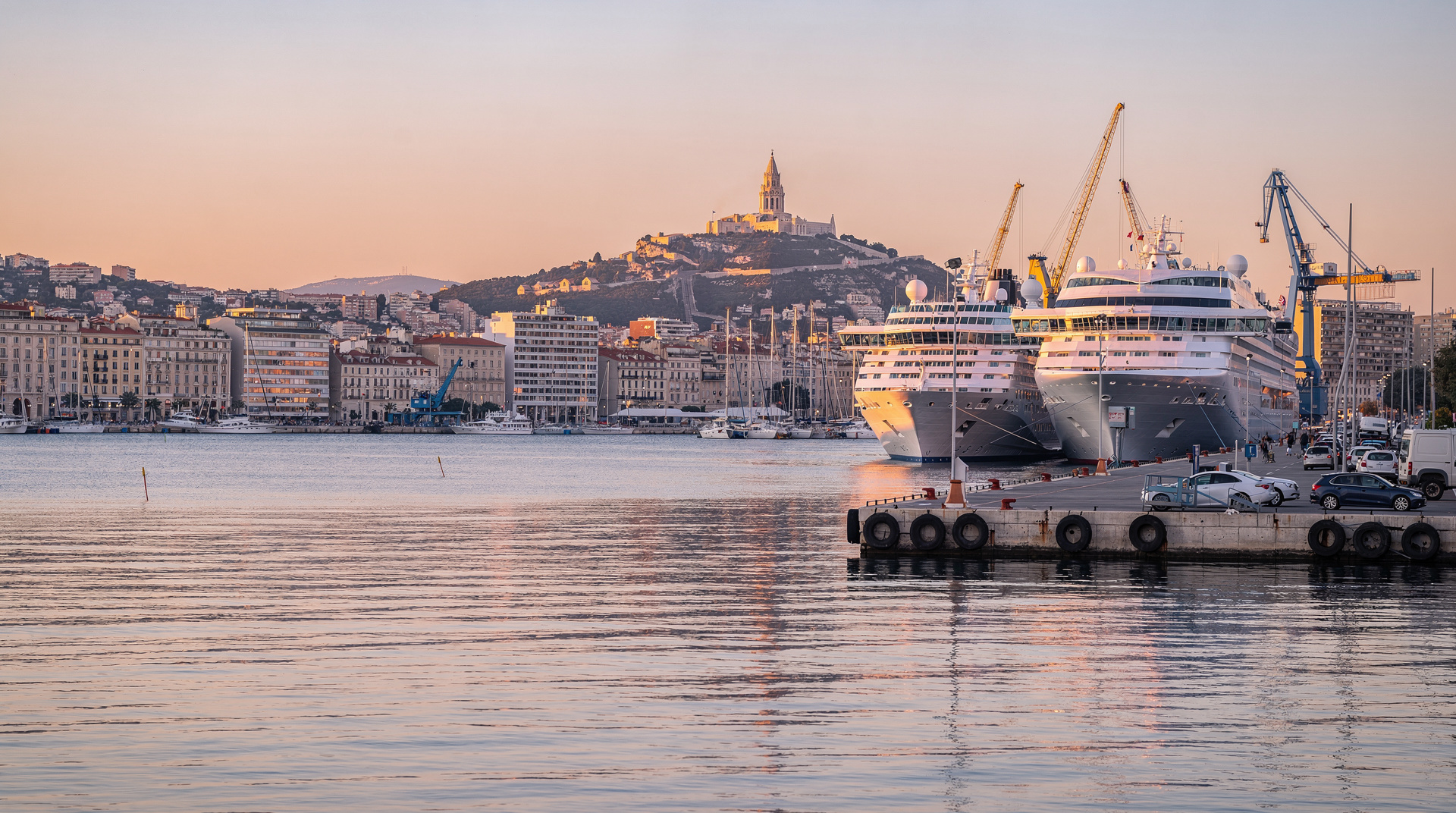
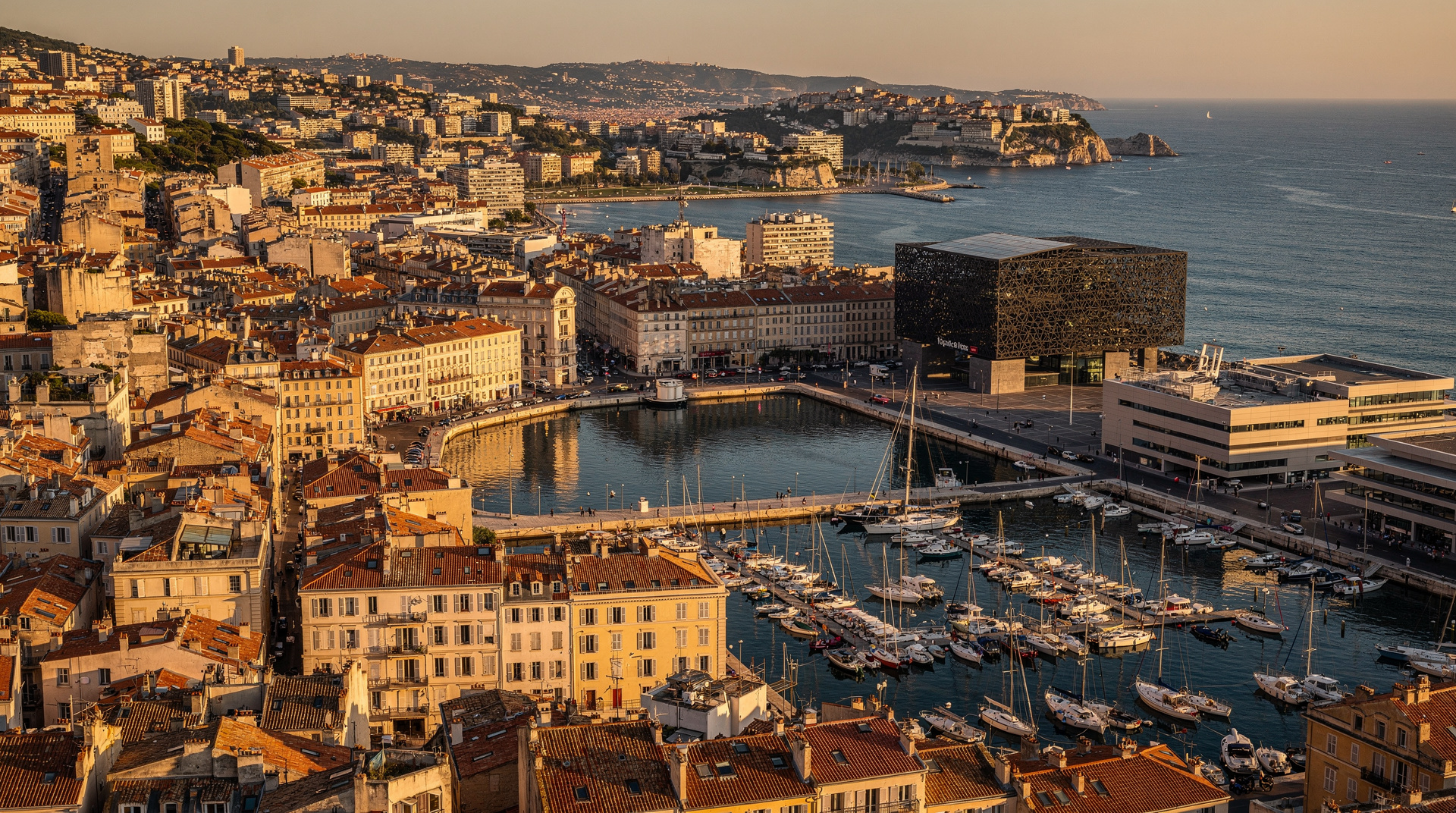
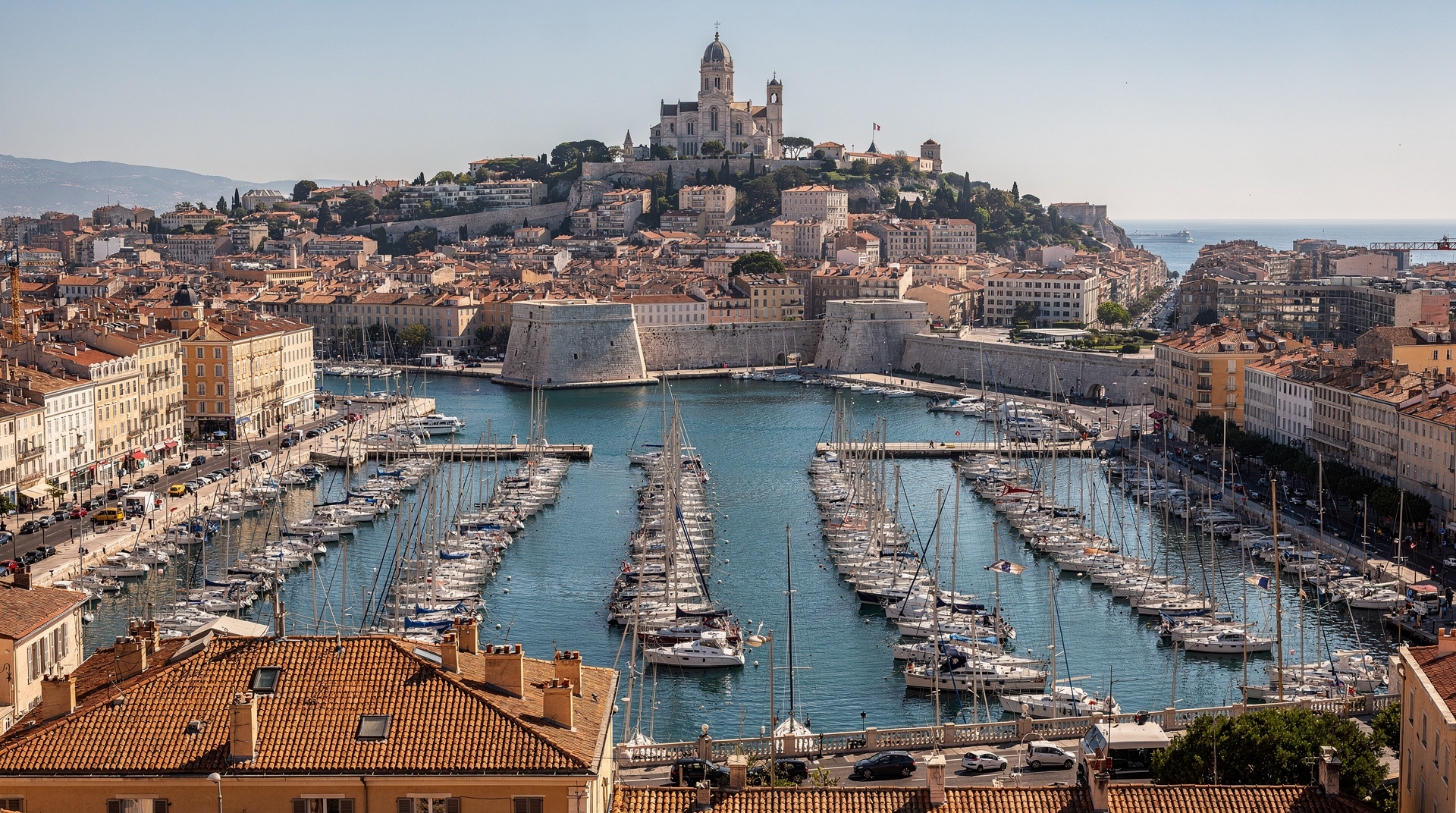
Le Panier occupies the hill directly above the northern shore of the Vieux-Port. It is the oldest continuously inhabited quarter in Marseille — and given that Marseille is among the oldest cities in France, that makes Le Panier one of the oldest urban neighbourhoods in the country, with 2,600 years of settlement on its limestone hill.
The name means “the basket” — one of several theories connects it to an 18th-century cabaretier who hung a wicker basket outside his inn as a sign, giving the neighbourhood its nickname. More prosaically, the quarter sits in a natural hollow between two ridges that gives it a basket-like topography when viewed from above.
The quarter was almost entirely demolished by the Nazi occupiers in January 1943. Over 1,500 residents were expelled and 1,400 buildings — the entirety of the waterfront Panier district — were destroyed in a four-day operation. What remains today is primarily the upper Le Panier, above Rue de la Guirlande, and the buildings that survived. New construction after the war created the lower section, which is why the architecture varies so noticeably: medieval and 17th-century streets in the upper quarter, 1950s urban fabric lower down.
Getting there
From the Vieux-Port: The most direct approach is on foot. From the north quai (Quai du Port), walk past the ferry landing toward the hill — Rue de la Guirlande or the steps of Montée des Accoules take you up from the waterfront level. The climb takes 10 minutes at a moderate pace and gains significant elevation. The steepness is real; those with mobility concerns should plan for the effort.
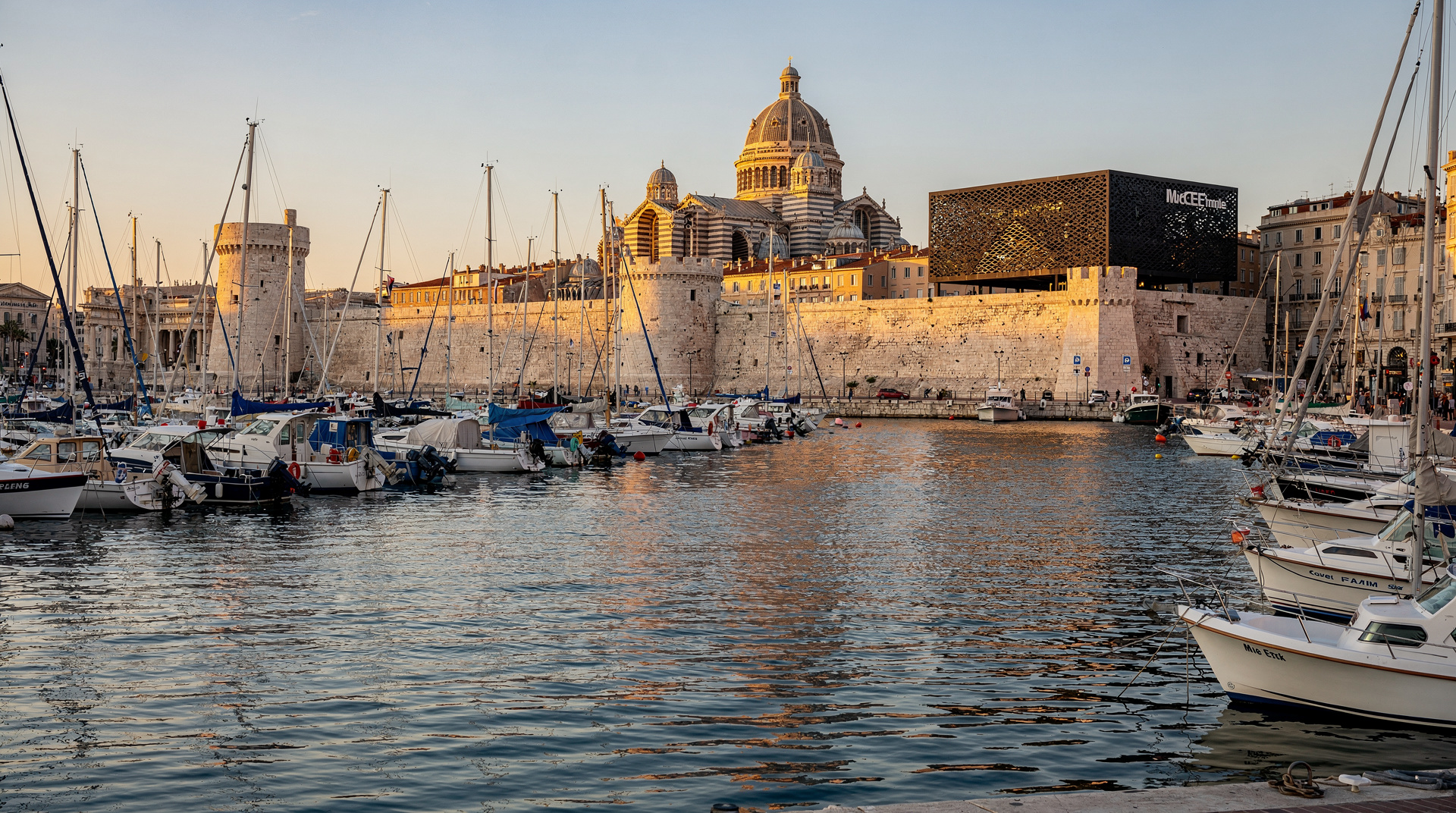
From the Joliette/MuCEM side: Coming from MuCEM on the western side, the hill drops toward the Quai du Port and Le Panier begins as you walk east from the MuCEM waterfront. This approach enters the quarter from below through the 1950s sections — less atmospheric but equally straightforward.
By public transport: There is no metro or tram directly into Le Panier. The closest station is Joliette (M2), from which it is a 10–15 minute walk downhill and east to enter the upper quarter.
The Vieille Charité
The Vieille Charité is the architectural centrepiece of Le Panier and one of the finest examples of Baroque architecture in Provence. The complex was built between 1671 and 1749 by the architect Pierre Puget — born in Marseille, a student of Bernini — as a hospice and refuge for the city’s poor. It comprises three storeys of arcaded galleries surrounding a central courtyard, with a stunning oval domed chapel at its centre.
After serving as an actual hospice until the 19th century, then as a barracks, then as a slum, the Vieille Charité was extensively restored in the 1980s. Today it functions as a cultural centre housing the Musée d’Archéologie Méditerranéenne (Mediterranean archaeology, including Egyptian artefacts), the Musée des Arts Africains, Océaniens et Amérindiens (MAAOA), and a programme of temporary exhibitions.
What to know:
- Entry to the courtyard and the exterior is free
- Museum entry fees vary by exhibition — check current schedule at marseille.fr
- The courtyard has a small café
- The quality of the architecture — specifically the oval dome and the three tiers of galleries — is exceptional whether or not you enter the museums
- Morning light in the courtyard, before the tourist groups arrive, is particularly good for photography
Place des Moulins
Place des Moulins sits near the summit of the Le Panier hill, at the highest point accessible by foot without climbing to the rooftops. The name recalls the windmills that once operated here — the plateau provided sufficient wind to grind grain for the city below.
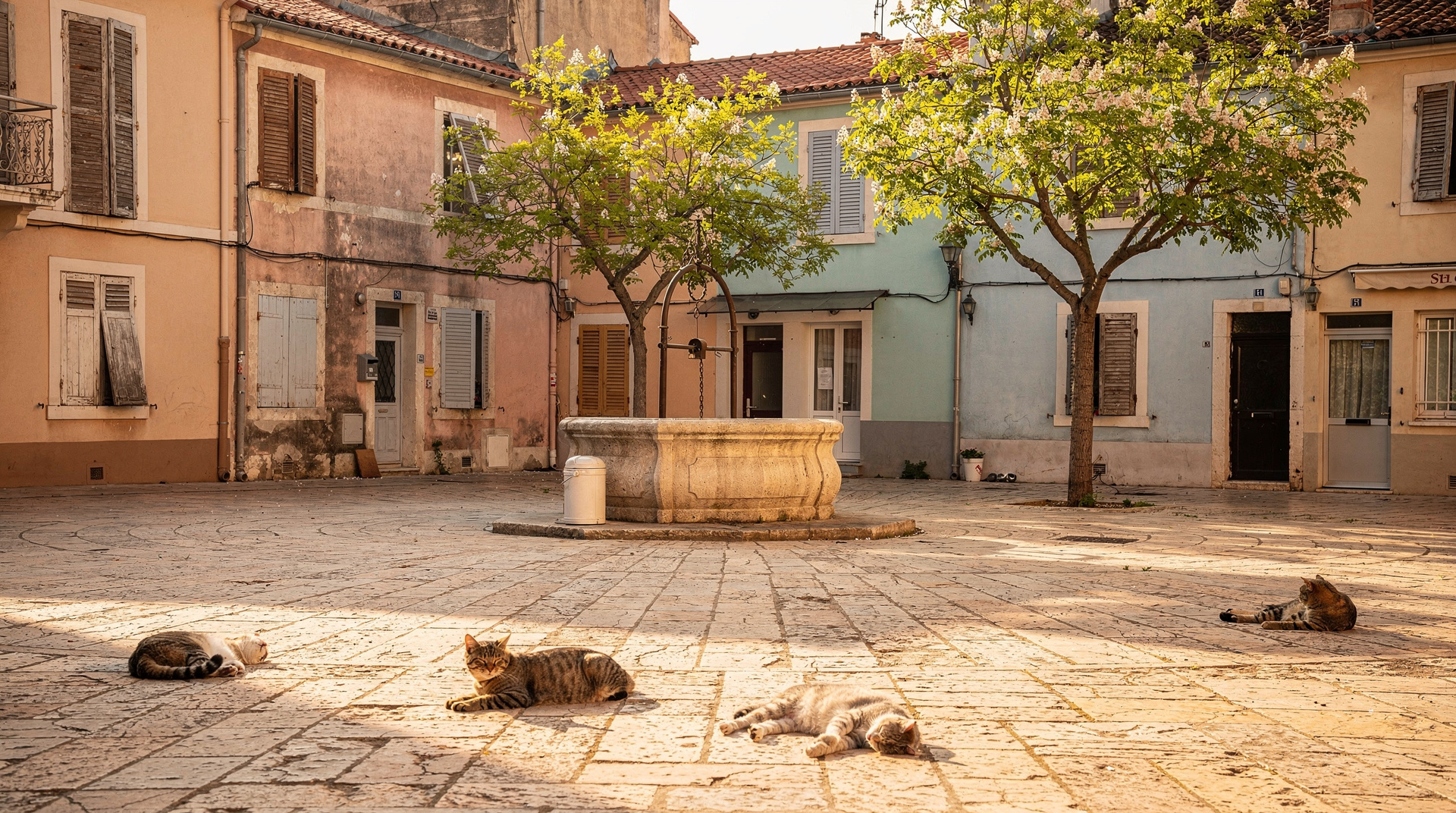
Today the square is quiet and almost entirely untouristy: a cluster of late-19th-century buildings, a few benches, some plane trees, and views north over the city toward the limestone hills behind Marseille. Few tourists reach it; most settle for the Vieille Charité and the lanes immediately adjacent. Place des Moulins rewards those who climb the extra 10 minutes beyond the Charité.
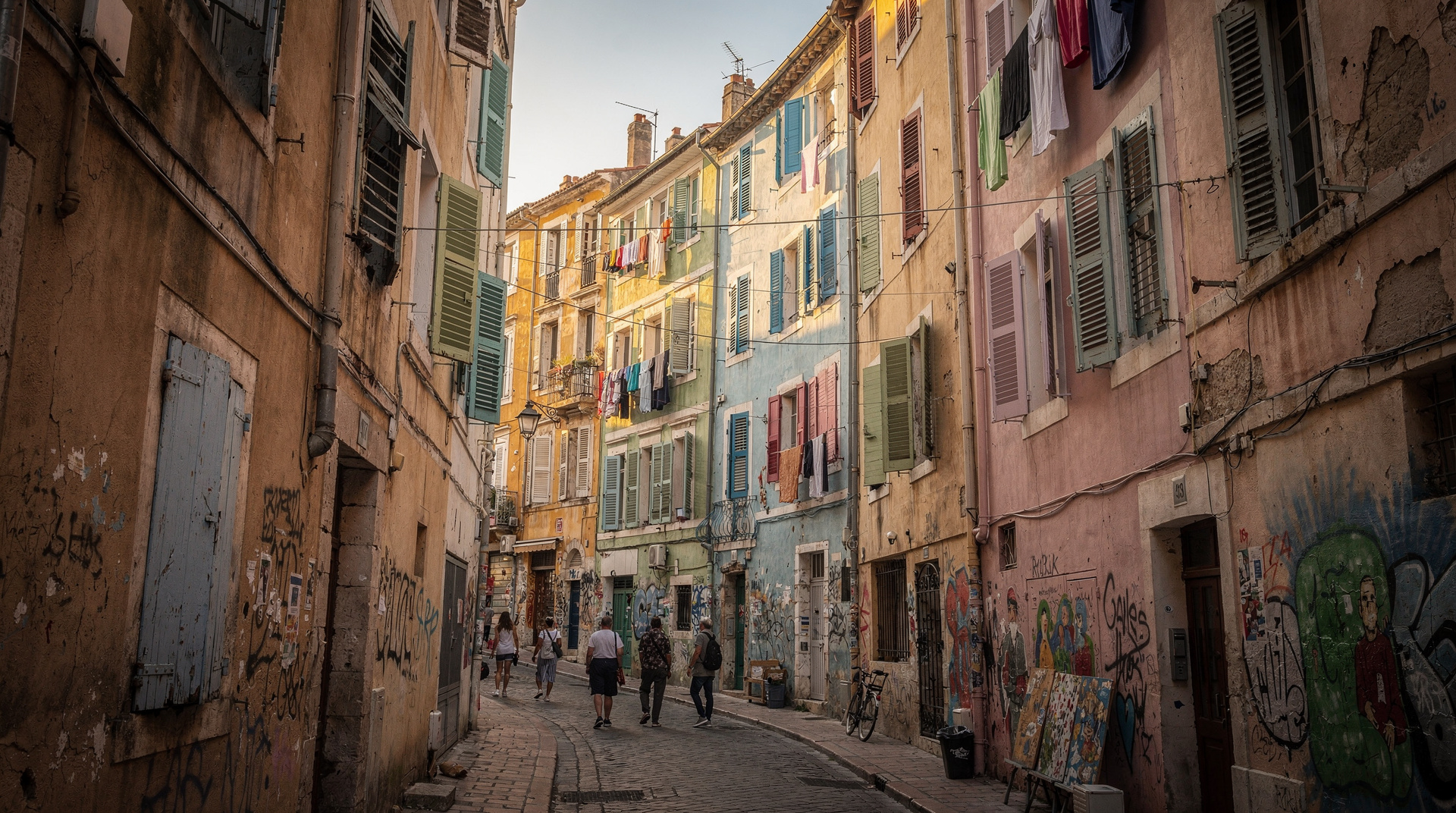
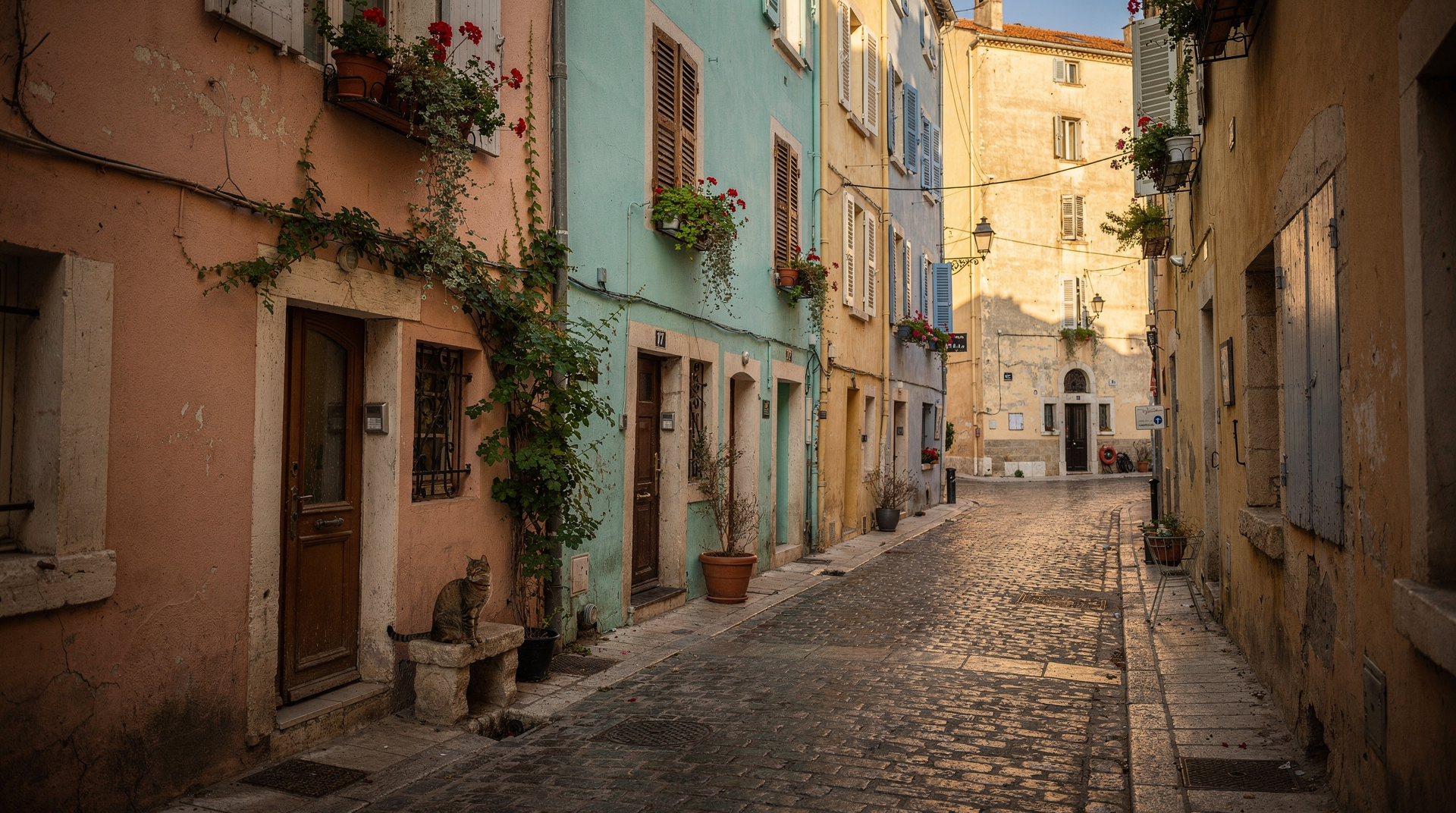
The streets between the Vieille Charité and Place des Moulins — Rue du Panier, Rue du Petit Puits, Montée des Accoules — contain the most photographically productive section of the quarter: pastel-painted walls (blue, ochre, terracotta, faded yellow), washing lines strung between balconies, cats on windowsills, doorways opening into narrow interior courtyards.
Street art in Le Panier
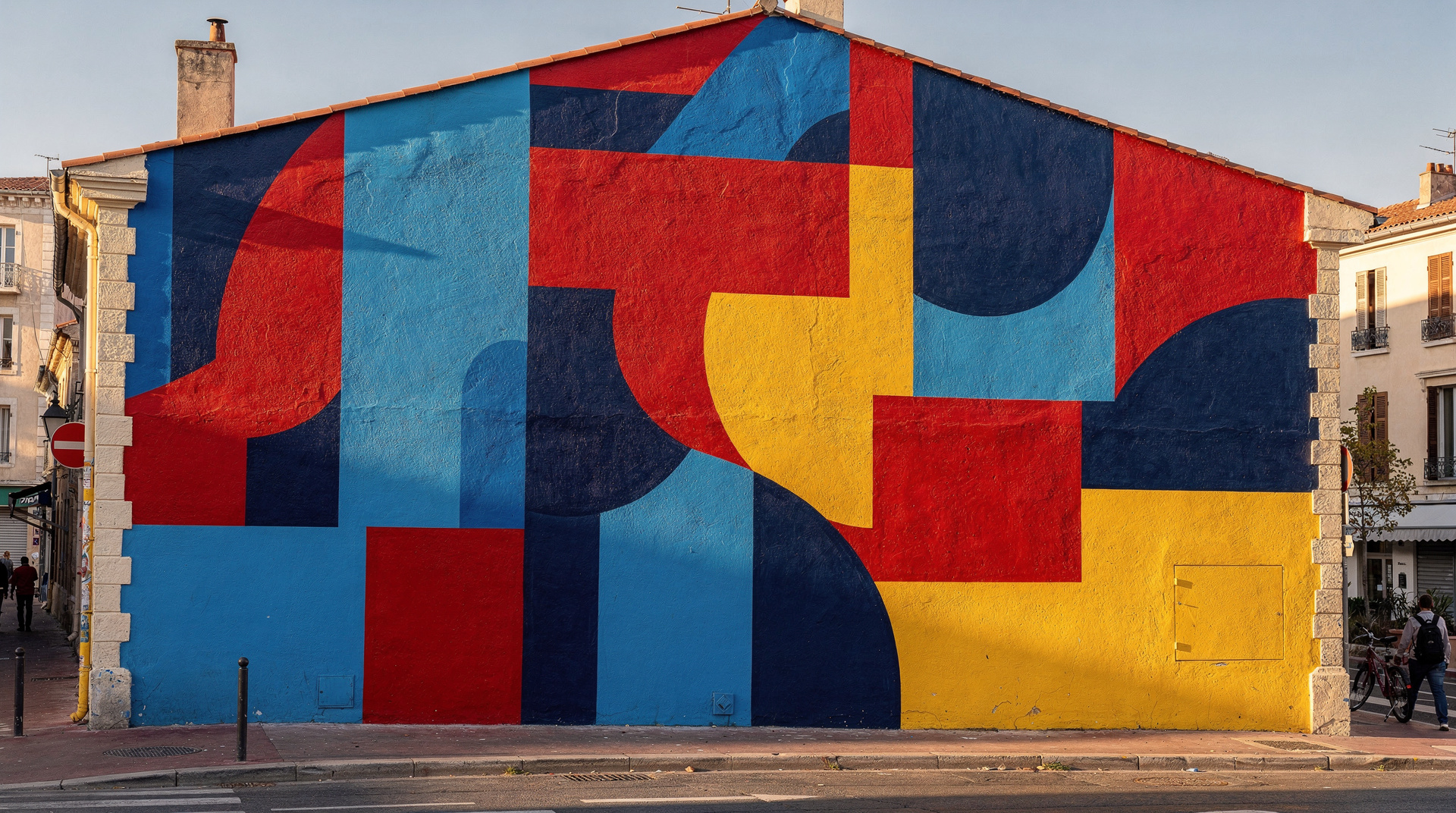
Le Panier’s street art is different in character from Cours Julien’s monumental building-scale murals. Here it is more intimate: small to medium-sized pieces woven into the texture of the lane walls, often playful or political, sometimes semi-hidden at the end of a narrow passage or around a corner.
The most productive approach is simply to walk without a map, turning into any alley that looks interesting. The quarter is small enough that you cannot get seriously lost — if you go downhill, you reach the Vieux-Port; if you go uphill, you reach Place des Moulins. Within that range, every lane is worth exploring.
Some pieces have been there for years; others are new. The rotating nature of street art in Le Panier means no guide (including this one) can give you a definitive map — what matters is the attention to the walls, not a checklist.
Soap ateliers and artisan workshops
Le Panier has a small but genuine artisan economy. Several workshops produce savon de Marseille — the traditional olive-oil soap that has been made in the region for centuries — and sell directly. The genuine article is 72% vegetable oil content, made in Marseille or the immediate region, and bears the authentic mark. Counterfeit “savon de Marseille” from factories elsewhere is sold everywhere in tourist Marseille; the Le Panier ateliers are among the most reliable sources of the real thing.
Beyond soap, the quarter contains potters, perfumers, textile workers, and photographers’ studios scattered among the residential streets. The boundary between shop, workshop, and home is often intentionally blurred — the potter in the ground floor of a building where the upper floors are apartments, the ceramics arranged in a window half-open to the lane.
This is not a curated artisan market in the tourist sense. It is a neighbourhood with working ateliers that also sell, at their own pace, on their own terms.
Where to eat in Le Panier
Dining options in Le Panier proper are limited compared to the Vieux-Port or Cours Julien. The lanes are too narrow for large terraces, and the neighbourhood is primarily residential. What exists tends toward:
Small lunch spots: Sandwiches, simple plates, and salads served from the few restaurant-cafés scattered through the upper quarter. Prices are honest — this is not a tourist-trap zone — but selection is limited.
Panini and street food: Several spots near the Vieille Charité offer quick lunch options at around 5–8 EUR. Suited to eating while walking or sitting on the courtyard steps.
A serious lunch: For a sit-down lunch that showcases what Le Panier produces as opposed to where you eat it, walk downhill 5 minutes to the Vieux-Port south quai back streets (Cours Estienne-d’Orves area), which have better restaurant selection while still being within the Le Panier orbit.
The most honest food-related thing Le Panier offers is proximity to the fish market below it. For a morning visit, stopping at the fish market (Quai des Belges, before 9:00) before climbing up into Le Panier gives you the full bottom-to-top sequence of the old city in two hours.
When to visit
Morning (8:00–11:00): Best light for photography. The lanes are quieter before guided tour groups arrive (typically 10:00 onward). The fish market below is active. This is the recommended window.
Midday: Busier, hotter in summer. Guided tours arrive in numbers. Still entirely enjoyable but more crowded.
Late afternoon: The light from the west catches the pastel facades at a good angle. Slightly cooler. The quarter quiets as some visitors depart for dinner.
Evening: Quiet. A few bars and restaurants operate in the lower edges of Le Panier near the Vieux-Port. The upper quarter is residential and peaceful after 20:00. Not a nightlife destination.
What to skip
The lower section of Rue de la République: The main commercial boulevard connecting the Vieux-Port to the Joliette passes through the lower edge of what is sometimes called Le Panier but is actually a 19th-century Haussmann-era street with banks, chain stores, and apartments. Not worth time compared to the authentic upper quarter.
Guided big-group tours: The narrow lanes of Le Panier become extremely congested when a group of 20+ tourists moves through together. If you book a tour, choose small-group or private options — the atmosphere of the quarter rewards unhurried exploration rather than checkpoint-to-checkpoint commentary.
Connecting Le Panier to your Marseille visit
Le Panier makes the most sense as part of a Vieux-Port morning: fish market at 8:30, cross the north quai, climb into Le Panier by 9:30, Vieille Charité by 10:30, Place des Moulins by 11:00, back down and across to MuCEM for the late morning. This gives you the historic core of Marseille in a continuous 3-hour walk without backtracking.
Building a day around the quarter
Le Panier works best as one chapter of a longer day rather than a destination on its own. The walk down from Place des Moulins leads naturally to the Vieux-Port, and from there the MuCEM guide picks up the story on the waterfront. If you are still deciding how much time the city deserves, the Marseille for first-timers guide helps you slot the quarter into a wider plan, and the Marseille in one day itinerary shows one way to combine it with the other classic stops.
For the neighbourhood itself, the Le Panier destination page gives a quick overview, while the Vieux-Port destination page covers the harbour you will keep looking down on as you climb. Visitors who enjoy the quarter’s lanes and murals often continue to Cours Julien, where the street art is bolder and the atmosphere more bohemian. And if the climb has left you hungry for the city’s signature dishes, the Marseille food tour guide points to what is worth eating once you are back at sea level.
The Vieille Charité in more detail
The hospice complex is a more significant building than its casual mention in most Marseille tourist literature suggests. Pierre Puget, who designed it, was the most important sculptor of 17th-century France — a rival to Le Brun and the favoured artist of Colbert. Working on the Charité in his native Marseille was both a practical commission and a personal statement. The central chapel, with its oval drum dome and the Baroque lantern above it, demonstrates the influence of Bernini and Borromini that Puget absorbed during years in Rome and Genoa.
The complex initially housed Marseille’s poor and vagrants — a form of social control as much as charity, common across French cities in the 17th century following Colbert’s great enclosure of the poor. It was an unhappy institution in practice, and its charitable function eventually contracted. The building fell into disrepair, serving as barracks and then as housing for the Spanish Republican refugees who arrived in Marseille after the fall of Barcelona in 1939.
The restoration carried out by the city from the 1970s onward reclaimed the building for cultural use. The archaeological museum inside houses Egyptian artefacts — mummies, reliefs, and ceremonial objects from the ancient world — that are somewhat unexpectedly impressive given their provenance in a Marseille municipal collection. The MAAOA (Musée des Arts Africains, Océaniens et Amérindiens) on the upper floors contains ethnographic objects from the French colonial period, now curated with a critical lens.
The historical trauma of 1943
The Nazi destruction of Le Panier in January 1943 is part of the neighbourhood’s identity and is worth understanding before you visit. The German occupiers, aided by the French police under the Vichy government, expelled the entire population of the lower Panier — approximately 1,500 residents, many of them Jewish or Roma — and dynamited the district’s waterfront buildings over four days. The stated justification was sanitary (the buildings were labelled insalubrious) but the operation was systematically anti-Semitic and a deliberate act of urban destruction.
The area you walk through today — particularly the rebuilt section below Rue de la Guirlande — is post-war construction on the cleared ground. The older, authentic Le Panier begins above this line. The contrast in architecture is abrupt and, once you know what you are looking at, legible: 1950s concrete below, 17th–18th century stone above.
Photography: the specific spots
For photographers specifically, the most productive areas in Le Panier:
Rue du Panier: The lane closest in character to the traditional quarter’s texture — narrow, irregular building heights, laundry visible, the occasional courtyard gate ajar. Best in mid-morning when the sun is still on the east-facing walls.
Montée des Accoules: The stepped street connecting the waterfront level to the Vieille Charité plateau. The steps themselves, and the perspective along them from the bottom, are consistently strong compositionally.
Place de Lenche: A small square at the western edge of Le Panier, overlooking the port. The combination of Mediterranean light, the flat roof terraces of the buildings below, and the distant sea horizon make this an unusual viewpoint.
Inside the Vieille Charité courtyard: The three tiers of galleries surrounding the oval chapel, photographed from the courtyard level, give a powerful sense of the baroque scale. Morning light enters the courtyard from the east.
The alley walls: Textured plaster walls in shades of terracotta, ochre, and faded blue — some painted deliberately, some weathered to these colours naturally. These make excellent detail shots and context photographs that convey the neighbourhood’s material quality better than any wide-angle overview.
For the neighbourhood context and comparison with other Marseille areas, see our neighbourhoods guide. For the Vieux-Port specifically, see our Vieux-Port area guide.
Extending the visit
Beyond street art and architecture, Le Panier connects naturally to a few other Marseille interests. For coffee stops on the way up or down the hill, see our best cafés in Marseille guide. For the city’s wider street art scene beyond Le Panier’s intimate alley pieces, our Marseille street art guide covers Cours Julien and other districts.
If a soap atelier visit catches your interest, our soap workshop diary covers a hands-on savon de Marseille session in the neighbourhood. And for what actually makes the quarter special beyond the guidebook checklist, see our why we love Le Panier piece.
Frequently asked questions about Le Panier guide
Is Le Panier safe to walk around, including in the evening? Yes, during the day and early evening it is as safe as any central Marseille neighbourhood popular with tourists — normal city awareness applies. After dark, the upper quarter is quiet and residential rather than a nightlife area, so it is best treated as a daytime and early-evening destination rather than somewhere to wander late at night.
Do I need a guide to visit Le Panier, or can I explore it alone? You do not need a guide — the quarter is small, safe to wander without a plan, and impossible to get seriously lost in, since downhill always leads back to the Vieux-Port. A guide adds historical depth (particularly around the 1943 destruction and the Vieille Charité), but independent exploration captures the atmosphere just as well, especially in the morning light.
Top experiences
Bookable activities with verified prices and instant confirmation on GetYourGuide.