Prado beaches guide: Marseille's main sandy waterfront explained
Marseille: half-day e-bike tour from cruise port
Duration: 4 hours
Which Prado beach section is best for families?
Plage du Borély (Prado Nord) — the widest, sandiest, most fully facilitated section. Lifeguards mid-June to mid-September, shallow entry, outdoor showers, toilets, and beach restaurants. Bus 83 from the Vieux-Port stops directly outside.
The Prado beaches: artificial origin, genuine function
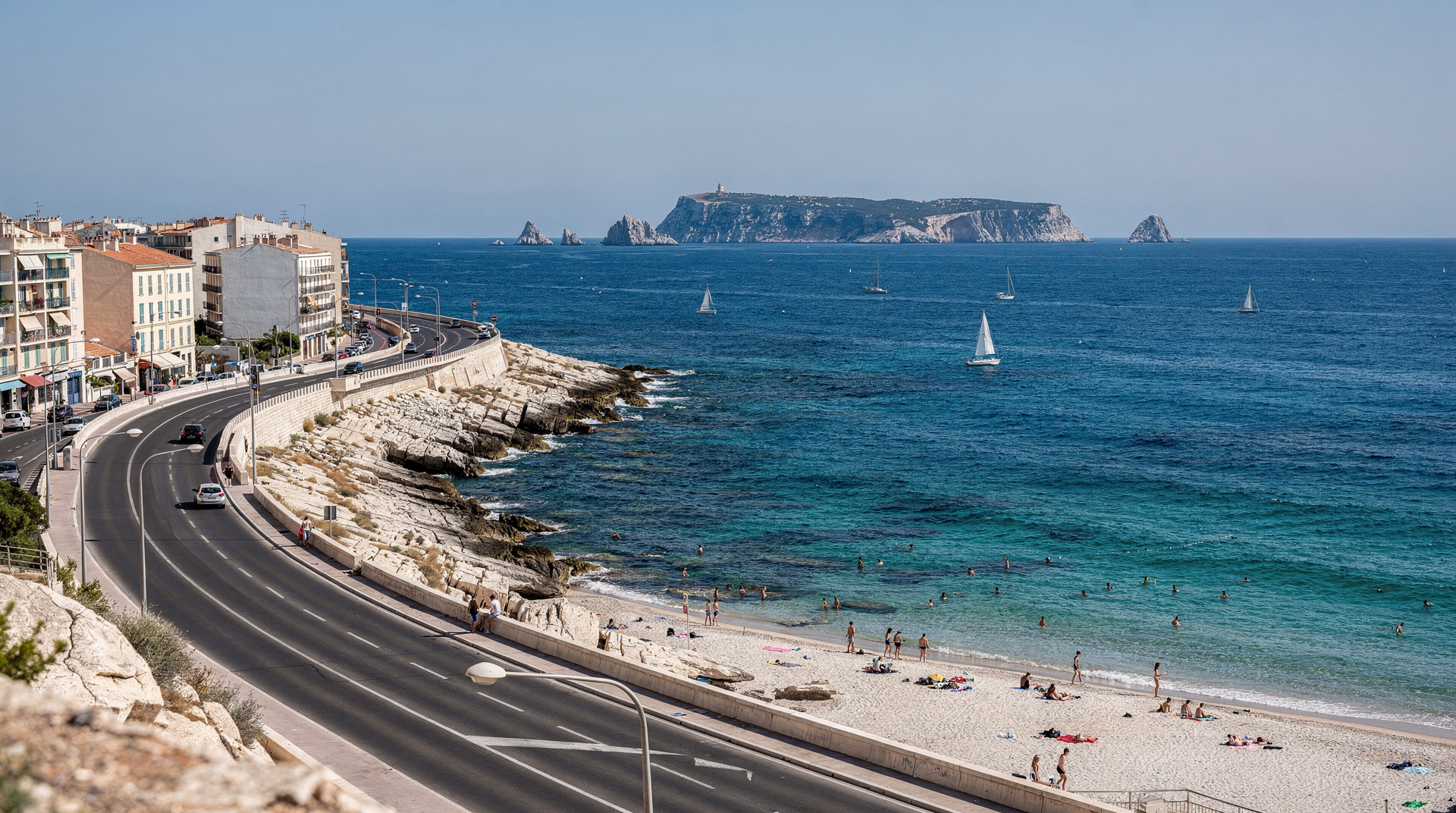
The Prado beach chain is Marseille’s main organised swimming and recreation zone — approximately 3.5 kilometres of sandy coastline in the southern 8th arrondissement (arrondissement 8). The beaches are entirely artificial. They were created between 1974 and 1981 from material excavated during the construction of the Marseille metro system, deposited on the rocky shoreline south of the city to create a sandy beach zone where none previously existed.
This origin story is worth knowing because it explains the uniformly sandy character of the entire Prado chain — unlike the Calanques (limestone pebble and rock) or Les Catalans (mixed sand and pebble), the Prado beaches are consistently sandy from one end to the other. The sand itself is from quarries in Provence, deposited and maintained through seasonal replenishment.
The result is genuinely functional: 3.5 km of sandy beach within 6 km of the Vieux-Port, served by public transport, with facilities that meet the standard a family expects. The Prado beaches are where Marseille people go to swim on a weekday afternoon, and where visitors on a beach day find the most reliable infrastructure.
| At a glance | |
|---|---|
| Where | 8th arrondissement, southern Marseille, around 6 km from the Vieux-Port |
| Cost | Free beach access; private sunloungers around EUR 15-30 for two |
| Time needed | A few hours to a full day |
| Getting there | Bus 83 from Castellane métro, around 20-30 minutes |
| Best time | June or September for warm water without peak-August crowds |
The sections: Borély to Pointe Rouge
The Prado beach zone is divided into named sections. From north to south:
Plage du Borély (Prado Nord)
The most northern section and the longest stretch of continuous sand in the Prado chain. Borély is approximately 1 km long, open, and wide enough to spread out even on moderately busy summer days. The sand is clean and regularly maintained by municipal machinery (typically early morning runs on weekdays).
Facilities:
- Lifeguards mid-June to mid-September, approximately 10:00–19:00
- Free outdoor showers (cold water) at multiple points along the beach
- Public toilets at the beach access points
- Several beach restaurants and snack bars (seasonal)
- Beach volleyball courts (north section)
- Petanque areas (north end)
Water: Seabed is sandy with a gradual slope — the depth at 5 metres offshore is approximately 1–1.5 metres. Good for children who want to stand in the sea and play at the water’s edge. Depth increases gradually, not dramatically.
Water quality: Borély consistently receives good EU bathing water quality results in the annual monitoring (classified as “excellent” or “good” in recent seasons). After heavy rain, urban runoff can temporarily affect quality — the city beach monitoring website publishes real-time results.
Adjacent: Parc Borély: The beach is immediately adjacent to Parc Borély — an 18th-century landscaped park with a lake, rose gardens, and the Musée des Arts Décoratifs in the Château de Borély. The park is free to enter and provides shade, picnic lawns, and a cool green contrast to the beach. The combination of park and beach makes the Borély area the best full summer day zone in southern Marseille.
Plage de Bonneveine
South of Borély, Bonneveine is slightly narrower and somewhat less crowded on busy summer days. The facilities are equivalent — lifeguards in season, showers, toilets, snack bars. The crowd tends slightly younger than Borély, with more water sports presence along the shoreline.
Between Bonneveine and Pointe Rouge, several intermediate beach sections (sometimes listed as Plage des Sablettes, Plage du David, and others by local signage) continue the sandy character of the Prado chain. These intermediate sections are less visited than Borély and sometimes provide calmer options on peak summer days.
Plage des Sablettes specifically is a smaller, slightly less-visited section between Bonneveine and Pointe Rouge. Good option when Borély is at capacity. The same water quality and gradual slope apply across the chain.
Pointe Rouge
The southernmost section of the Prado zone, Pointe Rouge is where the sandy beach character transitions toward the rocky Calanques. The beach here is smaller than Borély but has a distinct character: it is the water sports hub.
Pointe Rouge marina and water sports: The marina at Pointe Rouge is the base for SUP rental, kayak rental, and several diving clubs. Organised boat tours to the Calanques depart from here. The combination of a small beach with immediate access to organised water activities makes Pointe Rouge useful for visitors who want a beach base with activity options.
Private beach clubs at Pointe Rouge: Several private beach concessions operate at Pointe Rouge, offering sunloungers, parasols, and table service lunch at premium prices (typically EUR 20–30 per person for sunlounger plus food and drink). These occupy portions of the beach adjacent to the free public area.
Getting there: bus 83 and alternatives
Bus 83 is the essential transport link for the Prado beaches. It runs from the Castellane métro station (line 1) along the Corniche Kennedy to Rond-Point du Prado, passing Catalans, the Endoume area, and stopping at all major Prado beach sections. Journey time from Castellane: approximately 20–30 minutes. Frequency: every 10–15 minutes in summer.
Practical use: Board at Castellane (or at multiple stops along the Corniche) and alight at the beach stop that matches your destination section. The stops are named after the beach zones and are clearly signed. A single RTM ticket costs approximately EUR 1.70.
Tram T2: Reaches Rond-Point du Prado from the city centre and Joliette. From Prado tramway stop, the beach is a 10-minute walk south, or continue on bus 83 or 19.
Bicycle: The Corniche has a dedicated cycle path for most of its length. Le Vélo (Marseille bike-share) has stations along the Corniche. Cycling from the Vieux-Port to Borély takes approximately 20–25 minutes. The Prado beach zone itself has no bicycle parking infrastructure — lean against a road railing and lock.
Car: Paid parking in the Prado area in summer (EUR 2–3 per hour). Parking fills quickly on summer weekend afternoons — arriving before 10:00 is the only reliable strategy. Bus 83 is genuinely better for summer beach days; the parking stress is disproportionate to the distance.
Play areas and kids’ infrastructure
Borély has no dedicated children’s playground on the beach itself, but Parc Borély immediately adjacent has lawns, open green space, and a small playground zone appropriate for young children. The park provides the shade and quiet play environment that the beach cannot — it is the natural complement to a Borély beach day.
The beach volleyball courts at the north end of Borély are used by all ages and are open for public use when not occupied by organised groups. Petanque courts (boulodrome) adjacent to the beach are a free public facility.
Swimming gradient for children: The gradual sandy slope at Borély and Bonneveine makes these suitable for young children who want to wade and play in shallow water. The depth at 10 metres from shore is approximately 60–80 cm in the main swimming area — confident children can play independently in this zone.
Private beach clubs: worth it?
Along the Prado chain, private beach concessions (plages privées) rent sunloungers and parasols at EUR 15–30 for a set of two per day. The premium buys: numbered, cleaned sunloungers with a parasol, towel rental, drinks and food service to the lounger, and generally cleaner shower facilities.
The public beach immediately adjacent is free and has the same sand and water. The choice is essentially: pay for the service infrastructure or bring your own equipment (towel, parasol if desired, cooler).
For families spending a full day at the beach, the private club option eliminates logistics — everything arrives and is cleared away by staff. For budget-conscious travellers, the public section works perfectly with a beach bag and a towel.
What the Prado beaches do not have
For context: the Prado beaches are functional urban beaches, not Côte d’Azur glamour destinations. The scenery is pleasant but not spectacular — the backdrop is a mix of residential buildings and the Hippodrome (racecourse). The water visibility is good but not the 15-metre clarity of the Calanques. The service level at the private clubs is friendly but not luxury.
For the most beautiful water in the region, the Calanques and Les Goudes coves are what the Prado cannot match. For family convenience and reliable infrastructure closest to Marseille, Borély is the right answer. The two serve different purposes and the honest advice is to do both: a morning at Borély, an afternoon trip to the Calanques by boat.
Pairing the Prado with the rest of your trip
A Prado afternoon slots easily into a wider plan. If you are building a short stay, the Marseille in one day and Marseille in two days itineraries show where a beach break fits between the Vieux-Port and the hilltop sights, and the three-day family itinerary puts a beach morning at the centre of a relaxed rhythm. Travellers who prefer to stay without a car will find the Marseille without a car itinerary useful, since the Prado works well with buses and the tram.
For help with the bus, tram and métro connections mentioned above, our getting around Marseille guide and Marseille métro guide cover ticketing and routes. If you are still choosing a base, where to stay in Marseille and the best area to stay for families explain which neighbourhoods keep a beach day within easy reach.
Water temperature and swimming season
The Mediterranean water temperature at the Prado beaches follows the same seasonal pattern as the rest of the Marseille coast. May averages 17°C — cold without a wetsuit. June reaches 20°C. July–August peaks at 23–24°C — the standard family swimming season. September stays at 22°C, with fewer crowds than August and equally comfortable water.
Jellyfish: Pelagia noctiluca (mauve stinger) can appear at Prado beaches in July–August. Blooms are unpredictable — check with the lifeguard on the day. In most years, jellyfish are absent or sparse at the Prado; in bloom years (which have been more frequent as Mediterranean waters warm), they arrive in swarms and effectively close the beach for swimming for 1–3 days at a time before dissipating with wind changes.
The hippodrome and the surrounding area
The Hippodrome de Marseille (horse racing track) runs alongside the southern edge of the Prado beach zone. Racing seasons in spring and autumn bring occasional road closures around the track perimeter on race days — this can affect bus 83 routing and vehicle access. If you are visiting on a weekend in May or October, check whether racing is scheduled, as the area becomes busier and parking significantly more difficult.
Adjacent to the hippodrome, the Parc Balneaire du Prado is the organised park zone encompassing the beach, sports facilities, and greenery. The park is maintained by the city and provides the infrastructure base — public showers, toilets, footpaths, and the organised beach access points — that makes the Prado a reliable family destination rather than a wild swimming spot.
Choosing the season
The swimming-season notes above are easiest to weigh against the rest of the calendar. Our best time to visit Marseille guide and the Marseille in summer overview explain how the beach season sits alongside heat, crowds and events, while Marseille with kids gathers other ideas for days when the sea is not the plan. A rainy or too-cool day is better spent on indoor options, which the Marseille museums guide lays out.
Sunset and evening at the Prado
The Prado beaches face roughly southwest, which means summer sunsets are visible from the beach over the open sea. In July, sunset is at 21:15–21:30 — the beach in late afternoon (17:00–19:00) is still busy with families, but by 19:00 the sunlounger density drops and the evening light on the sea is beautiful. Several beach restaurants serve evening meals — a Prado dinner at dusk, with wine from Cassis or Bandol, is a pleasant way to end a beach day without returning to the city crowds.
Prado vs the other Marseille beach options
| Beach zone | Character | Best for |
|---|---|---|
| Prado (Borély, Bonneveine, Pointe Rouge) | Sandy, artificial, fully facilitated | Families, easy transport, full-day comfort |
| Catalans | Small sandy cove near Vieux-Port | Quick swim close to the centre, fills fast |
| Les Goudes / Calanques coves | Rocky, wild, clearest water | Snorkelling, scenery, less crowding out of peak hours |
For a fuller comparison of all the city’s swimming spots, see our best beaches in Marseille guide. The small cove near the old port has its own write-up in the Les Catalans beach guide, and the coastal road that links Catalans to the Prado is covered in the Prado and Corniche guide. If the sea tempts you beyond the city, snorkeling near Marseille and the Frioul islands are the natural next steps, and Vallon des Auffes is a pleasant sunset stop along the Corniche.
Frequently asked questions about Prado beaches guide
Are the Prado beaches free? Yes — all public sections of the Prado beach chain are free to access, with free showers and toilets. Private beach clubs at Pointe Rouge charge for sunloungers and service, but the sand and sea beside them are free.
Which Prado section has the calmest water for young children? Borély and Bonneveine both have a gradual sandy slope well suited to wading and shallow play; see the swimming gradient notes above for approximate depths.
For beach access to the Calanques from Cassis, see the Calanques beaches guide. The Corniche and Prado destination guide covers the coastal road, cycling routes, and full Corniche context. For family-specific beach planning across the region, see the family beaches guide.
Top experiences
Bookable activities with verified prices and instant confirmation on GetYourGuide.