Marseille street art guide: Cours Julien and beyond
Marseille: alternative walking and street-art tour with local drink
Where is the best street art in Marseille and how do I find it?
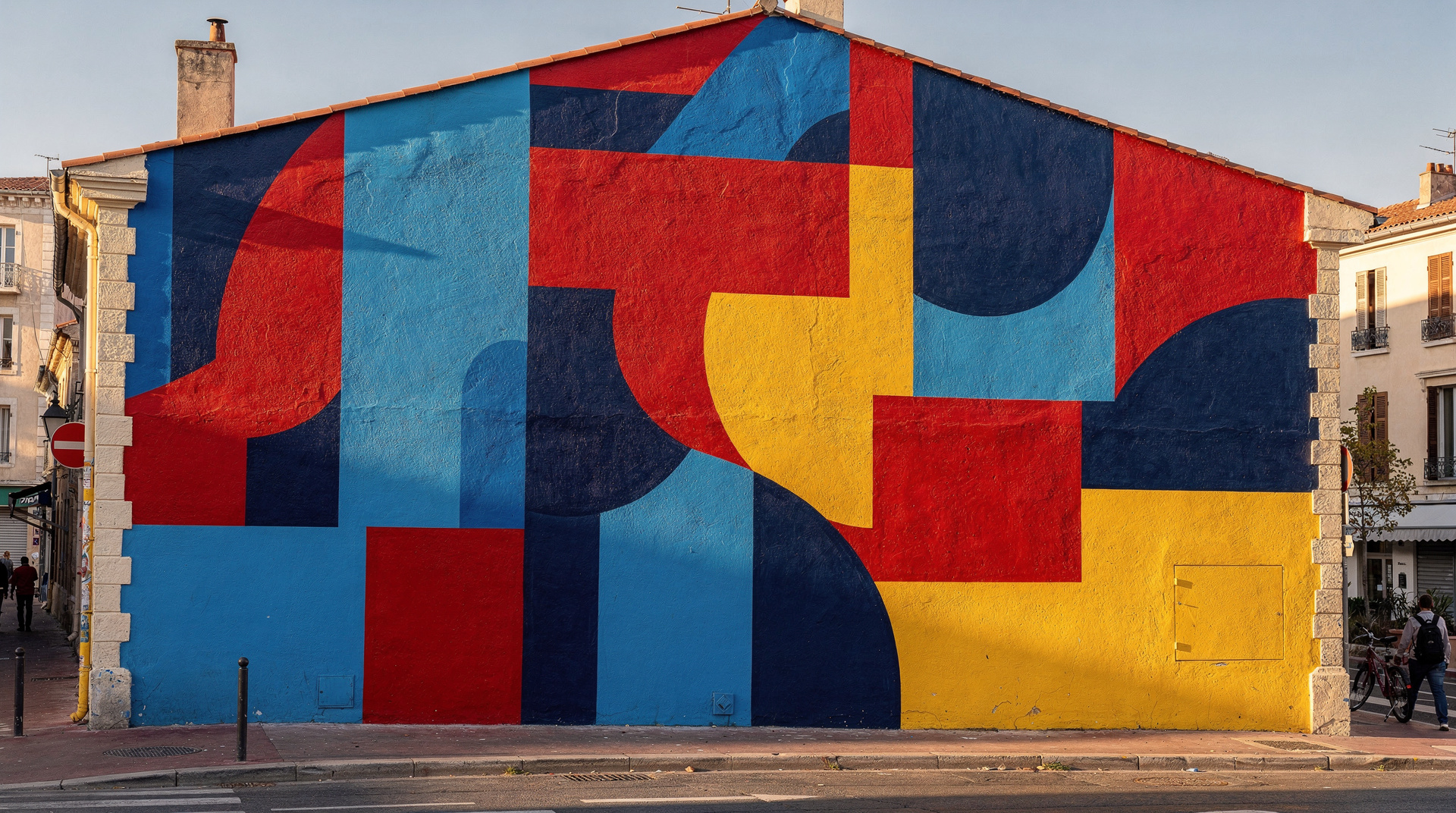
Cours Julien is the centre — building-scale murals cover entire facades in a 4-block radius. Take M2 to Notre-Dame du Mont – Cours Julien. Allow 2 hours for the area and explore Rue des Trois Mages, Rue Crudère, and the side streets north of the square. Le Panier has smaller-scale work in a more intimate setting.
A city that has been writing on its walls for decades
Marseille’s relationship with street art predates the Instagram economy and the urban branding moment. When artists and musicians moved into the empty wholesale market buildings around Cours Julien in the late 1970s and 1980s, they began painting the walls because the walls were there and the space was cheap. The scale grew from tagging to murals to building facades — not because anyone planned it, but because the artists who came here were serious and the surfaces kept presenting themselves.
What exists now in Cours Julien and the surrounding streets is one of the most impressive concentrations of large-format outdoor mural art in France. These are not decorations added to a neighbourhood; they are part of the neighbourhood’s structure, its identity, and its ongoing conversation with itself.
| At a glance | |
|---|---|
| Where | Cours Julien district (M2 Notre-Dame du Mont), plus Le Panier lanes |
| Cost | Free — it’s public walls, no ticket anywhere on the circuit |
| Time needed | Around 2 hours for Cours Julien; add 1–1.5 hours for Le Panier |
| Getting there | M2 métro to Notre-Dame du Mont – Cours Julien, or 15–20 min walk from Vieux-Port via Noailles |
| Best time | Weekday mornings or early Saturday for fewer people in frame; golden hour for photos |
Cours Julien: the centre of gravity
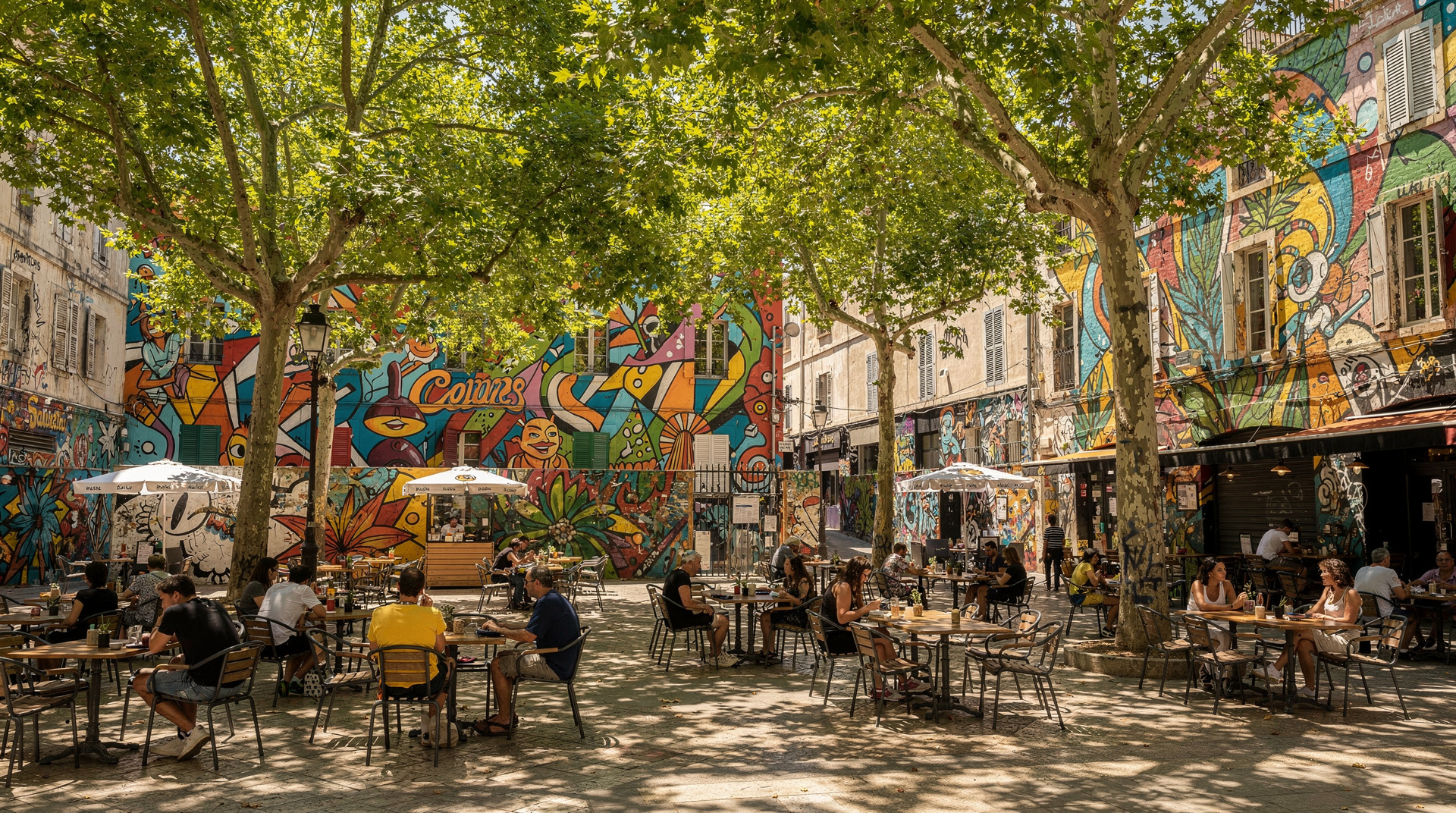
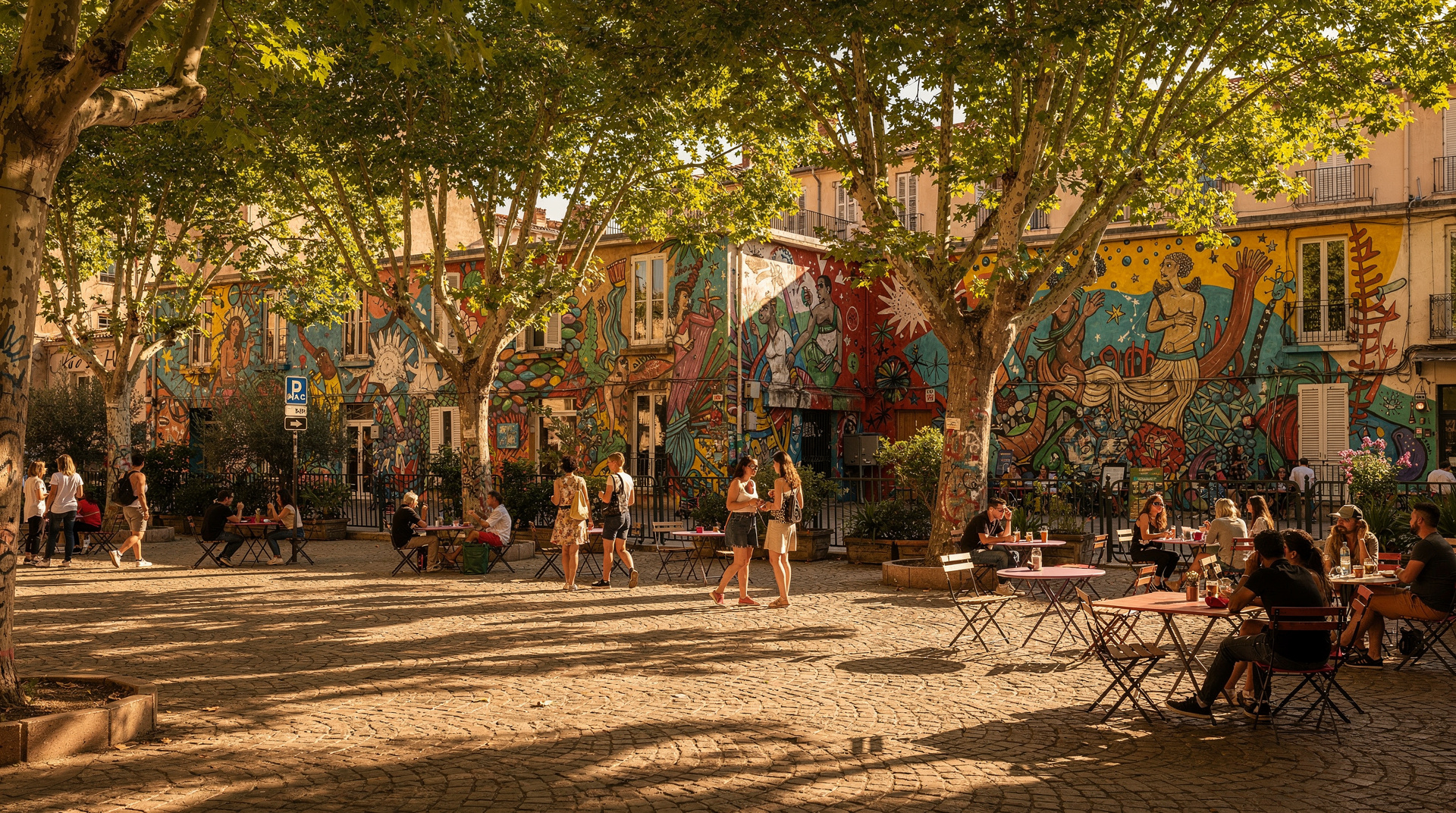
The Cours Julien district — roughly bounded by Boulevard Garibaldi, the Noailles area, and the Réformés neighbourhood — holds the largest and most ambitious murals in Marseille. The scale is the first thing that registers: these are not wall panels but building-end paintings that cover six and seven storeys of exposed facade, visible from two or three streets away in every direction.
The concentration is densest in the streets immediately surrounding the Cours Julien square:
Rue des Trois Mages: Immediately east of the square, this is one of the richest single streets for murals. Multiple large-scale works of high technical quality are packed into a short block.
Rue Crudère: Running north-south parallel to the square, with several major pieces on the residential buildings.
Rue Jean Roque and the passages to the north: The streets and covered passages north of the square carry work that ranges from quick throw-ups to carefully executed large-scale compositions.
The steps of Montée de la Vierge: A tiled staircase connecting the Cours to the Notre-Dame du Mont area, with integrated artwork on the walls and risers. One of the more photogenic spots in the district.
The square itself: Several of the buildings bordering the Cours Julien square carry major works on their facades.
A thorough walk through the 4-block radius around the square takes about 90 minutes to 2 hours if you actually look at the works rather than just photograph them. Allow more time if you want to understand what you are looking at.
Place Notre-Dame du Mont: the late-night continuation
Place Notre-Dame du Mont — the small square adjacent to the church of the same name, immediately north of the Cours Julien square — is both a social space and another concentration of street art. The church wall and the buildings facing the square carry significant works. The square itself is the centre of the evening bar culture that extends from the Cours Julien, and the art is part of its atmosphere rather than a separate attraction.
From the Place du Mont, exploring east into the streets toward the Réformés neighbourhood turns up additional murals less visited by tourists — the density drops but the quality does not.
Le Panier: a different register
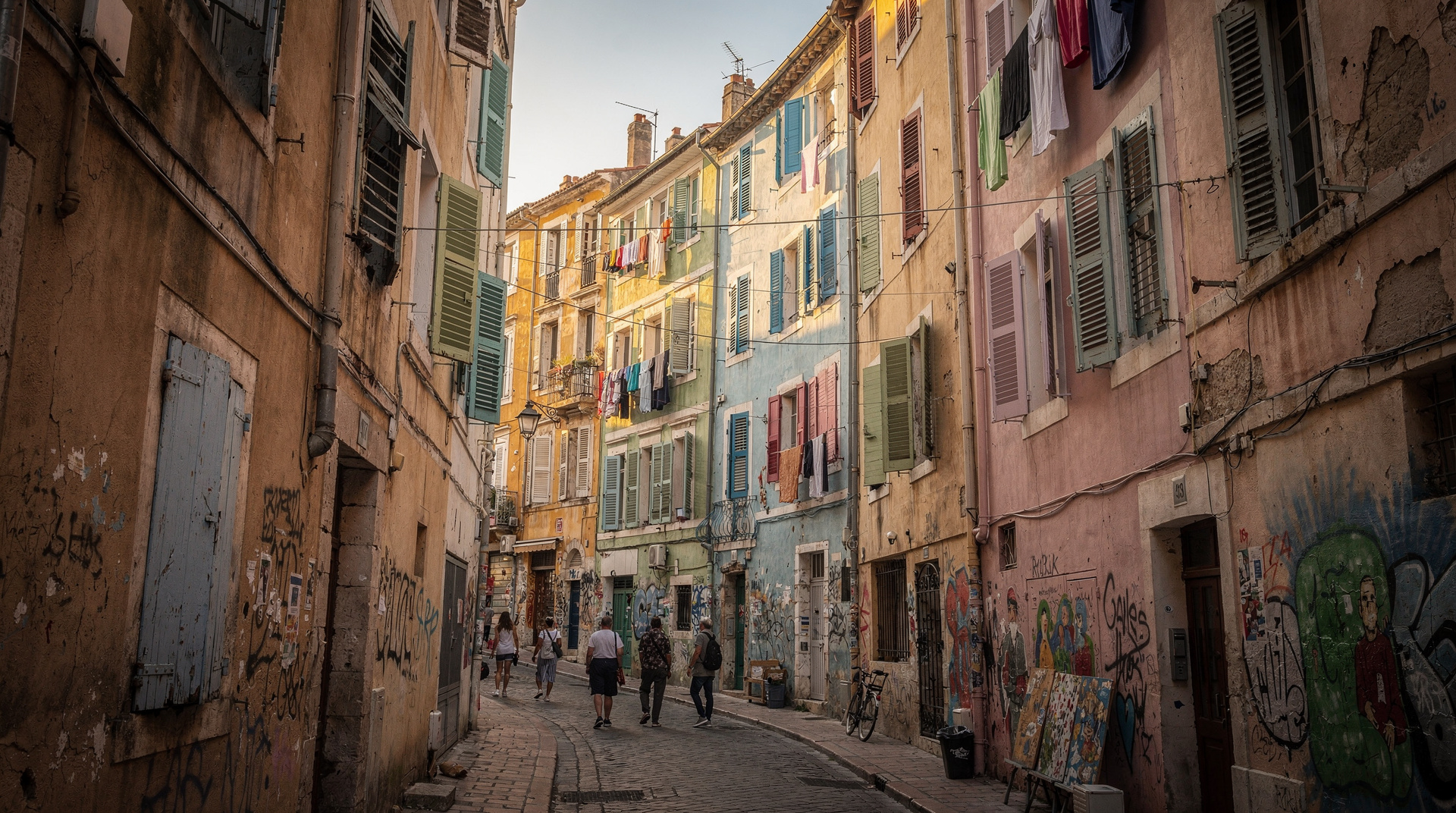
The street art in Le Panier operates at a different scale and mood from Cours Julien. The lanes are too narrow for building-facade murals, and the art here tends to fill smaller surfaces — archway soffits, staircase walls, shuttered shop fronts, courtyard corners. The pieces are smaller, often more intimate, and embedded in the 17th-century fabric of the neighbourhood in a way that feels organic rather than commissioned.
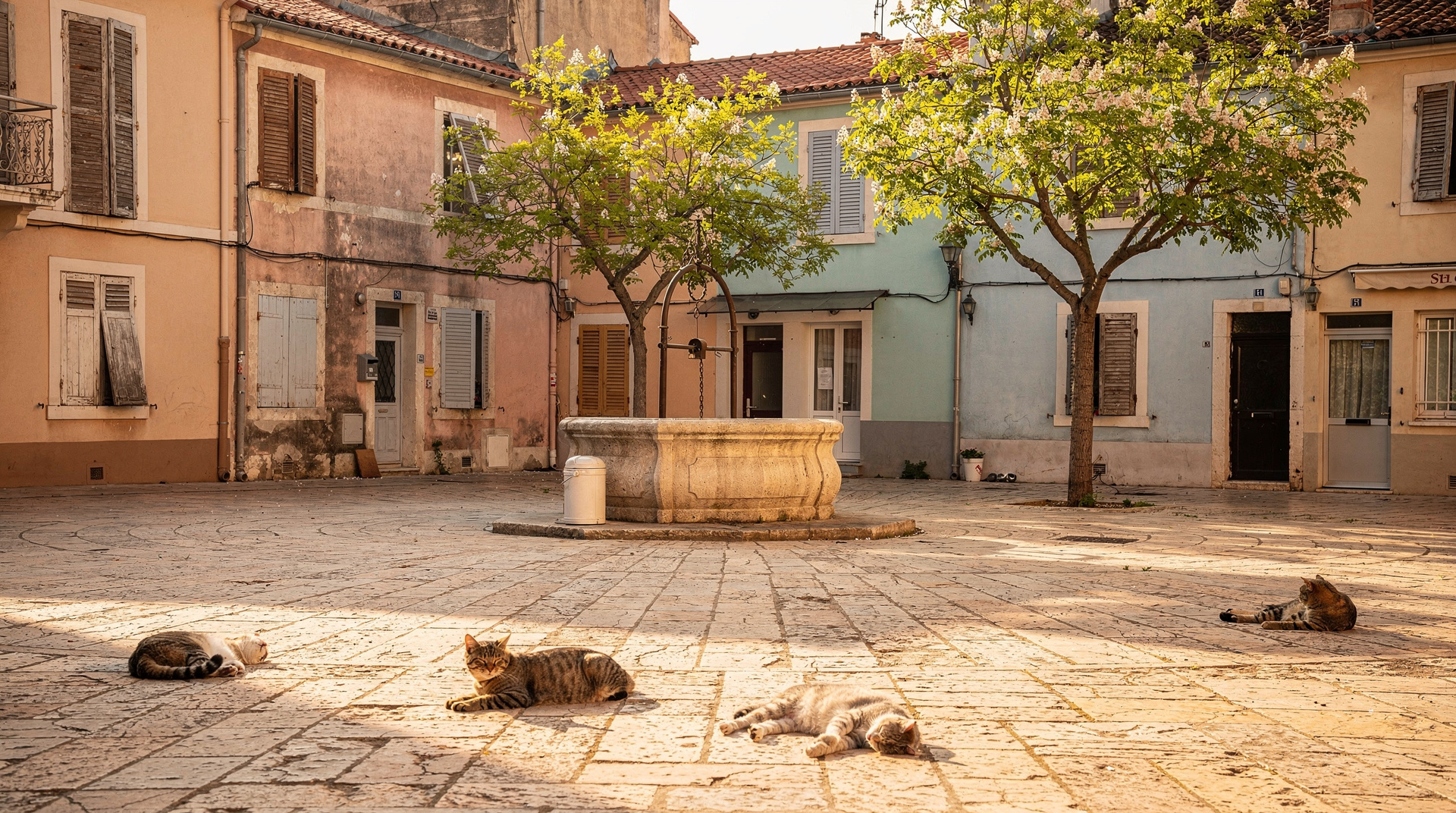
The area around Place du Refuge and the upper Rue du Panier has the strongest concentration. The contrast between the pastel plaster walls, the Mediterranean light, and the contemporary art creates an atmosphere that Cours Julien — more urban, more assertive — does not replicate.
For photography: Le Panier’s light and setting often produce better individual photographs; Cours Julien’s scale produces better documentation of the art’s ambition. If you have time for both, walk Le Panier in the morning for the light, and Cours Julien in the afternoon.
The MAR collective and Marseille’s organised street art scene
The Marseille Art Republic (MAR) collective has been one of the driving forces behind the organised large-scale mural programme that defines much of what you see in Cours Julien. MAR works with property owners, local authorities, and visiting international artists to commission building-scale works on available facades. The collective has brought artists from across Europe and beyond to work in the district, and has helped establish Marseille as one of the credible stops on the international street art circuit.
The festival Marseille Provence — which takes place annually — includes street art events and new commissions in Cours Julien and sometimes other districts. The exact programme varies year to year; check local listings during your visit.
What MAR represents is important for understanding what you are looking at: Cours Julien’s murals are not all spontaneous — many are commissioned, negotiated, and planned. But this is not a criticism; the best commissioned murals here are as ambitious and personal as anything made without permission. The commission format allows the scale. The scale is what makes Cours Julien exceptional.
The guided tour versus independent exploration
The guided street art and alternative walking tour (see above) covers approximately 2 kilometres in 2 hours, hitting the most significant murals with context on the artists and their work, the neighbourhood’s social and cultural history from the 1980s onward, and the role of street art in Marseille’s reinvention. It typically includes a drink at one of the local bars — a format that works well for getting inside the neighbourhood rather than remaining a spectator of it.
What a guide adds: Context is the primary value. Many of the most significant pieces are works by internationally exhibited artists who also maintain public art practices — knowing this changes how you look at the work. The neighbourhood’s history as a wholesale market, its counter-cultural 1980s and 1990s period, and its current role in Marseille’s creative economy are all threads that a good guide makes visible.
Independent exploration: Start at the Notre-Dame du Mont métro station (M2) and walk in any direction. The murals are embedded in the neighbourhood — you cannot miss them. Turn into any side street that draws your eye. The art is not hidden or signed; it is on the walls and available to anyone who looks.
Best photo spots and practical photography advice
Lighting: Morning light from the east works best for the south-facing walls on the north side of the streets. Afternoon light is better for the north-facing walls. The golden hour before sunset turns some of the large figurative pieces into extraordinary photographs.
Avoiding crowds in frames: The area is busiest on Saturday afternoon and weekend evenings. Early Saturday morning (before the market fills) is the best time to photograph the square and surrounding streets with fewer people. Weekday mornings are the quietest.
The challenge of scale: Building-scale murals are genuinely difficult to photograph with a phone. A wide-angle lens helps; stepping back into the opposite street helps more. Many of the best murals are almost impossible to capture in their entirety from street level. The alternative is to find the section that works and photograph that — an honest strategy that produces better individual images than an incomplete wide shot.
Night photography: Several of the murals face streetlit walls or are near bars with exterior lighting. The Cours Julien area at night offers interesting low-light photography opportunities — the social life happening in front of the murals is often as visually interesting as the art itself.
Getting there and the street art circuit
From central Marseille: Take M2 (red line) to Notre-Dame du Mont – Cours Julien station. This deposits you directly at the square. One stop from Noailles (M1/M2 interchange at the Vieux-Port end), which itself connects to Vieux-Port and Gare Saint-Charles.
On foot from the Vieux-Port: 15–20 minutes uphill via Rue d’Aubagne through Noailles (the North African market quarter, itself visually rich and worth time). The walk through Noailles passes food stalls, spice shops, and the general energy of one of the most genuinely multicultural streets in France.
On foot from Le Panier: 20–25 minutes via the Canebière and Noailles.
A coherent street art day in Marseille: Morning (9:00–11:30) in Le Panier — the intimate version of Marseille street art at its best light. Take the ferry across from the Vieux-Port south quai, walk up through Le Panier to the Vieille Charité and around the upper lanes. Then descend to the Vieux-Port for a mid-morning coffee and take M2 to Cours Julien. Spend the afternoon (12:30–17:00) working through the district, eat in one of the neighbourhood restaurants in the evening. This gives you both scales and contexts in a single day.
The economics and ethics of large-scale street art
The street art landscape of Cours Julien raises questions that are worth engaging with rather than bypassing. Some of what you see is commissioned — paid for by property owners, local authorities, or cultural organisations — and some is unauthorised. The distinction is not always obvious from the work itself.
The commissioned model has advantages: it allows the scale that defines the district’s character, it compensates artists for significant work, and it creates durability — a commissioned piece on a facade is unlikely to be painted over quickly. The disadvantage is that commissioning introduces institutional filters: the most provocative work tends not to receive commissions from institutional sources.
The unauthorised work — tags, throw-ups, and occasional large-scale pieces — occupies a different social position. Much of it is ephemeral, painted over within weeks. The pieces that survive long enough to become part of the neighbourhood’s character are often those that property owners chose not to remove — a passive commissioning by neglect that produces its own editorial logic.
For visitors, the practical implication is this: what you see in Cours Julien is not a spontaneous expression of pure counter-cultural energy but a curated environment shaped by multiple forces — institutional commissioning, property owner tolerance, artist reputation, and the physical availability of suitable surfaces. This does not make it less interesting. It makes it legible as what it actually is: a specific cultural programme that emerged from specific historical conditions and is now maintained by a specific community of artists, residents, and institutions.
Seasonal and festival programming
The Marseille street art scene is not static. New commissions arrive regularly, existing pieces are painted over and replaced, and major new works appear without much advance notice. Several annual events bring new work to the district:
The Festival Marsatac (summer) occasionally includes street art programming alongside its music schedule. The Quartiers Libres cultural programme supports neighbourhood-level cultural events including murals. The MAR collective’s own programme continues to commission new facade works from visiting and local artists.
The practical advice: if you visited Cours Julien on a previous trip and return, the large structural pieces will be there but the medium-scale work will have changed. The neighbourhood’s visual landscape is a living document, not a fixed collection.
Beyond Cours Julien: street art elsewhere in Marseille
La Plaine (Place Jean Jaurès): The square itself and the surrounding streets north of Cours Julien have a history of political murals and large-scale work. Less curated than the Cours Julien programme, more raw.
Noailles: The market district immediately south of Cours Julien has painted shutters, graphic art on shop fronts, and a more spontaneous visual culture than the commissioned mural programme. Worth looking at as you pass through.
La Belle de Mai: The former tobacco factory district north of Gare Saint-Charles, now a creative industry hub, has building art and urban interventions across its industrial spaces. Less accessible but worth knowing about.
The Friche la Belle de Mai: One of the most important cultural facilities in Marseille — a converted tobacco factory that functions as a centre for performing arts, visual arts, and creative industries. The building and courtyard have permanent and temporary art installations. Worth a dedicated visit if contemporary culture is your primary interest.
For the full neighbourhood context — where Cours Julien sits in relation to the rest of Marseille — see our Cours Julien guide. For the city’s broader cultural landscape, see our museums guide.
Where street art fits into a longer Marseille visit
Street art is a half-day activity, not a full day, and it pairs naturally with a walk through Le Panier or a stop at Cours Julien itself for lunch or coffee once you’ve walked the murals. Several visitors combine the circuit with the museums guide’s recommendations for a rainy-day alternative, since the murals lose most of their appeal in genuinely wet weather — the light flattens and the streets empty.
If you’re building a broader itinerary around Marseille’s neighbourhoods, our hidden gems of Marseille piece covers several of the same streets from a different angle. For general orientation before you set out, start with the Marseille destination guide.
Frequently asked questions about Marseille street art guide
Is the Cours Julien street art free to see? Yes. Every mural covered in this guide is on a public street or square — there is no admission, no ticket, and no gallery to enter. The only cost is your time and, if you choose it, the price of the guided walking tour.
Can I see the murals in one visit if I only have an hour? An hour is enough to see the highlights on Rue des Trois Mages and around the square itself, but you’ll be moving quickly and skipping the passages to the north. Two hours is the realistic minimum to actually look at what you’re seeing rather than just photograph it in passing.
Top experiences
Bookable activities with verified prices and instant confirmation on GetYourGuide.