Cours Julien guide: Marseille's bohemian quarter
Marseille: alternative walking and street-art tour with local drink
What is Cours Julien like and how do I get there?
Cours Julien is Marseille's bohemian centre — street-art, natural wine bars, indie restaurants and a Wednesday/Saturday market. Take M2 to Notre-Dame du Mont – Cours Julien. Best from late afternoon through evening.
| At a glance | |
|---|---|
| Where | 6th arrondissement, Marseille, around the Cours Julien square |
| Cost | Free to walk; lunch formules around EUR 13–17, tastings/drinks extra |
| Time needed | 2–4 hours (2 hours for street art alone) |
| Getting there | Métro M2 to Notre-Dame du Mont – Cours Julien, or 15 min walk from Vieux-Port |
| Best time | Late afternoon through evening, Wednesday or Saturday for the market |
Where Marseille actually lives
Cours Julien is where you go when you want to understand Marseille as a contemporary city rather than a heritage destination. It is not the Vieux-Port — there is no fish market, no medieval fort, no departure point for boat tours. What it has instead is a density of intelligent, owner-operated restaurants, the most impressive outdoor mural programme in the south of France, a serious music scene, vinyl shops that draw buyers from across the region, and a market that sells genuine produce and genuine curiosities rather than tourist goods.
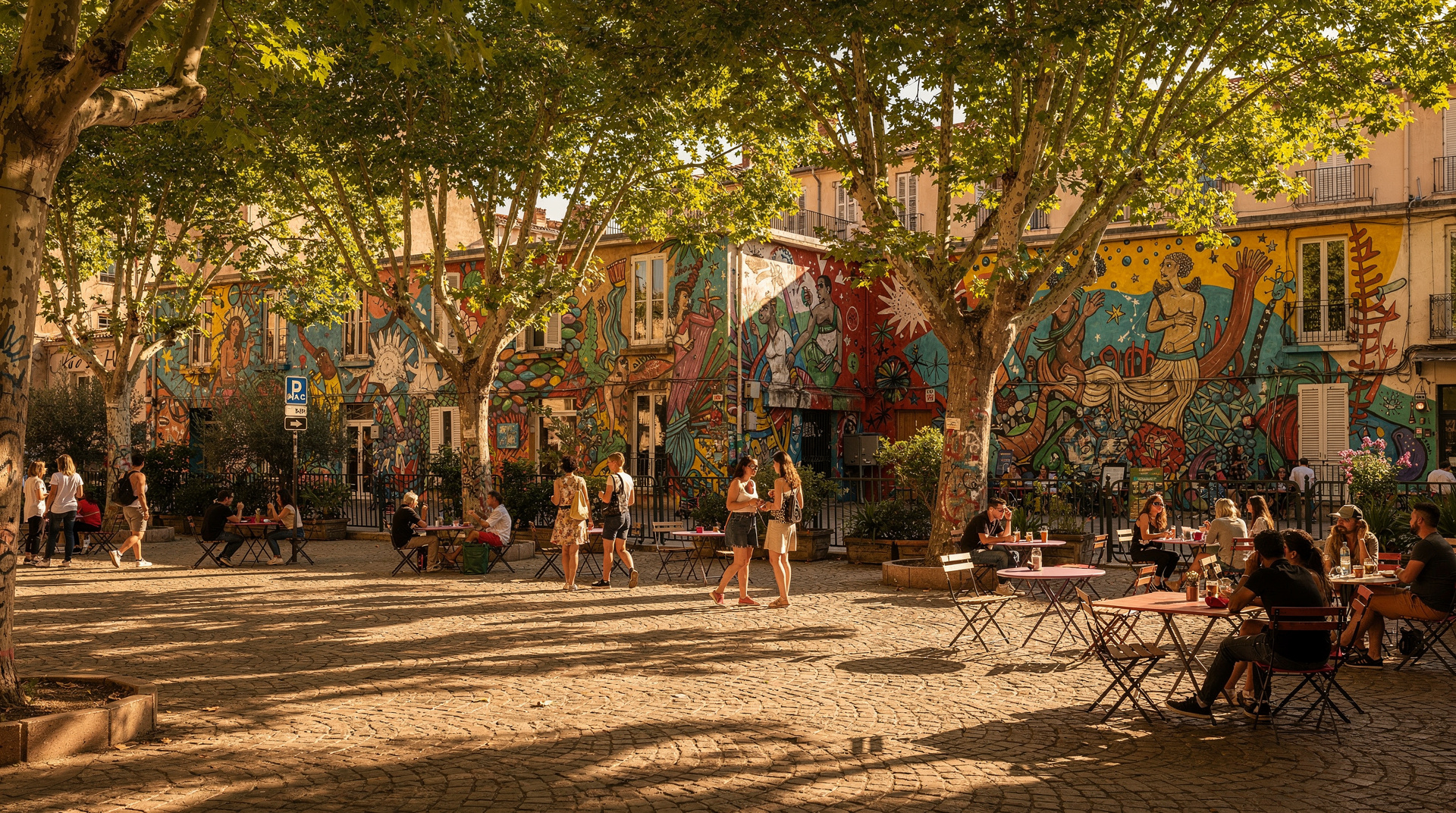
The quarter sits in the 6th arrondissement, roughly bounded by Boulevard Garibaldi to the west, Rue Breteuil to the south, and the Noailles market neighbourhood to the north. The centre of gravity is Cours Julien itself — an elongated public square lined with plane trees, sloping gently uphill — which gives its name to the entire surrounding area.
Getting there
Métro M2: The stop is Notre-Dame du Mont – Cours Julien, which opens directly onto the Cours Julien square. This is the most direct approach from any central location — one stop from Noailles (interchange with M1), which connects to Vieux-Port and Gare Saint-Charles.
On foot from the Vieux-Port: 15 minutes uphill via Rue d’Aubagne (the colourful street market route) or via Rue Paradis. The walk goes through Noailles — Marseille’s North African market district — which is a worthwhile destination in itself.
On foot from Le Panier: 20–25 minutes via the Canebière and Noailles. Not the most direct approach but an interesting walk through the central city.
The street art
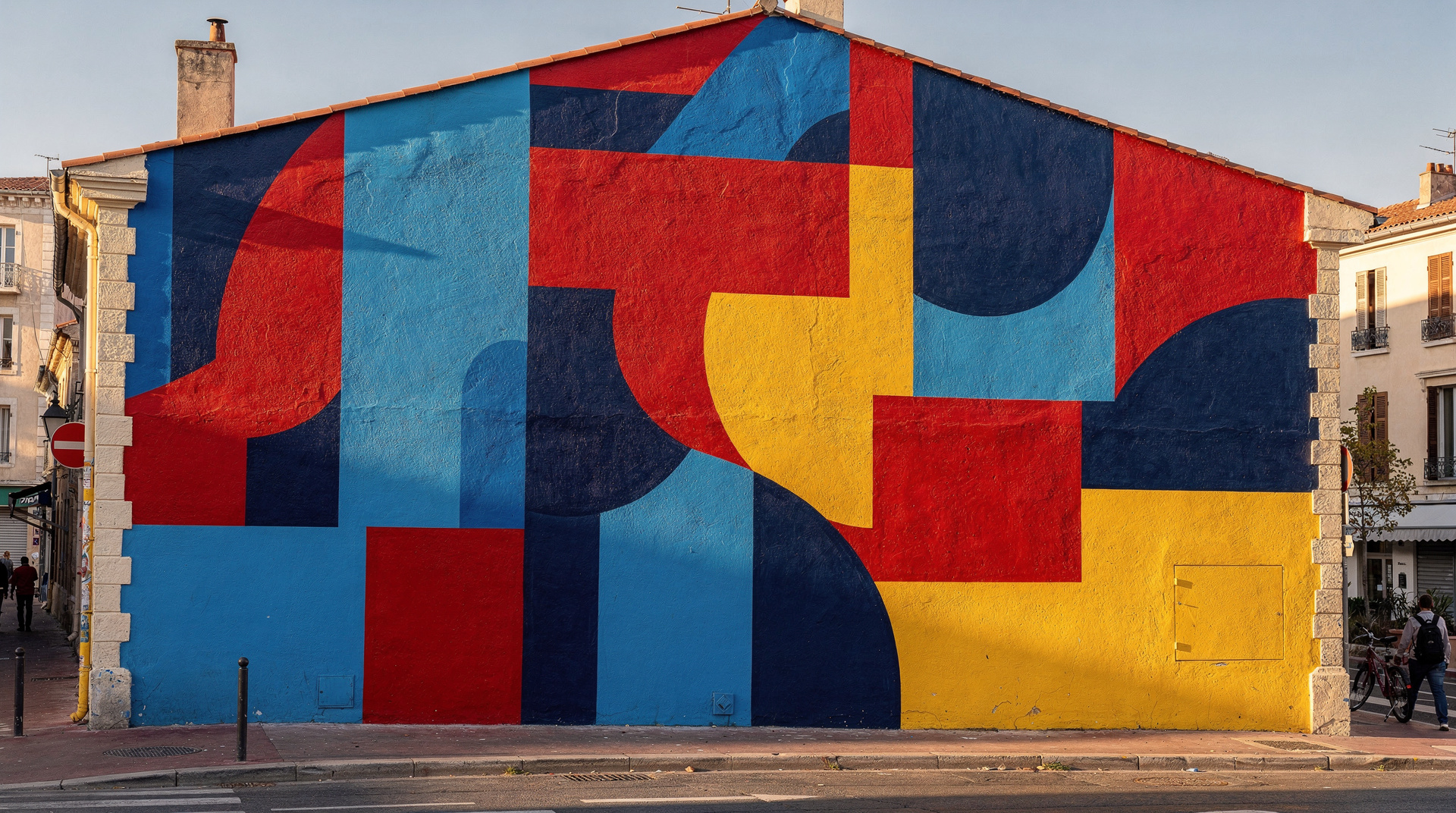
The street art of Cours Julien operates at a different scale from Le Panier. While Le Panier has small, intimate pieces woven into alley walls, Cours Julien has wall paintings that occupy the entire facades of 6- and 7-storey buildings — some of the largest outdoor murals in France, visible for blocks in each direction.
The tradition began informally in the 1980s when the quarter attracted artists and musicians priced out of other Marseille neighbourhoods. The scale has grown since: today the streets around the Cours (particularly Rue des Trois Mages, Rue Crudère, and the streets northwest of the square) carry commissioned works by artists including internationally recognised names alongside local painters.
The murals change — some are permanent, others are painted over and replaced as new commissions arrive. The best approach is to walk without a fixed list, into any side street that draws your eye. You cannot cover it in 30 minutes; allow 2 hours if street art is a priority.
Key locations:
- The Cours Julien square itself — several large-scale works on the buildings bordering the square
- Rue des Trois Mages — one of the densest concentrations, immediately east of the square
- Boulevard de la Libération (north of the square) — building-scale works on several residential facades
- The steps of Montée de la Vierge — a tiled staircase with integrated artwork connecting the Cours to Notre-Dame du Mont area
The Wednesday and Saturday market
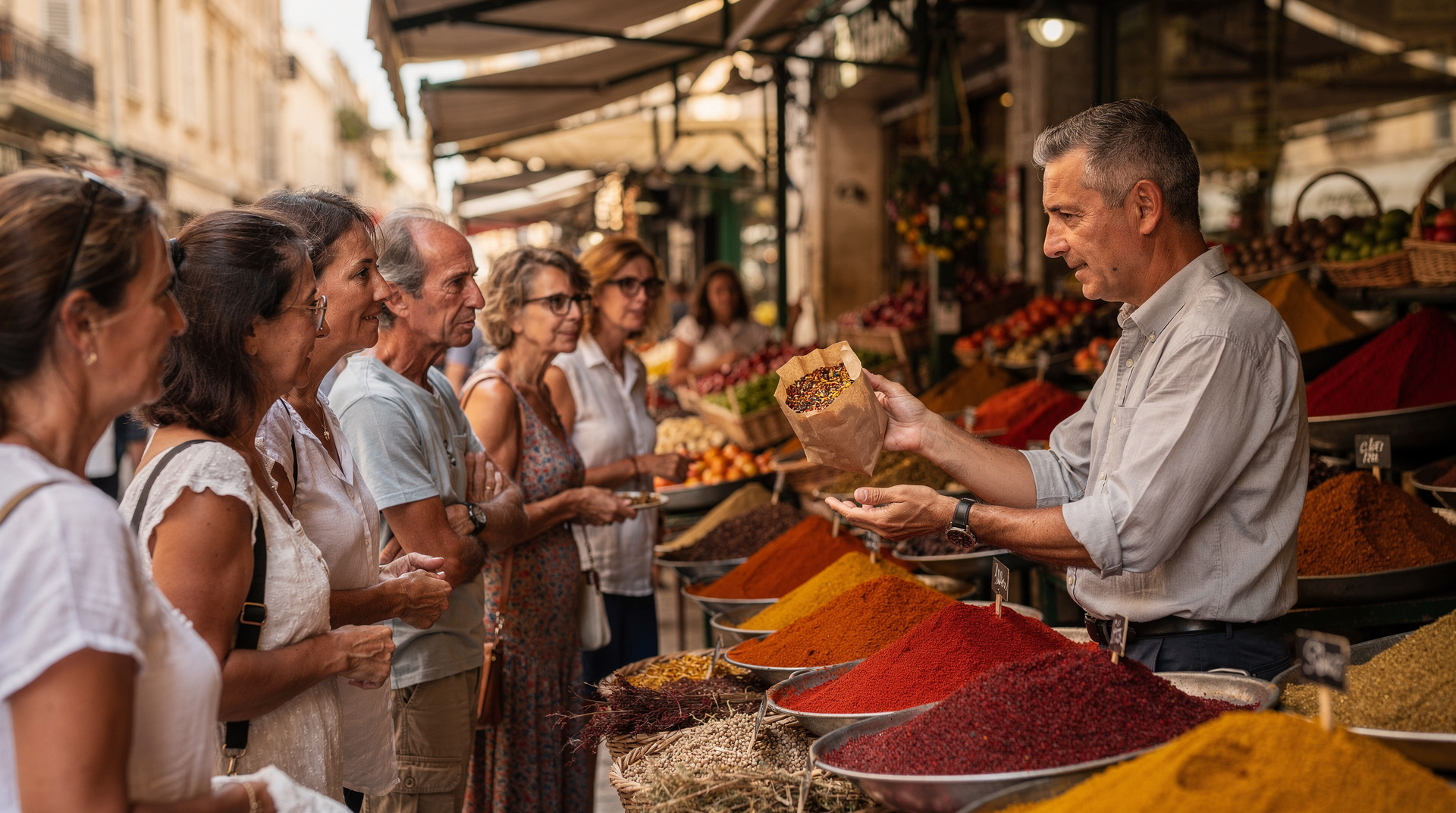
The market on the Cours Julien square operates Wednesday and Saturday mornings. It is not primarily a food market (that is Noailles, a few minutes north), but rather a general market with:
- Vintage clothing and furniture
- Antiques and brocante (second-hand collectibles)
- Vinyl records
- Plants and flowers
- Some food — seasonal produce, cheese, and regional specialities
The Saturday market is larger and draws serious buyers as well as browsers. Arrive by 9:00–10:00 for the widest selection; by noon much of the interesting stock is sold or packed up.
What to look for: The vinyl stalls are particularly worth attention. Marseille has a historically significant music scene (particularly in hip-hop and electronic music), and the record culture here is genuine — collectors, not decorators.
The restaurants: where to eat
Cours Julien has the highest concentration of interesting, owner-run restaurants in Marseille. The food skews toward:
Mediterranean-creative: Market-driven menus using seasonal produce, often with a North African or Middle Eastern influence given the neighbourhood’s cultural geography.
Natural wine: Several wine bars and restaurants with serious natural wine lists operate within the Cours Julien orbit — by far the best selection in Marseille for drinkers interested in low-intervention wines.
Vegetarian and vegan: More options here than anywhere else in Marseille. The quarter has absorbed a vegetarian and vegan dining culture that the tourist-facing zones have not.
The honest pricing note: Lunch menus (formule midi) typically run 13–17 EUR for a two-course meal with a glass of wine or water included. This is Marseille mid-range, not tourist-premium — the same quality would cost twice as much in central Paris.
When to arrive: For dinner, most Cours Julien restaurants fill between 19:30 and 21:00. Walk the square first, look at the menus in windows (printed menus displayed outside the door are standard practice), and choose before the rush. Reservations recommended on Friday and Saturday evenings.
Wine bars and aperitif culture
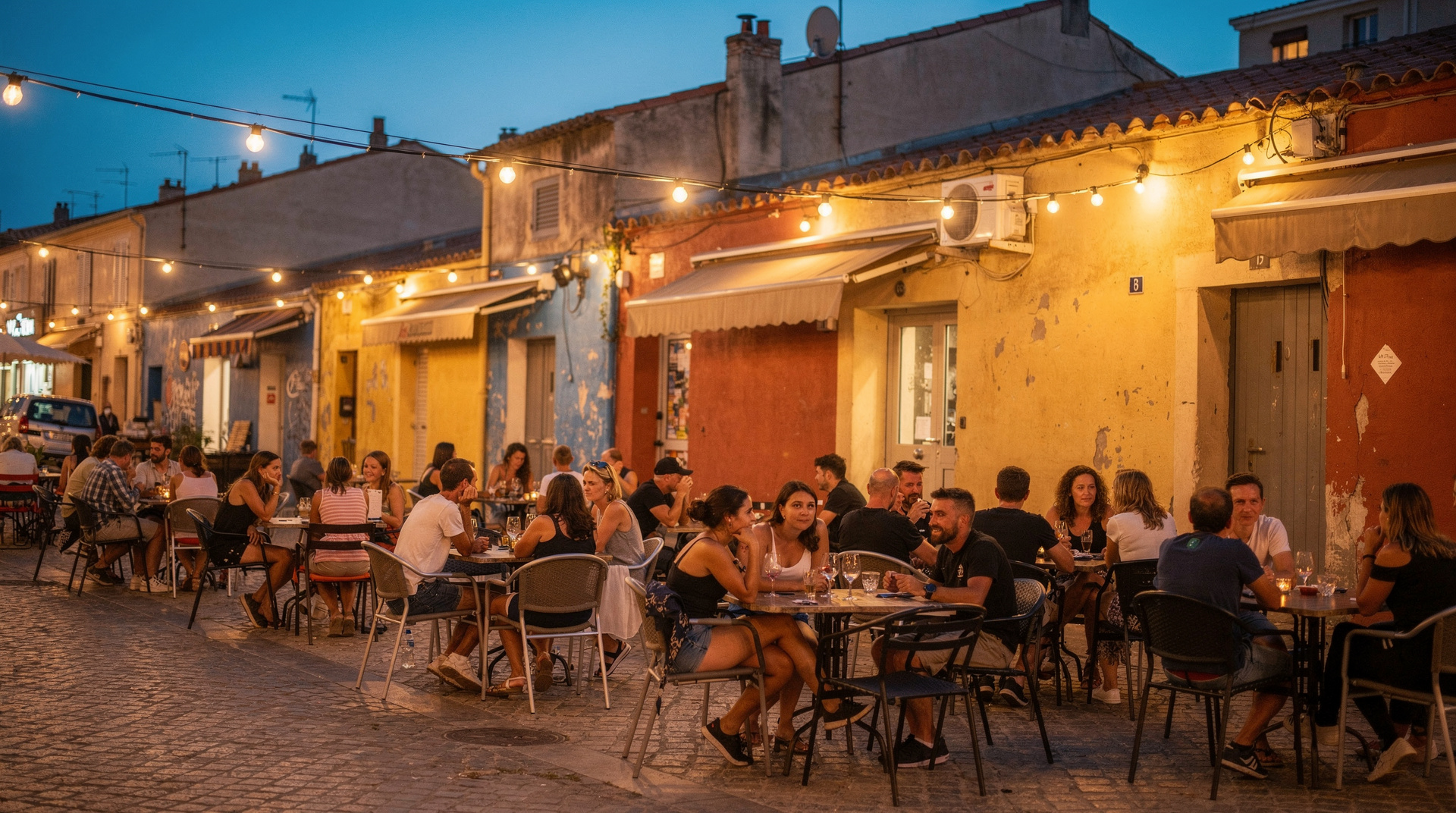
The aperitif hour at Cours Julien — roughly 17:00 to 20:00 — is a serious social ritual. The terraces of the wine bars fill with a mix of students, young professionals, musicians, and artists. The drinks tend toward:
- Pastis (this is Marseille — always available)
- Natural wine by the glass
- Local craft beer
- Non-alcoholic alternatives (most bars have serious options)
The atmosphere is not performatively hip — it is genuinely relaxed, with the easy confidence of a neighbourhood that does not need to impress tourists. That is precisely what makes it worthwhile.
Music in the neighbourhood
Cours Julien is Marseille’s music quarter. The legacy is partly hip-hop — Marseille has historically been one of the most important cities in French-language hip-hop — and partly an ongoing contemporary scene in jazz, electronic, and rock.
Several music venues operate in and around the square. The Espace Julien — just east of the Cours on Cours Julien itself — is a major mid-sized concert venue hosting national and international acts. Le Molotov (a short walk from the square) has a long history in alternative and underground music. Check venue websites for current programmes.
Record shops: Several vinyl shops in the neighbourhood cater to the local music culture. These are not souvenir shops with generic greatest-hits compilations — they are working record shops with buyers who know the stock. If vinyl is your thing, Cours Julien warrants a dedicated afternoon.
The Notre-Dame du Mont area
Directly connected to Cours Julien, the Notre-Dame du Mont neighbourhood (centred on Place Notre-Dame du Mont, adjacent to the Cours Julien square) is the late-night extension of the Cours Julien bar scene. The bars here tend to be smaller, more neighbourhood-oriented, and busier after 22:00.
Place Notre-Dame du Mont itself — the square adjacent to the church of the same name — is the late-night centre of gravity. On warm evenings, the terraces spill into the square, and the energy continues past midnight.
Honest late-night safety assessment
Cours Julien and Notre-Dame du Mont in the evening — up to midnight or so on weekdays, later on weekends — are safe urban bar environments. The clientele is mixed (students, professionals, musicians, tourists, locals) and the atmosphere is generally relaxed.
After midnight, the standard advice for any busy urban bar area applies:
- Don’t leave a drink unattended
- The usual awareness in crowded spots
- Taxi or VTC for getting home if you are late — the metro closes Monday–Thursday around 21:30, and while relay buses and night buses exist, a taxi is more reliable at 01:00
The honest assessment: Cours Julien at night is not dangerous. It is a lively urban neighbourhood, not a party zone with tourist-trap dynamics. The risks are the standard ones of any city’s nightlife district, not anything specific to Marseille.
Avoiding the Belsunce area at night: The Noailles/Belsunce market district immediately north of Cours Julien is a different proposition after dark. During the day it is a vibrant, excellent market neighbourhood. Late at night, it is quieter and less inviting — not dangerous in any absolute sense, but not comfortable territory for visitors unfamiliar with it. The boundary is roughly Rue Longue and the Cours Belsunce. Stay within the Cours Julien orbit at night.
Boutiques and shopping
The independent retail scene in Cours Julien runs parallel to the restaurant culture: owner-operated, specific, not chain-dominated.
Vintage clothing: Several serious vintage shops in the streets off the Cours — not the jumble-sale variety but curated vintage, mostly from the mid-20th century. Prices reflect curation but are fair by vintage market standards.
Ceramics and contemporary craft: Small boutiques selling work by local and regional ceramicists, designers, and jewellers. Not souvenir shops — work by actual makers.
Books and zines: Independent booksellers and a zine culture operating from several spots around the quarter. French-language stock predominantly.
Connecting Cours Julien to your Marseille visit
For a typical visit, Cours Julien works best as an evening destination: arrive around 17:00 for the aperitif hour, walk the street art, have dinner, and continue into the evening. It pairs naturally with a morning in the Vieux-Port or Le Panier — the two bookend Marseille’s day very satisfyingly.
Building Cours Julien into a longer stay
Cours Julien rarely fills a whole day, so the useful question is what to put around it. If you are still deciding how long to spend in the city, our how many days in Marseille guide helps you weigh an evening here against the big sights. A first visit usually works well with the Marseille for first-timers overview, which places the quarter alongside the Vieux-Port and the hilltop basilica.
For a ready-made sequence, the Marseille in one day and Marseille in two days itineraries show where an evening in the 6th arrondissement fits. With more time, Marseille in three days leaves room for a slow morning market and a long dinner.
If you plan to stay nearby, where to stay in Marseille compares the areas, and the Cours Julien destination page gives a short summary of the quarter. Food-minded visitors can pair the aperitif hour with the best restaurants in Marseille and vegetarian Marseille guides, while the best cafés in Marseille are useful for a slow morning before the market crowds build.
Getting back to your hotel after a late night is easier with a plan, so read getting around Marseille and the Marseille metro guide before you go. Our Marseille pickpocket zones guide covers the habits worth keeping in busy crowds, and the is Marseille safe guide puts the city’s reputation in context.
The history of Cours Julien as a neighbourhood
The physical transformation of Cours Julien from a working wholesale market to a creative quarter is a specific mid-20th century urban story. Before the 1970s, the Cours functioned as a wholesale food market — a logistics hub for the city’s food supply, with loading docks, warehouses, and the daily grunt work of market economies. When the wholesale function moved to a new facility at Arnavaux in the northern arrondissements, the buildings around the Cours emptied.
The void was filled from the late 1970s and 1980s by people who needed cheap space and could not get it elsewhere: musicians, painters, theatre companies, graphic designers, and eventually small restaurants and bars. The city government, initially uninterested, eventually recognised the cultural value of what had emerged and began commissioning the large-scale wall paintings that now define the quarter’s visual identity.
This history matters because it explains why Cours Julien feels different from purpose-designed “creative quarters” in other cities — the creativity arrived before the design strategy, not after. The authenticity is structural, not curated.
The political dimension
Marseille has a strong tradition of left-wing and anti-establishment urban politics, and Cours Julien is the part of the city where this most visibly expresses itself. The murals include overtly political works — anti-fascist, anti-colonial, and environmental — alongside purely aesthetic painting. The bars carry flyers for unions, concerts, and political events. This is not performance; it is the actual social character of the neighbourhood.
For visitors, this political texture is mostly background — it adds depth to what you see without demanding any particular engagement. For visitors specifically interested in this dimension of Marseille’s culture, the quarter is the most productive place in the city.
The pétanque culture
Pétanque — the Provençal ball-throwing game played on gravel or compacted earth surfaces — has its own social ecology in the Cours Julien area. The squares and open spaces around the neighbourhood host informal and organised games, particularly on weekend mornings. The game is not a tourist performance here; local residents play seriously, with the ritualistic gestures (pointing, shooting, measuring with a tape) that have been the same for a century.
The word “pétanque” itself derives from pied tanqué — feet fixed — referring to the rule that both feet must stay together in a small circle when throwing. The game originated in La Ciotat (east of Marseille) in 1907 when a boules player with rheumatism could no longer take the long approach run of traditional boules. Marseille claimed it immediately.
Watching a game in progress — or, if invited, participating in a casual game — is one of the more genuine social interactions available to visitors in Marseille. Several guided experiences in the area offer a structured introduction, including a pétanque game combined with a local aperitif.
After dark: the late-night sequence
For those staying out late in Cours Julien, the social geography shifts as the evening progresses:
17:00–20:00: Aperitif hour on terraces. Relaxed, cross-generational, the best time to experience the neighbourhood’s social life.
20:00–22:00: Dinner rush. Restaurants fill; queues form at the most popular spots. The energy is high but focused on eating.
22:00–midnight: Bars fill. The terrace atmosphere transitions to interior bar culture. Music volumes increase. Street performers sometimes appear in the square.
After midnight: Concentrated around Place Notre-Dame du Mont and the bars facing the square. A smaller, more committed crowd. The metro is closed (Monday–Thursday; on weekends it runs until 00:30). Uber/VTC apps work well in this area for the journey home.
The key practical point for late nights: the RTM metro closes Monday–Thursday at approximately 21:30. If you are planning to stay until midnight or later on a weekday, plan your return journey by taxi, VTC app, or the night buses (N1/N2 from Vieux-Port) in advance. Do not assume you can walk the distance — Cours Julien to Prado, for example, is 40 minutes on foot at night, which is fine for some and impractical for others.
For the neighbourhood context, see our Marseille neighbourhoods guide. For the street art in more detail, see our Marseille street art guide. For nightlife across the city, see our nightlife guide.
Cours Julien vs Le Panier: which bohemian quarter fits your day
| Cours Julien | Le Panier | |
|---|---|---|
| Scale of street art | Building-facade murals | Small, intimate alley pieces |
| Best time to visit | Late afternoon–evening | Morning–early afternoon |
| Character | Bars, music, natural wine, nightlife | Historic lanes, artisan shops |
| Food | Owner-run restaurants, vegetarian-friendly | Cafés and small bistros |
See our Le Panier destination guide and our Le Panier guide for the daytime counterpart to a Cours Julien evening.
Frequently asked questions about Cours Julien guide
Is Cours Julien safe at night? Up to around midnight on weekdays and later on weekends, it’s a normal, relaxed urban bar district with a mixed crowd. Standard nightlife precautions apply; the adjacent Belsunce/Noailles area is less comfortable after dark, so stay within the Cours Julien and Notre-Dame du Mont orbit.
How does Cours Julien compare to the Vieux-Port for a first-time visitor? They serve different purposes — the Vieux-Port is Marseille’s postcard centre with the port, markets, and boat departures, while Cours Julien is where locals actually socialise. Most visitors do both: Vieux-Port or Le Panier by day, Cours Julien in the evening.
Top experiences
Bookable activities with verified prices and instant confirmation on GetYourGuide.