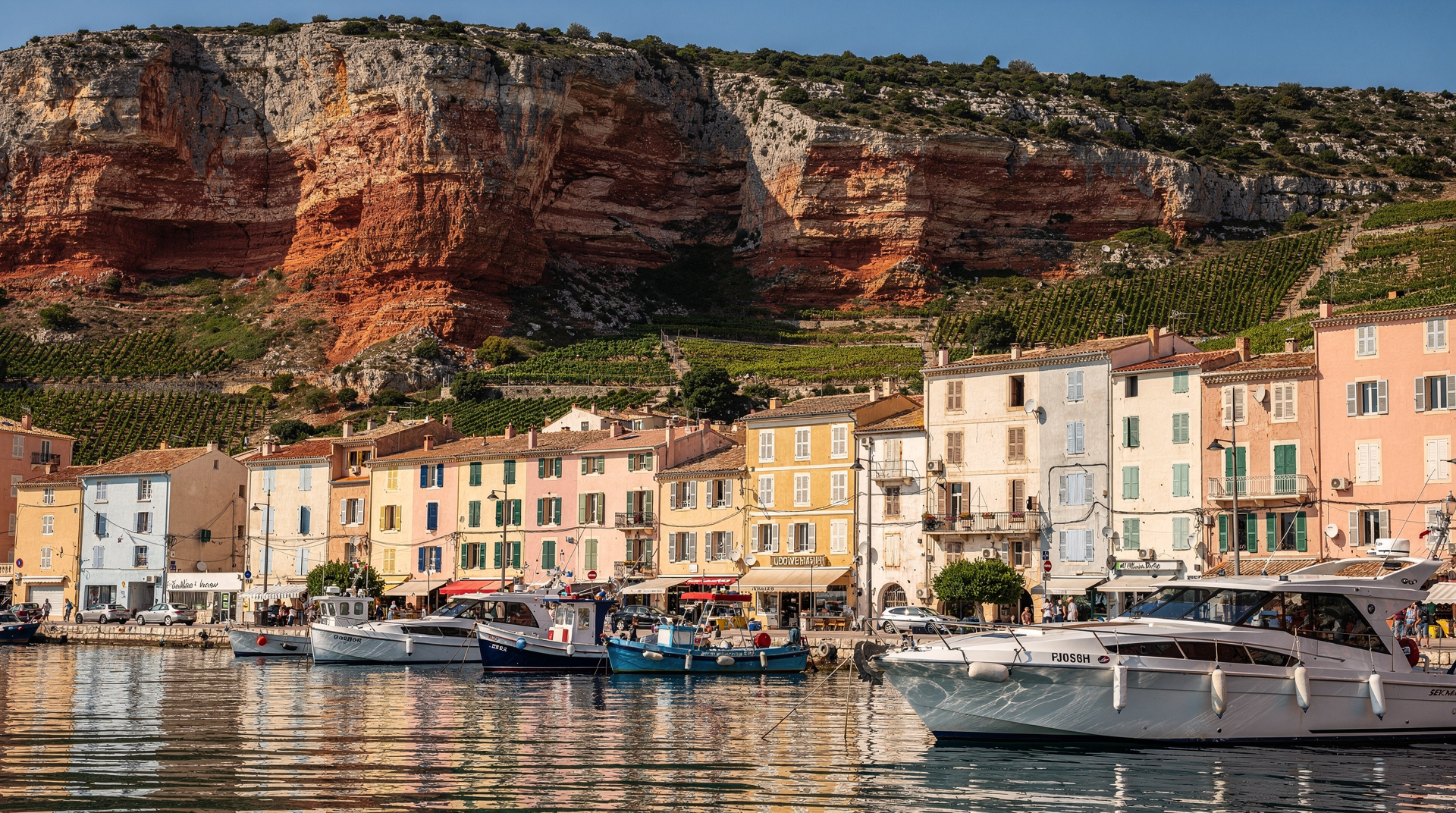
Marseille catamaran cruises: sailing vs motor, lunch, family, and adult options
Marseille: sailing catamaran tour into the iconic Calanques
What is the difference between a sailing and motor catamaran cruise from Marseille?
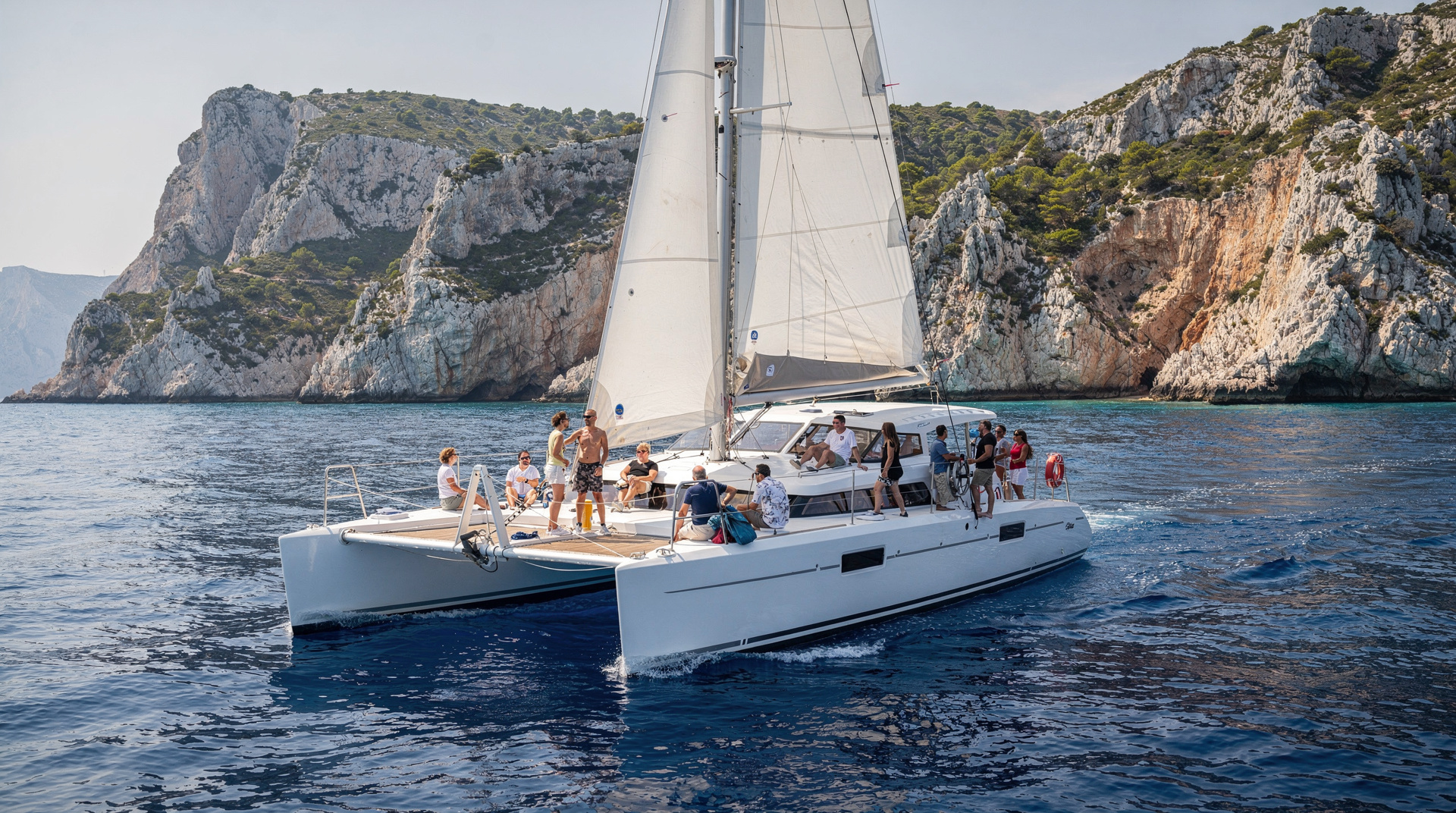
A sailing catamaran uses wind when conditions allow — quieter, more atmospheric, and in a light-to-moderate breeze genuinely different from a motorboat. A motor catamaran is faster, more predictable, and reaches more calanques in the same time. Most Calanques tours use motor catamarans.
At a glance
| Where | Departs from the Vieux-Port, Marseille, into the Calanques National Park |
| Cost | Around EUR 50–90 half-day, EUR 80–130 full-day with lunch, EUR 85–130 for a dinner cruise |
| Time needed | 3–4.5 hours half-day; 6–7 hours full-day with lunch |
| Getting there | Board directly at the Vieux-Port; no transfer needed |
| Best time | Morning departures (9:00–9:30) beat the crowds; May–June and September–October offer the best sailing wind |
Why catamarans dominate the Marseille cruise market
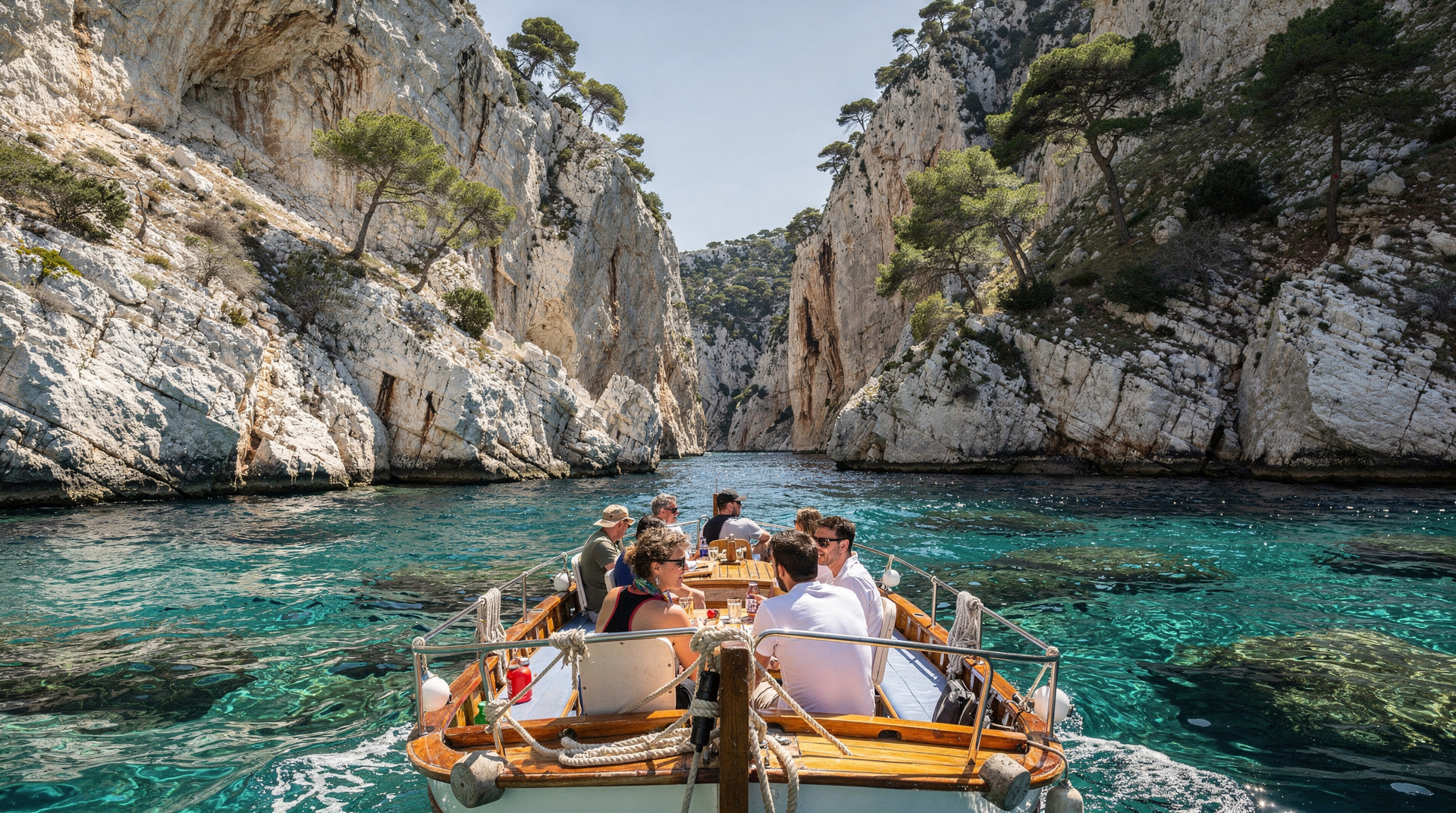
The catamaran is the most common vessel type on the Calanques boat tour market, and for practical reasons. Its twin-hull design provides the stability that makes swim stops feasible for non-sailors and families. Its deck space allows comfortable seating for 20–40 passengers. Its draught is shallow enough to anchor close to calanque shores. And in Marseille’s Bay — a body of water with reliable summer sea breezes and occasional mistral — the ability to sail rather than motor is a genuine advantage when conditions allow.
But “catamaran cruise” covers a wide range. This guide breaks down the main types and what each actually gives you.
Sailing catamaran vs motor catamaran
Sailing catamaran
A sailing catamaran — one that actually raises sails and moves by wind — operates on the physics of available wind. The best conditions for sailing in the Bay of Marseille are:
- A steady southwesterly or westerly breeze of 10–20 knots (not too light to sail effectively, not strong enough to create rough chop)
- Stable summer afternoons in May–June and September–October when thermal winds build in the afternoon
- Not a mistral day (the mistral at 40+ km/h creates waves too rough for a comfortable cruise)
On a good sailing day, the experience is genuinely different: the sound of the hull through water without engine noise, the heel of the boat as the sails fill, the physical sensation of wind-powered movement. This is what people imagine when they picture a sailing cruise and, on the right day, it delivers.
On a flat-calm summer afternoon, the sailing catamaran motoring between calanques is functionally similar to a motor catamaran. Some operators are honest about this; others oversell the sailing experience.
Ask before booking: Does the tour actually sail when possible, or does it motor regardless? Some “sailing catamaran” tours are motor catamarans with rigging as a prop.
Motor catamaran
The majority of Calanques tour operators use motor catamarans — twin-engine, fast, and predictable. A motor catamaran covers more distance in a fixed time, delivers a guaranteed itinerary regardless of wind, and is more suitable for tours that need to reach specific calanques at specific times.
The trade-off: More noise (engine), less atmospheric than sailing when the wind is right, faster and more efficient when time is the constraint.
When motor catamaran is the right choice: Full-day tours covering 4+ calanques. Any tour where seeing specific calanques matters more than the quality of the transit. Family tours where predictability and stability are priorities.
Group size and its effect on the experience
The catamaran format specifically determines how group size affects the experience:
Small catamaran (10–20 passengers): More intimate. The boat feels less crowded at anchor; the swim stop is less choreographed; the guide can interact with everyone personally. The deck space is adequate but not spacious. This is the format that generates the best reviews for quality of experience.
Medium catamaran (20–35 passengers): The most common commercial format. Comfortable deck space, organised swim stop, professional commentary. The experience is good but less personal than a smaller vessel.
Large catamaran (35–60 passengers): Approaching the scale where the boat feels like a managed excursion rather than a personal experience. Swim stops involve a longer queue for the ladder; the onboard catering becomes more like a cafeteria service than sharing a meal with fellow travellers. Not inherently bad, but the scale changes the character.
Lunch and dinner catamaran cruises
Half-day with aperitif
The most common catamaran format: 3–4.5 hours with a selection of drinks and snacks. Not a meal. The emphasis is on the water experience rather than food.
Price range: EUR 50–90 per person.
Full-day with lunch
A 6–7 hour catamaran cruise with a prepared lunch served at anchor in a calanque. The lunch at anchor version — eating in a sheltered calanque cove with the cliff walls above and the water around the hull — is a specific experience worth the price premium over a standard tour.
The food quality varies significantly by operator. The better operations serve fresh local dishes (grilled fish, charcuterie, tapenade, seasonal salad, rosé wine). Less careful operations run to baguette sandwiches and warm rosé. The price is similar in both cases — reading recent reviews specifically about the food is the only reliable filter.
Price range: EUR 80–130 per person with lunch and wine.
Dinner catamaran cruise
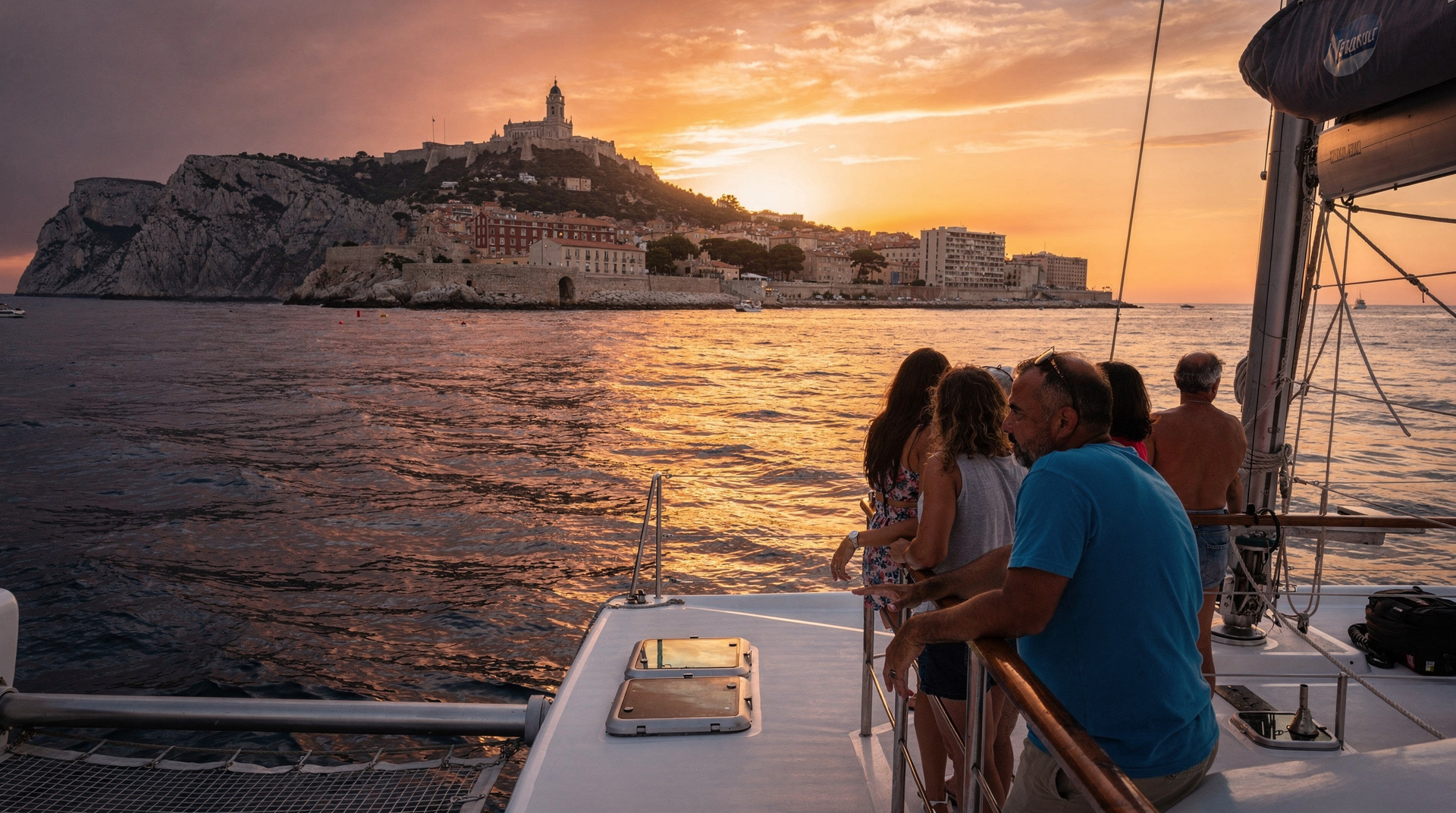
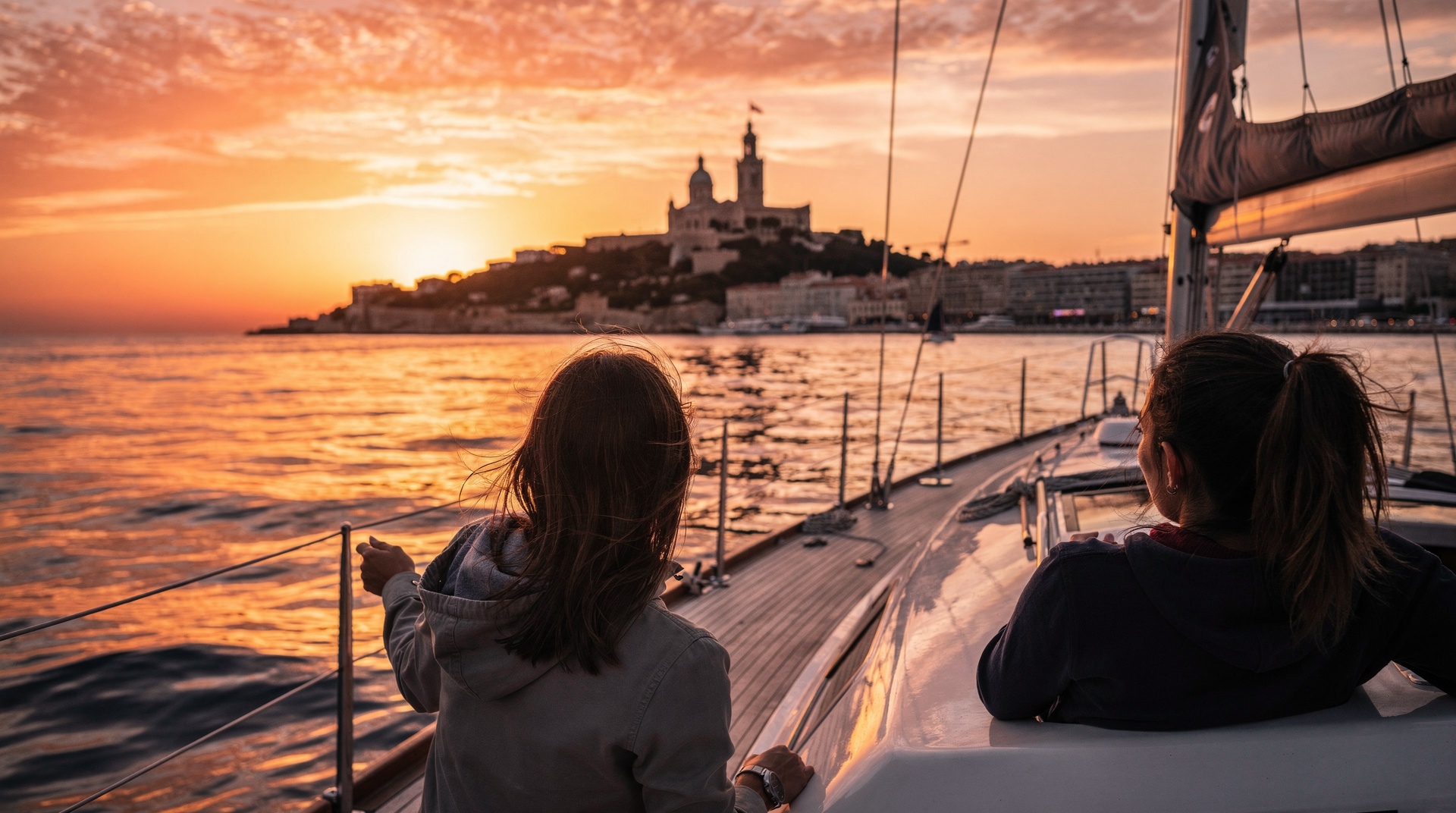
Evening departure, dinner served aboard or at anchor, return after dark. The sunset-to-dark window is genuinely atmospheric — the Bay of Marseille at dusk with dinner aboard is a memorable evening. The food and wine are the key variables; see the sunset cruise guide for the format in full.
Price range: EUR 85–130 per person with dinner and wine.
Family vs adult-only catamaran tours
Most commercial catamaran tours in Marseille are not age-restricted. Families with children are the majority audience on summer morning departures. The catamaran format — stable, spacious deck, organised swim stop with safety supervision — is the most child-friendly boat tour format available.
What families typically get: The swim stop with a supervised ladder entry. Snorkelling equipment for children (rentable from most operators). Space on deck to keep children occupied during transit sections. Commentary that adapts to a mixed audience.
What changes for adult-only groups: Some private charter operators offer adult-only sunset and dinner cruises — more flexibility with wine, later return times, different atmosphere. These are explicitly private or small-group formats rather than commercial all-ages tours.
Age considerations for children: Most operators accept children aged 3 and above. The swim stop requires children to be comfortable swimming in open water (depth drops quickly at the calanques). Children under 6 should be accompanied in the water. Life jackets are available.
The catamaran with standup paddle option
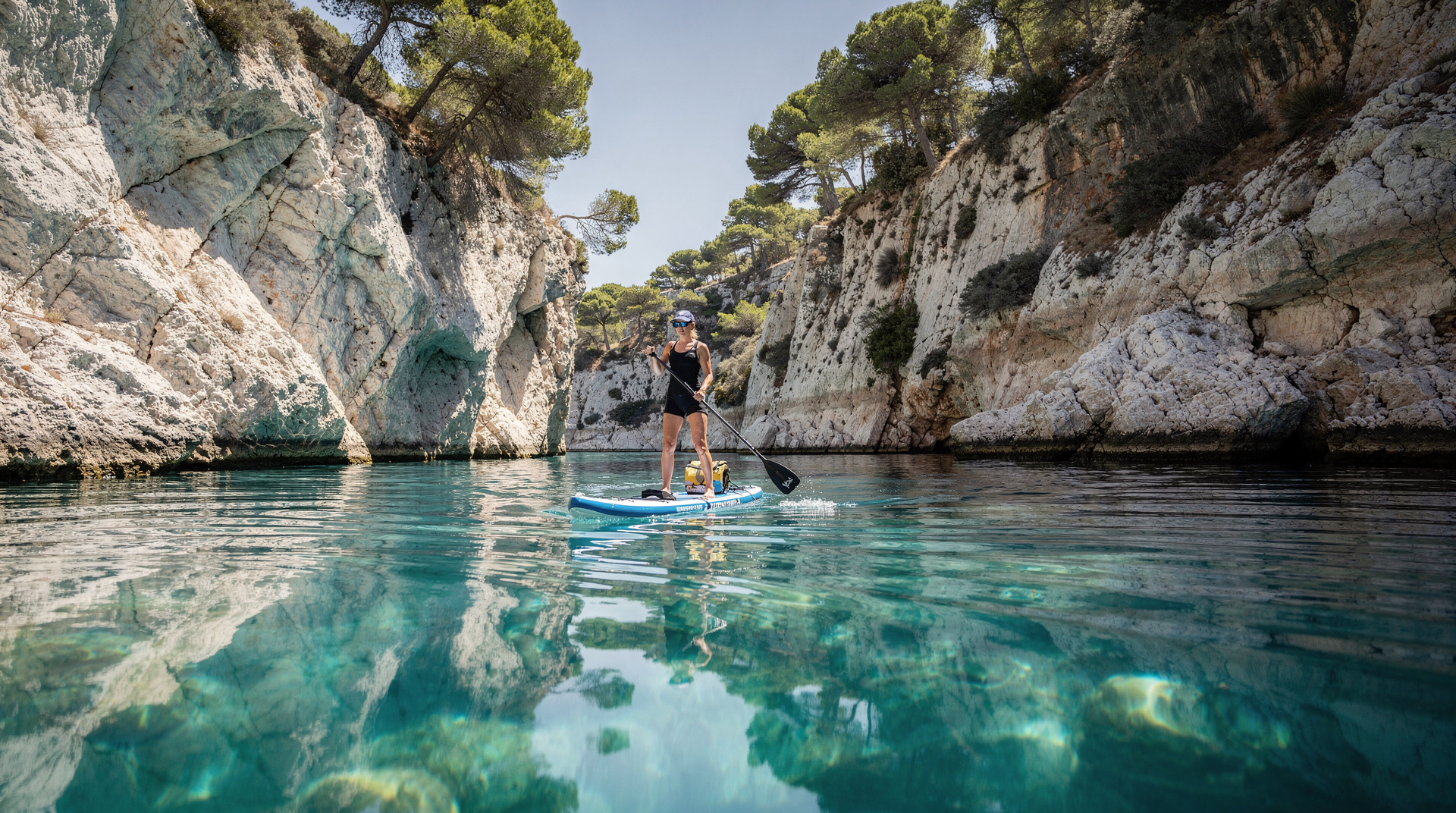
Some operators run a catamaran-plus-SUP format: the tour includes a 30–45 minute standup paddleboard session at the calanque during the swim stop. You have the stability of the catamaran as a base and the option to explore the calanque under your own power by SUP. This format suits active visitors who want more than passive swimming.
The SUP boards are rental-quality (stable, wide, for beginners and intermediates). The SUP session is typically inside the sheltered calanque rather than on open water — conditions are appropriate for most paddling ability levels. See the SUP in the Calanques guide for the dedicated SUP experience.
What makes a genuinely good catamaran day
Based on the consistent variables that distinguish satisfying from disappointing catamaran tours:
The guide: The single most impactful variable. A guide who genuinely loves the Calanques, knows the ecology and geology, adapts to the group, and makes the swim stop feel personal rather than managed transforms the experience. A bored guide reading from a script undermines even good conditions.
The timing: Morning departure (9:00–9:30) arriving at calanques before the crowds. The difference between a calanque with 3 boats and 20 boats is significant.
The anchor time: At least 45 minutes per swim stop. Tours that rush through three calanques in 3 hours without adequate time at any of them deliver quantity but not quality.
The food and wine: On any tour with included catering, local and fresh beats generic and packaged. AOC Cassis or Bandol rosé is a different level from bulk rosé. The difference in price to the operator is small; the difference to the passenger is meaningful.
The boat condition: A well-maintained catamaran with clean facilities, functioning equipment, and adequate shade options. A boat where the swim ladder is awkward, the toilets are broken, or the deck is crowded beyond comfort makes a negative impression regardless of the conditions at the calanques.
The catamaran at anchor: what the swim stop actually looks like
Understanding the mechanics of a catamaran swim stop removes the uncertainty for first-time passengers. Here is what happens, step by step:
Approach: The catamaran slows as it enters the calanque. The guide (or skipper) explains the calanque you are entering — its geology, the marine environment, what you might see while swimming. Some guides enter the water first; others stay on deck to supervise.
Anchoring: The boat anchors or ties to a mooring buoy (the park restricts direct anchoring in some zones to protect seagrass beds). This takes 5–10 minutes. Once secured, the boat does not move for the duration of the swim stop.
Swim ladder deployment: A ladder is deployed from the stern or side. This is the only way in and out of the water — jumping from the deck is sometimes permitted (at the guide’s discretion) but the ladder is the standard access point.
In the water: Most passengers use the ladder to enter. The depth immediately below the boat at most calanque anchorages is 3–8 metres — there is no shallow approach. This is relevant for those who are less confident in open water. The catamaran hull is visible from below; you can see the boat at all times while swimming.
Snorkelling: Equipment rental or loan (usually included or EUR 3–8) gives you the mask and snorkel. Fins make navigation easier but are not always available — check with the operator. The water below a catamaran at anchor in a Calanques cove typically has excellent visibility: you can see the anchor chain going down, the rocky bottom, and the fish that shelter around the hull.
Duration: 30–60 minutes for a standard swim stop. The guide signals the end of the stop with a horn or whistle. All passengers must be back on the boat before the anchor is raised.
Catamaran vs kayak for Calanques exploration
The catamaran and the sea kayak deliver fundamentally different versions of the Calanques experience. Understanding the difference helps you choose:
Catamaran: You go where the boat goes, on the boat’s schedule. The guide’s commentary is the access point for understanding what you’re seeing. The swim stop is supervised and time-limited. The physical effort is minimal — you sit on the boat and then swim. This is appropriate for most visitors and for anyone for whom the Calanques is one activity among many.
Sea kayak: You move under your own power along the coastline. You enter narrow inlets that the catamaran cannot access. The pace is yours; you can linger at an interesting section of cliff. The physical effort is the point — 3–6 hours of paddling is a workout. The perspective from a kayak (water level, moving) is completely different from the catamaran perspective (elevated deck, stationary). This is for active visitors who want the Calanques as a physical engagement, not a visual experience.
The combination: Some catamaran tours include a standup paddleboard component during the swim stop — a hybrid that adds agency without requiring the full commitment of a kayak tour. See the SUP guide for the standalone paddleboard Calanques experience.
Booking the catamaran tour: what to look for
Beyond the general questions applicable to all boat tours (see the best Calanques boat tours guide), catamaran-specific things to verify:
The sail question: If you care about actually sailing (not just being on a sailing vessel), ask explicitly whether the boat uses its sails on the route in question. Motor-assisted or motor-only operation is common — there is nothing wrong with it, but it should be accurately described.
The catering: Catamaran tours with lunch or aperitif are significantly differentiated by food quality. Read recent reviews specifically mentioning the food and wine. “Good rosé” and “warm supermarket rosé” are both possible at similar price points.
The sun deck: All catamarans have deck space, but the usable shaded area varies. In July–August, shade is a real value — a boat with an awning over the main deck is meaningfully more comfortable for a 4-hour tour than one without.
For the complete boat tour options picture, see the Calanques boat tour master guide and best Calanques boat tours. For sunset specifically, see the sunset cruise guide. For private charter options, see private boat charter. For tours including swim stops with detail on water conditions, see boat tours with swimming.
Which calanques a catamaran tour typically visits
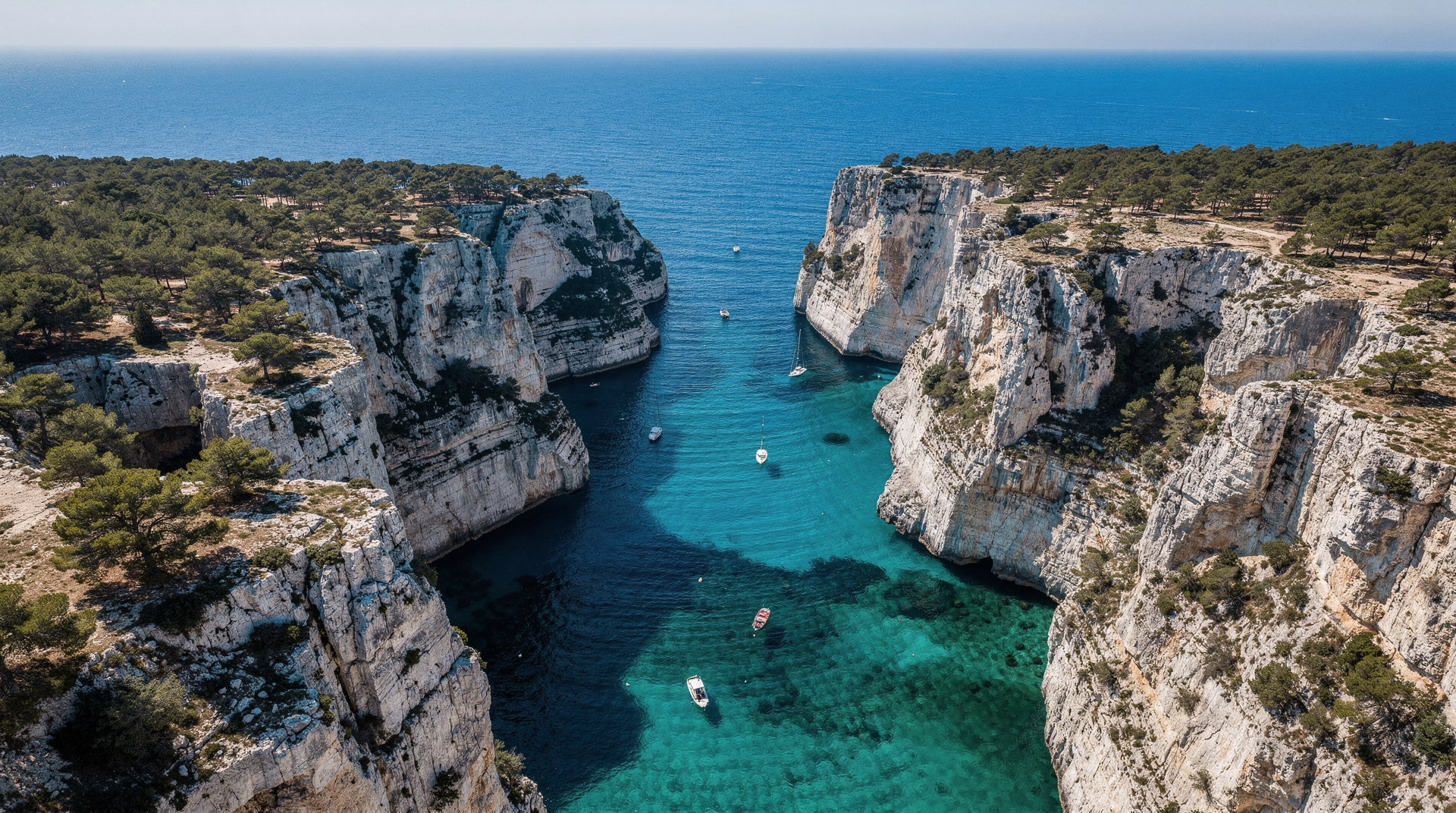
Most half-day catamaran tours from the Vieux-Port reach two to three calanques within the Calanques National Park, most commonly Sormiou, Morgiou, or En-Vau depending on the operator’s route and the day’s conditions. Full-day tours can add a fourth stop and more time at anchor. If you have a specific calanque you want to see — En-Vau and Port-Pin or Sormiou and Morgiou — check the operator’s stated itinerary before booking, since routes vary and are weather-dependent.
Catamaran cruise vs a day trip to Cassis
A catamaran cruise departing Marseille explores the Calanques from the western (Marseille) side of the park. An alternative is basing the day around Cassis, which offers its own boat departures into the eastern calanques with a shorter transit time to the first cove. Neither is objectively better — the Marseille departure suits visitors staying in the city centre without wanting to relocate, while a Cassis-based day suits those already exploring that town. See the Cassis vs Marseille calanques boat comparison for a direct breakdown.
Seasonality: when to book which type of catamaran cruise
| Season | Wind conditions | Water temperature | Crowds | Best catamaran type |
|---|---|---|---|---|
| May–June | Steady thermal breezes, good sailing | Cool, swimmable with a wetsuit for some | Moderate | Sailing catamaran |
| July–August | Variable, sometimes mistral | Warm, comfortable swimming | Highest | Motor catamaran, early morning departure |
| September–October | Reliable afternoon breezes, good sailing | Still warm | Lower | Sailing catamaran |
| November–March | Mistral more frequent, choppier | Cold, most tours pause swim stops | Lowest | Limited operator schedules; check availability |
Frequently asked questions about Marseille catamaran cruises
Do I need to know how to swim to join a catamaran swim stop?
Basic swimming ability is expected — the water at most calanque anchorages drops to 3–8 metres immediately below the boat, with no shallow entry. Life jackets are available for less confident swimmers, and children are usually required to be accompanied in the water.
Can I bring my own snorkelling gear on a catamaran tour?
Yes, most operators are happy for passengers to bring their own mask and snorkel. Rental gear (typically EUR 3–8, sometimes included) is also available on board if you prefer not to travel with your own.
Top experiences
Bookable activities with verified prices and instant confirmation on GetYourGuide.