Le Corbusier's Cité Radieuse: visiting Marseille's béton brut masterpiece
Marseille: Old Port to Cité Radieuse rooftop tuk-tuk tour
Can visitors access Le Corbusier's Cité Radieuse and what is inside?
The exterior and public areas are accessible freely. The MaMo contemporary art centre on the roof is open Wed–Sun 11:00–18:00. Hotel Le Corbusier offers 21 rooms within original residential modules — book months in advance. Get there by bus 21 from Castellane métro, or bus 521/221.
At a glance
| Where | 280 Boulevard Michelet, 13008 Marseille |
| Cost | Exterior and public areas free; MaMo exhibitions and hotel/restaurant priced separately |
| Time needed | Around 1-2 hours for the building and rooftop; longer if visiting a MaMo exhibition |
| Getting there | Bus 21 from Castellane métro (10-15 min), or a 15-minute walk |
| Best time | Weekday mornings for a quieter rooftop and interior street |
The building that needs a visit to understand
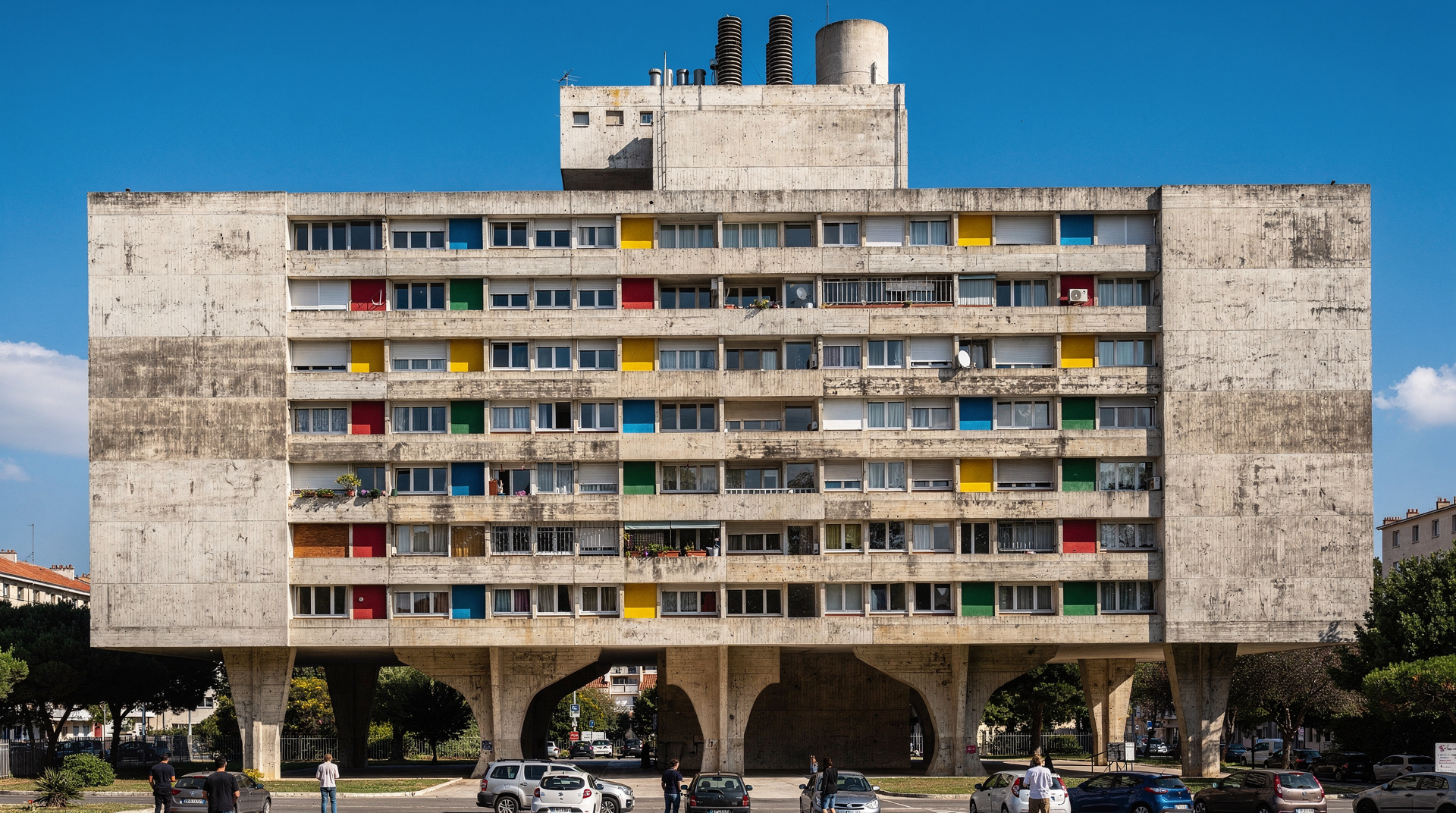
Looking at photographs of the Cité Radieuse prepares you for it inadequately. The images show a large concrete block on stilts — seventeen storeys, a series of horizontal bands of balconies, a rooftop covered in sculptural forms — and the reaction tends to be either aesthetic admiration or puzzlement about what all the fuss is about. The experience of actually standing inside it, walking its internal streets, taking the lift to the rooftop, and understanding the logic of what Le Corbusier was doing here is something photographs do not transmit.
The Unité d’Habitation at Marseille is the first and most complete realisation of an idea that occupied Le Corbusier for most of his career: the vertical city. Not a residential tower in the conventional sense but a building that contains within it the full infrastructure of urban life — housing, shops, hotel, a running track, a gymnasium, a pool, a nursery, terraces, and a rooftop landscape that functions as a park in the sky. Le Corbusier calculated that a single Unité could house 1,600 people on a footprint that left the surrounding land free, unbuilt, available for landscape.
Whether the idea worked is a complicated question. The Cité Radieuse as it actually exists is one of the most sought-after addresses in Marseille, whose residents are fiercely proud of their building and defensive of its reputation. That is a data point worth holding.
The architecture: béton brut and pilotis
The building stands on massive concrete pilotis — pillar supports — that raise the entire structure off the ground, freeing the landscape beneath. This was one of the Five Points of Architecture that Le Corbusier had articulated since the 1920s: the building should not colonise the ground, it should stand above it.
The exterior finish is béton brut — raw, shuttered concrete with the patterns of the wooden formwork boards left visible in the surface. Le Corbusier did not smooth or polish the concrete; he considered the marks of manufacture part of the honest language of the material. This was not pragmatism — it was aesthetic doctrine. The Cité Radieuse is the building that gave English-speaking architects the word “Brutalism” — a term derived from béton brut and intended, originally, as a description of honesty rather than aggression.
The building measures approximately 165 metres long, 24 metres wide, and 56 metres high. It runs on an east-west axis on the Boulevard Michelet, with the long facades facing north and south to maximise the balconies’ solar exposure. The 337 residential units are double-height maisonettes (duplex apartments) that run the full depth of the building — each unit has windows on both the north and south facade, creating genuine cross-ventilation. The interlocking section of the maisonettes means that the internal access corridors — called rues intérieures (interior streets) — run on every third floor, serving six units at a time rather than two.
The colour in the building comes from Le Corbusier’s use of his Polychromie Architecturale system — carefully selected colours on the interior surfaces of balconies and on the interior walls, visible from outside as flashes of red, yellow, green, and blue between the concrete frames.
MaMo: contemporary art on the roof
The rooftop of the Cité Radieuse is where the building’s utopian logic is most fully expressed. Le Corbusier designed a landscape of sculptural forms here — the ventilation stack becomes a curved tower, the gymnasium has a curved roof, a small paddling pool and a running track run along the length of the building. It is simultaneously a piece of industrial infrastructure and a landscape design.
The MaMo — Marseille Modulor, an acronym honouring both the city and Le Corbusier’s system of proportions — is a contemporary art centre created by designer Ora-Ïto within these rooftop structures. It presents rotating exhibitions of contemporary and design work, and the rooftop itself is part of the exhibition experience.
MaMo hours: Wednesday to Sunday, 11:00–18:00. Hours may vary seasonally; check mamo.fr before visiting. Access: MaMo is accessible to non-residents during its opening hours. Check the current exhibition programme on the MaMo website. The view: The rooftop offers an unobstructed panorama of Marseille from the south — the Bay of Marseille to the west, Notre-Dame de la Garde visible on its hill, and the Calanques ridgeline to the east on clear days.
Note that the rooftop pool and gymnasium are residential amenities and not part of the public visitor experience.
Hotel Le Corbusier: sleeping inside the building
Hotel Le Corbusier occupies original residential modules within the Cité Radieuse — 21 rooms adapted from the building’s apartments while preserving the original proportions, built-in furniture, and architectural character. The rooms range from compact cabin-style units to studios with sea views, and a larger suite.
This is not a luxury hotel experience in the conventional sense — the materials are raw concrete and the spirit is functional, as Le Corbusier intended. It is an architectural experience: a night inside the building whose logic you came to understand.
Availability: The hotel books out months ahead, particularly for summer. If you are seriously interested, check availability when planning your trip rather than on arrival.
Restaurant: The building contains a restaurant (Le Ventre de l’Architecte — “the Architect’s Belly”) on the interior shopping street level, open to non-hotel visitors. The name is accurate; the location is on the internal rue intérieure of the 7th–8th floor.
The internal streets and commercial level
The 7th and 8th floors of the Cité Radieuse were designed as an interior shopping street — boutiques, a post office, a hairdresser, a children’s nursery, and the hotel. In the building’s original conception this internal commercial level would have meant residents could access everything they needed without leaving the building.
In practice, the commercial level has had variable fortunes. Some units have been empty, some have changed function. Currently the rue intérieure houses the hotel, the restaurant, and a handful of boutiques and ateliers. Walking it is part of the visit and gives the clearest sense of Le Corbusier’s vertical city logic from the inside.
The level is accessible to visitors during the hotel and restaurant’s operating hours.
Why UNESCO listed it in 2016
The Cité Radieuse Marseille is one of seventeen Le Corbusier buildings across seven countries inscribed on the UNESCO World Heritage List in 2016, under the collective nomination “The Architectural Work of Le Corbusier, an Outstanding Contribution to the Modern Movement.”
The UNESCO citation notes that the building is “an outstanding realisation of a new architectural language that broke with the past” and that it made a “decisive contribution to the architectural culture of the 20th century.” More specifically: the Marseille Unité d’Habitation influenced the design of social housing, urban planning, and large-scale residential architecture across the world for decades after its completion. The influence was not always positive — many postwar housing blocks that are now demolished cited Le Corbusier as inspiration while misunderstanding the depth of his thinking about light, proportion, and the relationship between building and landscape.
The Marseille original is what the idea actually looked like when executed with rigour and adequate resources. That is why it is worth visiting.
Getting there
Bus 21: Departs from Castellane métro station (M1 and M2 interchange) and stops at the Cité Radieuse stop on Boulevard Michelet. Journey time approximately 10–15 minutes. This is the most direct public transport route.
Buses 521 and 221 also serve the site.
On foot from Castellane: The building is approximately 1.2 km south of Castellane métro along Boulevard Michelet — a 15-minute walk on a straight boulevard.
By car: Limited on-street parking on Boulevard Michelet. The building is at 280 Boulevard Michelet, 13008 Marseille.
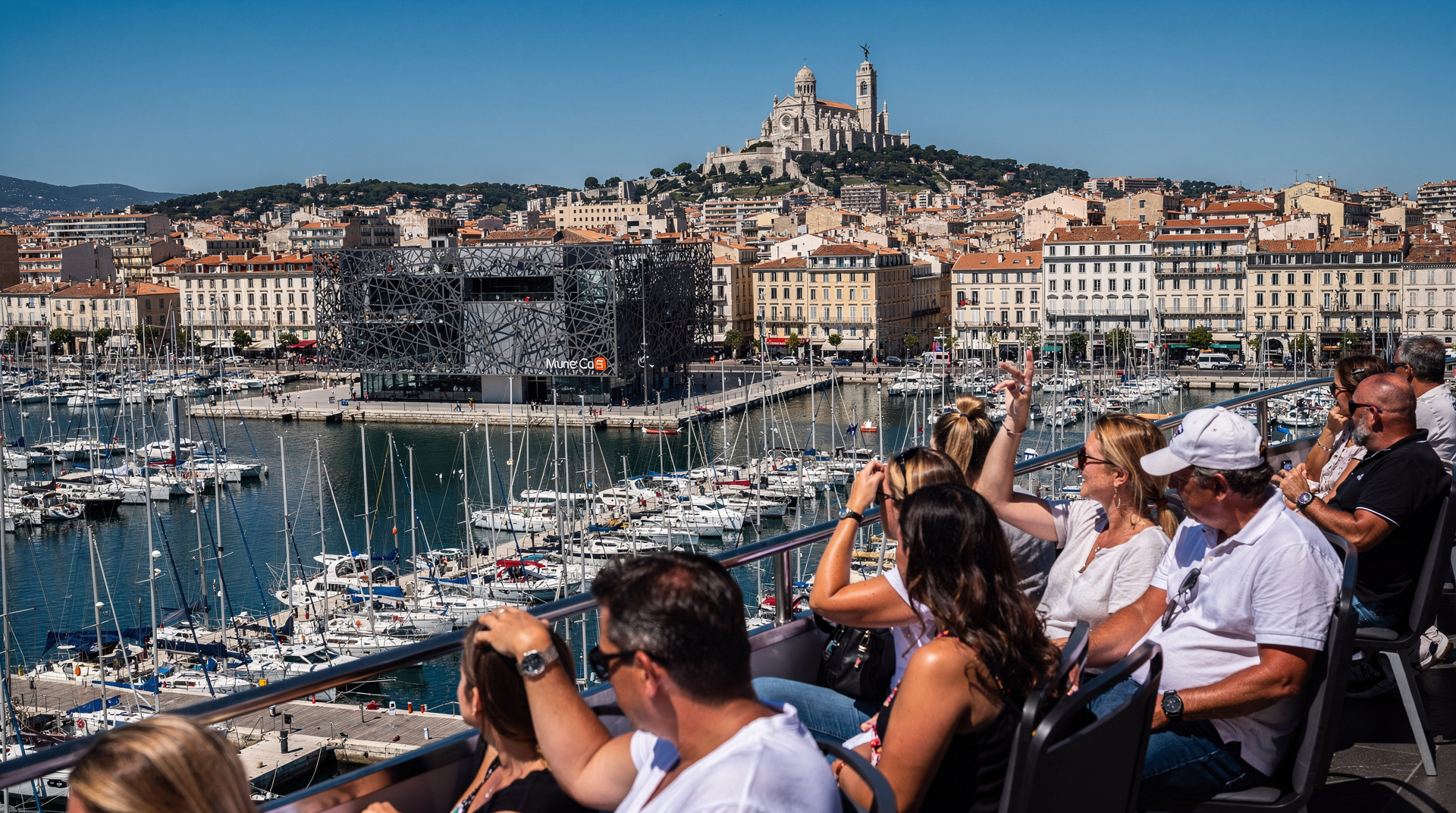
The tuk-tuk tour (see tours above) runs from the Vieux-Port to the Cité Radieuse rooftop — an unusual way to see the building in the context of the broader city.
The Modulor: Le Corbusier’s system of proportions
The Cité Radieuse was designed using Le Corbusier’s Modulor — a proportioning system he developed from the late 1940s onwards that based architectural dimensions on the human body and the Fibonacci sequence. The Modulor is essentially a harmonic series of measurements derived from the height of a standardised man with an outstretched arm (2.26 metres in the final version), producing a sequence of lengths that relate to each other mathematically in the same way that musical notes relate in a harmonic scale.
The practical consequence is that every dimension in the Cité Radieuse — ceiling heights, corridor widths, balcony depths, window proportions — relates to every other dimension through this system. Whether you consciously perceive this or not, the building feels proportionally right in a way that is difficult to analyse without knowing the system.
The concrete reliefs of the Modulor figure — a silhouette of the standardised man with outstretched arm — are visible on the exterior wall near the main entrance. They are Le Corbusier’s literal signature on the building, marking it as a work designed to human measure even at the scale of a 17-storey housing block.
The residential community
The Cité Radieuse is a functioning residential building. Its 337 apartments are privately owned and occupied; the building has one of the most active residents’ associations of any modernist housing complex in Europe. The residents have historically fought vigorously to preserve the building’s integrity — to prevent changes to the façade, to maintain the original colour palette, and to resist the kind of gradual modification that has degraded other Le Corbusier buildings elsewhere.
This fierce resident pride is not universal — some residents find the building difficult: hot in summer (the brise-soleils that Le Corbusier designed to shade the balconies work imperfectly in a Mediterranean climate), occasionally noisy due to the shared structure, and occasionally impractical for families with young children on the upper floors with no lift access beyond a certain point. But the building’s waiting list for apartments — which exists — suggests that the community of engaged residents consistently exceeds the number who feel they have made a mistake.
Who should visit
The Cité Radieuse is specifically rewarding for:
- Architecture enthusiasts and students — this is a pilgrimage site
- Visitors interested in 20th-century housing, urban planning, and the welfare state’s relationship with design
- Anyone curious about what life inside a “machine for living in” actually feels like
It is less essential for visitors who primarily want to see Mediterranean landscapes, Greco-Roman history, or conventional museums. If your Marseille time is limited, the MuCEM, Notre-Dame de la Garde, and the Calanques should come before the Cité Radieuse. But if you have three or more days and any interest in architecture, this is not something to skip.
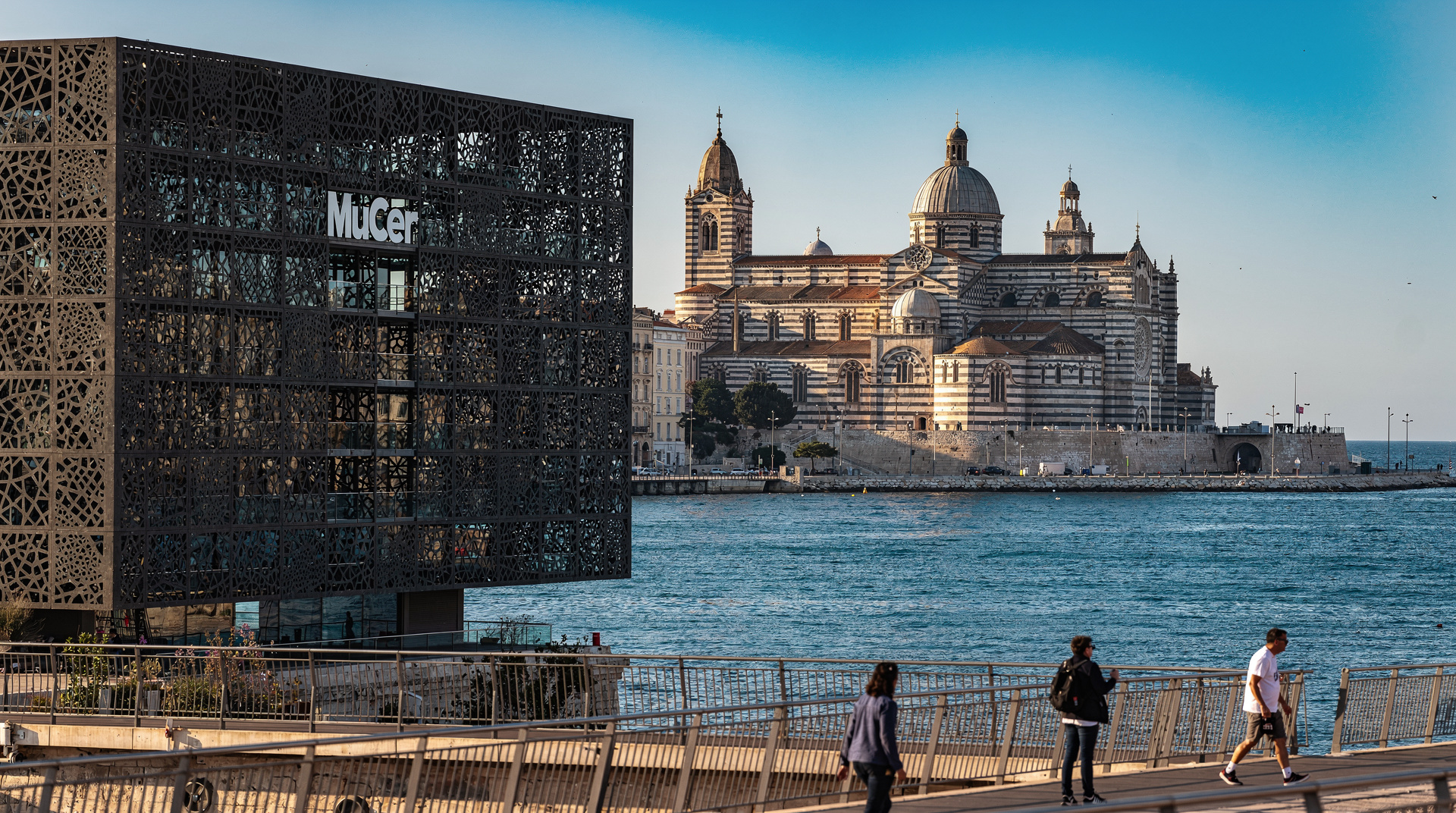
Honest note: The building requires a certain engagement to give back what it offers. Visitors who approach it expecting visual spectacle in the manner of the MuCEM building may be underwhelmed. Visitors who engage with what Le Corbusier was trying to do — and why it has been so consequential — tend to find it one of the most thought-provoking hours they spend in Marseille.
For more architectural context across the city — from the J4 waterfront to the Ombrière, from the Tour CMA-CGM to the Cité Radieuse — see our Marseille architecture guide.
Combining the visit with the rest of Marseille
The Cité Radieuse sits well outside the historic core, so most visitors treat it as a dedicated half-day rather than a stop on a Vieux-Port walk. It combines naturally with the Stade Vélodrome area if you are already south of the centre, or with a broader architecture-focused day using our getting around Marseille guide to plan transit between sites.
For visitors building a full itinerary, our 3-day Marseille planning guide shows where a visit like this fits against the city’s other highlights, and our Marseille museums guide covers the MaMo alongside the city’s other collections. For deeper background on the building’s place in the city’s story, see our Marseille history guide.
Seeing the building in the context of the wider city
The Cité Radieuse makes more sense once you have a feel for the rest of Marseille. Visitors who start with the MuCEM guide and the Notre-Dame de la Garde guide tend to arrive with a better sense of how different the postwar city is from the old port, and the contrast is part of what makes the rooftop view rewarding.
If you are still deciding where to base yourself, our where to stay in Marseille guide and Marseille neighborhoods guide explain how the southern districts fit with the centre. For a ready-made plan that leaves room for an architecture stop, the Marseille in three days itinerary is a good starting point, and the Marseille for first-timers guide covers the priorities to settle before you add something like this.
Frequently asked questions about Le Corbusier’s Cité Radieuse
Is the Cité Radieuse worth visiting if I only have one full day in Marseille? Generally no — with a single day, the Vieux-Port, Le Panier, Notre-Dame de la Garde, and MuCEM deliver more of what most first-time visitors come for. The Cité Radieuse rewards visitors with at least two or three days, or a specific interest in architecture and 20th-century design.
Can I visit the apartments themselves, or only the public areas? The apartments are private residences and not open to the public, with the exception of the units converted into Hotel Le Corbusier, which paying guests can stay in overnight. Visitors without a hotel booking can still walk the rue intérieure (interior street), visit the restaurant, and access the rooftop and MaMo during opening hours.
Top experiences
Bookable activities with verified prices and instant confirmation on GetYourGuide.