The petit train debate — gadget or genuine shortcut?
Marseille: iconic Calanques boat tour with swimming
Duration: 3-4.5 hours
The thing that divides travellers
The tourist petit train — the small road train that departs from the Vieux-Port and trundles up to Notre-Dame de la Garde via Le Panier — is one of those travel devices that polarises people in a specific way. On one side, travellers who used it and found it efficient and pleasant. On the other, travellers who find it an embarrassing concession to tourist laziness and prefer to climb on foot. Both positions are held with more conviction than the subject warrants.
We have taken the petit train. We have also walked. We have also taken the bus. We have opinions about all three and we are prepared to share them in descending order of nuance.
| At a glance | |
|---|---|
| Where | Departs Quai des Belges (Vieux-Port), via Le Panier, to Notre-Dame de la Garde |
| Cost | Around EUR 12–15 per adult for the Notre-Dame circuit |
| Time needed | 45–60 minutes for the full circuit; more if you want real time on the terrace |
| Getting there | Board at the Vieux-Port; the walking alternative starts from the same point |
| Best time | Spring or autumn mornings, when the walking alternative is genuinely pleasant |
What the petit train actually is
The petit train is not a train. It is a road vehicle — an electric or diesel tractor pulling two or three enclosed carriages — that runs on the public road between the Vieux-Port and Notre-Dame de la Garde via Le Panier. There is a commentary (in several languages, via headphone), the route covers about 45 minutes to an hour depending on stops, and the price is around EUR 12–15 per adult for the Notre-Dame circuit, approximately EUR 8–10 for the Le Panier circuit alone.
It departs from the Quai des Belges at the east end of the Vieux-Port, runs along the coastal road briefly, then winds up through the streets behind the Vieux-Port toward Le Panier, continues up to Notre-Dame, and returns via the same route. The street access is the same streets pedestrians can use; the petit train is not on any exclusive route.
The case for
The hill to Notre-Dame de la Garde is not trivial. From the Vieux-Port, the direct walking route involves 162 metres of elevation gain, most of it on exposed streets in the southern Marseille heat. In July or August, this walk is genuinely punishing in the middle of the day. In September, it is manageable but warm. For older visitors, for visitors with knee problems, for families with children who are past their hiking enthusiasm by 11:00, and for cruise passengers with a four-hour stop who need to be efficient, the petit train converts an obstacle into a 45-minute experience.
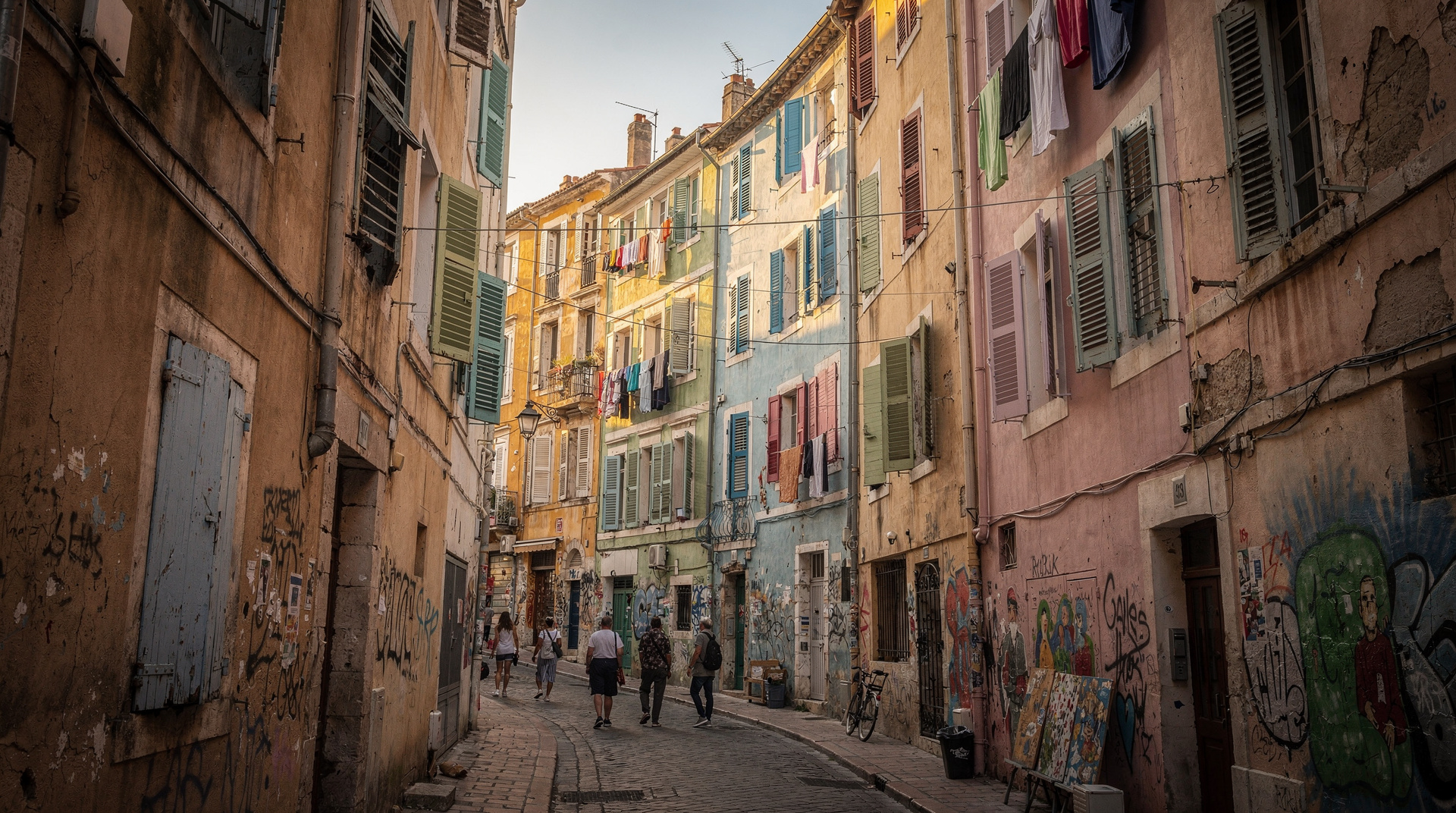
The commentary is adequate if not inspired. The Le Panier section of the route goes through lanes that are narrow enough that the train negotiates them at a pace that allows genuine observation of the neighbourhood’s architecture. From inside the carriage, looking up at the buildings of Le Panier, you get a ground-level perspective that a bus window or a car would not give you.
The case against
The walk to Notre-Dame is excellent. The southern approach from the Corniche, or the more direct route through the residential streets south of the Vieux-Port, passes through neighbourhoods that the petit train does not. The elevated position of Notre-Dame means that the walk toward it becomes increasingly spectacular as you ascend — the bay appearing in stages, the Frioul Islands resolving, the scale of the city below you changing. This experience, which requires walking, is among the better urban walks in Marseille.
Le Panier seen from inside a petit train carriage is a compressed version of Le Panier walked. The lanes are narrow, the speed is slow, but the carriage creates a separation from the neighbourhood that walking eliminates. You observe rather than participate.
There is also a quality of self-consciousness about the petit train that some travellers find uncomfortable — the obvious tourist vehicle in a city whose appeal is partly its resistance to tourist-orientation. This matters less than purists suggest but it does exist.
If your real interest is Le Panier itself rather than transport to Notre-Dame, walk it separately, at your own pace, ideally combined with a coffee stop and a wander off the main lanes — our full Le Panier guide covers the neighbourhood in the detail this piece cannot.
Our verdict
The petit train makes sense for: families with young children or older relatives for whom the climb would be difficult, cruise passengers with limited time who need to get to Notre-Dame efficiently, visitors who are genuinely exhausted by the time afternoon comes, and people for whom the commentary is useful context.
It does not make sense for: healthy adults with two or more days in Marseille who have time to walk, visitors whose primary interest is the neighbourhood character of Le Panier (walk instead), and anyone visiting in the cooler months (spring and autumn) when the uphill walk is genuinely pleasant.
Bus 60 from Castellane métro is the transport compromise: it goes directly to Notre-Dame, costs EUR 1.70, runs regularly, and gives you the hill view from a normal bus window. It is less atmospheric than walking and less comfortable than the petit train, but it is honest transport that Marseille residents actually use.
The three ways up, compared
| Walking | Petit train | Bus 60 | |
|---|---|---|---|
| Cost | Free | Around EUR 12–15 | EUR 1.70 |
| Time | 30–45 minutes uphill | 45–60 minute circuit | 15–20 minutes direct |
| Effort | 162m elevation gain, exposed streets | None | None |
| What you see | The full ascending view, Le Panier lanes on foot | Le Panier and the hill from inside a carriage | The hill view from a bus window |
| Best for | Healthy adults with time, spring/autumn | Families, older visitors, cruise passengers, summer heat | Budget travellers who still want no walking |
The honest position
The petit train is not a gadget. It is a transport solution for a specific set of conditions (the hill, the heat, the limited time) that is occasionally overused by visitors who have not thought through whether those conditions apply to them. Used correctly, it is efficient. Used by default — as a tourist ritual rather than a considered choice — it produces a version of Notre-Dame visit that is thinner than the alternative.
Our general advice: if you can walk, walk. The climb rewards the effort with a sequence of views that the petit train cannot replicate. If you cannot walk the hill, or if the conditions (summer heat, limited time, family needs) argue against it, take the petit train without guilt. It does what it says.
Notre-Dame itself
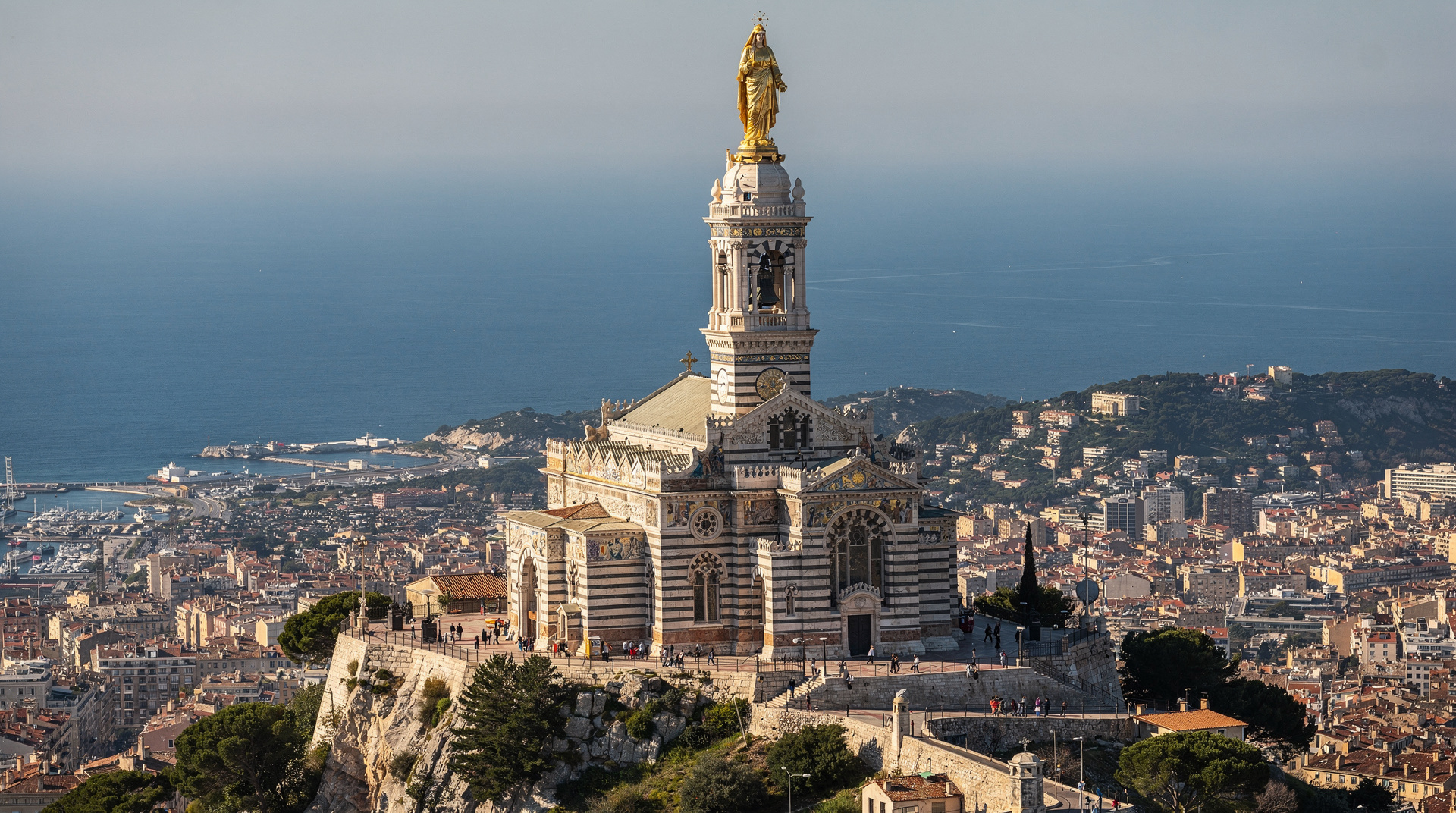
One final point that sometimes gets lost in the transport debate: Notre-Dame de la Garde is excellent regardless of how you get there. The Romano-Byzantine basilica on Marseille’s highest point is free to enter, the interior is covered in ex-votos — the thanksgivings left by sailors, fishermen, and travellers over a century and a half — and the panorama from the terrace is one of the best urban viewpoints in France.
From the terrace, you see the whole bay of Marseille — the Frioul Islands with the Château d’If visible, the tanker traffic on the horizon, the limestone ridge of the Calanques to the southeast, the industrial port to the north, and the spread of the city below in all its unself-conscious complexity. Whatever transport decision you make to get up there, spend time on the terrace. It is the correct response to the view.
The basilica is open daily from 7:00 to 19:00 (until 20:00 in summer). No admission charge. Dress code applies inside (shoulders and knees covered). The golden Madonna on the bell tower, 11 metres tall and visible from the sea, is in fact covered in gold leaf — the specificity is part of why it works as a landmark. The votive offerings inside the church, left by sailors who survived storms at sea and mothers who believed their sons came home because of prayers made at this basilica, are a reminder that Notre-Dame de la Garde is not primarily a tourist attraction. It has been the city’s spiritual anchor for well over a century. The tourists are the recent part.
Fitting the climb into the rest of your day
The transport choice is easier once you decide what else the day holds. If Notre-Dame is one stop among several, our one-day Marseille itinerary shows how the hill can sit alongside the harbour and the old quarter without turning the day into a race. If you have longer, the three-day itinerary leaves room to walk up at a relaxed pace and keep the afternoon free.
Season matters more than most visitors expect. Our notes on the best time to visit Marseille and on Marseille in summer explain why the same hill can feel like a pleasant stroll in one month and a chore in another, which is the heart of the petit train question.
If you are leaning towards the bus, the Marseille metro guide and the broader getting around Marseille guide explain how the Castellane connection fits with the rest of the public transport network. Cruise passengers working to a fixed return time will find the cruise port guide useful for planning the hours either side of the climb.
Finally, the Notre-Dame de la Garde visitor guide goes deeper on the basilica itself, and the Vallon des Auffes is the natural reward at the bottom if you choose to walk back down.
Practical details
The petit train circuit takes approximately 45–60 minutes including the Le Panier loop and the Notre-Dame stop. If you want more time at Notre-Dame itself (the terrace view warrants 20–30 minutes minimum), allow for the return journey separately — the petit train does not always give you the time at the top that the visit deserves.
The walking descent from Notre-Dame — down through the residential streets of the 7th arrondissement toward the Corniche and the Vallon des Auffes — is a very good way to return. The descent takes 30–40 minutes at a relaxed pace and passes through the quieter southern residential quarters that the tourist circuit generally misses. This is the route we typically take when we can.
The Notre-Dame de la Garde guide covers the hill, the basilica, and the view in detail. The broader Marseille guide covers transport options across the city. Our cruise stop blueprint addresses the time-constrained visit specifically. The Vieux-Port guide covers where the petit train and the walking route both begin.
Frequently asked questions about petit train debate — gadget or genuine shortcut?
How much does the Marseille petit train cost?
Around EUR 12–15 per adult for the full Notre-Dame de la Garde circuit, or roughly EUR 8–10 for the shorter Le Panier-only circuit. Prices vary slightly by operator and season.
Is it better to walk or take the petit train to Notre-Dame de la Garde?
Walking gives you a genuinely spectacular ascending view and costs nothing, but involves about 162 metres of elevation gain on exposed streets — hard going in summer heat. The petit train removes the effort at the cost of atmosphere and around EUR 12–15. Healthy visitors with time should walk; families, older visitors, and anyone short on time or visiting in peak summer heat are better served by the petit train or Bus 60.
Top experiences
Bookable activities with verified prices and instant confirmation on GetYourGuide.