Frioul Islands boat guide: ferry, schedule, prices, and what to do
Marseille: Frioul Islands boat tour with swim stop
Duration: 2 hours
How do you get to the Frioul Islands from Marseille?
By ferry from the Vieux-Port (Quai du Port, north quai). Operator: Frioul-If Express. Crossing time 25–30 minutes. Return ticket approximately EUR 14 per adult. Combined Frioul + Château d'If approximately EUR 16.20. Ferries run throughout the day; book online in summer.
The practical case for the Frioul Islands
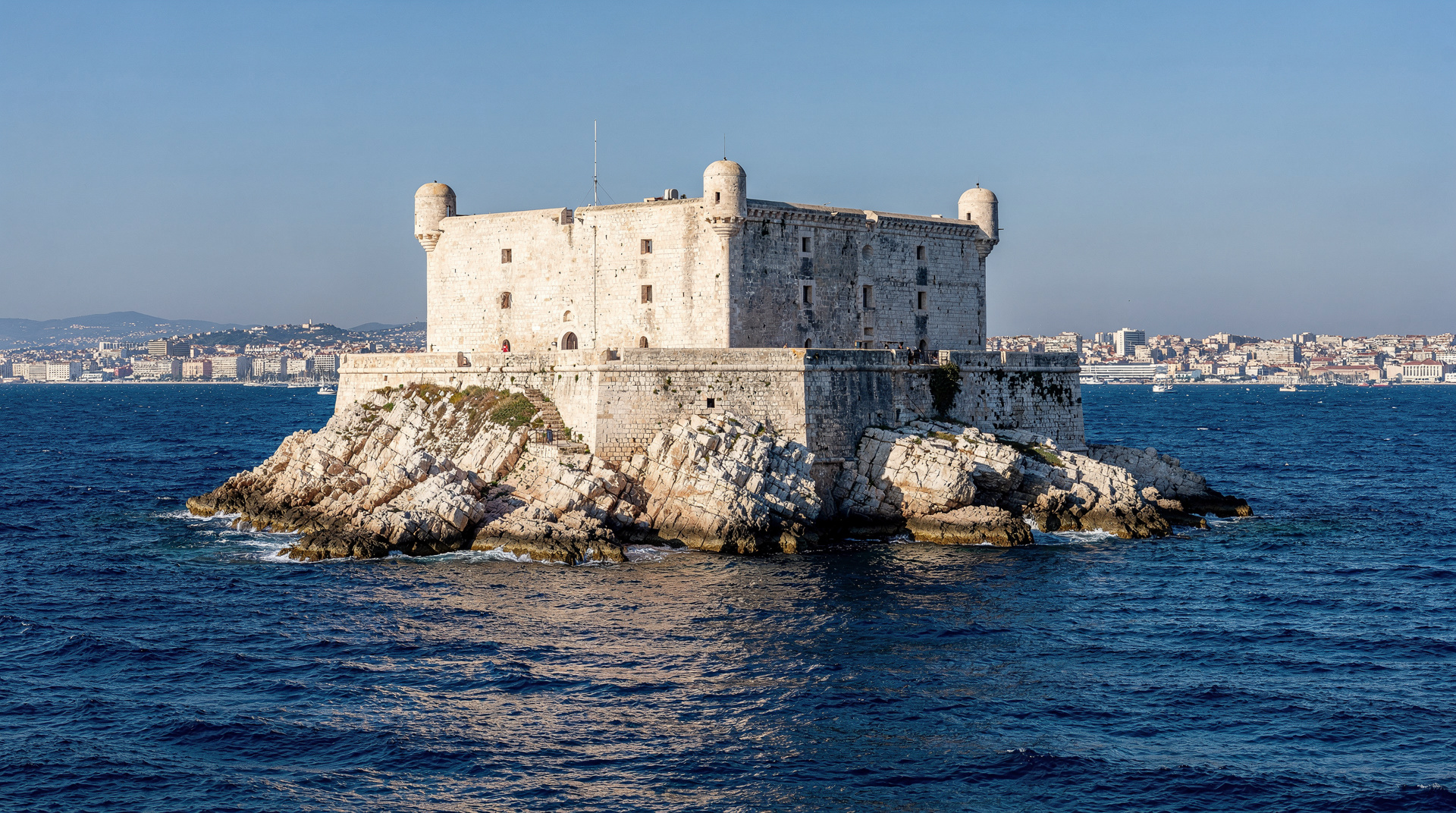
The Frioul archipelago — Ratonneau and Pomègues, the two main islands — sits 3 kilometres offshore from the Vieux-Port in the Bay of Marseille. Twenty-five minutes by ferry from the city centre. No hiking required. No summer fire risk closures. Water clarity that matches the Calanques. And considerably less crowded than the Calanques boat tours that circle the same bay.
The islands are not glamorous in the way some Mediterranean island destinations are. They are rocky, arid, exposed to the mistral, and have minimal services — one seasonal restaurant, a small harbour, and the extraordinary ruin of the Hôpital Caroline on Ratonneau. For visitors who want a half-day out of the city with clear swimming water and a genuine sense of offshore, they are excellent. For visitors who expect a beach resort island, they will disappoint.
This guide focuses on the logistics: the ferry, the prices, what you find when you arrive, and how to build a sensible visit.
At a glance
| Where | Frioul-If Express ferry, Quai du Port, Vieux-Port |
| Cost | Around EUR 14 return per adult; EUR 16.20 combined with Château d’If |
| Time needed | Half-day (3–4 hours ashore) or full day (6+ hours) for both islands |
| Getting there | 25–30 minute ferry crossing, no car needed |
| Best time | First morning ferry in summer for the calmest crossing and least-crowded coves |
The Frioul-If Express ferry
Operator: Frioul-If Express (lebateau-frioul-if.fr) — the sole operator serving both the Frioul Islands and Château d’If from the Vieux-Port.
Departure point: Quai du Port (north quai of the Vieux-Port), near the Fort Saint-Jean end. Look for the Frioul-If Express kiosk. From Vieux-Port métro station: walk north along the quai approximately 10 minutes. From MuCEM: cross the Fort Saint-Jean footbridge and walk along the quai (about 10 minutes).
Crossing time: Approximately 25–30 minutes to Frioul. If the ferry stops at Château d’If first (it sometimes does, depending on the departure), add 10–15 minutes.
Schedule: In high season (June–September), departures run approximately every 30–60 minutes from early morning (first departure typically around 09:00 or 09:30) through late evening (last return around 18:00–19:00 depending on season). In low season, frequency drops significantly — check the operator website for exact schedules on your travel date.
Prices (2026):
- Frioul Islands return: approximately EUR 14 per adult
- Château d’If return: approximately EUR 10.80 per adult
- Combined Frioul + Château d’If: approximately EUR 16.20 per adult
- Children’s rates and group discounts available
Ticket purchase: At the Quai du Port kiosk or online at lebateau-frioul-if.fr. In July–August, buying online in advance is strongly recommended — queues at the kiosk on peak summer mornings can add 30+ minutes to your departure time.
Weather cancellations: The ferry operates on most days year-round, but cancellations occur in significant mistral wind or rough sea conditions. In winter and spring, check weather forecasts before planning a Frioul day — a mistral cancellation is not unusual.
The ferry route: what to expect
The crossing from the Vieux-Port takes you out of the harbour past the Fort Saint-Jean and the Fort Saint-Nicolas (the two forts guarding the Vieux-Port entrance), then southwest across the Bay of Marseille toward the islands. The view back toward Marseille as you cross — Notre-Dame de la Garde on its hill, the white housing blocks of the northern neighbourhoods, the MuCEM on the waterfront — is one of the better city views available anywhere.
In summer the bay is typically calm in the morning; afternoon mistral can create chop on the return crossing. The ferry is a conventional open-deck boat — not an enclosed vessel — so wind is present in the crossing.
What you find at the Port de Frioul
The ferry docks at the Port de Frioul — the small artificial harbour created by the causeway connecting Ratonneau and Pomègues. A few things are immediately available:
- The seasonal restaurant at the port (limited menu, reasonable quality, book for lunch on summer weekends)
- Toilets at the port
- A small information board with walking routes on both islands
Everything else — swimming coves, the Hôpital Caroline ruins, the Pomègues interior — requires walking from the port. The islands have no vehicle traffic and no shops. Everything you need beyond a restaurant lunch must be brought from Marseille.
Ratonneau: the swimming coves
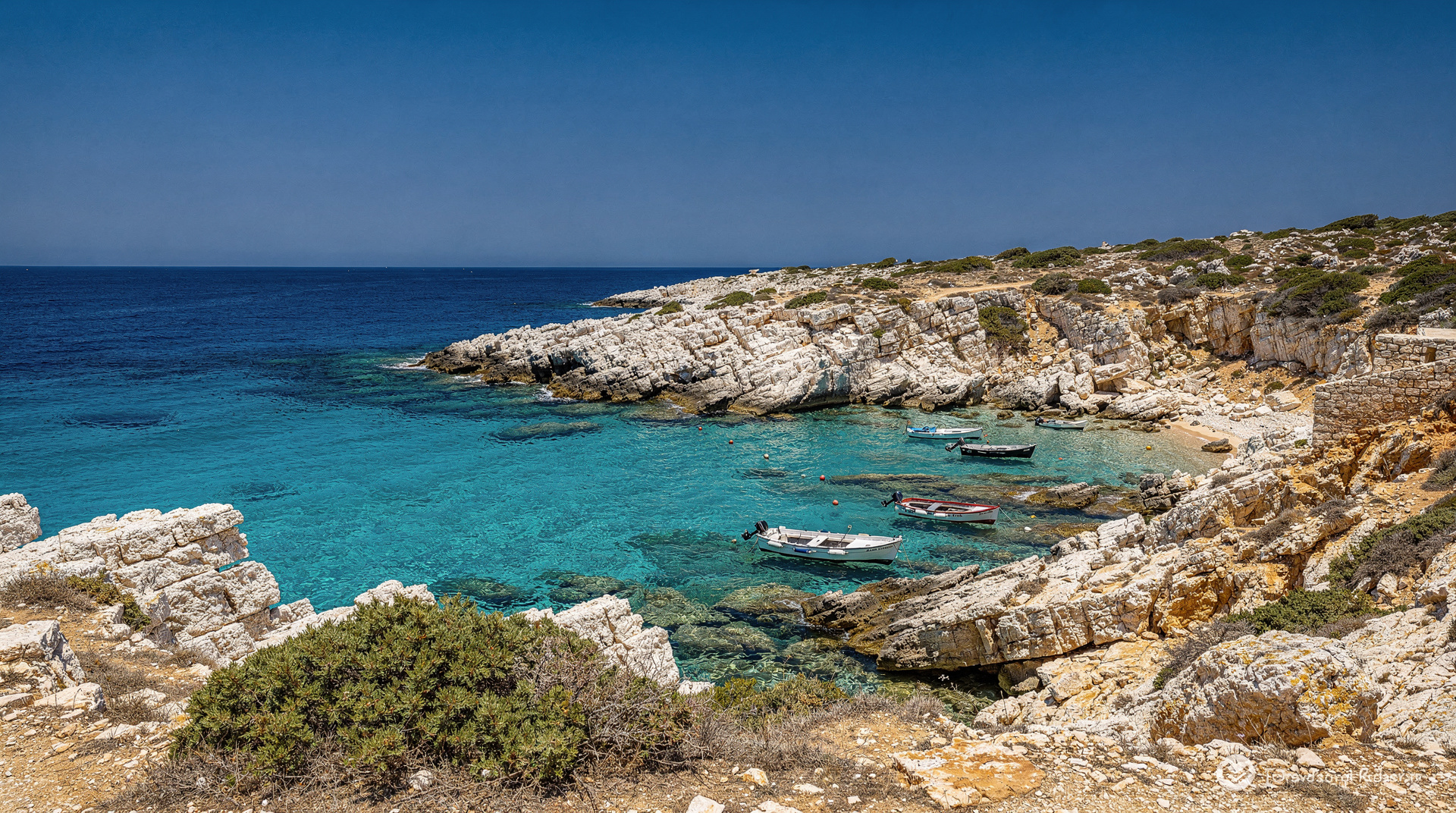
Ratonneau is the more accessible of the two islands from the ferry dock. The swimming coves are on the south-facing shore, reached in 15–20 minutes on foot from the Port de Frioul on marked paths.
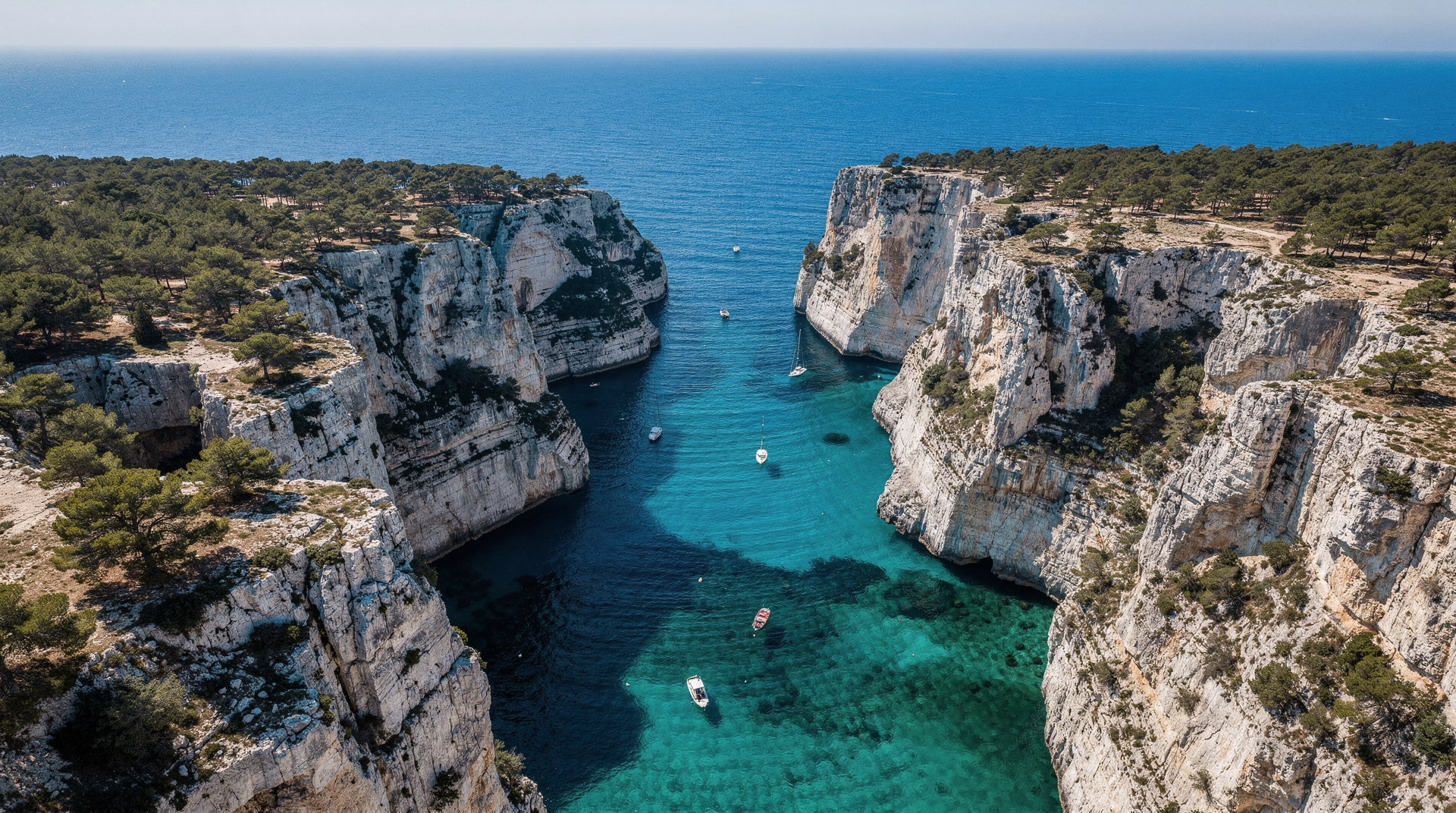
Water quality: Excellent — 10–15 metre visibility in calm conditions. The coves are sheltered from the north mistral by the island’s topography, making the south-facing shore swimmable in conditions that would be rough on the exposed Calanques coastline. The rocky bottom (some small pebble sections) and lack of sand is typical of the Marseille coast.
Entry: From rocks and ladders at the cove edges. No beach. Water depth drops quickly — comfortable for confident swimmers, less so for those nervous about depth or rocky entry. Sea urchins are present on the rocky bottom; water shoes or fins are recommended.
Practical note: The most popular coves fill on peak summer days, particularly on the first or second ferry after the morning rush. Taking a very early ferry (first departure) or a midweek visit significantly improves the experience.
Pomègues: quieter and wilder
Connected to Ratonneau by the causeway, Pomègues is less visited and requires more walking from the ferry. The western and southern coastal paths are accessible; the military installation on the island (closed to visitors) occupies part of the territory.
No services at all on Pomègues — no toilets, no food, no water. The walking terrain is rougher than Ratonneau. For those willing to put in 30–40 minutes of walking from the Port de Frioul to the Pomègues western shore, the rewards are isolation and views toward the Calanques coastline that the Ratonneau coves don’t provide.
In spring (March–May), Pomègues has wildflower coverage across the rocky ground — the combination of sea lavender, sand marigold, and anchusa on white limestone with the Calanques visible to the south is the most underrated visual in the Marseille bay.
The Hôpital Caroline
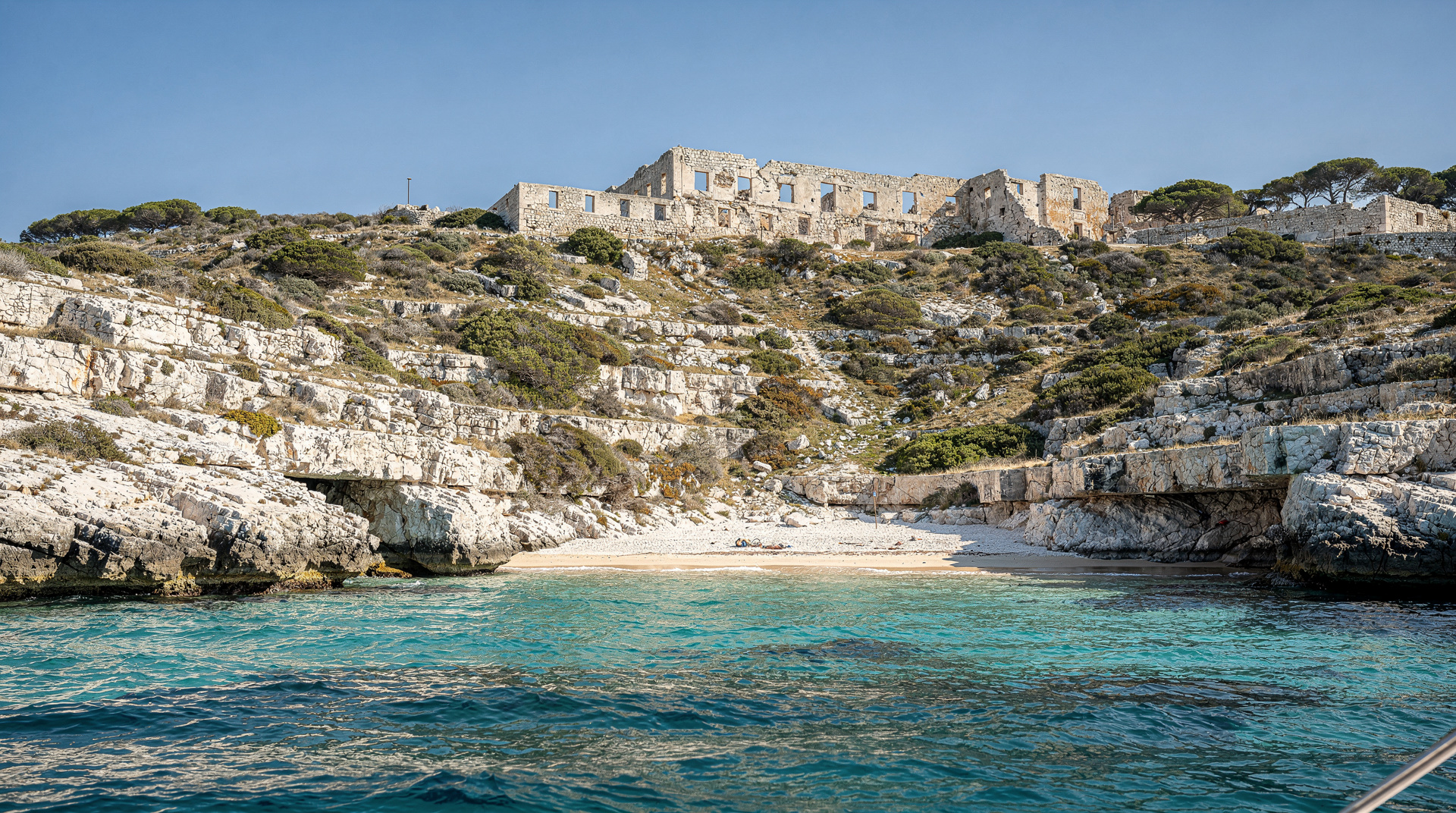
The ruined quarantine hospital on Ratonneau’s eastern end is the most historically interesting structure on the islands. Built between 1823 and 1828 as an isolation facility for ships carrying plague or epidemic disease from the Middle East and North Africa, the Caroline processed thousands of passengers over the 19th century. The complex — built in dressed stone with arched arcades, a chapel, a water cistern, and administrative buildings — was progressively abandoned after 1900.
Access: About 30 minutes on foot from the Port de Frioul, following the path along Ratonneau’s northern edge.
State of the site: The ruins are partially stabilised but remain dramatically intact — massive stone walls, arched galleries open to the sky, interior courtyards with the sea visible through every gap. Not a polished heritage attraction; a genuine atmospheric ruin, one of the more unusual spaces in the Marseille area.
Note: There is no dedicated tour or interpreter at the site. It is simply accessible on foot. The combination of the scale of the ruins and the maritime landscape around them makes it worth the walk even for visitors with no particular interest in the history.
Half-day vs full-day plan
Half-day (3–4 hours ashore): Take the morning ferry. Walk to one Ratonneau swimming cove (15–20 min). Swim. Return via the Hôpital Caroline (30 min walk from the cove). Lunch at the Port de Frioul restaurant if you reserved. Return ferry. This half-day sees the key elements without requiring extended walking.
Full day: Morning ferry. Swim at one Ratonneau cove. Walk to the Hôpital Caroline. Cross to Pomègues via the causeway and walk the western coastal path. Return to the port for lunch. Afternoon swim at a different Ratonneau cove. Late afternoon return ferry. A full day gives you both islands and multiple swim stops without rushing.
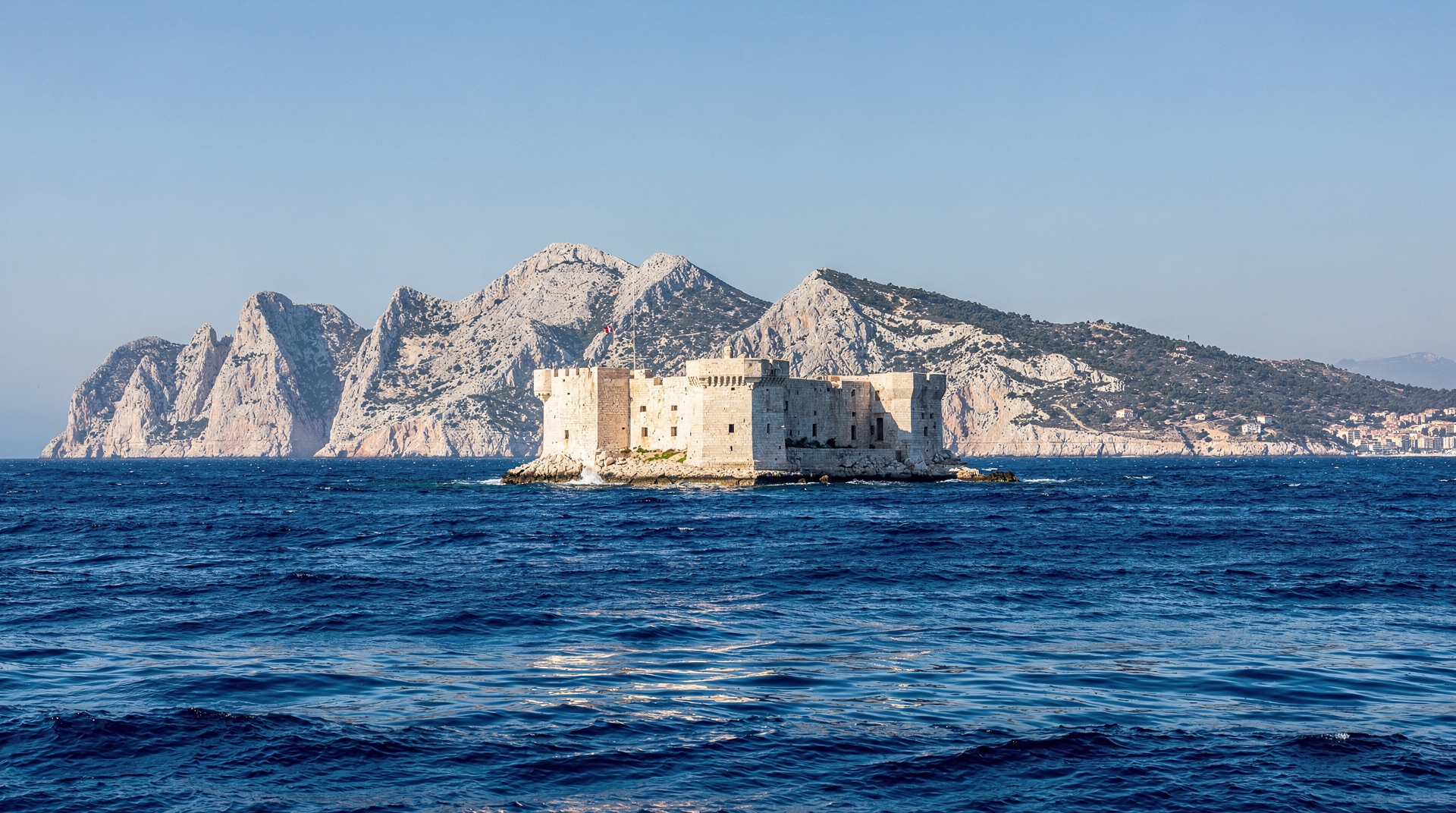
Combined with Château d’If: Take the ferry with a Château d’If stop on the outward journey (20 minutes at the fortress) and continue to Frioul for the main visit. Return direct from Frioul. Total time: 4–5 hours minimum. See the Château d’If boat guide for timing at the fortress.
Sunset cruises around Frioul
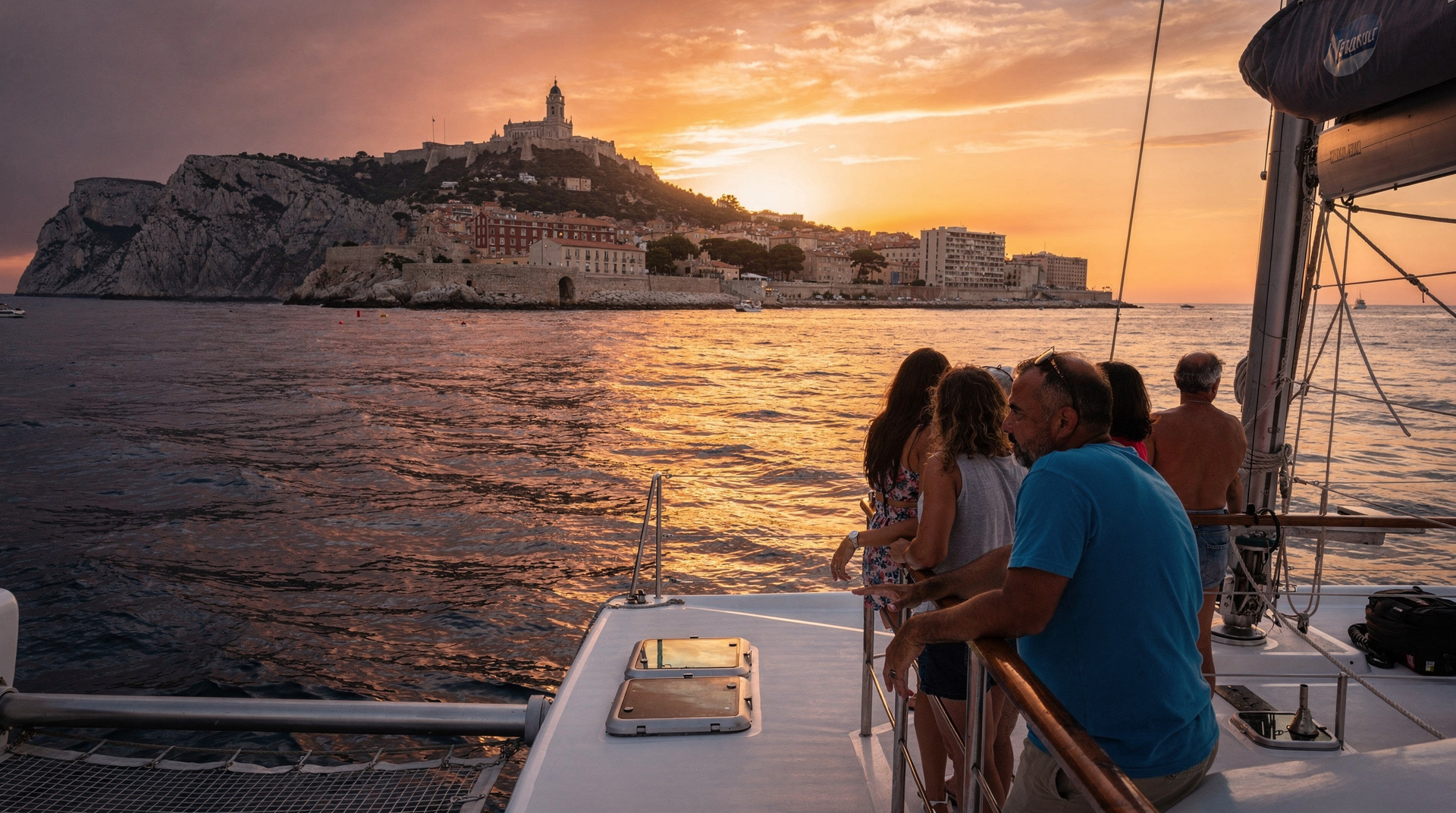
Several operators run evening sunset cruises from the Vieux-Port that include circuits of the bay passing Château d’If and the Frioul Islands. These typically depart around 17:00–19:00 (time varies by season and sunset time) and return after dark. The light on the white limestone of Ratonneau in the last hour before sunset — combined with the city silhouette to the east — is one of the standard visual highlights of this type of cruise.
See the sunset cruise guide for operators and price ranges.
The Frioul in different seasons
Spring (March–May): The best season for walking and landscape photography. Wildflower cover on both islands creates the most photogenic conditions — sea lavender, sand marigold, and anchusa carpet the limestone ground between mid-March and late April. Air temperatures are comfortable (15–22°C). Sea temperature is cold for swimming (14–17°C). Crowds are minimal; the ferry runs on its reduced spring schedule.
Summer (June–September): The swimming season. Sea temperature reaches 24–26°C in August, and the south-facing coves on Ratonneau are genuinely pleasant. Ferry frequency increases; peak July–August brings larger crowds on the island — still far below Calanques levels, but the best coves are occupied by mid-morning. Go on the first ferry of the day.
Autumn (October–November): Sea water is still warm (20–22°C) through October, and the crowds have gone. The island vegetation turns ochre and brown against the white limestone. Excellent photography light in the raking autumn sun. Some ferry frequency reduction in November.
Winter (December–February): The Frioul in winter is an extraordinary landscape — stark, cold, nearly empty, with the light on the stone dramatic. No swimming. Wind exposure significant. The Hôpital Caroline in winter — bare stone walls in a cold sea wind — is among the most atmospheric heritage experiences accessible from Marseille. Ferry runs on reduced schedule; check before going.
What the ferry crossing tells you about Marseille
The crossing from the Vieux-Port to the Frioul Islands is itself a useful orientation experience. Standing on the ferry deck as it passes through the entrance of the Vieux-Port, between the Fort Saint-Jean and the Fort Saint-Nicolas, gives you the view back at Marseille that no street-level visit achieves.
From this angle, Notre-Dame de la Garde on its hill resolves clearly above the white housing blocks. The MuCEM’s black concrete lattice and the Fort Saint-Jean behind it appear in their intended relationship to the sea. The container cranes of the Joliette port are visible to the north. The scale of the city — a large port city built on and around a natural harbour — is legible from the water in a way that it is not from within.
The outward crossing (Vieux-Port to Frioul) gives you Marseille. The return crossing (Frioul to Vieux-Port) shows you the city approaching from the sea — the way it would have appeared to every ship arriving here over the last 2,600 years, since Massalia was founded by Greek sailors from Phocaea in approximately 600 BCE.
What to do if the ferry is cancelled
Mistral wind and rough sea conditions occasionally cancel the Frioul-If Express service with short notice. If your Frioul day is disrupted:
Check the operator website first: Frioul-If Express publishes cancellation announcements on lebateau-frioul-if.fr. The decision is usually made by 7:00–8:00 for morning departures.
Alternative water activities: If the ferry is cancelled due to wind, the Vieux-Port area itself is accessible regardless. The Fort Saint-Jean is open to walk across the footbridge from MuCEM. The Cosquer Méditerranée at the Villa Méditerranée is an indoor alternative relevant to anyone interested in the Calanques (the Cosquer Cave replica, discovered under the Sormiou headland). The MuCEM itself is open regardless of weather.
Reschedule: The mistral typically runs 1–3 days. A cancellation today usually means a calm day tomorrow. If you have flexibility in your itinerary, a rescheduled Frioul day on the post-mistral clear-sky day (the Marseille term for this is the “beau temps d’après mistral” — the beautiful weather after the mistral) gives the best conditions of the entire trip.
For the full Frioul Islands destination guide — including ecology, birdwatching, and history — see the Frioul Islands destination guide. For the Château d’If combination, see Château d’If guide. For planning your Marseille visit, see how many days in Marseille and the Marseille guide.
Frioul vs a Calanques boat tour
Both leave from near the Vieux-Port and both promise clear-water swimming, but they are different trips. A Calanques boat tour is a guided, time-boxed circuit with a swim stop chosen by the operator; the Frioul ferry drops you on an island you explore at your own pace, choosing your own cove and how long to stay. For a side-by-side comparison of what each actually delivers, see our Calanques boat vs hike guide and our best Calanques boat tours guide. Families in particular should weigh the two carefully — see our family day out on the Frioul guide for the self-paced case.
Frequently asked questions about Frioul Islands boat guide
Is the Frioul Islands ferry the same as the Château d’If ferry? They’re operated by the same company (Frioul-If Express) from the same Vieux-Port dock, but they’re separate tickets and not every departure serves both islands — check the combined ticket if you want both in one day.
Do the Frioul Islands have any sandy beaches? No — the coves on Ratonneau and Pomègues are rock and pebble entry with no sand, which is typical of this stretch of coast. For sandy alternatives, see our family beaches near Marseille guide.
Top experiences
Bookable activities with verified prices and instant confirmation on GetYourGuide.