Marseille street art walk — a self-guided Cours Julien itinerary
Marseille: alternative walking and street-art tour with local drink
Why Marseille has one of France’s best street art scenes
Marseille was a street art city before street art was a tourism category. The combination of large blank surfaces (post-war rebuilding left enormous gable walls on end-terrace buildings), a municipal tolerance that is historically relaxed by French standards, a port-city creative culture, and the Mediterranean light that does something specific to colour on exterior walls — all of this produced conditions that serious muralists recognised and sought out from the 1980s onward.
The concentration is highest around Cours Julien and the streets radiating from it. This walk covers the core two hours; an extended version adds Le Panier and the northern Joliette area for a four-hour route.
| At a glance | |
|---|---|
| Where | Cours Julien and surrounding streets, extending to Le Panier |
| Cost | Free (self-guided); guided tours typically run a set fee for around two hours |
| Time needed | 2 hours core route, 4 hours with the Le Panier extension |
| Getting there | M1 métro to Notre-Dame-du-Mont / Cours Julien |
| Best time | Saturday or Wednesday morning for the market, or a weekday afternoon for quiet |
Starting point: Place Jean-Jaurès
Take the M1 métro to Notre-Dame-du-Mont / Cours Julien station. You surface directly onto the street. Stand for a moment and look at the end walls of the buildings around you. You are already in the inventory.
The starting logic of the walk: from Place Jean-Jaurès, go east toward Cours Julien itself (roughly 400 metres uphill), then circle through the residential streets above, then return through the Rue de la Bibliothèque and Rue des Trois-Mages.
The core Cours Julien murals
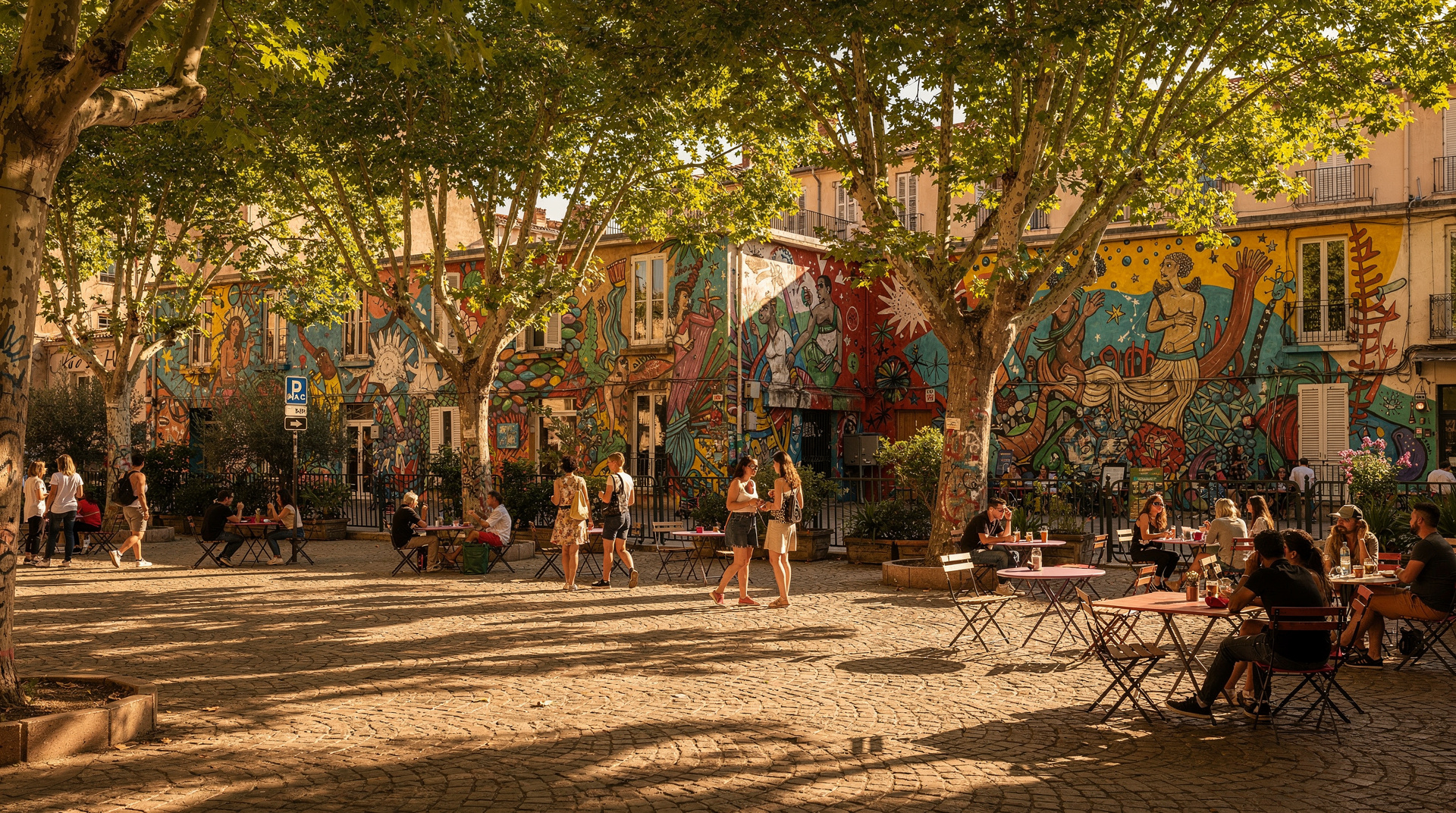
The square itself — the pedestrianised section with the fountain and the market stalls on Wednesdays and Saturdays — is surrounded by building ends covered in murals. These change periodically; what was there in 2022 may not be what you see in 2025, which is both a limitation of any street art guide and part of what keeps the area interesting.
The things that have persisted, or types that persist:
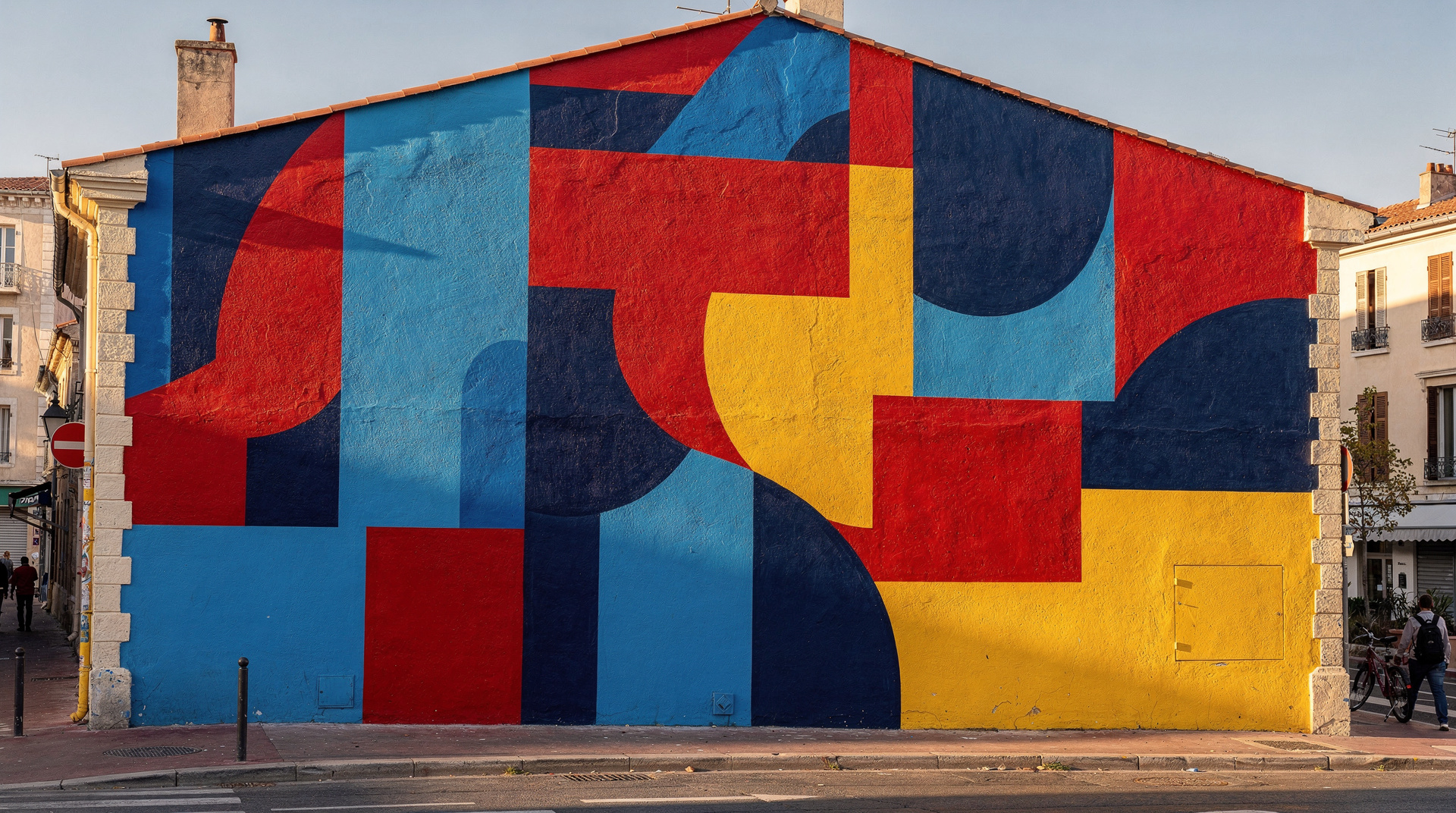
Large-format figurative works on the gable walls of the six- and seven-storey buildings — figures painted at a scale that makes them visible from across the square. These are usually commissions, organised by the neighbourhood association, and the quality is consistently high because the commissioning process selects for serious artists.
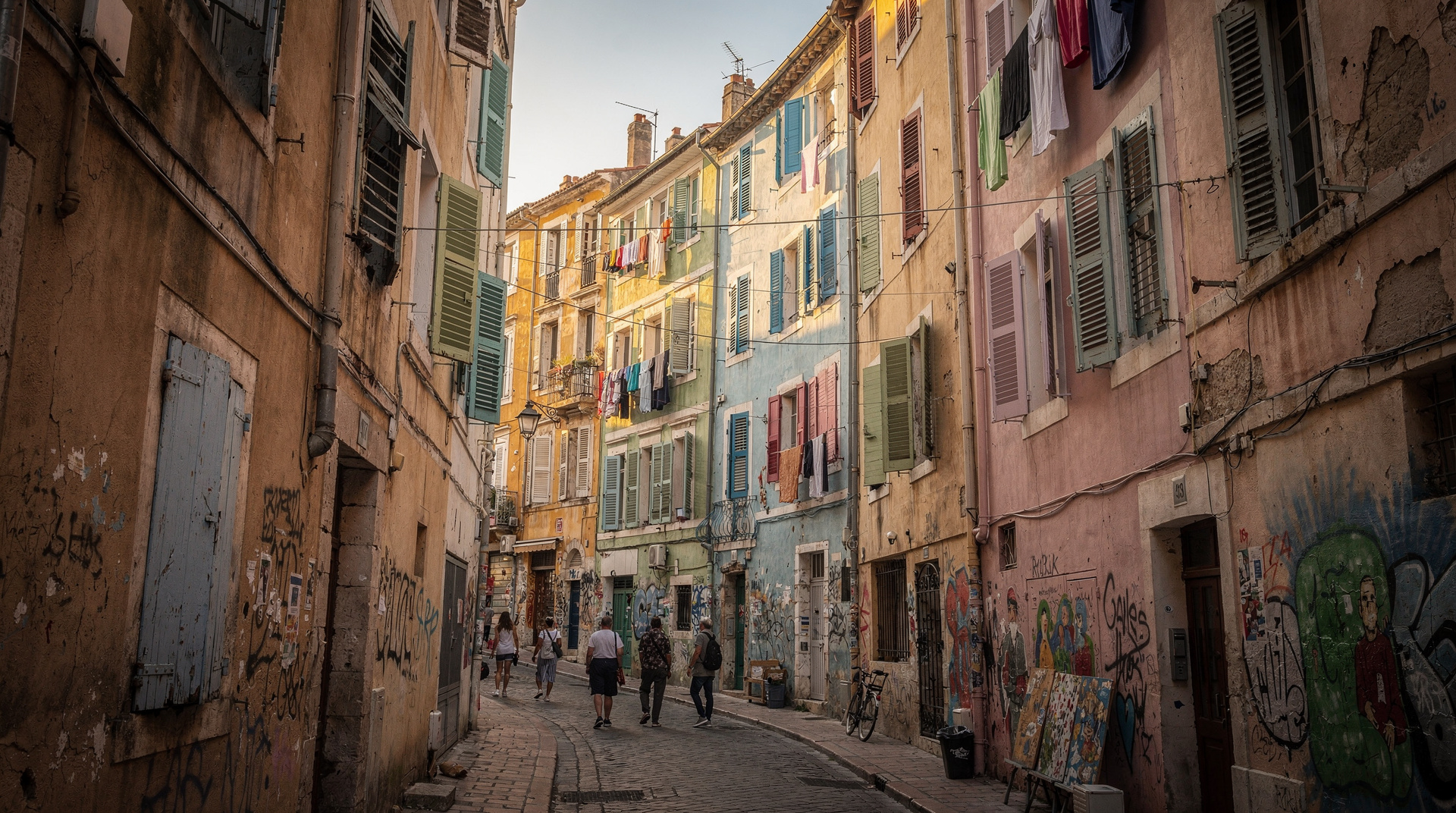
Lettering and typography — Marseille has a strong tradition of graffiti calligraphy, influenced by the Arabic script traditions of the large North African community. The best examples are on the walls of Rue des Trois-Mages and the narrow alley connecting it to the Rue Pierre Puget.
Door and shutter art — the lowered metal shutters of the shops and bars on the streets around Cours Julien are an additional canvas. This is the most spontaneous category, changing most frequently, and the most likely to disappear before any guide can document it.
The route: upper streets
From the north end of Cours Julien, take the Rue Crudère uphill (northeast). This is one of the best single streets for street art concentration in the city — both gable walls and smaller-format work on doorways and ground-floor surfaces. The hill creates a natural gallery effect: works appear as you ascend, framed by the staircase-like elevation of the street.
Continue to the Rue des Bons-Enfants and the small squares at the top of the hill. The residential streets above Cours Julien have less concentrated work but the density of small pieces — stickers, paste-ups, small murals — is higher here than in the main square. These are the streets where working artists live and use the surfaces around their own buildings.
Descend via the Rue du Musée or the Rue Ferrari, which returns you to the south end of Cours Julien.
The route: Le Panier extension
For a longer walk, continue from Cours Julien toward Le Panier, which has its own street art tradition though of a different character. Le Panier’s murals tend toward narrative and community art — the lane widths are narrower, so works are smaller and more intimate. The upper sections of the Montée des Accoules have several substantial works worth finding.
The full Le Panier extension adds 45–60 minutes and is worth doing in the morning if you are combining the street art walk with a Le Panier visit. See our Le Panier piece for the neighbourhood context.
If the extension tempts you, the Le Panier guide covers the lanes and viewpoints worth slowing down for, and the Vieux-Port area guide helps if you want to finish by the water rather than back uphill.
What makes Marseille’s street art different
The best Marseille street art is not decorative. It does not aspire to be a pretty thing painted on a wall. It engages with the city’s specific culture — the immigrant communities, the port history, the football obsession (OM murals are their own genre), the Mediterranean light and colour tradition, the political anger that surfaces regularly in a city with real inequality.
A mural in the Noailles area depicting the neighbourhood’s North African heritage, painted at three-storey scale by an artist from the community itself, is doing something different from a commissioned mural in a gentrified quarter of Lyon. Marseille street art has subject matter.
For a wider look at the artists, styles and neighbourhoods behind the scene, our Marseille street art guide goes further than a single walk can. To place Cours Julien and Noailles within the rest of the city, the neighbourhoods guide is the useful companion, and the Cours Julien guide goes deeper on the quarter itself.
What to bring and what to skip if pressed for time
You do not need a dedicated street art map — the murals are dense enough around Cours Julien that wandering with the general route above will surface most of the highlights. If you only have an hour rather than the full two, skip the upper residential streets (Rue des Bons-Enfants and the small squares) and stay concentrated on Cours Julien itself and the Rue Crudère climb, which has the highest density per minute walked. Comfortable shoes matter more than any piece of equipment; the Rue Crudère section is a genuine hill.
The guided alternative — the organised street art tour with a local guide — is genuinely good if you want context and the history of specific artists and works. The guide will know which works are which, who painted them, when, and what replaced what. For people who want the social and artistic context rather than simply the visual inventory, the guided tour earns its two-hour time slot. Our Marseille guide lists some of the tour operators who run this route.
After the walk: Cours Julien for lunch or an aperitif
The walk naturally ends at or near Cours Julien, and the neighbourhood has several good options for the midday break or early aperitif. The natural wine bars scattered through the side streets tend to open from noon. The small restaurants on the square and the surrounding streets are generally good value and genuinely owner-operated.
The Wednesday and Saturday market (morning until about 13:00) adds a layer if your timing allows — organic produce, artisan bread, a few vintage and record stalls. The neighbourhood feels most itself in the market morning, before the afternoon restaurant crowd arrives.
If you would rather turn the break into a proper stop, our best cafés in Marseille and best restaurants in Marseille guides make it easy to choose, and the markets guide explains how the other markets around the city compare with this one.
Practical details
Time needed: Core walk, 2 hours at a comfortable pace. Extended version with Le Panier, 4 hours.
Start: Notre-Dame-du-Mont / Cours Julien métro station (M1 line). Get off at the right station — the M1 has a Cours Julien stop and a separate Castellane stop. Our métro guide and getting around Marseille cover tickets and the other ways to reach the neighbourhood.
Best time: Any day. Saturday morning gives you the market. Wednesday morning also has the market. Weekday afternoons are quiet. The light on the murals is best in morning or late afternoon.
Weather: Street art is an outdoor activity, but the walk has enough narrow shaded lanes to be manageable on hot days. In rain, some sections are uncomfortable. See our rainy day guide for interior alternatives.
Photography: Nothing special needed. The big gable murals require a wider lens or standing back. The alley works are easier with a smartphone — the close quarters defeat telephoto.
The Cours Julien destination guide has the full neighbourhood context, including what to eat and drink in the area. For the broader Marseille cultural picture, our main Marseille guide is the starting point.
Frequently asked questions about Marseille street art walk — a self-guided Cours Julien itinerary
Is the Marseille street art walk safe to do alone? Yes, generally — the Cours Julien area is a well-used, socially active neighbourhood at most hours, though ordinary city awareness (bag habits, being alert in busy market moments) applies as it does anywhere. Daytime is the natural time to see the murals properly in any case.
Do the murals change often, and will this route still be accurate later? Yes, they change — some works are semi-permanent commissions, others (especially shutter and paste-up art) can disappear within months. The route and street logic above stay valid even when individual murals are replaced, since the concentration points (Cours Julien, Rue Crudère, Rue des Trois-Mages) remain consistent.
Top experiences
Bookable activities with verified prices and instant confirmation on GetYourGuide.