Via ferrata on Cap Canaille: Cassis's vertiginous cliff adventure
Cassis: via ferrata on the Cap Canaille
Duration: 4.5 hours
How difficult is the Cap Canaille via ferrata?
Cap Canaille is a challenging, technically demanding via ferrata — rated in the experienced/difficult category (comparable to D/TD in the French rating scale). It is not suitable for children or people with a fear of heights. The key feature is a natural rock arch crossing with significant sea exposure. Guided with a professional guide recommended.
Europe’s highest maritime cliff, fixed iron rungs, and a view that does not feel real
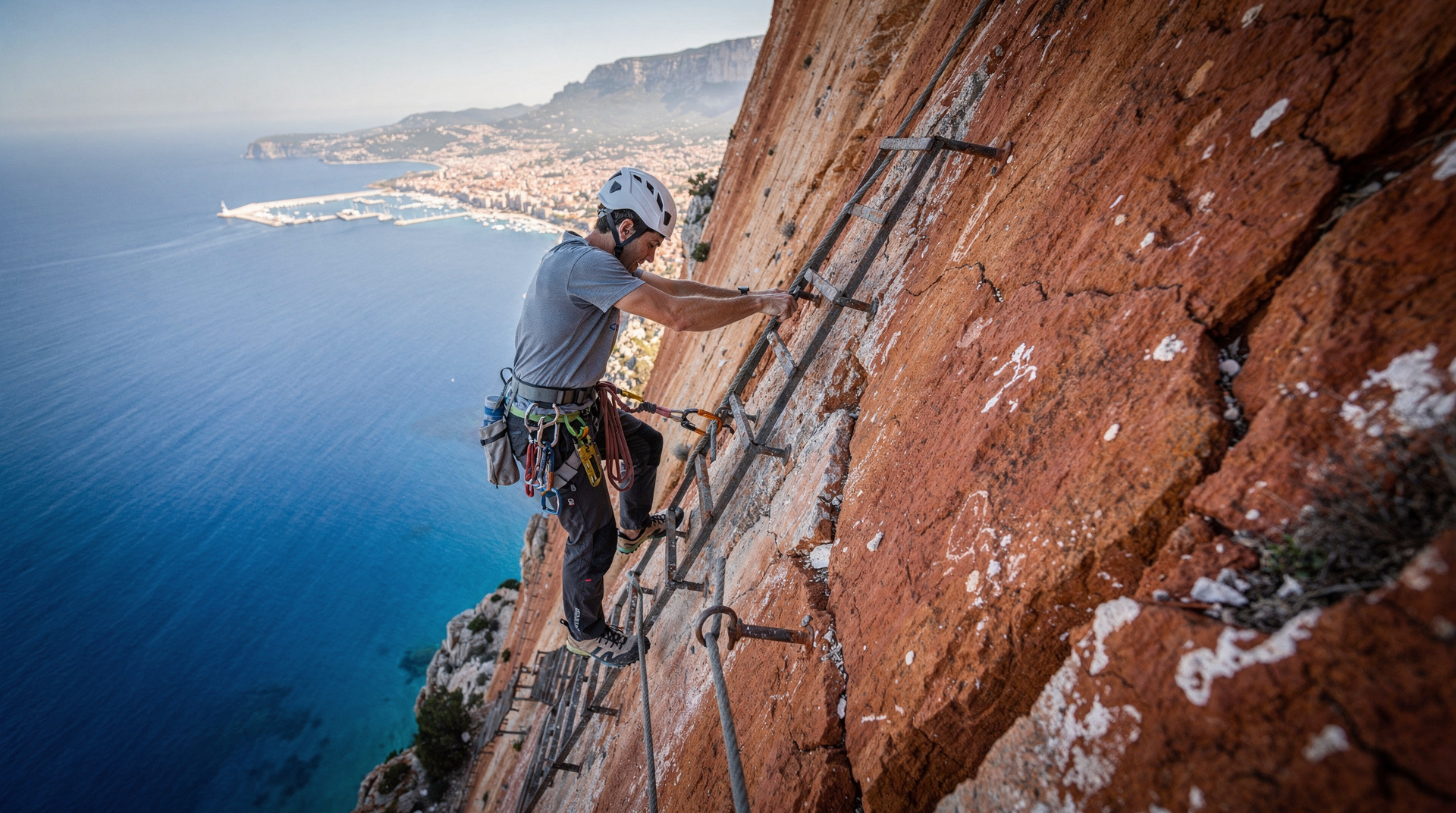
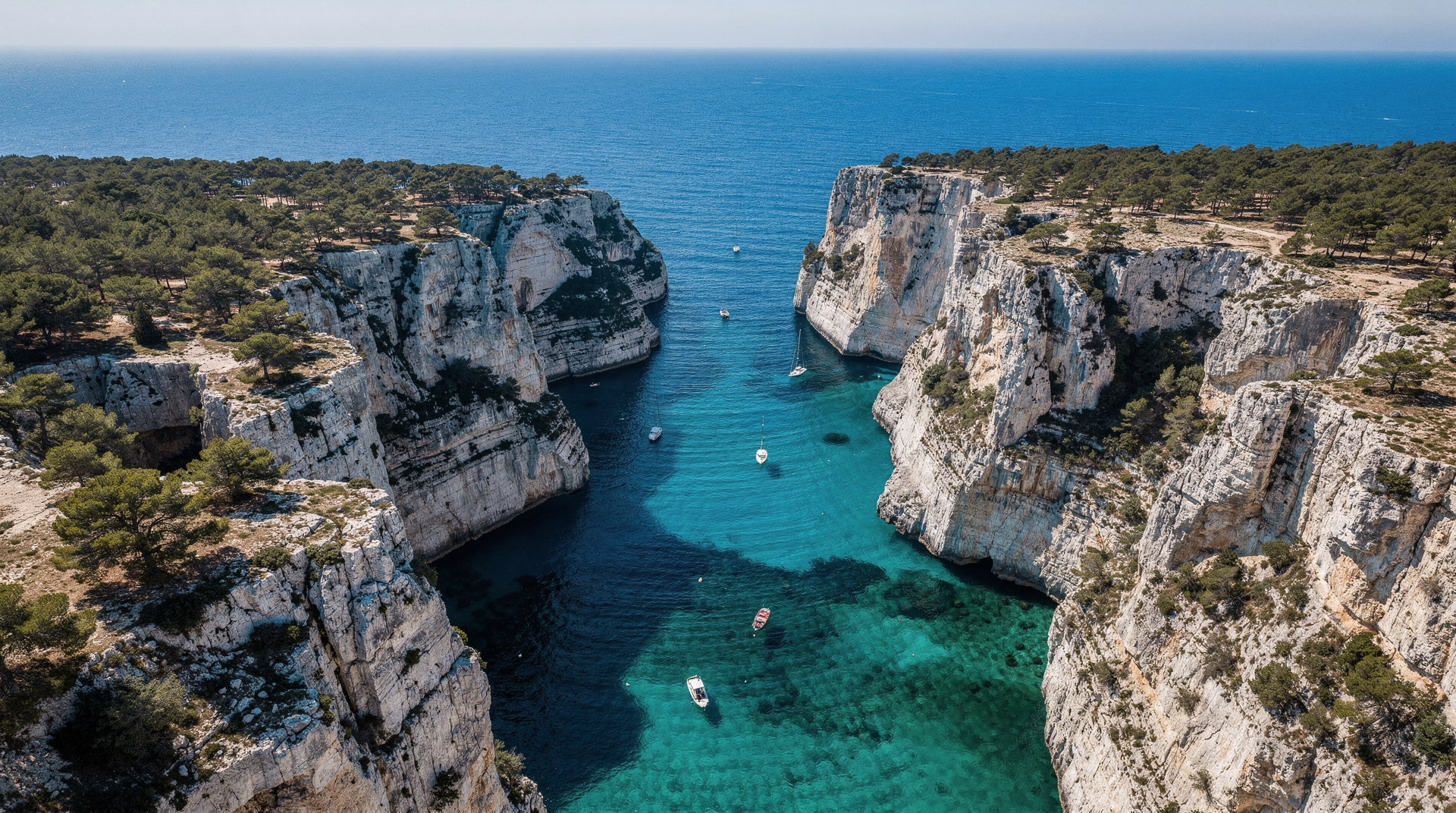
Cap Canaille is the eastern headland of Cassis — a wall of orange-red conglomerate rock that rises approximately 394 metres directly from the Mediterranean. It is the tallest coastal cliff in France, and one of the tallest in Europe. The panoramic viewpoint at the summit (accessible by road) draws visitors daily. The via ferrata takes a different route: a multi-pitch ascent fixed with iron rungs, cables, and ladders, climbing the cliff face with the sea directly below, culminating in a traverse across a natural rock arch that hangs above the void.
This is not a via ferrata for first-timers who have never been on a via ferrata. It is not suitable for children under approximately 12 years old, and even then only with exceptional young climbers. It is not a course that forgives uncertainty about heights. The sustained exposure — hundreds of metres of sea below for long sections of the route — is what makes it exceptional and also what makes it demanding.
For experienced via ferrata practitioners and active adults with reasonable fitness and no fear of heights, Cap Canaille is one of the most impressive via ferrata circuits in southern France.
If you are still deciding how to spend your days on this coast, the Cassis day trip guide puts the village and its cliff in context, and the Calanques boat vs hike comparison helps you see where a vertical day fits next to the gentler options.
| Where | Cap Canaille cliff, east of Cassis |
| Cost | Guided tours typically run in the EUR 60–90 per person range, equipment included |
| Time needed | Around 4 hours 30 minutes total, including approach and return |
| Getting there | Meeting point in Cassis; around 35–40 minutes by car or bus from Marseille |
| Best time | April–June or mid-September–October for stable weather and comfortable temperatures |
The route: what you actually encounter
Departure point: The guided tour begins at Cassis. The approach to the cliff base takes roughly 20–30 minutes on foot from the meeting point.
Duration: Approximately 4 hours 30 minutes total, including the approach and return. The active via ferrata section runs 2.5–3 hours.
The natural arch: The centrepiece of the route is a crossing of a natural rock arch — a bridge of stone spanning a gap in the cliff face, with sea visible hundreds of metres below on both sides. The arch is narrow enough that balance and focus are required. The fixed cable is there for security, but the exposure on the arch is real and immediate. This section is what differentiates Cap Canaille from easier via ferrata routes.
Difficulty: The Calanques guide operators and specialist sources describe Cap Canaille as requiring “experienced persons in excellent physical condition.” French via ferrata ratings run from F (facile/easy) through PD, AD, D, TD to ED (extrêmement difficile). Based on the sustained exposure, technical arch crossing, and large rappel sections, Cap Canaille sits in the D to TD range — difficult. This is above beginner and intermediate level.
Vertical sections: The route includes large vertical rappels (abseil descents on fixed ropes) as well as steep ascending passages on the iron rungs. The rappels require operating the via ferrata Y-lanyards correctly under downward load — something the guide demonstrates before the route begins.
Equipment: what the guide provides vs what you bring
Guide provides: Harness, helmet, Y-lanyard with energy absorbers (the via ferrata safety connector), belay device for rappel sections, gloves (optional). This is full safety equipment. You clip to the fixed cables and are protected throughout the route.
You bring: Approach shoes or trail runners (not sandals, not flip-flops, not city shoes — the approach trail and rock sections require grip). Water — at least 1.5 litres per person for a 4.5-hour session in the sun. Sun protection (sunscreen, hat if worn under the helmet). Comfortable clothing that allows full range of movement.
What you do not need: Your own harness or helmet — the guide provides this as part of the guided tour. No technical climbing experience is required — the fixed cable system means you are always attached to the cliff, and the guide demonstrates all techniques before you need them.
If you want a sense of the terrain from the ground first, the Cap Canaille hike walks the same cliff country without a harness, and the Calanques hiking safety guide covers the habits that apply on any exposed Mediterranean rock: water, footing, and knowing when to turn around.
Age limits and fitness requirements
No specific minimum age is stated by the GYG-listed operator, but the route description (“experienced persons in excellent physical condition”) and the difficulty level effectively exclude young children. As a practical guide:
- Adults of any fitness background who are genuinely comfortable at height: suitable with preparation
- Adults with limited experience at height: consult the operator before booking; the arch section is not reversible once committed
- Children under 12: not recommended
- Children 12–16: only with prior via ferrata experience and parental assessment of comfort at height
Fitness requirements: The 4.5-hour total duration, vertical climbing sections, and sustained exposure require reasonable general fitness — equivalent to being comfortable hiking 3–4 hours on hilly terrain. No specific training is needed.
Weather windows: when to go and when to cancel
Cap Canaille is an exposed clifftop environment. Wind, rain, and extreme heat all create problems for via ferrata:
Wind: The Mistral wind regularly exceeds 40 kph on the Cap Canaille headland. Climbing on fixed cables in strong wind is dangerous — the route involves sections where a gust can swing a person outward from the cliff. Guided operators monitor weather and will cancel or postpone in strong Mistral conditions. Do not pressure an operator to continue in deteriorating wind conditions.
Rain: Wet rock on steep via ferrata sections significantly increases difficulty and reduces the effectiveness of approach footwear. Rain-day cancellation is standard practice. Post-rain, orange conglomerate rock (the Cap Canaille rock type, different from the Calanques white limestone) can remain wet and slippery for 1–2 hours after precipitation stops.
Summer heat: The south-facing cliff face heats rapidly in July–August. Metal rungs and cables in direct sun can reach temperatures that require gloves. Starting early (07:00–08:00) is essential for summer sessions; afternoon starts in July–August should be avoided. The best months for Cap Canaille via ferrata are April–June and September–October — comfortable temperatures, lower wind probability, and the cliff face at its most pleasant.
Best booking window: April to June for spring conditions (not too hot, stable wind). Mid-September to October for autumn — excellent conditions, fewer visitors, and the landscape at its most colourful with autumn light on the orange cliff.
Booking: advance reservation is non-negotiable
Cap Canaille guided via ferrata tours run with limited participant numbers per guide. In spring (April–June) and autumn (September–October), demand from both local and visiting climbers fills available spots. Booking 2–3 weeks in advance is appropriate for peak periods; 1 week may be sufficient in shoulder months.
Because the weather decides whether the tour runs, keep your dates flexible if you can. The best time to visit Marseille and the seasonal guide to the Calanques explain how the seasons shape this coast, and a spare day in your plan gives you a second chance if the Mistral cancels the first.
The GYG booking process confirms the date and time and typically requires payment. Cancellation policy varies by operator — check at booking. Most quality operators cancel for weather with full refund; client cancellations within 48 hours may incur charges.
Group bookings: The guided format works well for small groups of 2–4. Larger groups (6+) slow the route significantly and increase waiting at bottlenecks. If booking for a group larger than 4, ask whether the operator will provide two guides — a sensible question that reveals the operator’s quality level.
Combining with Cassis: a full day out
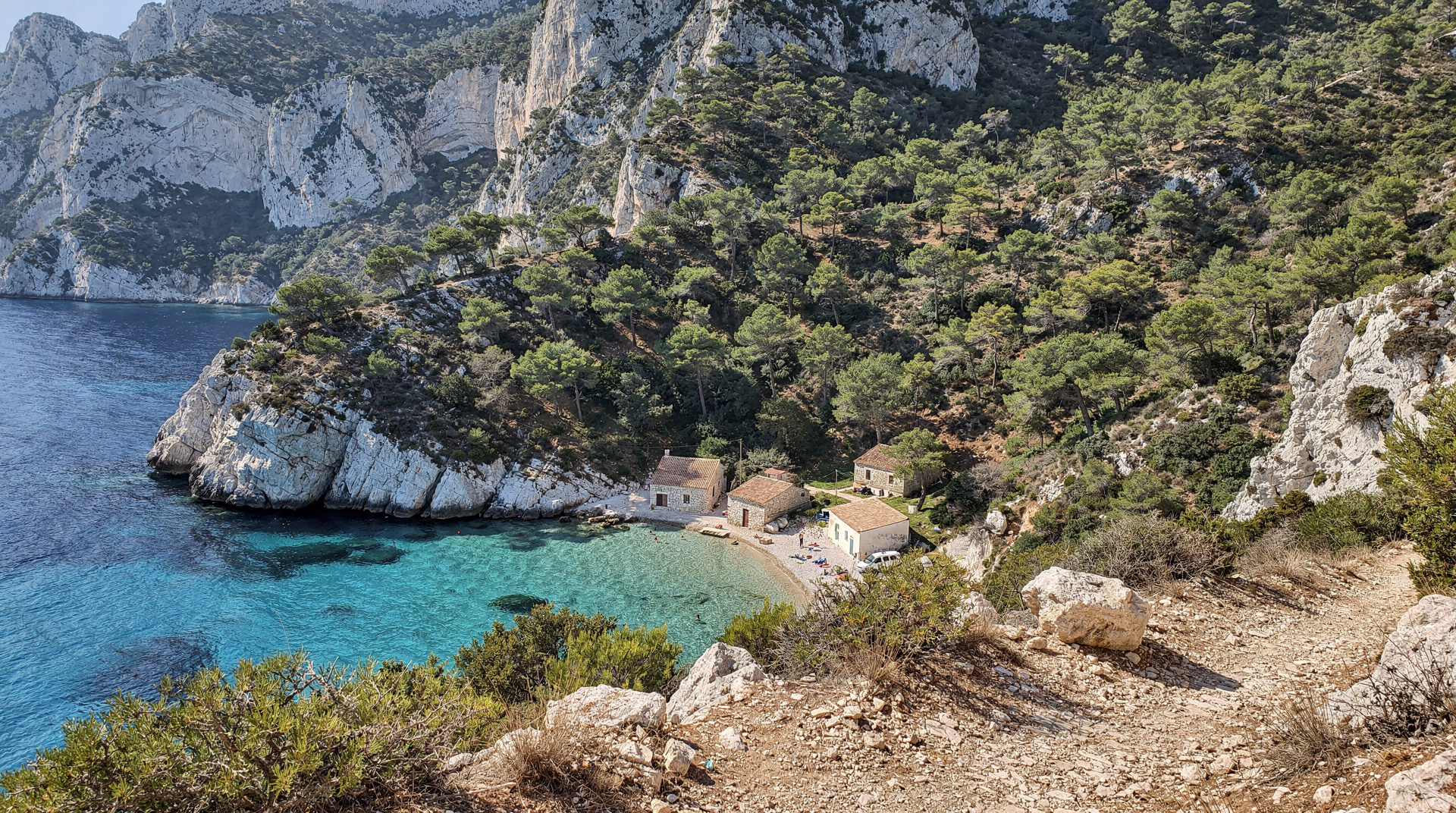
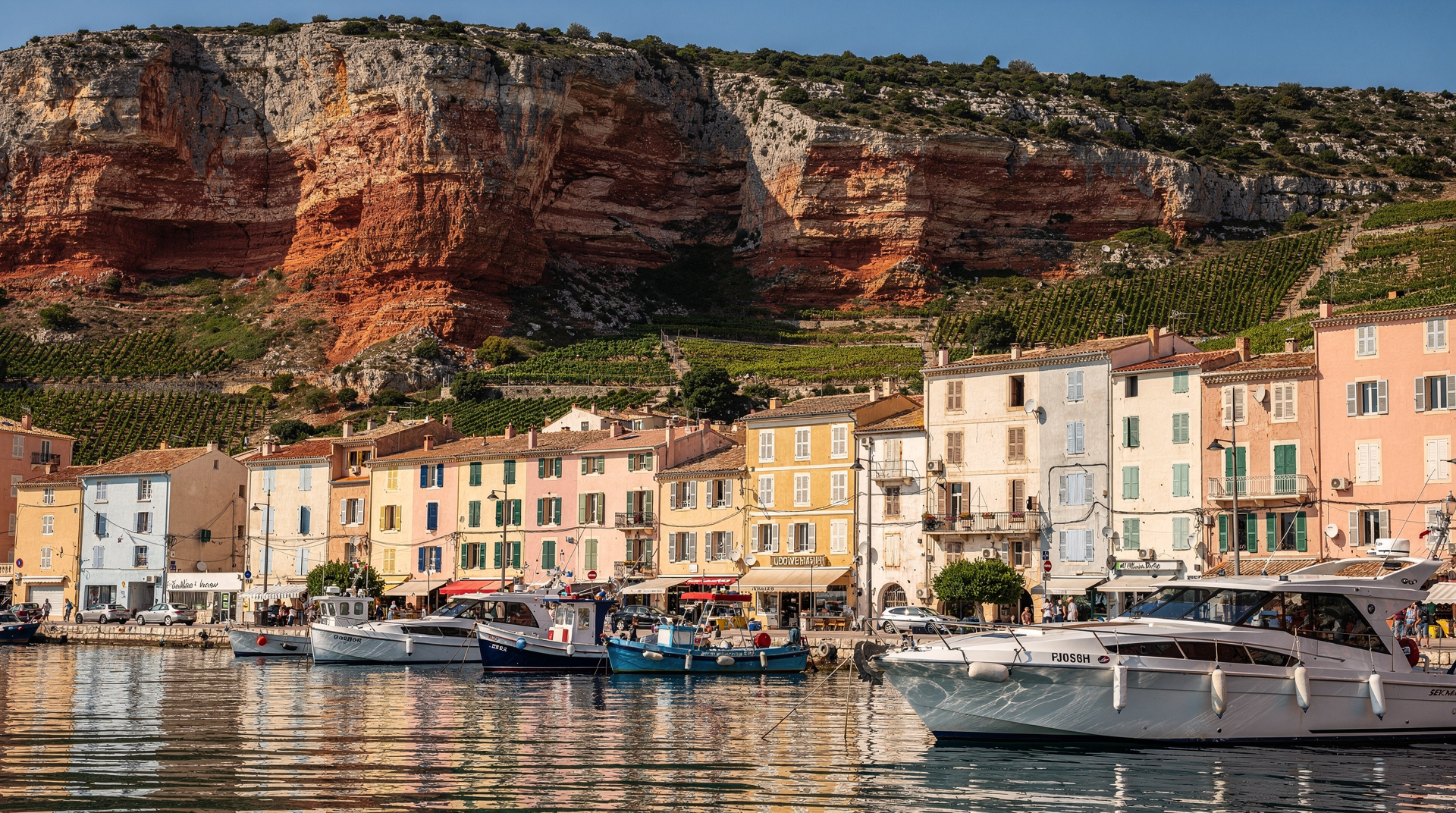
Cap Canaille via ferrata is a morning activity (4.5 hours). This pairs naturally with an afternoon in Cassis — lunch at the port with a glass of AOC Cassis wine, a walk to Port-Miou, or a swim at the Bestouan beach. The route descends back toward the Cassis side, making the village the natural endpoint.
Coming from the city, the Marseille to Cassis transport guide lays out the options for reaching the meeting point, and the Cassis wine guide is worth reading before that lunch glass. If Cassis becomes your base, the Marseille and Cassis in 2 days itinerary shows one way to string the two together.
Alternatively, the Route des Crêtes scenic road drive from Cassis to La Ciotat over the summit of Cap Canaille (accessible only by car) makes an excellent post-via-ferrata perspective — seeing from above the cliff face you climbed from below.
For overnight stays that allow an early start, Cassis has hotels ranging from small guesthouses to larger establishments. See the Cassis destination guide for accommodation options and the full range of activities.
The Sormiou via corda: a gentler alternative
If the Cap Canaille difficulty level seems too committed, the via corda at Sormiou near Marseille offers an accessible alternative. The via corda (Level 1, 4 hours) follows a fixed-rope ridge line above Sormiou calanque — with impressive views but less technical difficulty and lower exposure than Cap Canaille. It is a genuinely good introduction to vertical terrain for those new to the discipline.
The Sormiou via corda is operated at difficulty Level 1, with fixed ropes throughout and no technical climbing moves required. You progress along a limestone ridgeline with significant sea views, clipped to the cable, with the guide ahead or alongside. The experience gives genuine height and exposure — enough to assess whether you want to escalate to a proper via ferrata — without the committed nature of Cap Canaille. The Sormiou and Morgiou area is also a rewarding place to explore on foot, and the Sormiou calanque hike shows what the ground below that ridge looks like.
Physical preparation: how to be ready
The cap Canaille via ferrata does not require athletic training, but some preparation makes the experience noticeably better.
Upper body endurance: The iron rungs require pulling yourself upward repeatedly over 2.5–3 hours. If you have never done pull-ups or hanging exercises, your forearms will fatigue faster than expected. Basic arm and shoulder conditioning in the weeks before the tour is worthwhile.
Cardiorespiratory fitness: The approach walk and sustained climbing effort will elevate your heart rate for extended periods. If you can walk briskly uphill for 30 minutes without stopping, you have the baseline aerobic fitness needed.
Footwear: Approach shoes or trail runners with sticky rubber soles are the correct choice. The rock on Cap Canaille (conglomerate rather than the smooth Calanques limestone) has good grip when dry, but approach shoe rubber performs significantly better than regular trainers. Hiking boots are acceptable; anything less grippy is not.
Height tolerance: There is no guaranteed way to know before you are on the cliff whether you will be comfortable at height. If you have avoided heights your whole life and suspect a fear of heights, the arch crossing section and large rappels at Cap Canaille will be extremely stressful. If you have looked out from a balcony several floors up without distress, you are likely to manage. The guide will assess the group at the beginning and can advise.
If you are unsure, test yourself on a lower-stakes outing first: a walk such as the En-Vau calanque hike or a session with the rock climbing options in the Calanques will tell you a lot about how you feel on steep ground. For the wider picture of the protected coast around you, see the Calanques National Park page.
Cap Canaille vs Sormiou via corda at a glance
| Factor | Cap Canaille via ferrata | Sormiou via corda |
|---|---|---|
| Difficulty | D–TD (difficult) | Level 1 (accessible) |
| Duration | Around 4.5 hours | Around 4 hours |
| Exposure | Sustained, sea directly below | Present but less committed |
| Technical moves | Rappels, arch crossing | Fixed ropes, no technical moves |
| Suitable for | Experienced climbers, confident with heights | Beginners curious about vertical terrain |
What makes Cap Canaille different from inland via ferratas
The defining characteristic of Cap Canaille is the sea. On most via ferrata routes, the consequence of looking down is rock, scrub, and possibly a distant valley. At Cap Canaille, looking down means looking directly at the Mediterranean — 300–400 metres below, in the full colour range of shallow to deep water. When the sea is visible on both sides simultaneously (as it is at the arch crossing), the exposure is qualitatively different from any inland route.
This is not a reason to avoid it. For many participants it is the reason to do it — the combination of physical engagement, fixed-cable security, and a sea view of genuine dramatic scale is the kind of experience that stays clearly in memory. But it is honest to describe it as specifically maritime exposure rather than generic altitude.
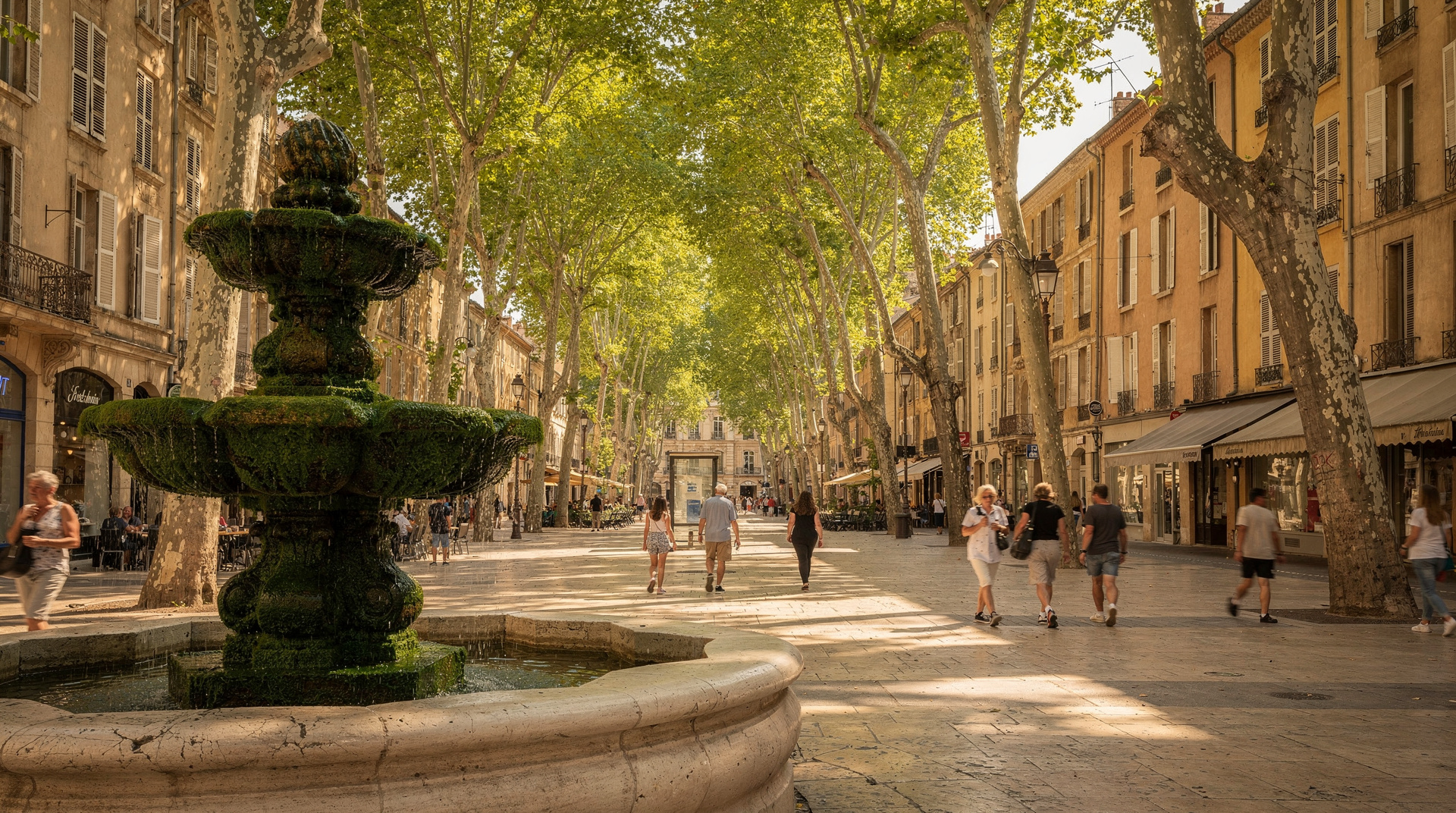
For experienced climbers who want more after the via ferrata, the Sainte-Victoire via ferrata near Aix-en-Provence offers an additional venue with different rock character and scenery. See the rock climbing guide for the full Calanques climbing picture, and the Cassis guide for the overview of all Cassis activities including kayaking and wine.
The hiking guide covers the Cap Canaille hike from Cassis as a walking alternative to the via ferrata route, and the Cassis beaches guide covers where to swim after a morning on the cliff face.
Summer access to the trails nearby can change with the fire risk, so check the Calanques summer access rules before building a plan around a walk. For a longer stay on this stretch of coast, the Marseille Calanques weekend itinerary is a good frame for adding a vertical morning to a wider trip, and the kayaking guide offers a calmer way to see the same cliffs from the water.
Frequently asked questions about Via ferrata on Cap Canaille
Do I need previous via ferrata experience for Cap Canaille?
Previous experience is not strictly required since the guide teaches the technique before the route begins, but Cap Canaille’s difficulty rating (D–TD) and sustained exposure make it a poor choice as a first-ever via ferrata. Beginners are better served starting with the Sormiou via corda.
How does Cap Canaille compare to the Sainte-Victoire via ferrata near Aix?
Both are demanding routes for experienced participants, but they differ in character: Cap Canaille’s defining feature is direct sea exposure hundreds of metres below, while Sainte-Victoire offers inland mountain scenery and a different rock type. See the rock climbing guide for more on Calanques-area climbing options.
Top experiences
Bookable activities with verified prices and instant confirmation on GetYourGuide.