Rock climbing in the Calanques: a practical guide to world-class limestone
Marseille: climbing class in the Calanques National Park
Duration: 4 hours
Is rock climbing in the Calanques suitable for beginners?
Yes — guided introduction sessions are available from Marseille and Cassis for complete beginners, covering fundamentals on single-pitch limestone routes graded 4a–5a. The Calanques also offer 2,500+ bolted sport routes up to 9a for advanced climbers. Heat management in summer is the main practical constraint.
| At a glance | |
|---|---|
| Where | Sormiou, Morgiou, En-Vau, and Cap Canaille crags within the Calanques National Park |
| Cost | Around EUR 60–100 for a half-day guided introduction session |
| Time needed | 3.5–4 hours for a guided intro; a full day for multi-pitch routes |
| Getting there | Guided sessions include transport from a Marseille or Cassis meeting point |
| Best time | April–June and late September–November; avoid July–August afternoons |
One of Europe’s great climbing destinations
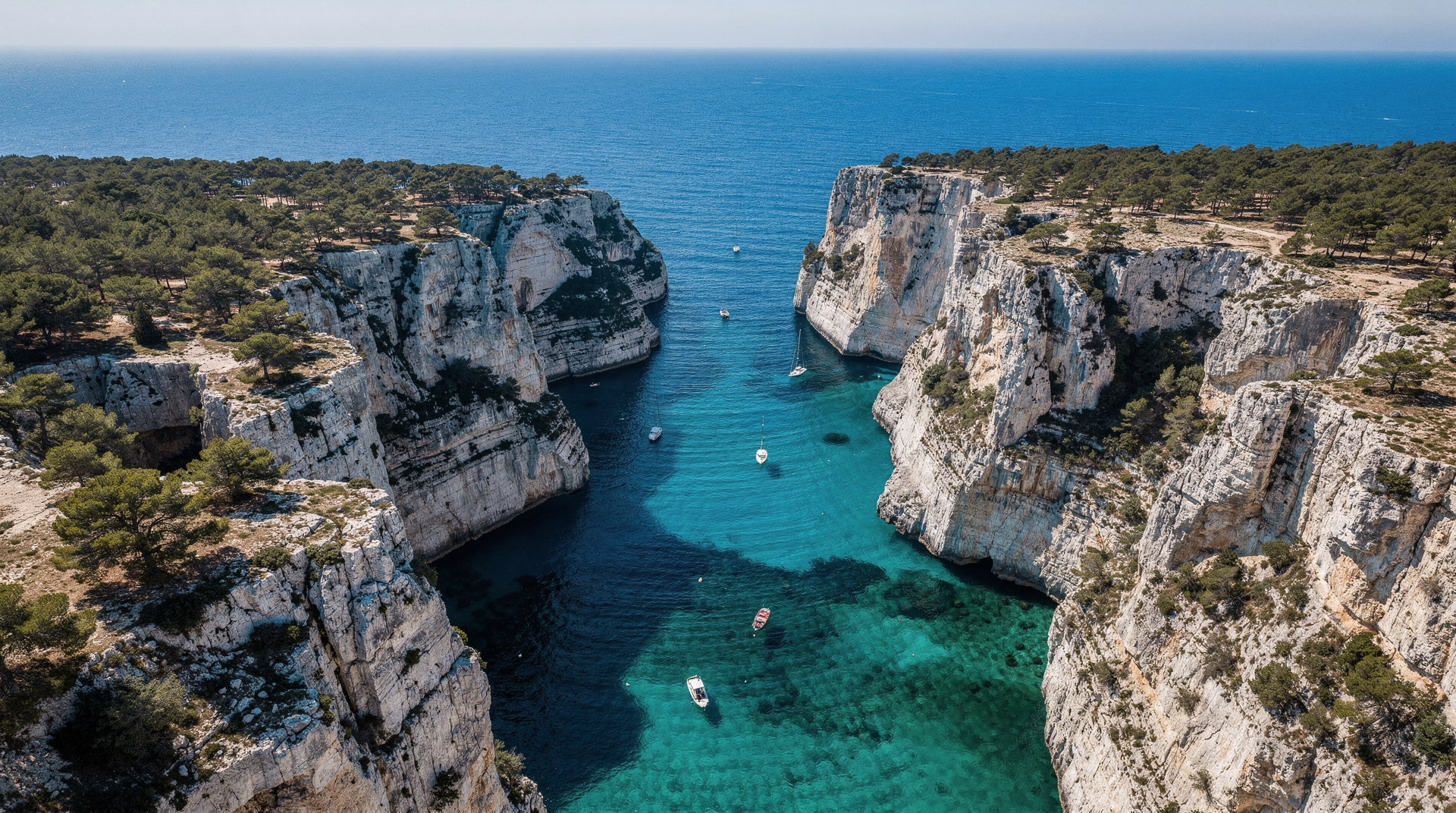
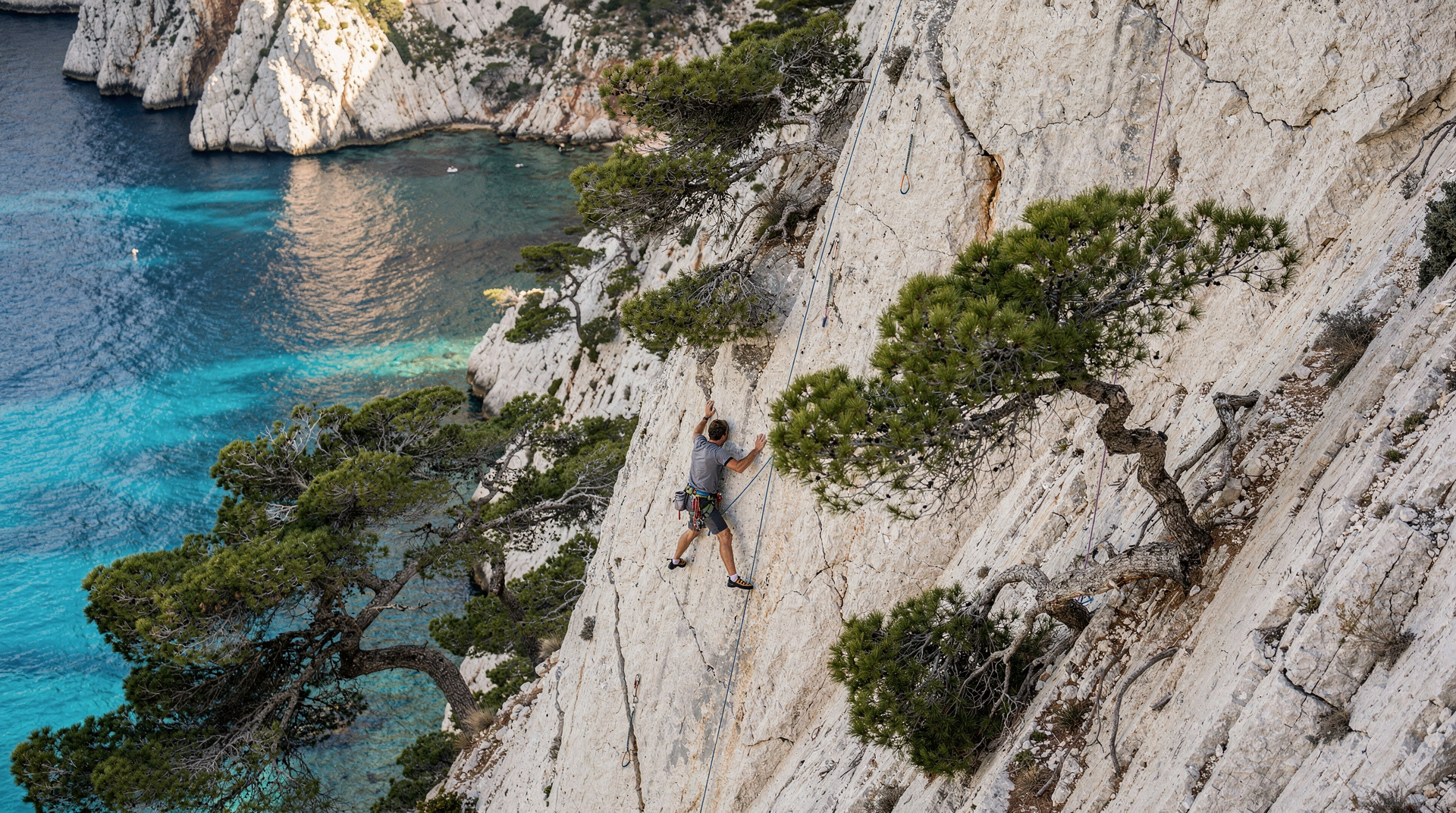
The Calanques limestone is the reason serious climbers have been coming to Marseille since before it was fashionable. The rock is white, compact, and sharp-featured — a limestone character that rewards technical footwork and precise movement rather than raw power. The setting, above turquoise water with views across the Bay of Marseille, adds something that no inland crag can replicate.
The Calanques National Park contains approximately 2,500 bolted sport routes, around 1,000 traditional (gear-protected) routes, and hundreds of deep water soloing (DWS) routes — traverses and faces climbed directly above the sea, where the landing is a swim rather than a crash. In total, the massif offers climbing from French grade 4 through to 9a, spread across multiple crags from the Marseille suburbs to the Cassis side. It is one of the most complete single climbing venues in France.
This guide covers the main crags, the grade reality, how to access the crags as a beginner, and the honest advice about when to go and when to stay home.
The main climbing sectors
Marseilleveyre and the Marseille-side crags
The crags above and between Sormiou and Morgiou — collectively often called the Marseilleveyre sector — form the Marseille-facing side of the massif. These include multi-pitch routes up to 250 metres on the main faces, and an extensive network of single-pitch sport climbing on the lower walls.
Sormiou sector: The crags above Sormiou calanque offer everything from beginner-friendly single-pitch routes in the 4a–5c range to multi-pitch lines on the taller limestone faces. The rock is generally well-bolted and the orientation includes north-facing options that stay cooler in summer.
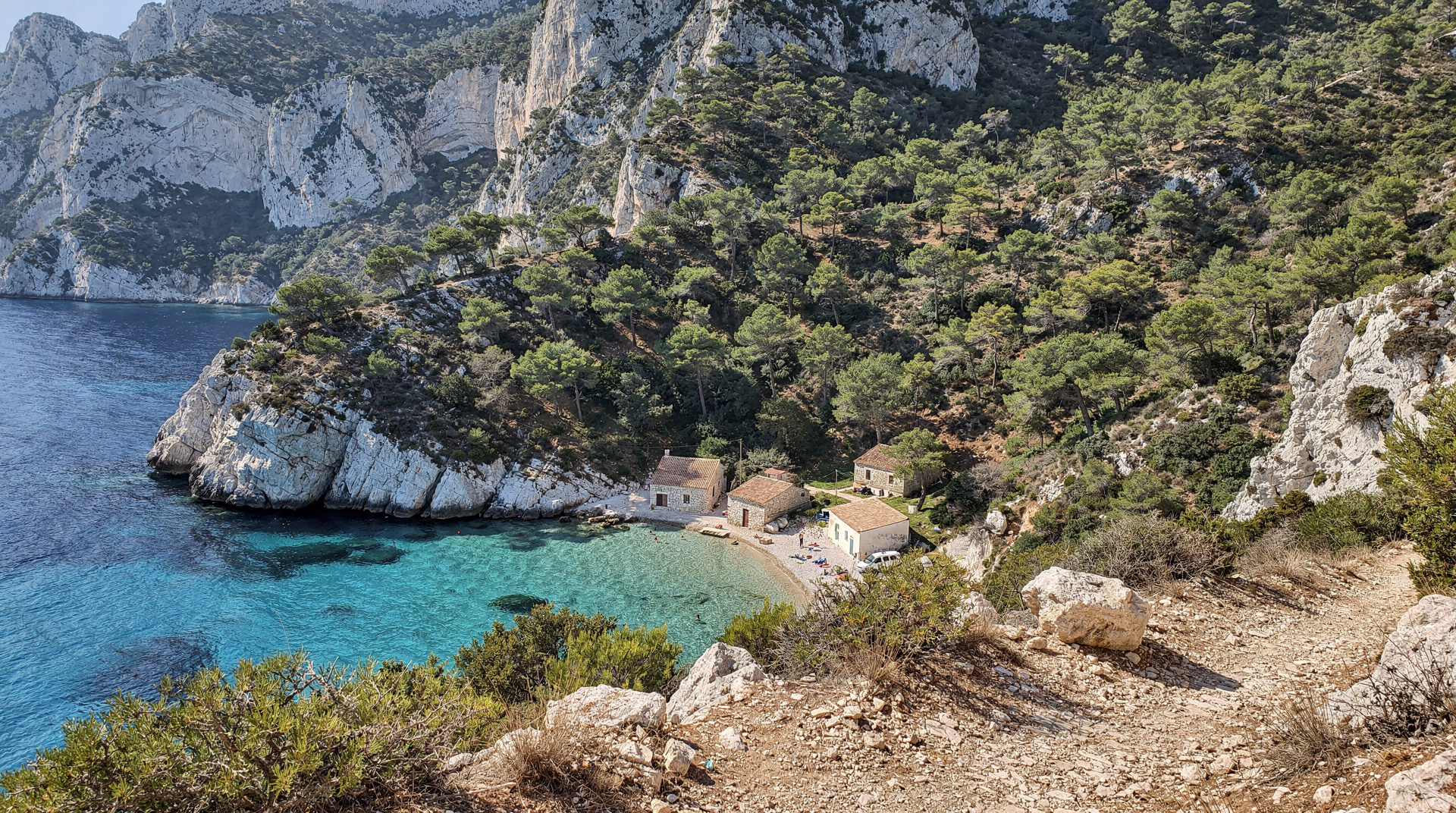
Morgiou crags: Between Morgiou and Sugiton, several less-visited sectors provide good sport climbing with less competition for routes than the more popular areas. Approach times from the road are longer (45–90 minutes), which naturally filters out the casual visitor.
Via corda at Sormiou: The via corda (a semi-guided route with fixed ropes on an easy ridge line above Sormiou) is distinct from technical rock climbing but provides a taste of exposure and height without requiring climbing technique. The guided via corda session runs 4 hours and is rated Level 1 — appropriate for beginners with basic fitness and no fear of heights. This is a good introduction to what the Calanques feel like from above before committing to technical climbing.
Cassis crags: En-Vau approach and Cap Canaille
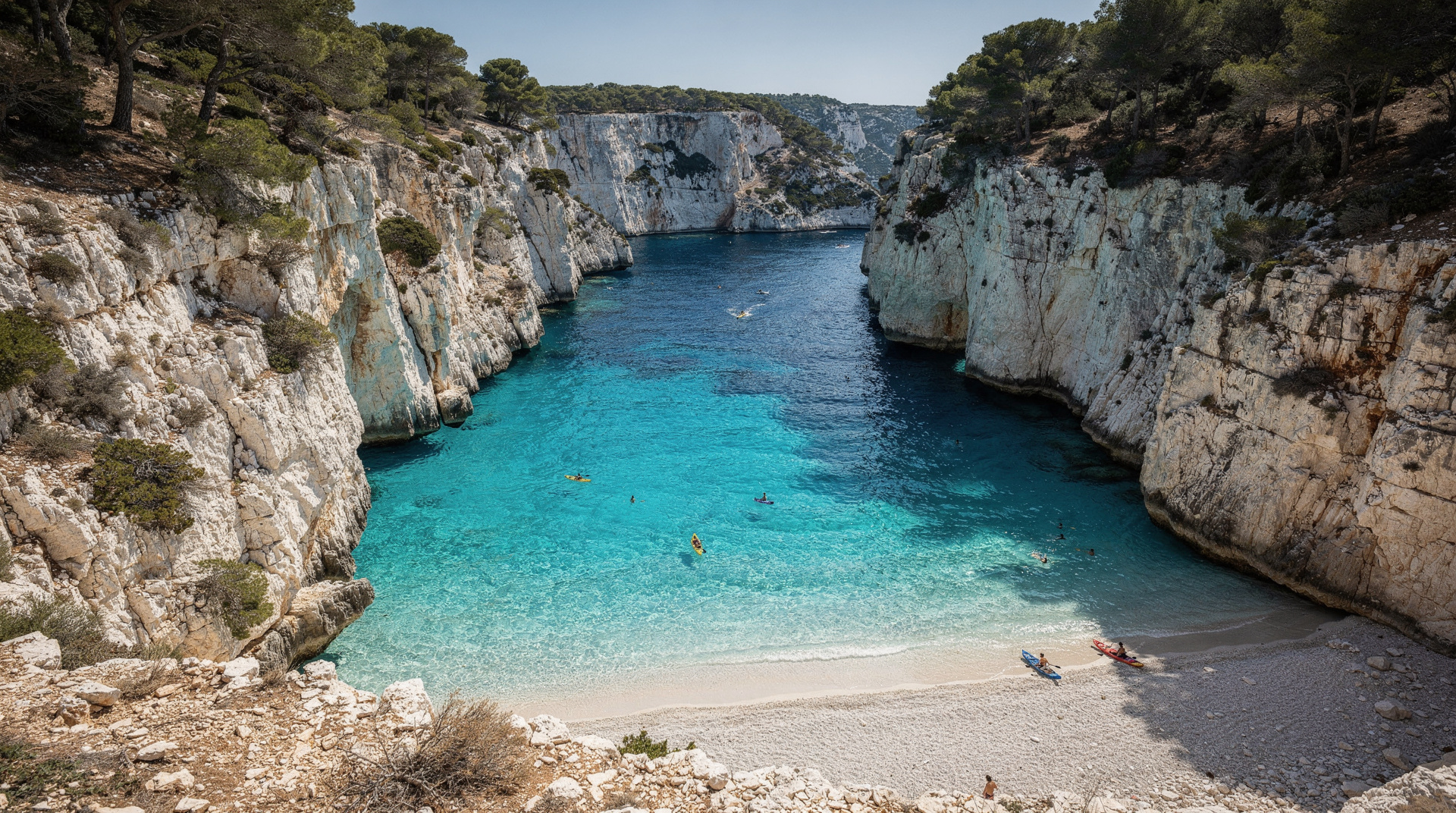
The Cassis side of the national park offers the biggest limestone faces in the system. The walls above En-Vau and in the immediate vicinity rise 150+ metres, with multi-pitch routes that are among the finest in southern France. These are not beginner routes — the approach alone (2 hours on steep trail) and the scale of the face require competent multi-pitch climbing skills.
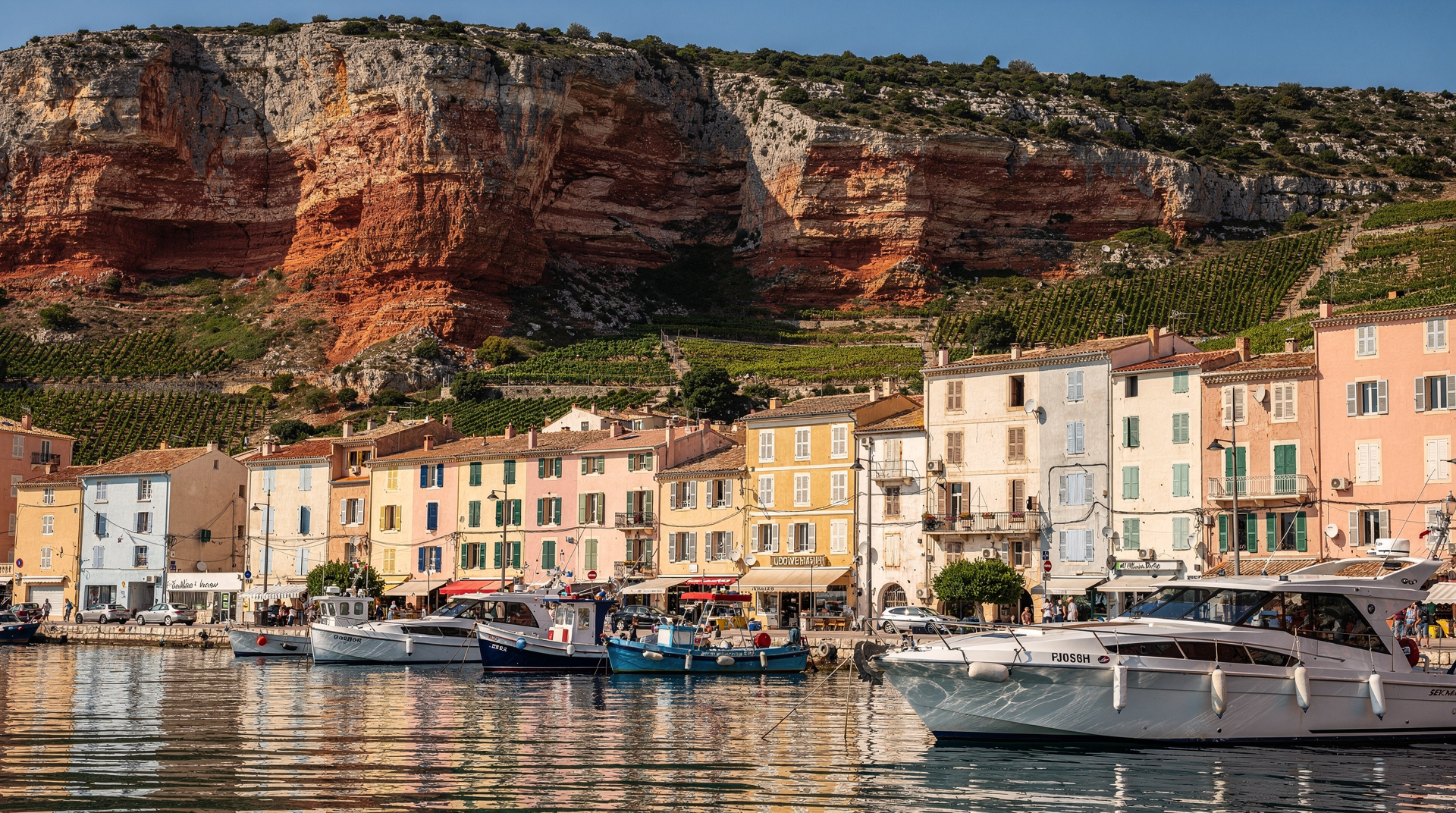
Cap Canaille: The 394-metre orange-red cliff face east of Cassis offers a completely different rock type — a conglomerate and puddingstone with holds that climb differently from the white limestone of the Calanques proper. Routes here were added after 2012 (when the area was incorporated into the national park zone) and include multi-pitch lines accessible to strong recreational climbers (grade 5c–7a) as well as harder test pieces.
The guided climbing discovery session from Cassis covers beginner-appropriate terrain near Cassis with the Calanques as a backdrop — practical for those who want an introduction with a qualified guide in the Cassis context without the long approach to the bigger walls.
Deep water soloing zones
The DWS routes in the Calanques are among the most spectacular in Europe. Climbers traverse limestone walls that drop directly into 2–10 metres of water, moving laterally along the cliff face with no rope and the sea as the landing zone. The most accessible DWS zones are accessible by boat or from specific water-level entry points.
DWS is not beginner-appropriate — the consequence of a fall is a water entry at speed from up to 10 metres, which requires swimming competence and the ability to orient the body correctly for entry. Do not attempt DWS without a guide who knows the sites and conditions.
French grading: what the numbers mean
The French sport climbing grade system runs from 1 to 9+ in the Calanques context. For practical reference:
| Grade | Level | Who it suits |
|---|---|---|
| 4a–5a | Beginner | Guided introduction sessions; comfortable with basic movement on rock |
| 5b–6a | Intermediate | A few days of climbing experience; some body tension awareness |
| 6b–7a | Strong recreational | Regular climbers; good technical skills |
| 7b–8b | Advanced | Experienced sport climbers; serious training background |
| 9a | Elite | Professional level; four routes in the park as of 2023 |
Most guided introduction sessions for beginners focus on routes in the 4a–5b range. The goal is not to reach a particular grade but to experience what movement on limestone feels like, understand basic safety systems, and develop confidence on an exposed rock face.
Guided introduction sessions: what to expect
A typical guided climbing introduction session from Marseille runs 4 hours and is suitable for complete beginners. The guide takes groups of 2–4 people (check maximum group size when booking; smaller is better) to a crag with accessible beginner routes.
Session structure:
- Equipment fitting — harness, helmet, climbing shoes
- Safety system explanation — top-rope belay, commands, how to fall safely
- First routes (4a–4c) — guide leads, sets up top rope, participants climb with continuous support
- Progression — grade increases as comfort builds; most participants reach 5a–5c in a 4-hour session
- Debrief — what the experience felt like, next steps if interested in continuing
The guide carries all equipment. You bring water, sun protection, approach footwear, and comfortable non-restrictive clothing.
From Marseille: 4-hour climbing class in the Calanques National Park. Departs from a Marseille meeting point. Targets beginner-accessible crags in the Marseilleveyre area. Group limited to 4 participants per guide.
From Cassis: 3.5-hour climbing discovery session near Cassis. Similar format, Cassis-side terrain. Small group format. The Cassis base is useful if you are combining climbing with a visit to the village or the calanques.
Summer heat: the most important practical constraint
The Calanques climbing community has an expression: “climbing in the Calanques in July is suffering, not climbing.” This is not hyperbole.
South-facing limestone walls heat rapidly in the Mediterranean summer. By 09:00 on a July morning, rock temperature on south and east-facing crags can exceed 30°C. By 11:00, the rock is 40–45°C. Friction on this temperature of limestone is dramatically reduced — holds that are positive and reliable at 15°C feel greasy and unsafe at 40°C. Chalk, which absorbs hand moisture, becomes ineffective above 30°C ambient temperature. Routes that are excellent in October become unclimbable by 10:30 in July.
Practical guidance for summer climbing:
- North-facing sectors only in July–August. Several crags in the massif face north and stay in shade through most of the day. These are the summer venues for serious climbers.
- Start at dawn. Summer climbing sessions that start at 06:00 finish before the critical heat window. This requires camping or accommodation near the park, or staying in Marseille and driving before sunrise.
- Water stops on long routes. Multi-pitch routes in summer require 3+ litres of water per person. There are no water sources in the massif. Dehydration and heat stroke are real risks on exposed summer multi-pitch.
- Avoid south-facing crags entirely. In July–August, south and east-facing rock is dangerous before noon and inaccessible by afternoon.
The ideal climbing seasons are April to June and late September to November. October in particular — warm ambient temperature, cooler rock, excellent friction, and lower tourist numbers — is the local consensus for optimal conditions.
Fire closures and crag access
The national park fire closure system applies to approach trails, not to climbing itself. However, many crag approaches pass through the massif interior on trails that close July–August. If the approach trail is closed, you cannot reach the crag regardless of whether climbing is technically permitted.
Some crags are accessible from the road without crossing restricted terrain — ask your guide about which crags are accessible in the current fire-risk period before booking summer sessions.
The park website (calanques-parcnational.fr) publishes daily closure maps. Check the morning of any planned session, including guided sessions — the guide will already have verified this, but personal confirmation is good practice.
Multi-pitch climbing: the bigger experience
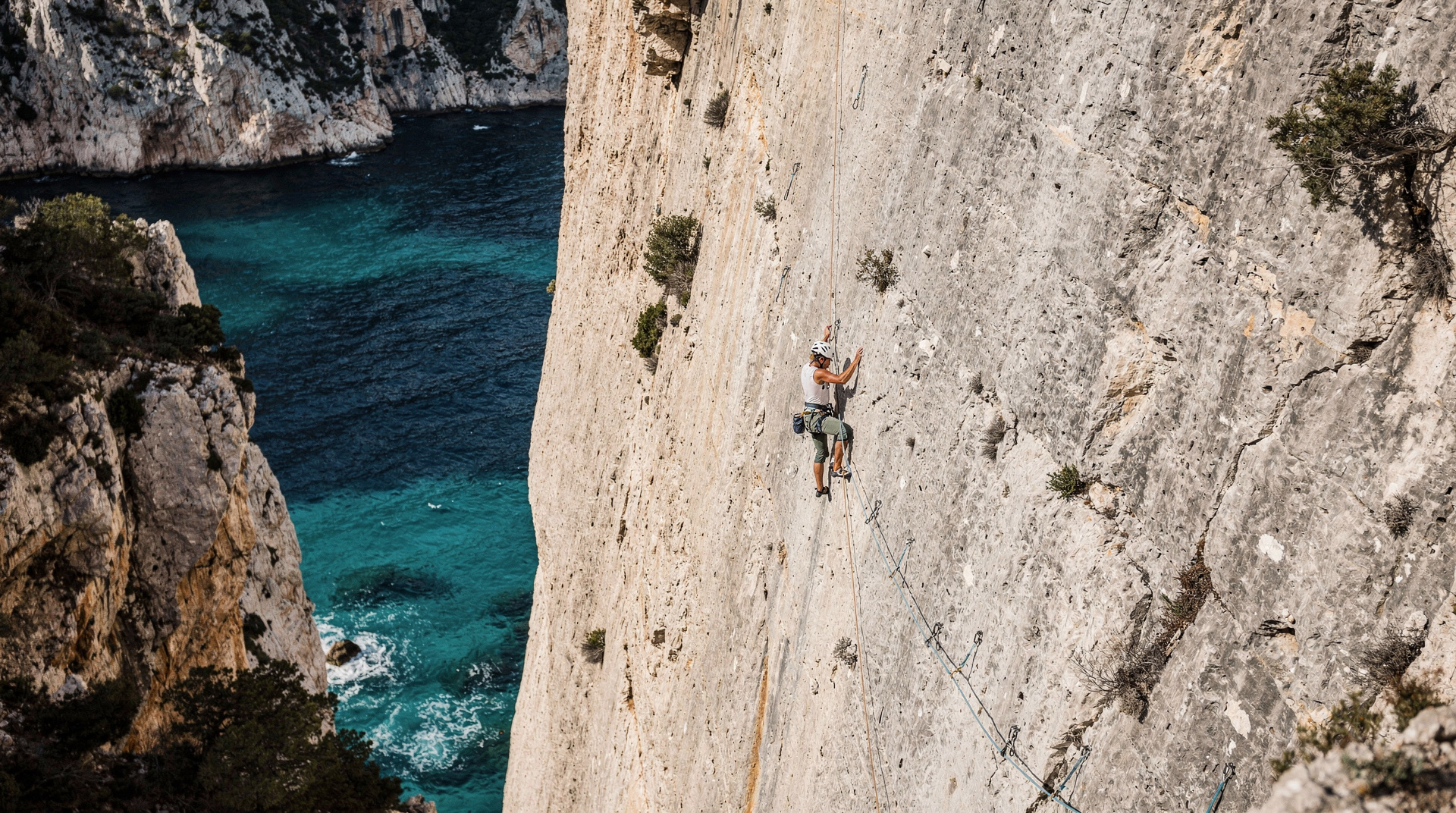
For experienced climbers, the multi-pitch routes in the Calanques are the real prize. Routes of 8–15 pitches on 150–250 metre faces, with exposure increasing rapidly with height and the sea visible from every belay ledge, represent a level of climbing that very few venues in the world match for quality and setting.
The GR98 coastal traverse and the Calanques ridge systems offer committed multi-pitch adventures at grades from 5c upward. These require experienced leaders, gear knowledge (traditional protection on some routes), and accurate weather assessment before committing to an abseil descent.
For multi-pitch climbing, personal instruction from a qualified guide (Bureau des Guides des Calanques and affiliated operators) is strongly recommended for those who have not climbed multi-pitch in the Calanques before. The route-finding is complex, the marine environment adds specific hazards (salt on holds, sudden sea mist, wind), and the consequences of getting lost on a 200-metre face are serious.
Sainte-Victoire: a complementary climbing destination
When the Calanques crags are too hot in summer or inaccessible due to fire closures, Aix-en-Provence’s Montagne Sainte-Victoire offers an alternative limestone climbing venue 40 km north. The south face crags of Sainte-Victoire hold routes from beginner to expert level, and the north face stays cooler in summer. A guided climbing session on Sainte-Victoire is available via GYG and complements a Calanques climbing trip if you are spending a week in the region.
Essential logistics
Getting to the crags without a car: Most guided sessions include transport from a central Marseille or Cassis meeting point to the crag. For independent access, public transport reaches the trail heads for some sectors (bus 21 to Luminy for the Sugiton-area crags), but most crag approaches require a car or taxi for the final section.
Guidebooks: The OmegaRoc digital guidebook covers the Calanques climbing comprehensively (OmegaRoc app, available in English and French). The traditional print guidebook by Éditions du Fournel is the local reference but heavy to carry to the crag. For a first visit with a guide, you do not need a guidebook.
Approach footwear: The trails to the crags are rocky and sometimes steep. Approach shoes or trail runners are essential — sandals are completely inadequate for any crag approach in the massif.
For the broader context of the Calanques, see the national park guide. For Cassis-based activities beyond climbing, the Cassis guide covers wine, kayaking, and the three-calanque hike. The via ferrata guide covers the Cap Canaille route for those interested in a different type of vertical adventure. For hiking approach trails to the same terrain, see the hiking guide.
Climbing vs hiking the same terrain
For visitors deciding between the two ways of experiencing the Calanques’ cliffs, the distinction is meaningful. Hiking (see the hiking guide) puts you on marked trails between the calanques, with elevation but no exposure requiring rope or harness. Climbing puts you on the vertical faces themselves — a fundamentally different, more committing experience that requires either prior skill or a guide.
Neither replaces the other: many visitors do both on the same trip, hiking one day and climbing (or trying the via corda) the next. Kayaking and boat tours (see the boat tours guide) offer a third, sea-level perspective on the same cliffs for those who prefer to stay off the rock entirely.
Planning a climbing trip around the rest of the Calanques
A climbing session rarely fills a whole trip, so it helps to slot it between other days on the massif. If you are still choosing where to base yourself for the coast, which calanque to visit compares the main inlets and shows where the crags sit relative to the beaches and trailheads. The Sormiou and Morgiou destination page gives the setting for the crags above those two calanques, and the Sormiou hike lets you see the approach terrain on foot before deciding whether to go up the walls.
Because the heat and the fire-risk closures shape every climbing plan, read Calanques summer access rules before booking anything between July and August, and use visiting the Calanques by season to choose the months that suit both climbing and the rest of your itinerary. Climbers who also want to walk the trails between sessions should skim Calanques hiking safety, since the same rocky paths, exposure and lack of water apply on the way to the crag.
For the big Cassis-side walls, the En-Vau hike shows what the approach to that sector involves, which is a useful reality check before you consider the multi-pitch routes above it. If you are basing yourself in the village, the Cassis day trip guide covers the rest of the day around a morning on the rock. For a first-person account of a day on the walls, the blog post climbing in the Calanques is a good companion read, and the Calanques weekend itinerary shows how a climbing morning can sit inside a longer stay.
Frequently asked questions about Rock climbing in the Calanques
What grades are the climbing routes in the Calanques?
The Calanques have around 2,500 bolted sport routes and approximately 1,000 traditional routes spanning French grades 4 to 9a. The majority of recreational climbing concentrates in the 5a–7a range. Four 9a-graded routes existed in the park as of 2023. Beginners will find accessible 4a–5b routes at guided introduction crags near Marseille and Cassis.When is the best time to climb in the Calanques?
October to May is ideal — comfortable temperatures (15–25°C), good rock friction, and the most route options available. June is viable with very early starts. July and August are genuinely problematic: rock temperature reaches 40–50°C by 10:00 on south-facing walls, chalk becomes ineffective, and routes that are excellent in spring are miserable in summer afternoon heat. Some north-facing sectors stay climbable in summer, but most experienced climbers avoid July–August.Do I need to book a guided session in advance?
Yes, especially in spring (April–June) and autumn (September–October) when demand is highest. The Calanques climbing guide community (Bureau des Guides des Calanques and similar operators) runs a finite number of spots. Book at least 1–2 weeks ahead for spring and autumn. Summer sessions in early morning slots also book up.Can I climb in the Calanques during fire closures?
Climbing itself is not banned by fire closures, but the approach trails to many crags pass through the massif interior — and those trails are subject to the same fire-risk closures as hiking paths (July–August). Some crags accessible from the road or sea are reachable even when interior trails are closed. Check with the national park and your guide before any summer session.What equipment do I need for a guided climbing session?
Nothing — the guide provides harness, helmet, shoes (rental), and draws. Wear comfortable clothing that allows movement, and bring sun protection, 2+ litres of water, and approach shoes (trail runners or hiking shoes) for the walk to the crag. The guide carries the rope.Is deep water soloing (DWS) possible in the Calanques?
Yes — the Calanques have hundreds of DWS routes where you climb directly above deep water and fall safely into the sea when you come off. This is a specialist discipline requiring swimming competence and knowledge of the specific DWS zones. It is spectacular when conditions are right. Do not attempt DWS without experience or a qualified guide.What grades are the climbing routes in the Calanques?
The Calanques have around 2,500 bolted sport routes and approximately 1,000 traditional routes spanning French grades 4 to 9a. The majority of recreational climbing concentrates in the 5a–7a range. Four 9a-graded routes existed in the park as of 2023. Beginners will find accessible 4a–5b routes at guided introduction crags near Marseille and Cassis.When is the best time to climb in the Calanques?
October to May is ideal — comfortable temperatures (15–25°C), good rock friction, and the most route options available. June is viable with very early starts. July and August are genuinely problematic: rock temperature reaches 40–50°C by 10:00 on south-facing walls, chalk becomes ineffective, and routes that are excellent in spring are miserable in summer afternoon heat. Some north-facing sectors stay climbable in summer, but most experienced climbers avoid July–August.Do I need to book a guided session in advance?
Yes, especially in spring (April–June) and autumn (September–October) when demand is highest. The Calanques climbing guide community runs a finite number of spots. Book at least 1–2 weeks ahead for spring and autumn. Summer sessions in early morning slots also book up.Can I climb in the Calanques during fire closures?
Climbing itself is not banned by fire closures, but the approach trails to many crags pass through the massif interior — and those trails are subject to the same fire-risk closures as hiking paths (July–August). Some crags accessible from the road or sea are reachable even when interior trails are closed. Check with the national park and your guide before any summer session.What equipment do I need for a guided climbing session?
Nothing — the guide provides harness, helmet, shoes (rental), and draws. Wear comfortable clothing that allows movement, and bring sun protection, 2+ litres of water, and approach shoes (trail runners or hiking shoes) for the walk to the crag. The guide carries the rope.Is deep water soloing possible in the Calanques?
Yes — the Calanques have hundreds of DWS routes where you climb directly above deep water and fall safely into the sea when you come off. This is a specialist discipline requiring swimming competence and knowledge of the specific DWS zones. It is spectacular when conditions are right. Do not attempt DWS without experience or a qualified guide.
Top experiences
Bookable activities with verified prices and instant confirmation on GetYourGuide.