Van Gogh in Arles: the 15-month period that changed art
Arles: walking tour in Vincent Van Gogh's footsteps
Duration: 2-3 hours
What can I see relating to Van Gogh in Arles?
Van Gogh's actual paintings are not in Arles — they are in Amsterdam, Paris, and New York. What exists here is the city where he painted them: a walking trail of 15–20 panels showing paintings made at their exact locations, and the Fondation Vincent van Gogh (open daily 10:00–18:00, EUR 10) with contextual exhibitions. The Café de Nuit on Place du Forum is still a café.
Fifteen months, three hundred paintings, one city
Vincent Van Gogh arrived in Arles on 20 February 1888 and left for the Saint-Paul-de-Mausole asylum in Saint-Rémy-de-Provence on 8 May 1889. In those fifteen months he produced approximately 300 paintings, around 200 drawings, and conducted one of the most sustained creative experiments in the history of art.
The mathematics are extraordinary. If Van Gogh worked every day (which he largely did, except during hospitalisation), 300 paintings in 450 days is roughly one painting every 38 hours of waking life. The sheer output is only part of what makes this period significant. The quality — the Sunflowers series, The Starry Night Over the Rhône, the Bedroom at Arles, the Night Café, the Alyscamps paintings made with Gauguin, the Sower, the Postman Roulin and his family, dozens of Arles landscape paintings — represents the fullest expression of everything Van Gogh had been developing since his Dutch period. He came to Arles to find the light of Japan in Provence, and in a sense he found it.
None of those paintings are in Arles. This is the most important fact about the Van Gogh experience here, and no guide should obscure it.
| Where | Arles old town (trail + Fondation), plus the Alyscamps and Pont de Langlois replica just outside it |
| Cost | Trail itself is free; Fondation Vincent van Gogh around EUR 10 adult; combined tickets EUR 12–17 |
| Time needed | Around 2–3 hours for trail plus Fondation; half a day with the Alyscamps and Espace Van Gogh added |
| Getting there | Arles is roughly 1 hour from Marseille by car or TER train; the trail itself is entirely walkable from the station |
| Best time | Spring or autumn mornings for soft light and manageable crowds; avoid peak midday heat in July–August |
The honest position: what Arles has and does not have
What Arles has:
- The locations where specific paintings were made — the actual streets, squares, fields, and bridges, largely unchanged in their topography if not in their buildings
- A network of panels (“Van Gogh route markers”) placed at the painting locations, showing the reproduction alongside a photograph of the current site
- The Fondation Vincent van Gogh Arles, which presents contextual and contemporary exhibitions (not original Van Gogh works)
- The Espace Van Gogh — the former Hôtel-Dieu hospital where Van Gogh was treated — now a cultural centre and library, with the courtyard that he painted visible from the entrance
- The café on the Place du Forum that occupies the site of the Night Café (the interior is now very different but the location and the evening atmosphere are the connection)
What Arles does not have:
- Any original Van Gogh painting from the Arles period
- The Yellow House (destroyed in a 1944 Allied bombing of the Place Lamartine)
- The bedroom as Van Gogh knew it
The Van Gogh Museum in Amsterdam holds the largest collection of his works. The Musée d’Orsay in Paris has major Arles-period paintings. The Metropolitan Museum in New York has significant pieces. The dispersal is global.
This is not a reason not to visit Arles for the Van Gogh connection. It is a reason to visit with the right expectations. The experience of standing where he stood and identifying the visual relationships between the landscape and the paintings is genuinely compelling — particularly with good reproductions in hand. The absence of originals is reframed by the presence of the actual place.
The Van Gogh trail: how to walk it
The trail consists of approximately 15–20 bronze panels installed at the precise locations where specific works were made. The panels show a reproduction of the relevant painting alongside a view of the current site, often highlighting the specific architectural or landscape features still visible today.
The Fondation Vincent van Gogh publishes a free trail map, available at the foundation and at the tourist office. This is the most useful tool for the walk. The trail covers about 2 kilometres in total within the old town.
Key stops on the trail:
Place du Forum: the Café de Nuit
The Place du Forum is the social centre of Arles — a shaded square where cafés extend their terraces and the evening aperitif culture is visible at full force. On the north side of the square, one café terrace carries Van Gogh branding: this is the site (approximately) of the Café de la Gare that appears in Van Gogh’s “Café Terrace at Night” (1888), with the yellow lamplight and the cobalt blue night sky that are among the most recognisable images in art.
The current building is a later construction and the interior has no particular connection to the original. But the square itself, at night, with the outdoor tables and the yellow café light against the deep blue sky, creates the atmosphere that Van Gogh was capturing — and that is genuine.
Espace Van Gogh: the hospital courtyard
The Hôtel-Dieu hospital where Van Gogh was treated after the December 1888 episode (the self-inflicted ear wound after the confrontation with Gauguin) is now a cultural centre called Espace Van Gogh. The hospital courtyard — with its enclosed garden of flowers and the gallery arcades surrounding it — is the subject of several Van Gogh paintings made during his convalescence.
The courtyard has been replanted to approximate Van Gogh’s painted version, using the flower species visible in the paintings. It is accessible without charge during the cultural centre’s opening hours. The garden is not identical to the original — the replanting is an interpretation — but the courtyard’s proportions and the architectural frame are authentic. Standing here is the closest the trail comes to the interior experience of Van Gogh’s confinement.
Place Lamartine: site of the Yellow House
The Place Lamartine, at the northern edge of the old town near the city walls, was the location of the “Yellow House” — the building Van Gogh rented for several months and where he set up his studio and lodgings for Gauguin’s planned arrival. The house was destroyed in 1944 Allied bombing that targeted the railway station and surrounding infrastructure. A parking area now occupies part of the site.
A panel marks the location. The absent Yellow House — which Van Gogh painted from outside in several works — is one of the more significant absences on the trail. The painting of the Yellow House (now in the Van Gogh Museum in Amsterdam) shows an ordinary provincial building painted yellow, which Van Gogh associated with sunlight, hope, and his vision of an artistic community. Its destruction during the same war that liberated France has a particular irony.
Pont de Langlois: the replica drawbridge
The Pont de Langlois — a drawbridge over a canal south of the old town that Van Gogh painted repeatedly — was replaced in the mid-20th century when the original was moved to Châteauneuf-les-Martigues. A replica has been constructed at the original site, visible from the access road south of Arles. It is a reconstruction of a structure that Van Gogh painted rather than the original, but the landscape context (canal, flat Camargue plain, Provençal sky) is authentic and the paintings are some of the most reproduced Van Gogh works from the Arles period.
The replica bridge is approximately 3 km from the town centre — a 20-minute walk or short drive south.
The Alyscamps: where Van Gogh and Gauguin worked together
The Alyscamps necropolis — the Roman sarcophagus avenue south-west of the old town — is the location where Van Gogh and Paul Gauguin painted side by side in October and November 1888, during the brief period of their cohabitation in the Yellow House. Both produced multiple paintings of the tree-lined avenue of sarcophagi; comparing their interpretations of the same subject is a study in the fundamental difference of their approaches.
Van Gogh’s Alyscamps paintings are in Lausanne and in the Kröller-Müller Museum in the Netherlands. Gauguin’s are in Paris and in private collections. But the avenue itself — the poplars, the stone sarcophagi, the church of Saint-Honorat at the end — is substantially unchanged from what they painted.
Fondation Vincent van Gogh Arles: what to expect
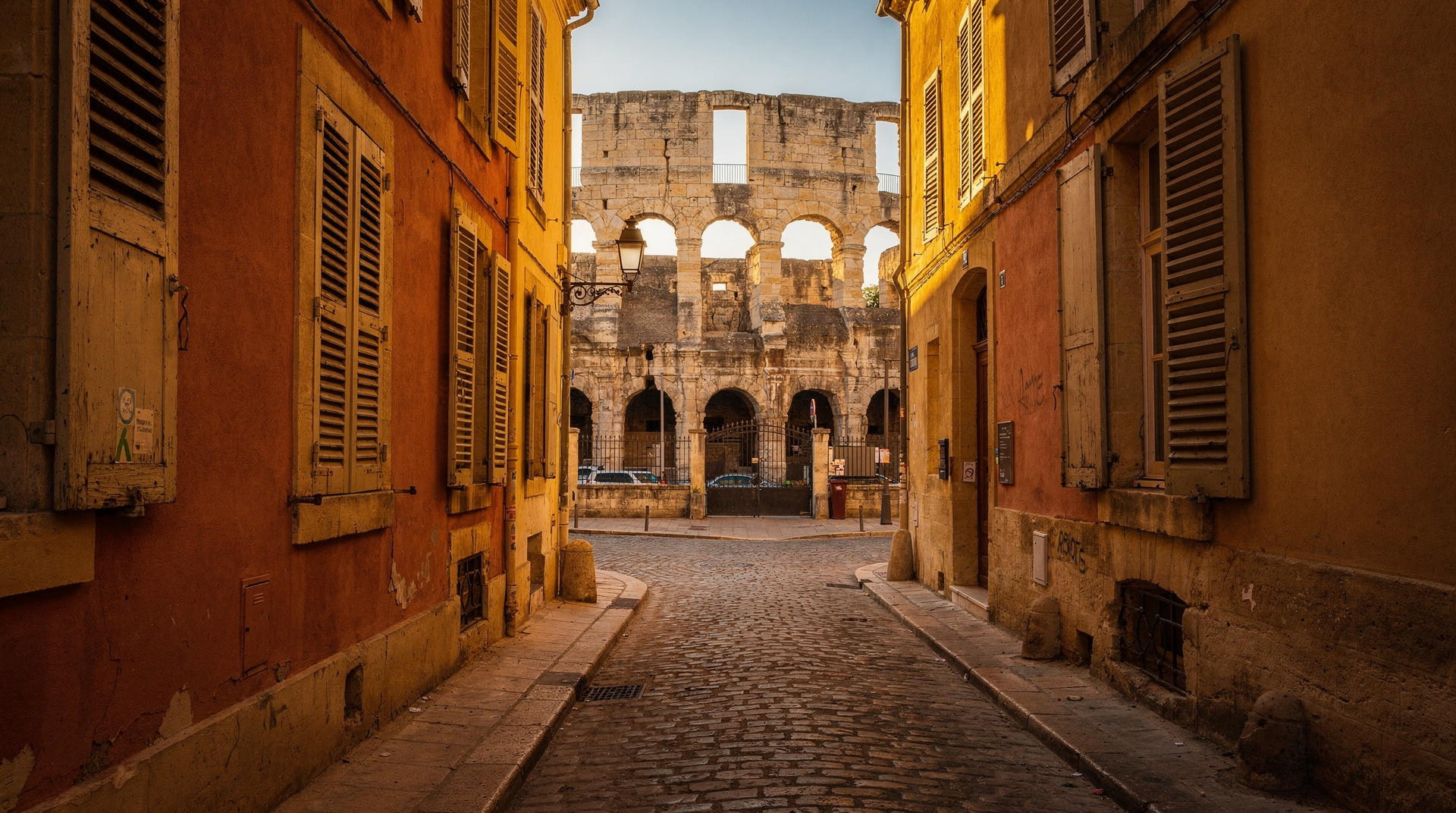
The Fondation occupies a beautifully converted 18th-century mansion (the Hôtel Léautaud de Donines) near the amphitheatre. It is one of the best-designed small museums in Provence — the conversion is elegant, the lighting is excellent, and the curatorial voice is consistently intelligent.
What it is not: The foundation does not hold a permanent Van Gogh collection. Its approach — explicitly adopted from the beginning — is to explore Van Gogh’s influence on subsequent art and how contemporary artists respond to his work, rather than to present the paintings themselves.
Current 2026 exhibition: “SUSPECTS – Van Gogh, Tricksters & Co.” (22 May – 18 October 2026). An exhibition devoted to artists who, following Van Gogh, chose dissent over conformity — exploring the tradition of artistic refusal and the relationship between reputation, marginality, and influence.
Practical information:
- Open daily 10:00–18:00 (last admission 17:30). Daily July–August.
- Entry EUR 10 adult, EUR 8 reduced (over-65, unemployed, large families). Free for under-26.
- Combined tickets: EUR 12 Fondation + Musée Réattu, EUR 17 Fondation + LUMA Arles.
Allow: 60–90 minutes for the foundation.
The December 1888 episode: what actually happened
The confrontation between Van Gogh and Gauguin on the evening of 23 December 1888 — which resulted in Van Gogh cutting off the lower portion of his left ear lobe and delivering it to a woman at a local establishment — has been so extensively mythologised that the actual sequence of events is frequently distorted.
The accurate account is more complex and more interesting than the legend. Gauguin and Van Gogh had been arguing intensely for weeks about artistic theory, living conditions, and Gauguin’s imminent departure. On the evening in question, after a confrontation, Van Gogh wounded himself and went to a nearby establishment. He was found the following morning by the police, who contacted Gauguin (who had already left). Van Gogh was taken to the Hôtel-Dieu hospital, where he was treated by Dr Félix Rey, who provided good care and with whom Van Gogh maintained a warm correspondence.
Van Gogh was not, after this episode, incapacitated. He returned to his studio, painted during periods of clarity, wrote lucid letters to his brother Theo and to Gauguin, and continued his engagement with the outside world. The paintings made in February and March 1889 — after the hospitalisation — include some of the most technically controlled work of the entire Arles period. He left Arles in May 1889 voluntarily, choosing the structured environment of the Saint-Paul-de-Mausole asylum over the disorder of independent living, not because anyone expelled him.
The episode is part of the story of Van Gogh’s mental health struggles, which were real and severe. It is not, as often implied, the turning point that caused his decline — he was already productive and lucid enough to produce his greatest work after it.
Why Arles, not Marseille or Aix, for this pilgrimage
Visitors sometimes assume a Van Gogh connection exists in Marseille or Aix-en-Provence too, since both are within easy reach of Arles. It does not, in any meaningful sense — Van Gogh’s Provence period was almost entirely centred on Arles and, after May 1889, Saint-Rémy-de-Provence, where he painted at the Saint-Paul-de-Mausole asylum (The Starry Night, among others, was painted from the asylum grounds, not from Arles).
Cézanne, not Van Gogh, is the painter associated with Aix — see the Aix day trip guide for that connection. Marseille’s own art history runs through different figures entirely; the Marseille history guide and museums guide cover the city’s own cultural story, which is distinct from the Van Gogh trail.
This matters for planning: a Van Gogh-focused Provence trip should treat Arles (and ideally Saint-Rémy) as the dedicated stop, rather than expecting fragments of the story to surface elsewhere.
Building the Van Gogh stop into a wider Provence trip
Arles works best as one chapter of a longer story. If Saint-Rémy is on your list, the Les Baux and Saint-Rémy day trip guide shows how to reach the asylum where Van Gogh went next, and the Saint-Rémy-de-Provence destination page gives the wider context for that stop. The Camargue day trip guide pairs naturally with Arles for travellers who want the flat, open landscape that Van Gogh kept painting.
If you are still deciding how many days to give the region, the Marseille to Avignon transport guide and the Avignon day trip guide help you judge whether Arles and Avignon belong in the same trip. For a first visit to the area, the Van Gogh pilgrimage blog post gives a personal account of walking the trail, which is a useful companion to the practical advice here. Travellers starting from the coast can also check the day trips from Marseille overview to compare Arles with the other options before committing.
Getting to Arles and combining the visit
Arles is reachable from Marseille by TER regional train (around 1 hour, direct) or by car via the A54 (roughly 1 hour). From Avignon, the train is shorter, around 20 minutes. Because the Van Gogh sites are concentrated in the compact old town, a car is not necessary once you arrive — the entire trail, the Fondation, and the Alyscamps are within a 20–25 minute walk of each other and of the train station.
Many visitors combine Arles with a wider Camargue or Provence loop. See the Arles day trip guide for the full logistics of a single-day visit from Marseille, and the Provence road trip itinerary for how Arles fits into a longer multi-stop trip.
Practical advice for the Van Gogh visit
Best approach: Buy the Fondation’s free trail map before starting. Walk the town centre trail (approximately 1.5–2 hours), then visit the Fondation (60–90 minutes). If time allows, continue to the Alyscamps and the Espace Van Gogh hospital courtyard. The Pont de Langlois replica is best visited by car or bicycle.
What to read in advance: Van Gogh’s letters to his brother Theo — particularly those written from Arles — are extraordinary documents and transform the trail experience. The complete correspondence is available online and is surprisingly direct, funny, and technically engaged with colour theory and composition in ways that visiting the sites makes concrete.
Managing the absence of originals: Bring reproductions. The Fondation sells excellent prints and the trail panels have high-quality reproductions, but having a small booklet of the Arles paintings on your phone significantly enriches the trail experience.
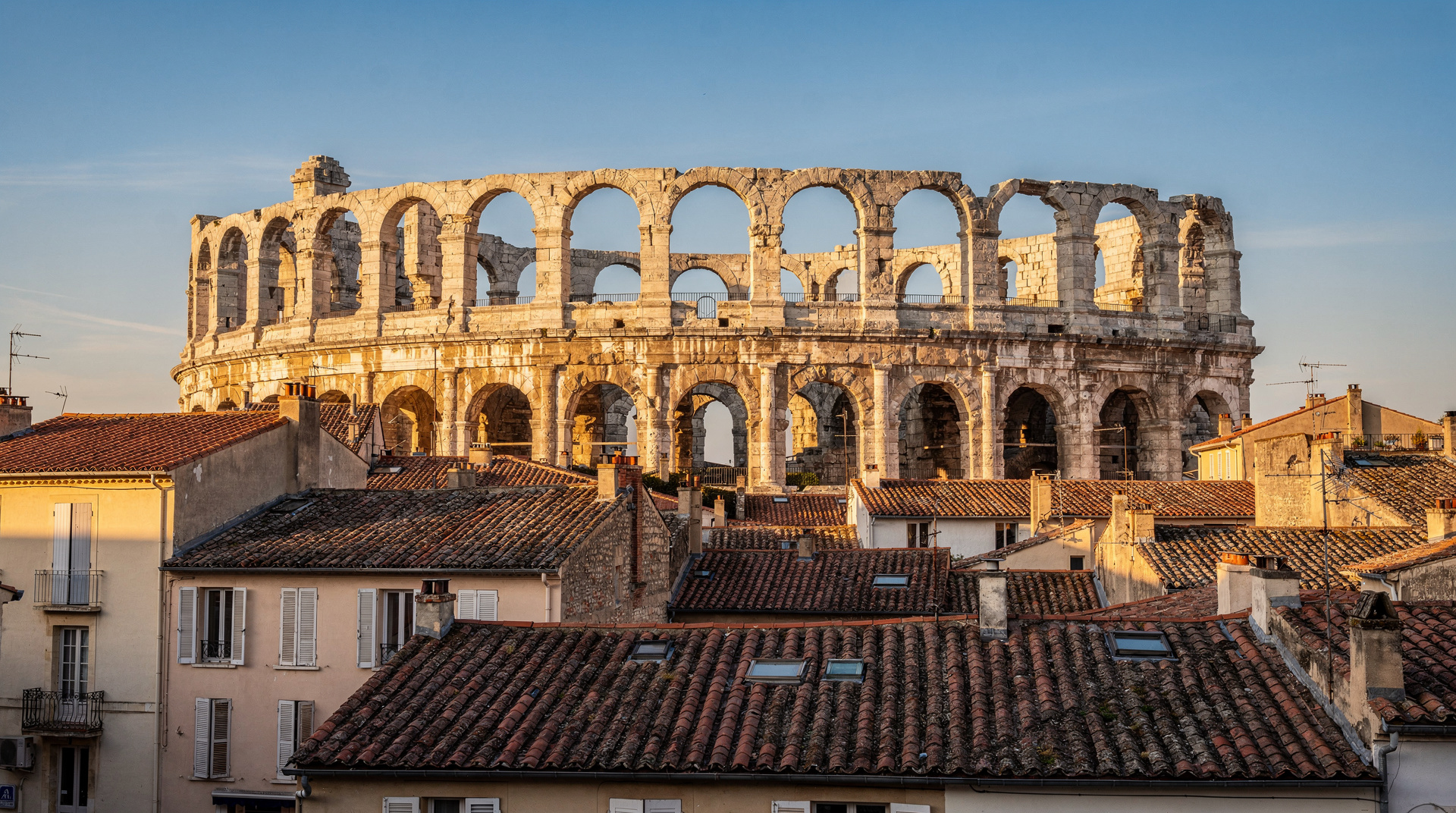
Combining with the Roman monuments: A full Arles day can combine Roman monuments (morning) and Van Gogh trail plus Fondation (afternoon). See our Arles Roman monuments guide for the morning sequence.
For the complete picture of Arles as a city — the market culture, the Luma Arles campus, the Camargue connection, and how to use it as a Provence base — see our Arles destination guide.
Frequently asked questions about Van Gogh in Arles
Can I see any original Van Gogh paintings in Arles?
No. All of Van Gogh’s Arles-period originals are held elsewhere — principally the Van Gogh Museum in Amsterdam, the Musée d’Orsay in Paris, and the Metropolitan Museum in New York. Arles preserves the locations, not the canvases.
Is the Van Gogh trail suitable for a half-day visit?
Yes. The core town-centre trail plus the Fondation takes around 2–3 hours, which fits comfortably into a half-day alongside lunch in Arles or a stop at the Roman monuments.
Top experiences
Bookable activities with verified prices and instant confirmation on GetYourGuide.