Pont du Gard
Pont du Gard guide — the three-tier Roman aqueduct, swimming in the Gardon, best photo angles, museum, and honest ticket and parking advice.
Pont du Gard: skip-the-line admission ticket
Quick facts
- Location
- Vers-Pont-du-Gard, Gard — in Occitanie (not PACA)
- Distance from Marseille
- ~1 h 30 by car
- Parking
- EUR 9 per car per day (mandatory — no free alternative)
- Site access
- Free once parked; museum EUR 8 adult (SNCF liO holders: EUR 6)
- Swimming
- Permitted at Gardon River beaches adjacent to the site
At a glance
| Where | Vers-Pont-du-Gard, Gard (Occitanie) — around 1 h 30 from Marseille |
| Cost | EUR 9 parking (mandatory); site access included; museum around EUR 8 |
| Time needed | 2–4 hours (longer with swimming) |
| Getting there | Car required — no practical public transport from Marseille |
| Best time | May–June and September–October for swimming without peak crowds |
The aqueduct that still stuns engineers
The Pont du Gard was built around 50 CE to carry water from Uzès to the Roman city of Nîmes, 50 kilometres away. It is the highest surviving Roman aqueduct bridge in the world: three tiers of arches rising 49 metres above the Gardon River, carrying a closed water channel at the top that maintained a 1-in-3,000 gradient across its entire length — precise enough that the water arrived by gravity alone.
The construction used no mortar for the lower two tiers. The stones — some weighing up to 6 tonnes — were fitted with such precision that the structure has survived intact for 2,000 years, two millennia of river floods, and the dismantling of its associated aqueduct along the hillsides. The Pont du Gard is what remains because it was the most permanent piece of the system.
It is a UNESCO World Heritage Site, one of France’s most visited monuments, and genuinely worth the label.
One important geography note: The Pont du Gard is in the Gard department — in Occitanie, not in Provence-Alpes-Côte d’Azur. It is west of Avignon, not east. Visitors coming from Marseille or Avignon will notice they cross into Occitanie as they approach. This does not affect the visit, but it explains why the signage and administration feel different from Provence.
Getting here from Marseille
The Pont du Gard has no practical public transport connection from Marseille. A car is required.
By car from Marseille: Around 1 hour 30 via the A54 toward Nîmes, then the D981 north. The Vers-Pont-du-Gard exit is well signed.
From Avignon: 25 minutes east on the D900. Avignon is the most practical base for a Pont du Gard visit without a car — several guided tours depart from Avignon that include the aqueduct.
From Nîmes: 25 minutes north on the D979. A Nîmes + Pont du Gard combination is one of the natural pairings — both Roman, both in the Gard, and within half an hour of each other.
The structure: what you are looking at
The three tiers are not identical in design:
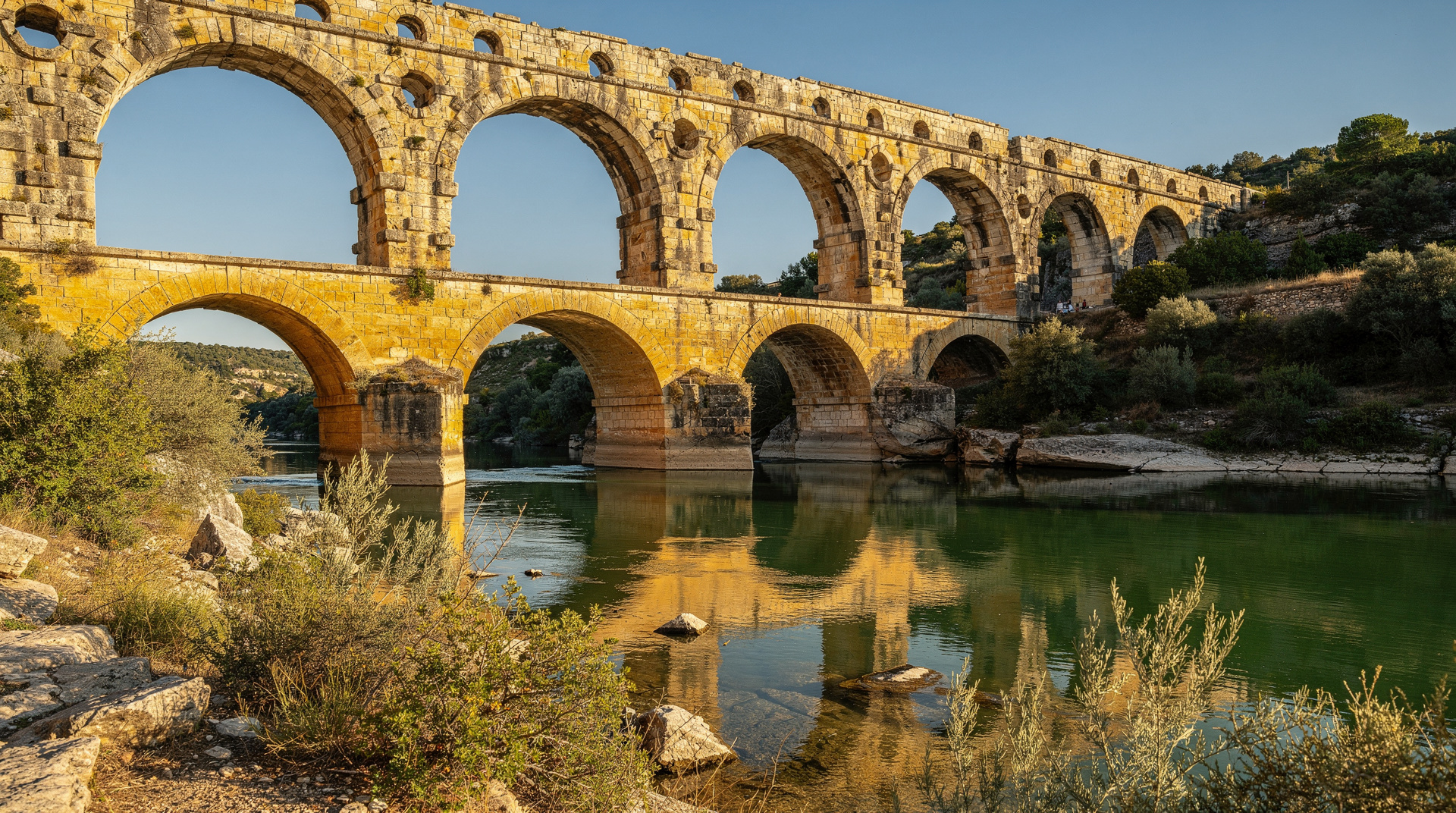
Lower tier: Six large arches spanning the Gardon River. These are the widest arches (up to 24 metres) and support the weight of the entire structure. The bridge deck of the lower tier is where the Roman road crossed — Pont du Gard was not only an aqueduct but a road bridge simultaneously.
Middle tier: Eleven arches, each roughly 4 metres wide. The alternating pattern of arch sizes between the lower and upper tiers distributes the structural load. The different stone colour and texture visible here is not decay — it is the natural variation in the limestone quarried from different depths along the Gardon.
Upper tier: Thirty-five smaller arches carrying the covered water channel. The channel itself is 1.22 metres wide and 1.76 metres high — large enough for a worker to crawl through for maintenance. The channel’s interior walls are covered with a hydraulic mortar still visible in sections.
Look for the construction bosses (protruding stone knobs) on the faces of the arches. These are the attachment points for the scaffolding used during construction — never removed, because the cost of chiselling them off would have been greater than leaving them.
The best photo positions
From the pedestrian bridge (Rive Droite): The modern pedestrian bridge 100 metres downstream gives the head-on view most commonly reproduced. This is the shot, but it is not necessarily the best shot.
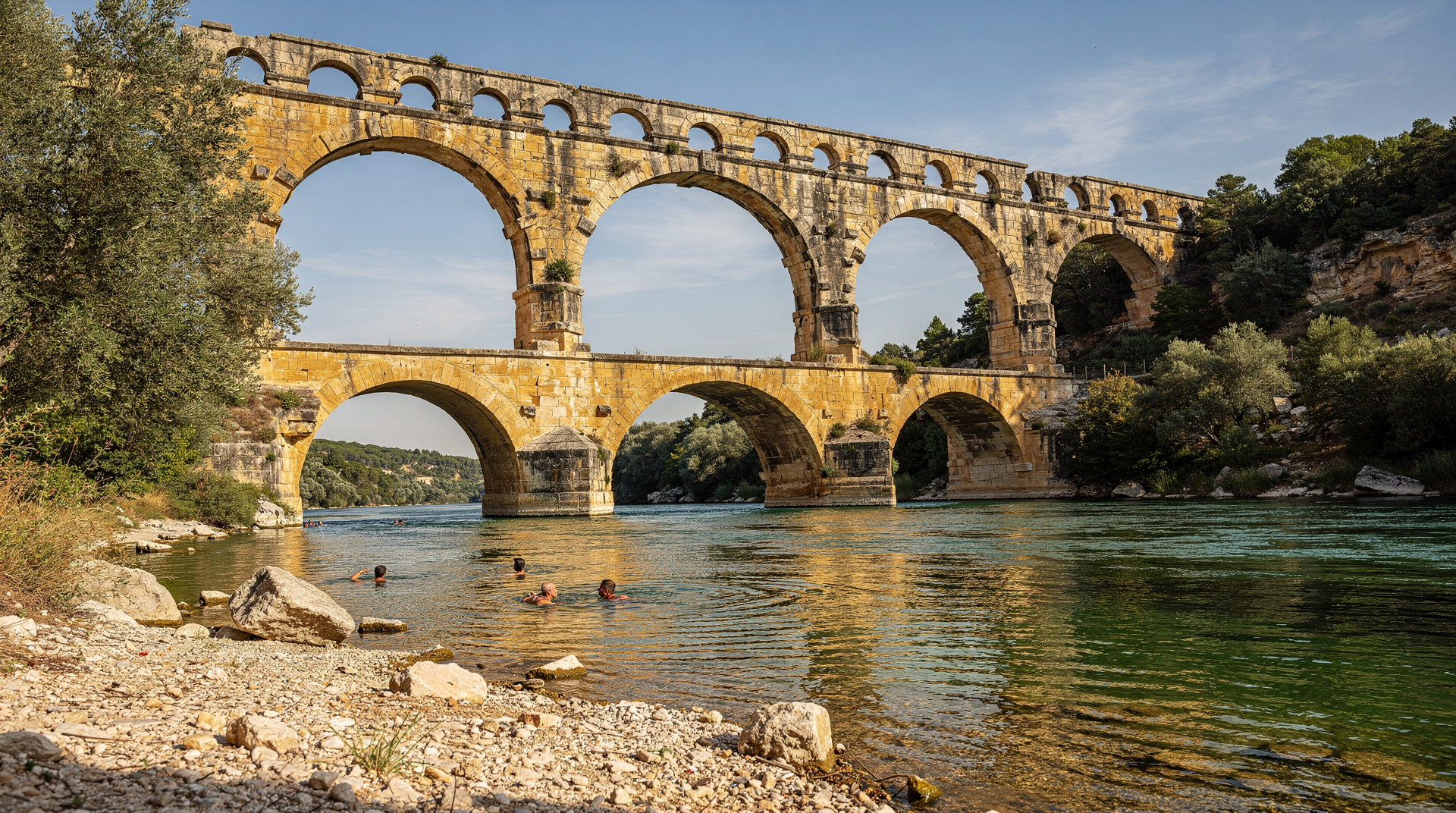
From the riverbank at water level: Walk down from either bank to the Gardon’s edge and look up through the lower arches with the upper tiers above. This is the view that conveys scale — when you see the aqueduct from below, the height of the lower arch suddenly makes sense in a way the aerial view does not.
From the Rive Gauche (left bank, downstream): A 15-minute walk downstream from the main site reaches a bend in the Gardon where the full three-tier silhouette is visible in side profile, with the river in the foreground. This is less crowded and, in morning light, one of the finest viewpoints.
From May 15 to September 20, the aqueduct is illuminated at dusk. A sound and light show runs from July 4 to August 30 at 22:30. These make evening visits worthwhile in summer if you can time it.
Swimming and river access
The beaches along the Gardon River within the Pont du Gard site are open for swimming. The river is shallow enough to wade in most conditions, with rocky bottom and clear water. The visual reward of swimming beneath one of the greatest Roman engineering achievements in the world is not nothing.
What is not permitted: Swimming directly under the aqueduct structure itself, jumping from the bridge or rocks, or entering any restricted zones marked by signage. The swimming areas are well marked and the rules are enforced by site staff in summer.
Practical: Bring a towel and water shoes — the river bottom is rocky. The beaches are busiest in July–August; a May or September visit has the same water access with a fraction of the crowd. Changing facilities are at the parking areas.
Tickets, parking, and the museum
Parking: Mandatory, EUR 9 per car per day. All approaches to the Pont du Gard funnel through the two car parks (Rive Droite and Rive Gauche). There is no free parking alternative. The parking fee gives you access to the site including the river banks and the exterior of the aqueduct.
Museum entry: The museum (Musée de la Romanité de Pont du Gard, on the Rive Droite) covers the construction of the aqueduct and the Roman city of Nîmes. Entry EUR 8 adult (EUR 6 for SNCF liO Train ticket holders). Children under 18 free. The museum is not essential for understanding the aqueduct — the structure explains itself — but the scale models of the complete aqueduct system across the 50-km route are worth seeing.
Skip-the-line tickets: Booking in advance avoids the ticket desk queue in peak season. The site is extremely busy in July–August, particularly on weekends.
Combining with Nîmes
Nîmes is 25 minutes south of Pont du Gard. A morning at the aqueduct (2–3 hours: the walk, swimming, the view points) followed by an afternoon in Nîmes (Arena, Maison Carrée, Jardins de la Fontaine) is a coherent Roman day that covers the two most significant Roman sites in the French south. See our Nîmes guide for what to expect in the city.
This combination from Marseille involves around 3 hours of driving total (Marseille–Pont du Gard–Nîmes–Marseille). It is achievable but a full commitment — leave Marseille before 08:00 to make it work without rushing. See our Pont du Gard day trip guide for a timed itinerary.
The Roman aqueduct system: context
The Pont du Gard is the most spectacular surviving section of a 50-kilometre aqueduct system that carried water from the Fontaine d’Eure springs near Uzès to the Roman city of Nemausus (Nîmes). The full system involved a channel cut through the hillsides, tunnels through rock, and a series of smaller bridge structures — most of which have not survived. The Pont du Gard survived because it was the most solid piece: massive enough to resist flood, too large to conveniently quarry for building stone.
The aqueduct channel maintained a gradient of 1 in 3,000 across its 50-km length — an engineering precision that required continuous surveying across the landscape. Fluctuations in the gradient never exceeded 1 in 1,000. The channel could carry approximately 40,000 cubic metres of water daily at full flow — enough to supply the 50,000 inhabitants of Roman Nîmes with roughly 800 litres per person per day, many times the modern standard for basic water supply.
The aqueduct fell out of use in the 6th century CE after invasions damaged the distribution infrastructure in Nîmes. The bridge itself was then used as a road bridge, with a medieval walkway added to the lower tier. By the 18th century, traffic had damaged the lower arches significantly — Louis XIV ordered repairs, and the modern restoration programme has continued since then.
The sound and light show
From July 4 to August 30, a sound and light show (Lumières du Gard) runs nightly at 22:30, projecting light and images onto the aqueduct from the riverbank. The show is free to watch from the site beaches; tickets are required for reserved seating areas. The illumination from May 15 to September 20 (every evening at dusk) is free and accessible to all site visitors.
An evening visit in this period — picnic on the riverbank, swimming at dusk, and the illuminated aqueduct after dark — is a genuinely memorable Provence summer experience that the daytime visit alone does not replicate.
Kayak and canoe access
The Gardon River is navigable by kayak and canoe for several kilometres upstream and downstream of the Pont du Gard. Several rental operators near Collias (12 km upstream) offer self-guided descents on the Gardon that end at the Pont du Gard — typically 2–3 hours of paddling through the garrigue landscape with the aqueduct as the destination. This is an excellent alternative way to arrive at the monument and a more active half-day than a direct drive.
Where it fits in a wider Provence trip
If you are building a longer stay, the aqueduct works well as one Roman-themed day among several. Our Avignon day trip guide and Arles day trip guide cover the neighbouring cities, and Avignon is the easiest base if you would rather not drive from the coast. Before committing, it helps to read do you need a car in Provence, because the Pont du Gard is one of the places where the answer is clearly yes unless you join a guided tour.
For a longer plan that includes the aqueduct, the Marseille and Provence in 5 days itinerary and the Provence road trip itinerary show how to space the Roman sites out so no single day becomes a marathon. For a first-hand account of the light on the stone at the end of the day, see our golden hour visit.
Honest assessment
The Pont du Gard merits its reputation. It is not like the reconstructed or partially restored Roman monuments elsewhere in France — it is complete, intact, and genuine in a way that stops you cold when you first see it from the riverbank. The river access and swimming make it more than a monument visit: you can spend 3–4 hours here between walking, swimming, and the museum without effort.
The parking cost is unavoidable. The July–August crowd density is high. April–June and September–October are the best months — weather warm enough for swimming, crowds manageable, and the late afternoon light on the stone doing its most flattering work.
Seasonality at a glance
| Season | Weather | Crowds | Notes |
|---|---|---|---|
| Apr–Jun | Warm, occasional rain | Moderate | River cool but swimmable by late May; best light for photography |
| Jul–Aug | Hot, dry | Very high | Sound and light show nightly; book skip-the-line tickets; parking fills by mid-morning |
| Sep–Oct | Warm, drier | Moderate to low | Illumination continues to Sep 20; warm water, thinner crowds |
| Nov–Mar | Cool, sometimes wet | Low | No swimming; museum and structure still fully open; quietest visit |
Combining with Saint-Rémy-de-Provence or Arles
Pont du Gard sits roughly equidistant between Nîmes and Avignon, which makes it easy to fold into a wider Roman-Provence day. Travellers coming from the Marseille side sometimes pair it with Saint-Rémy-de-Provence and its own Roman site at Glanum, or with Arles for a full day of ancient monuments — though be realistic about drive time: Pont du Gard to Saint-Rémy is around 45 minutes, and adding a third stop turns a relaxed day into a long one. For itinerary options that avoid overreach, see our day trips from Marseille guide.
Frequently asked questions about Pont du Gard
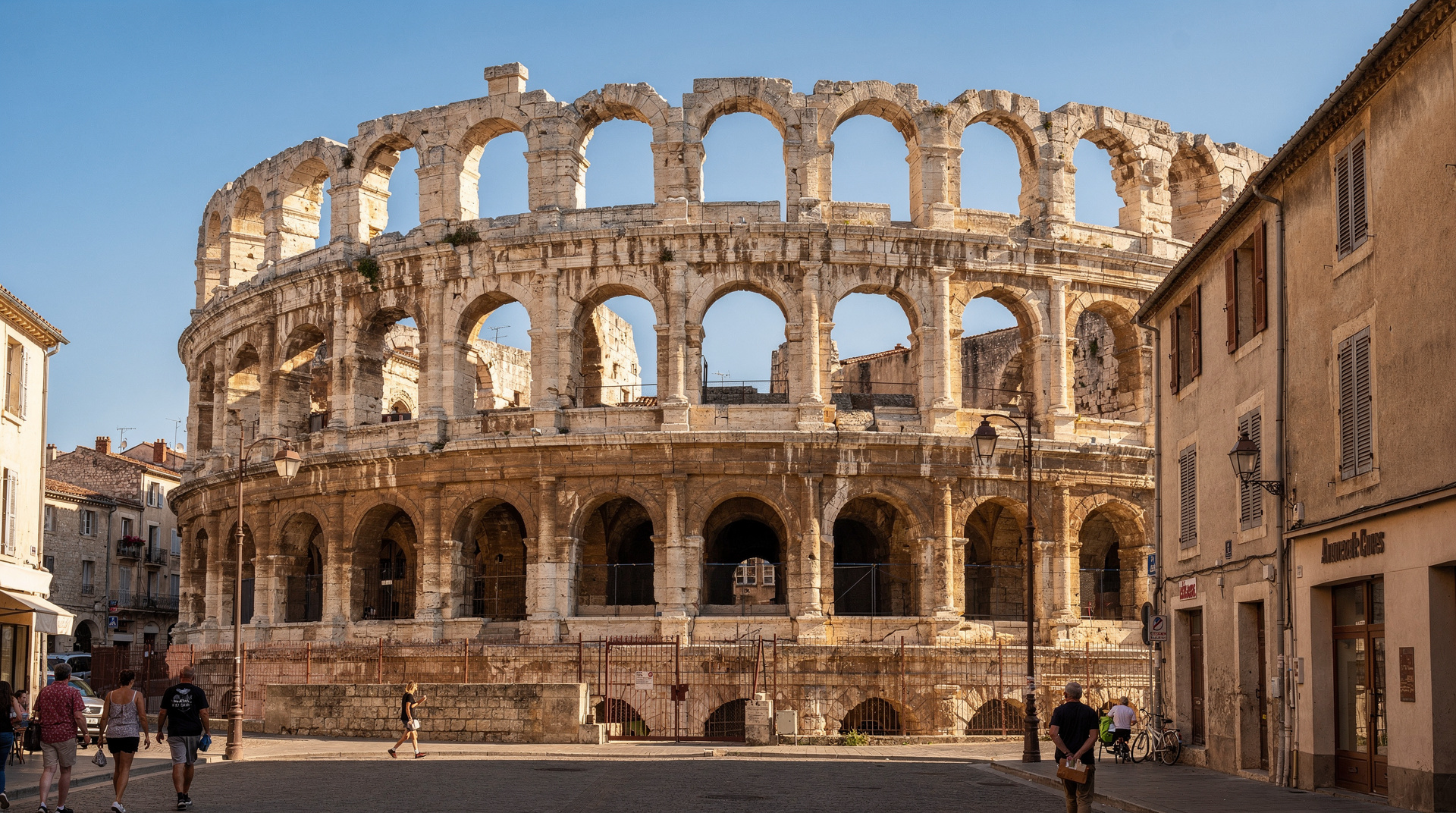
Is Pont du Gard worth visiting if you’ve already seen Roman ruins elsewhere in Provence? Yes — it is a different kind of monument from the amphitheatres in Arles or Nîmes: an engineering structure rather than a public building, and the only one of the three where you can swim beneath it. The scale, best appreciated from the riverbank, is genuinely singular.
Do you need to book Pont du Gard tickets in advance? Parking (which includes site access) rarely requires advance booking outside the busiest July–August weekends, but skip-the-line museum tickets are worth pre-booking in peak season to avoid the ticket desk queue.
Top experiences
Bookable activities with verified prices and instant confirmation on GetYourGuide.