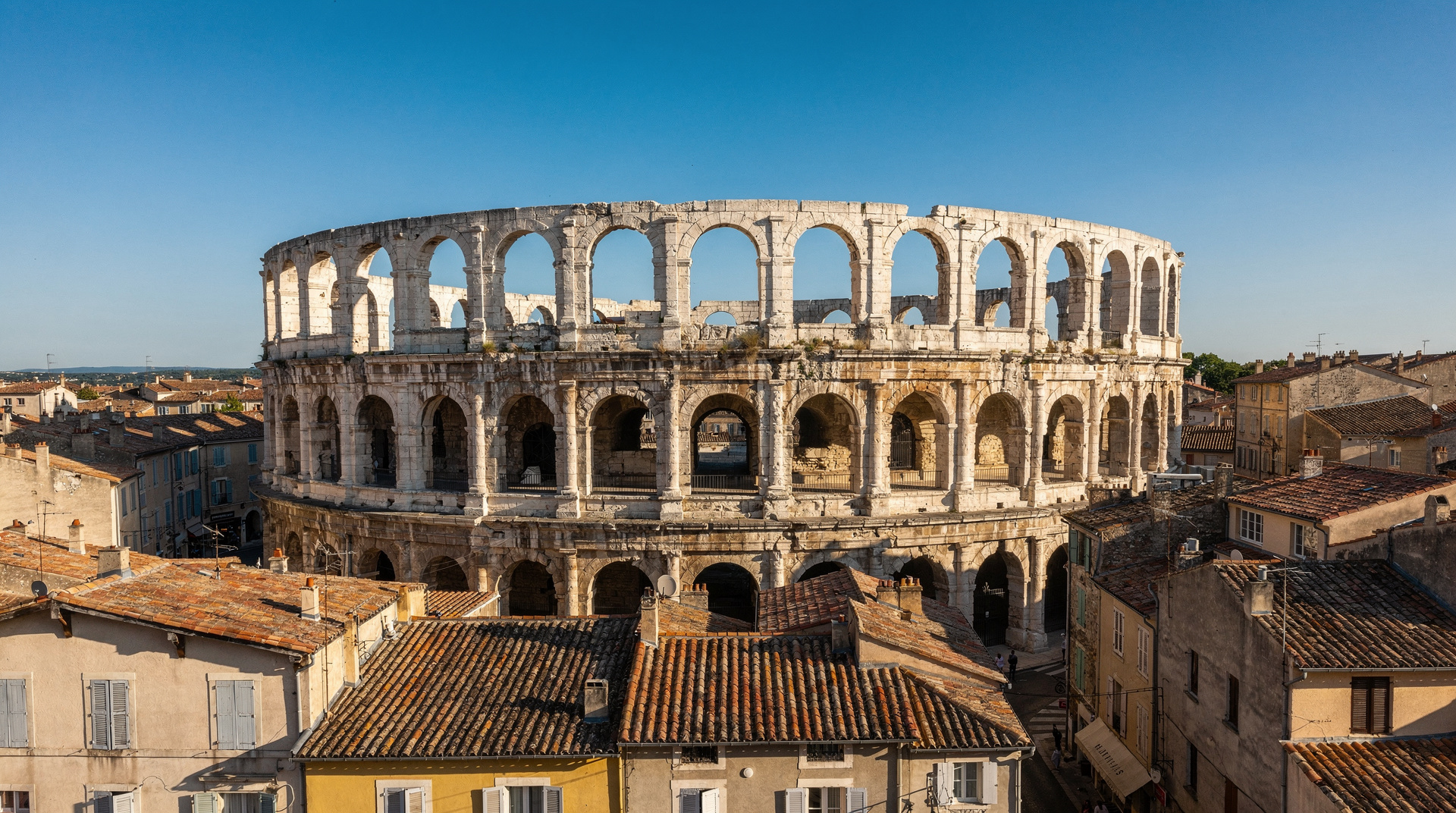
Nîmes
Nîmes guide — the Roman arena, Maison Carrée, Tour Magne, Jardins de la Fontaine, the Féria, and an honest 1 h 45 day-trip verdict from Marseille.
Nîmes: ancient Roman arena ticket & old-town audio tour
Duration: 2-4 hours
Quick facts
- Location
- Gard department, Occitanie — not in PACA
- Distance from Marseille
- ~1 h 45 by car; ~1 h by TGV (limited service)
- Arena ticket
- EUR 13 adult; open 9:30–20:15 in July–August
- Maison Carrée
- Combined pass with Arena and Tour Magne available
- Roman pass
- 3-monument pass (Arena + Maison Carrée + Tour Magne) recommended
The French Rome
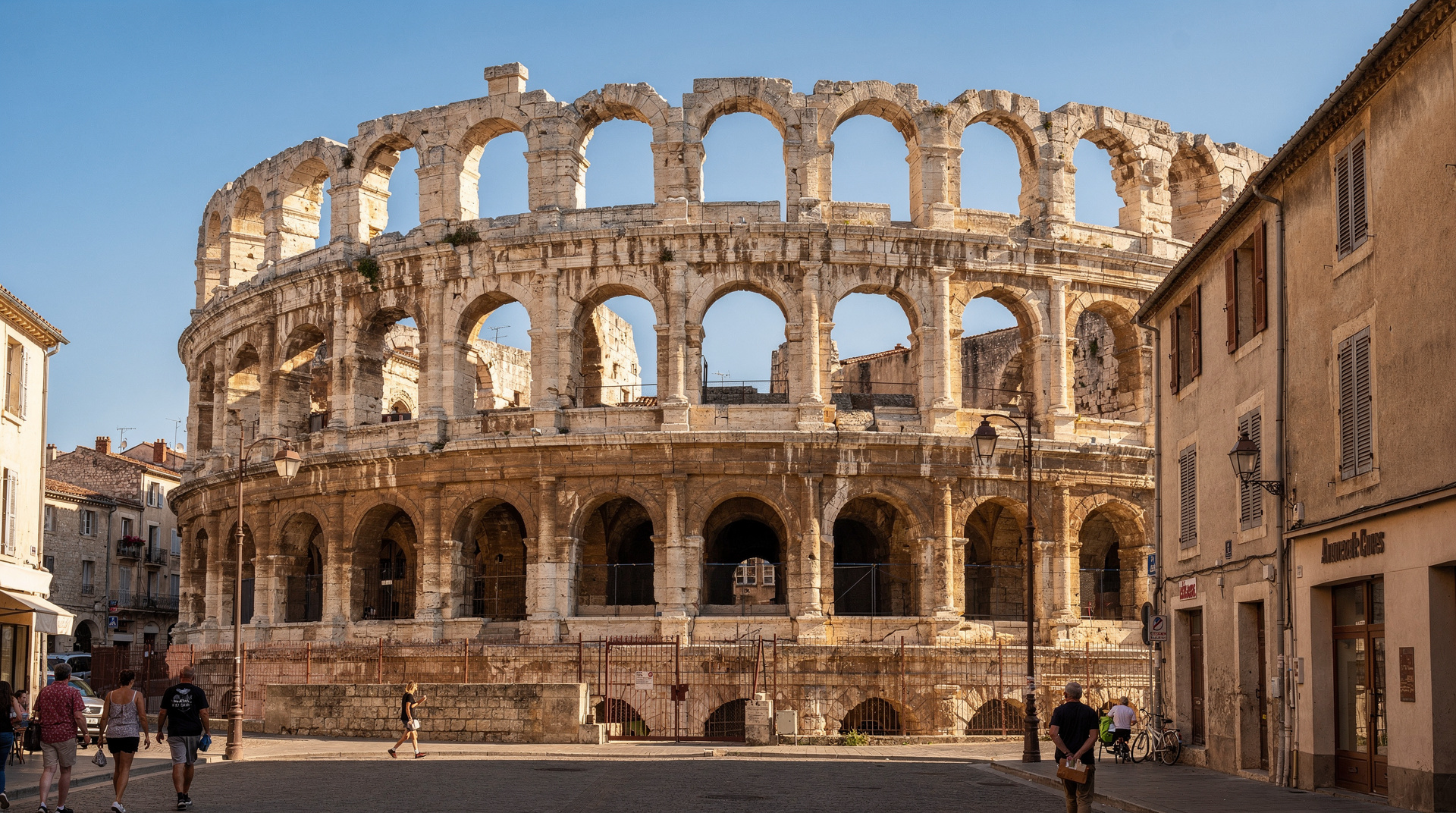
Nîmes holds a concentration of Roman monuments without parallel in France. The Arena (Arènes de Nîmes) is among the best-preserved amphitheatres in the world. The Maison Carrée — a 1st-century BCE Roman temple — is the most complete Roman temple surviving anywhere in the Western world. The Tour Magne, a Roman watchtower on the hill above the city, predates even Augustus. These are not reconstructions or partial ruins: they are the original structures, in largely original condition.
The city has 139,000 inhabitants and a working economy beyond tourism. The Monday market at the Arena fills the surrounding streets with the ordinary commerce of a regional capital. The two Férias — the Féria de Pentecôte in May and the Féria des Vendanges in September — transform the city into a festival of bullfighting, flamenco, and outdoor concerts that bring 500,000 people across the two events.
Geography note: Nîmes is in the Gard department, in Occitanie — not in Provence-Alpes-Côte d’Azur. The cultural and administrative difference is real. The accent is different from Marseille’s; the food leans toward Languedoc rather than Provence; and the self-image of the city is Occitan rather than Provençal. This distinction does not affect the quality of the monuments, but it helps explain why Nîmes feels different from Arles or Avignon despite the similar Roman inheritance.
| At a glance | |
|---|---|
| Where | Gard department, Occitanie (not technically Provence) |
| Cost | Around EUR 13 for the Arena alone; combined 3-monument pass is better value if visiting all three |
| Time needed | A full day; half a day if only doing the Arena and Maison Carrée |
| Getting there | ~1 h 45 by car from Marseille via the A54/A9, or ~1 h by TGV (limited direct services) |
| Best time | April–June and September–October; avoid Féria dates if crowds bother you |
Getting from Marseille to Nîmes
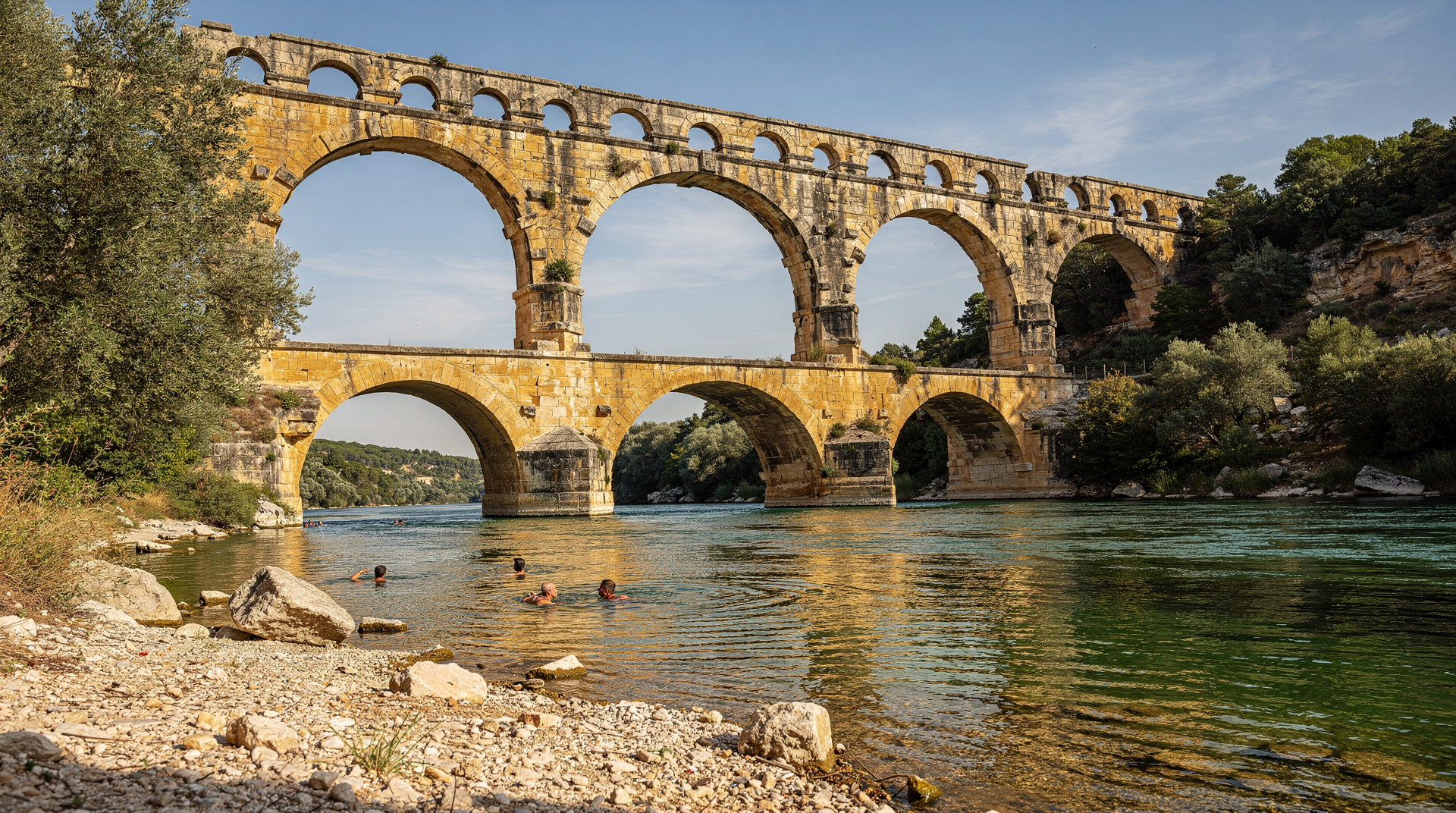
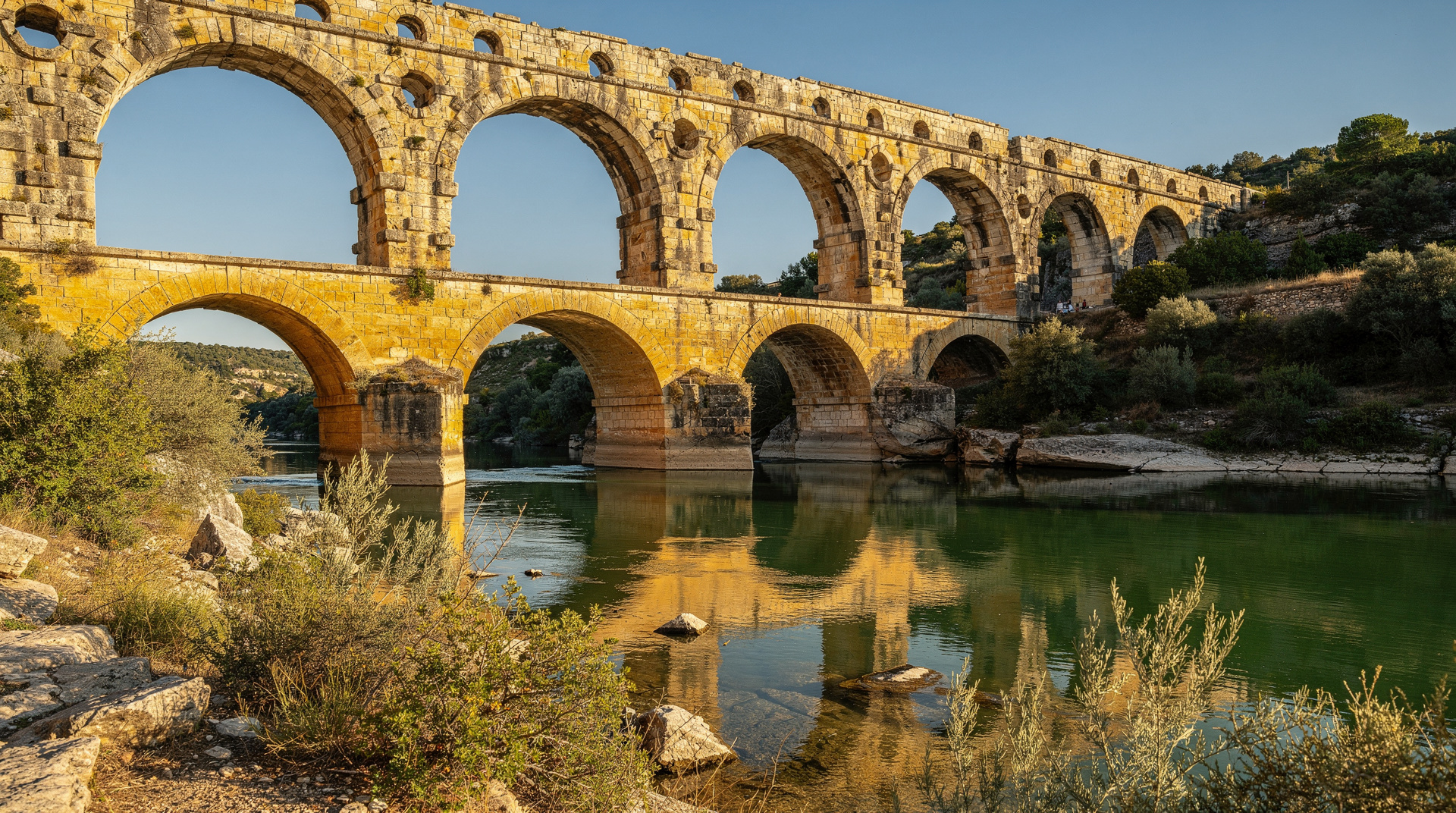
By car: Around 1 hour 45 via the A54 toward Arles, then the A9 northwest to Nîmes. This is the most practical option if you plan to combine with Pont du Gard (25 minutes north of Nîmes).
By TGV: Limited direct TGV services connect Marseille to Nîmes. Check the SNCF schedule — not every service is direct. Journey time approximately 1 hour on the fast services. Nîmes station is about 1 km from the Arena.
Honest assessment of the drive: 1 hour 45 is real driving time in normal conditions. Combine Nîmes with Pont du Gard to make the day worthwhile — both are Roman, both are in the Gard, and together they constitute one of the finest Roman day itineraries in France.
The Arena (Arènes de Nîmes)
The Nîmes amphitheatre was built around 70 CE, slightly later than the Arles amphitheatre and with a similar capacity (approximately 24,000 spectators). The exterior oval of two tiers of arched arcades is complete; the interior seating tiers are heavily restored but the structure is authentic. It is functioning: the arena hosts bullfighting during the Férias, concerts throughout the year, and a spectacle on the Roman gladiators seasonally.
In 2026:
- Open daily year-round. July–August: 9:30–20:15. April, May, September: 10:00–18:45. October, March: 10:00–18:15. November–February: 10:00–16:45.
- Entry EUR 13 adult. Children under 7 free.
- Note: certain dates in June and July have afternoon concerts — visitor access is restricted during these periods. The Féria des Vendanges (September 14–16, 2026) closes the Arena completely to visits.
- The Roman Nîmes Pass (Arena + Maison Carrée + Tour Magne combined ticket) is the best value if you plan to visit all three monuments.
The Maison Carrée
The Maison Carrée stands in the city centre on its own rectangular plinth, surrounded by a pedestrian square. It was built around 16 BCE in honour of Gaius and Lucius Caesar (grandsons of Augustus), and is the most complete example of a Roman temple in the world. The columns, the carved Corinthian capitals, and the elaborate entablature cornice are original — not restored copies.
Thomas Jefferson saw a cast of the Maison Carrée during his time as US Minister to France and used it as the model for the Virginia State Capitol building in Richmond. This is not apocryphal: his letters describe the encounter explicitly.
The interior now houses a film (“Nîmes, The Eternal City,” 22 minutes) that recreates the Roman city with digital reconstruction. Combined with the exterior, allow 30–45 minutes. Entry is included in the combined Roman monuments pass.
The Tour Magne and Jardins de la Fontaine
The Tour Magne is a Roman watchtower on the Mont Cavalier hill above the city — originally 36 metres high, now 32 metres after partial collapse, with a viewing terrace at the top reached by a spiral staircase of 140 steps. The view from the top takes in the whole city and the Garrigues landscape around Nîmes. Entry included in the Roman pass.
The Jardins de la Fontaine at the base of Mont Cavalier are the most elegant public space in Nîmes — an 18th-century formal garden built around the source of a sacred spring used since antiquity, now with ornamental canals, stone balustrades, and the remains of a Roman sanctuary (the Temple de Diane, partially standing). The gardens are free to enter and open daily.
This combination — Jardins, Temple de Diane, Tour Magne — is a 90-minute circuit that shows a different face of Nîmes from the Arena. The gardens are used by locals in the mornings; in summer they are noticeably cooler than the exposed city squares.
The Féria
Nîmes holds two annual Férias — the Féria de Pentecôte (Whitsun, typically late May or early June) and the Féria des Vendanges (harvest weekend, September). Each runs for 4–5 days and brings around 250,000 visitors per event.
The Féria is a bullfighting festival in the Spanish tradition: corridas and novilladas at the Arena, flamenco in the streets, outdoor concerts, and the general intoxicated energy of a city that closes its museums and puts up stages in every square. The Arena sells out completely for the bullfighting events months in advance.
For visitors uninterested in bullfighting, the Féria atmosphere itself — the costumes, the music in the streets, the bodega encampments — is one of the most distinctive events in southern France. Whether you find the corrida compelling or uncomfortable, the city’s own energy during Féria is worth experiencing at least once.
Practical note for museum visitors: The Féria des Vendanges (September 14–16) closes the Arena to visits. If your purpose is the Roman monuments, plan your dates accordingly.
Honest day-trip assessment from Marseille
Nîmes in a day from Marseille is achievable but requires commitment. The 1 hour 45 drive each way means 3.5 hours of driving for a day that should include at least 3–4 hours of monument time. The Pont du Gard combination (Marseille → Pont du Gard → Nîmes → Marseille) works if you leave Marseille by 08:00.
Alternatively: travel by TGV to Nîmes (check direct services), spend the full day at the monuments without driving, and return by evening train. This concentrates the experience more effectively than a car day with two major sites.
What rewards the effort: the Maison Carrée and the Arena together constitute the finest intact Roman cityscape outside Rome itself. No other French city offers this combination of complete monuments in an active urban setting. For anyone with a serious interest in Roman history, Nîmes is the most rewarding day trip in the region.
See our Pont du Gard day trip guide and Pont du Gard guide for the combined itinerary.
The Nîmes textile connection
Nîmes gave its name to one of the most widely worn fabrics in history. “Denim” derives from “de Nîmes” — the fabric of Nîmes — a twill-weave cotton cloth produced here from the 17th century. Levi Strauss used serge de Nîmes (and a similar fabric from the Genoese trade) for the first blue jeans in San Francisco in the 1870s. The city’s contemporary fashion and textile scene acknowledges this heritage with a degree of irony — there is a denim museum in the city, and several shops on the Rue de la Madeleine sell locally produced indigo-dyed pieces.
Contemporary Nîmes: the Carré d’Art
The Carré d’Art, directly opposite the Maison Carrée (the deliberate visual dialogue is by design), is Nîmes’s contemporary cultural institution — a library and museum of contemporary art designed by Norman Foster and opened in 1993. The glass-and-steel structure responds to the Roman temple directly across the square: Foster’s grid of columns and the transparent facades are an explicit conversation with the Maison Carrée’s stone colonnade.
The Musée d’Art Contemporain on the upper floors holds a permanent collection of European and French contemporary art from 1960 to the present and regularly changing exhibitions. Entry around EUR 8 adult; free on Sundays. The building’s glass atrium and roof terrace are worth visiting independently of the collection — the view of the Maison Carrée framed through the Foster facade is one of the better architectural photographs in southern France.
Nîmes for food
The city has a food culture rooted in its position between Provence and Languedoc — neither fully one nor the other. The local specialties include:
Brandade de morue: Salt cod pounded with olive oil and garlic into a smooth white paste, eaten on toast or as a gratin. This is the dish most specifically associated with Nîmes — the city claims the original recipe, though similar preparations exist across the Mediterranean.
Tapenade: Provençal influence dominant — olive, anchovy, and caper pastes available in every market.
Clafoutis and navettes: Pastry culture leans Occitan rather than strictly Provençal.
The market at the Les Halles Nîmes (covered market, open Tuesday–Sunday mornings) is the most useful food market in the city, with local producers from the Gard and the Hérault.
Practical information for Nîmes
When to visit: April–June and September–October. July–August is hot (temperatures regularly over 35°C in Nîmes, which has no coastal moderation). The Férias require planning — accommodation must be booked months in advance.
City transport: The centre is walkable. The Arena, Maison Carrée, Carré d’Art, Jardins de la Fontaine, and Tour Magne form a coherent circuit of about 45 minutes of walking between sites. Tram lines connect the station to the city centre.
Nîmes vs Arles: The two cities are often compared — both Roman, both southern, both with amphitheatres. Arles is more compact and more picturesque; Nîmes is larger and has a more complete collection of Roman monuments in a genuinely urban setting. Arles works well as a half-day (see our Arles day trip guide); Nîmes rewards a full day. If forced to choose, Nîmes’s Maison Carrée is unique — there is nothing comparable in France.
Nîmes vs Arles vs Avignon
| City | Roman highlight | Best for | Day-trip time from Marseille |
|---|---|---|---|
| Nîmes | Arena + Maison Carrée (most complete temple in the world) | The deepest, most intact Roman experience | ~1 h 45 by car, ~1 h by TGV |
| Arles | Amphitheatre + Van Gogh connection | A compact, picturesque half-day | ~1 h by train |
| Avignon | Papal Palace + Pont d’Avignon | Medieval history over Roman | ~1 h by TGV |
Travellers with only one day for Roman France should pick Nîmes; those splitting time across the region often combine Nîmes with Pont du Gard or add an Avignon day trip on a separate outing. See our Arles Roman monuments guide for the direct comparison of amphitheatres.
Frequently asked questions about Nîmes
Is Nîmes or Arles the better day trip from Marseille?
For the strongest concentration of intact Roman monuments, Nîmes wins — the Maison Carrée has no equivalent anywhere in France. For a more compact, picturesque half-day with Van Gogh history layered in, Arles is easier to fit alongside another stop. Travellers with only one day for Roman heritage should choose Nîmes; those wanting two lighter stops can pair Arles with Avignon instead.
Can I combine Nîmes with Pont du Gard in one day from Marseille?
Yes, and it is the itinerary most guides recommend — Pont du Gard is about 25 minutes north of Nîmes. Leave Marseille by 08:00, visit Pont du Gard first while it is cooler and quieter, then Nîmes for the afternoon and evening. See our Pont du Gard day trip guide for the combined routing.
Top experiences
Bookable activities with verified prices and instant confirmation on GetYourGuide.