Pont du Gard day trip from Marseille: the Roman aqueduct guide
Pont du Gard: skip-the-line admission ticket
Is Pont du Gard worth a day trip from Marseille?
Yes — the best-preserved Roman aqueduct in the world, 1h30 from Marseille by car. Parking EUR 9 covers the whole day. The site needs 2-3 hours; combine with Nîmes (30 min west) or Uzès (15 min north) to fill a day properly. River swimming below the arches is permitted at designated beaches.
The most impressive Roman structure you can reach by day trip
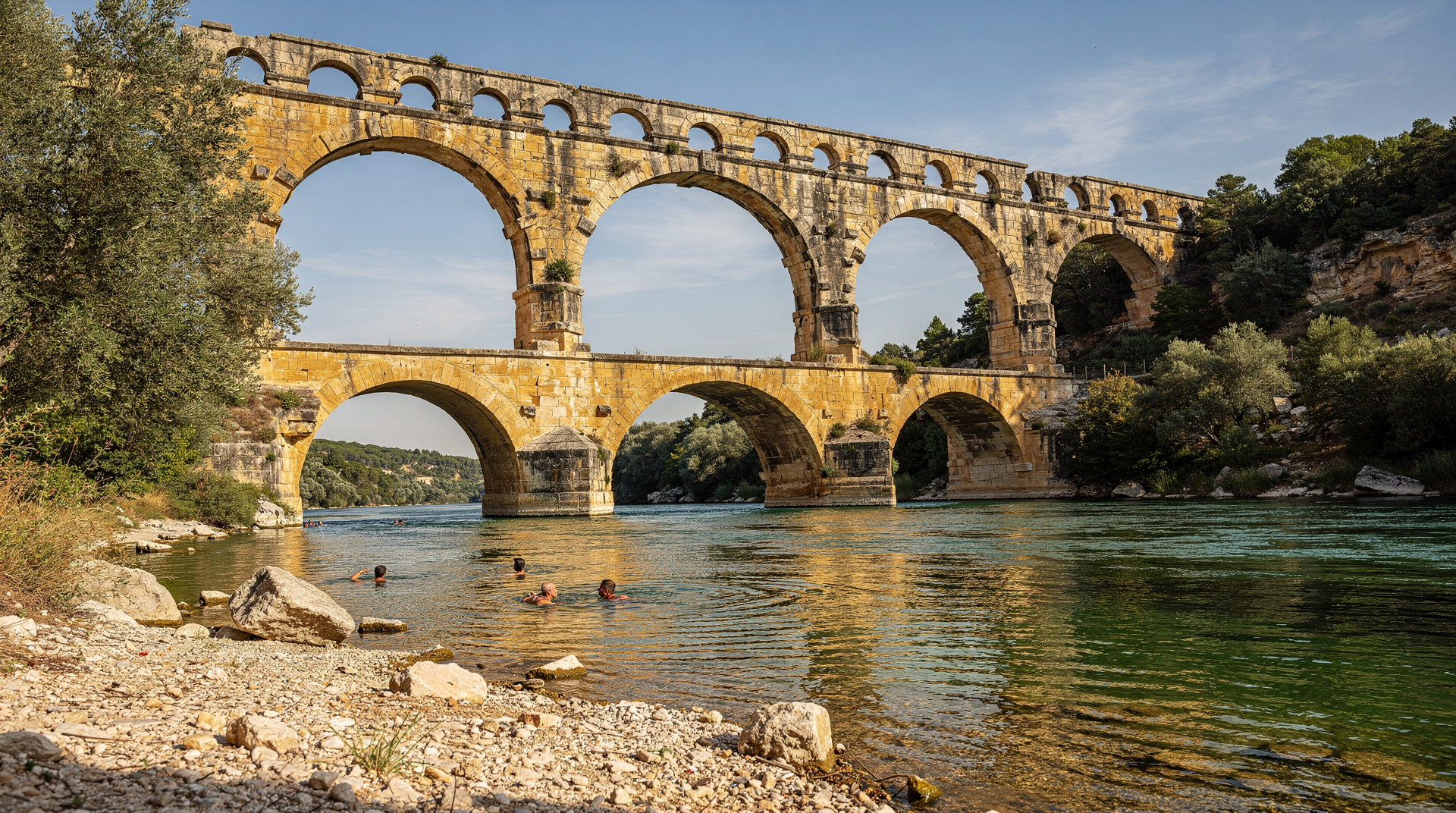
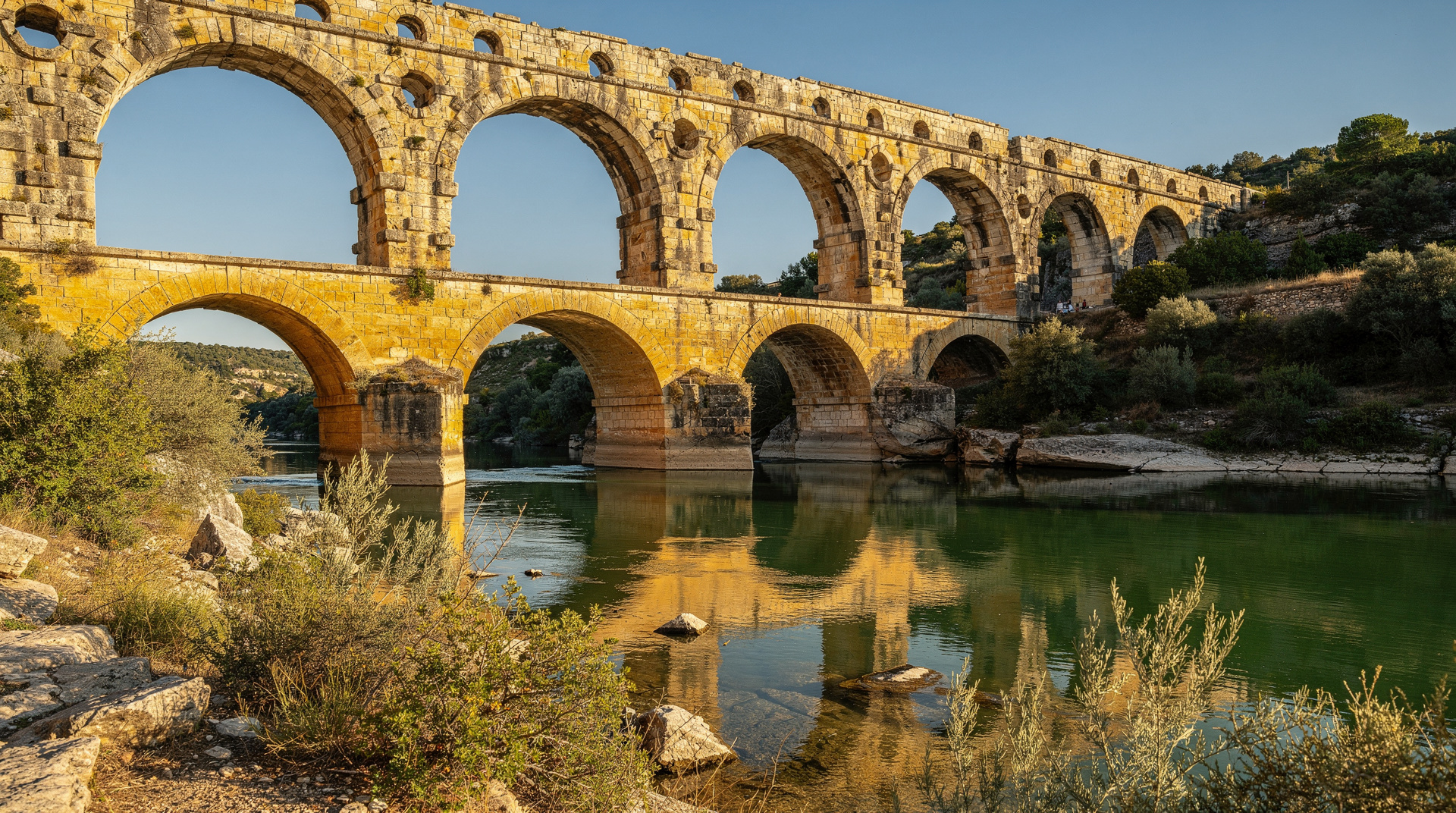
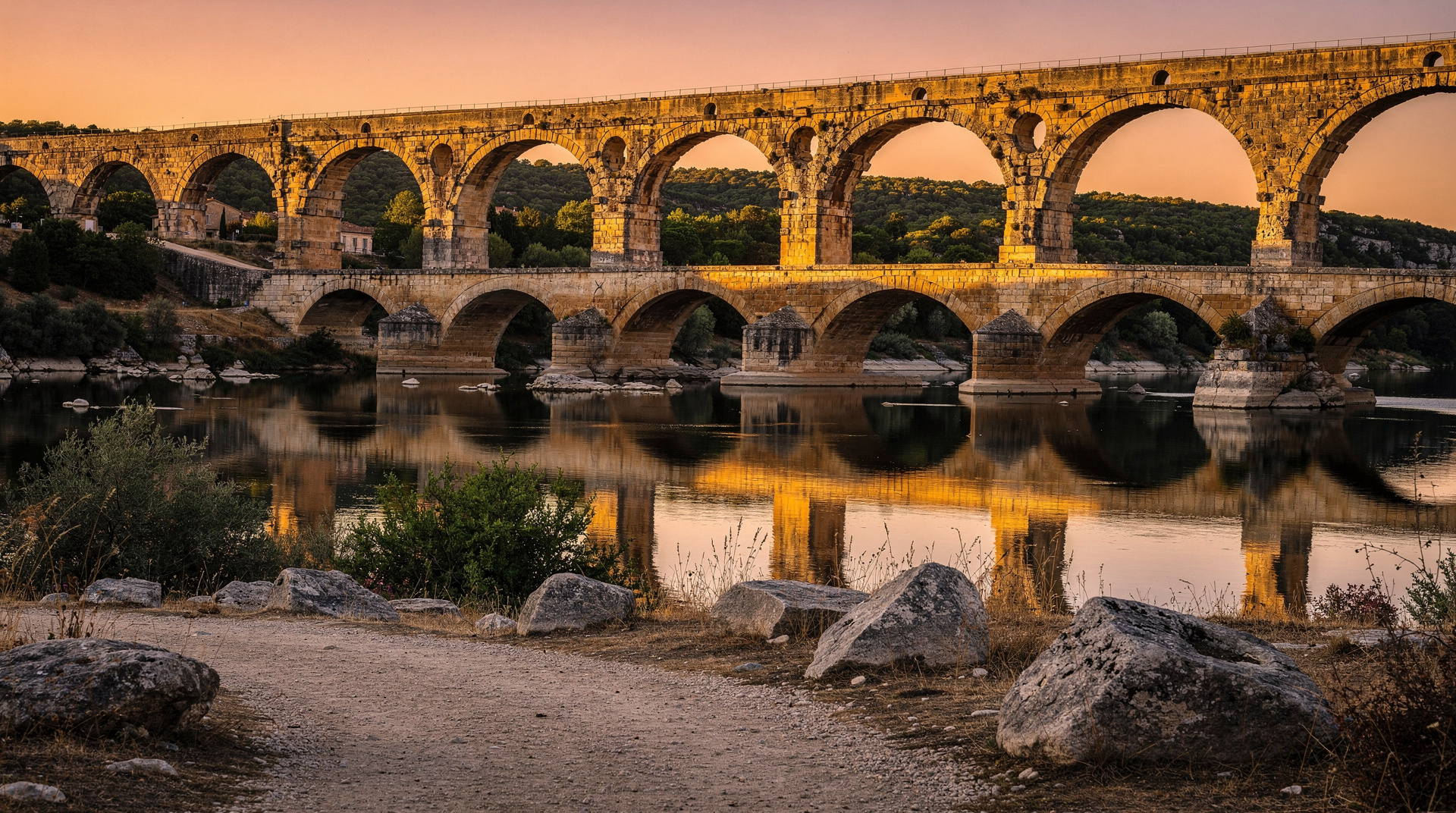
The Pont du Gard is a superlative that holds up under scrutiny. Built in the first century AD as part of a 50-km aqueduct system carrying water from the Uzès springs to the Roman city of Nîmes, it is the tallest Roman aqueduct ever built and one of the best-preserved ancient structures in the world. Three tiers of arches cross the Gard river — 49 metres high at the top, 275 metres wide at the widest point.
The engineering is extraordinary: built without mortar (the blocks are so precisely cut they hold each other by weight alone), with a gradient of only 34 centimetres across the entire 50 km route — a slope of less than 1 in 3,000. The Roman surveyors who calculated this using only rods and water levels across mountain terrain were operating at the edge of what was technically achievable.
As a visitor experience, it rewards people who care about history and engineering as much as it rewards those who simply want dramatic photographs. It also rewards families — the site is large, the river is swimming-friendly in summer, and the museum is genuinely excellent for children.
| At a glance | |
|---|---|
| Where | Pont du Gard, near Remoulins, Gard department (110 km from Marseille) |
| Cost | Around EUR 9 parking (whole site) + around EUR 6.50 adult for the museum/cinema |
| Time needed | Around 2-3 hours on site; a full day with Nîmes or Uzès |
| Getting there | Car only — around 1h30 via A7/A9, no direct train or bus |
| Best time | Spring or autumn for comfort; early morning in summer to beat both heat and crowds |
This guide focuses on the Marseille-side logistics; for a broader look at whether a car is worth renting for the whole region, see our do you need a car in Provence guide.
If you are still choosing between excursions, our day trips from Marseille overview lays out the options side by side, and the Pont du Gard destination page covers the monument itself in more depth. Travellers who like to read a first-person account before committing can also look at our golden hour visit to the aqueduct.
Getting there from Marseille
A car is the practical means. There is no direct train or bus connection from Marseille to Pont du Gard.
Drive time: Approximately 1h30 from Marseille to the Pont du Gard site (110 km via the A7 motorway north and A9 west, exit Remoulins).
Route: Marseille → A7 north → Lyon direction → A9 west toward Nîmes → exit “Remoulins / Pont du Gard” → D981 south → follow signs for the Pont du Gard (you cannot miss it — the brown heritage signs are on all roads approaching).
Parking: Two main car parks at the site (one on each bank). Cost is EUR 9 per vehicle (regardless of passenger count or visit duration). The parking fee admits you to the site grounds; the museum and cinema inside are a separate EUR 6.50 per adult (free under 18).
GYG skip-the-line ticket: Booking a skip-the-line admission through GetYourGuide lets you bypass the entry kiosk queue, which can be 20-30 minutes in July-August.
What to do at the Pont du Gard
The bridge itself (free after parking)
Walking to and under the Pont du Gard is free once you have paid the parking fee. The main viewing area is on the right bank (Rive Droite, where the main car park is). A path leads from the car park to the base of the arches in about 5 minutes.
Best photography positions:
- Below on the left bank: Wade into the river and look upstream — the arches frame perfectly from water level.
- The right bank downstream: About 100 metres downstream on the path, a small clearing gives the classic three-tier composition with the arches reflected in still river water (best in morning light).
- Kayak view: From water level in a kayak, the scale becomes fully apparent. Kayak hire is available at the site (see below).
Walking across: A modern pedestrian bridge runs alongside the lower tier, allowing you to cross between the two banks. You can walk along the second tier of the aqueduct with a guided tour (check the site for 2026 guided-visit schedule and prices — the upper level is not self-guided due to height and narrow walkway).
The museum and cinema
The Mémoire de l’Eau museum on the right bank explains the aqueduct’s construction, the Roman water system of Nîmes, and the engineering behind the gradient calculation. The presentation is well-designed and accessible for non-engineers — scale models, reconstructed tools, and visual explanations of the surveying methods. Entry EUR 6.50 adult (included with the combination site ticket; free under 18).
Allow 45-60 minutes.
River swimming
Swimming is permitted at designated beach areas on both banks. The right-bank beach (Plage de la Rive Droite) is larger and has shaded sections. The left-bank area has shallower water closer to the arches.
Important rule: Swimming directly beneath the bridge structure is not permitted. The designated beaches are 50-100 metres upstream or downstream. This is enforced by site staff in summer.
The river water is clear and relatively cool even in August — a welcome contrast to the heat of the exposed limestone site in high summer. Bring a swimsuit and towel if visiting between June and September.
Kayak hire at the site
Kayak and canoe hire is available at the site from the Kayak Vert operator on the left bank. A guided paddle below the arches gives you the most spectacular angle on the structure. Rental options include 45-minute sessions from the site and longer routes. Book ahead in summer.
Combining with Nîmes and Uzès
The Pont du Gard by itself takes 2-3 hours maximum (site, museum, river). For a full day, two natural combinations work well:
Nîmes (30 minutes west by car)
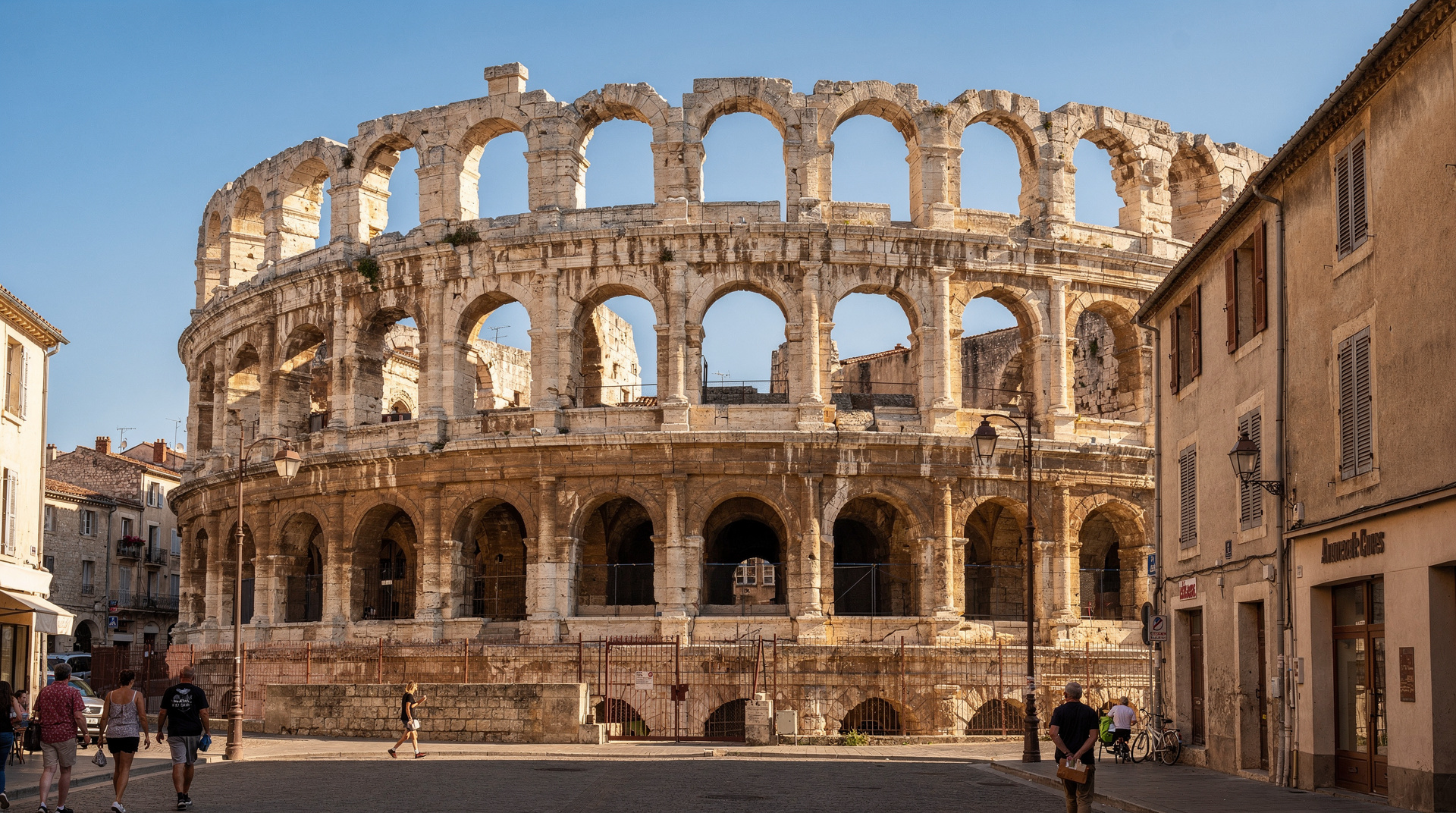
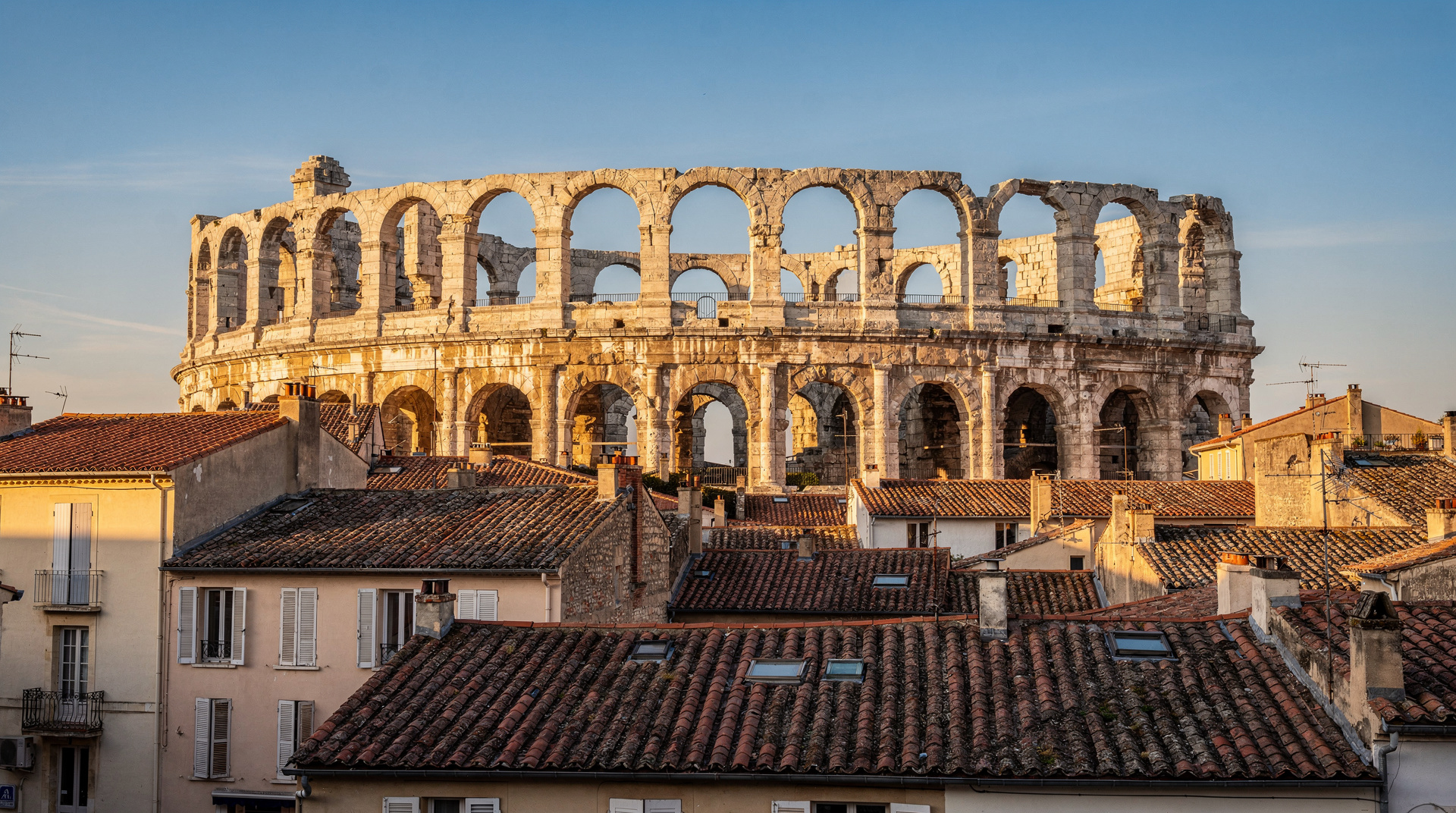
Nîmes is the city the aqueduct was built to serve. The Roman arena (Arènes de Nîmes, seating 24,000, still hosting events), the Maison Carrée (a complete Roman temple, among the best-preserved in existence, now housing a 3D film about Roman Nîmes), and the Jardins de la Fontaine make a compact 3-4 hour Roman city visit.
The combination Pont du Gard morning + Nîmes afternoon is the most popular full-day itinerary from Marseille via this route. Drive Pont du Gard first (get there by 9:30), spend 2.5 hours, then drive to Nîmes (30 min) for lunch and the afternoon monuments.
Uzès (15 minutes north of Pont du Gard)
Uzès is a medieval duchy town with an intact tower (the Tour Bermonde, visible from 30 km in every direction), a cathedral, and the best Saturday market in the Gard department. Less visited than Nîmes, more intimate in scale. The source of the aqueduct’s water — the Fontaine d’Eure springs at Uzès — is walking distance from the town centre.
Wednesday and Saturday morning markets at Place aux Herbes are excellent for Provençal produce, local honey, cheese, and crafts.
A practical timed day (Pont du Gard + Nîmes)
07:30 — Leave Marseille (A7/A9 north-west).
09:00 — Arrive Pont du Gard (car park open from 8:00). Park, walk to the site.
09:00-11:30 — Pont du Gard exploration: bridge, museum, right-bank photography, river (swim if warm enough).
11:30 — Drive to Nîmes (30 min).
12:00-13:30 — Lunch in Nîmes old town (the streets around the Maison Carrée have good options).
13:30-16:30 — Nîmes: Maison Carrée, Arena de Nîmes (entry approximately EUR 9), Jardins de la Fontaine.
17:00 — Drive back to Marseille (1h30, arrive ~18:30).
Making the most of your time on site
The site rewards a slow rhythm. Many visitors walk straight to the arches, take the obvious photograph and leave, which misses most of what makes the place worth the drive. A better order is to start with the museum while you are fresh, then walk out to the bridge with the construction story in your head. The arches look different once you know how the blocks were cut, lifted and fitted, and the gradient stops being an abstract number and becomes something you can picture along the valley.
Leave time for simply sitting. The banks of the Gard are pleasant places to stop with a picnic, and watching the light shift across the stone is part of the experience. If you are travelling with children, let them lead for a while: the river, the pebbles and the open space are as much of a draw for them as the monument. Slow, unhurried stops also suit a Roman-themed day better than a checklist approach.
Footwear matters more than people expect. The paths are uneven in places and the stone is exposed, so comfortable shoes that you do not mind getting wet are a sensible choice if you plan to wade or swim.
Turning it into a longer Provence trip
A single day at the Pont du Gard is easy to justify, but it also fits neatly into a wider stay. If you have several days, pair it with one of the other Roman or medieval towns in the region. The Avignon day trip works well on a different day, as does the Arles day trip if you prefer to stay closer to the coast. For a deeper look at the Roman legacy of the area, the Nîmes destination guide and the Avignon destination guide are natural companions.
Anyone planning a longer circuit should read about transport between Marseille and Avignon before deciding how to move around, and our Provence road trip itinerary shows how a car-based week can be shaped around stops like this one. If you would rather see several highlights without driving every day, the Marseille and Provence 5-day plan gives a gentler structure.
Seasonal notes
Summer (June-August): The hottest months make the swimming element most appealing. Arrive early — the site gets crowded by 10:30. The exposed stone retains heat; wear a hat and carry water.
Spring and autumn (April-May, September-October): The best conditions for sightseeing — comfortable temperatures, lower crowds, beautiful light on the stone. Swimming is possible but the water is cooler (16-20°C).
Winter: The site is open year-round. The Gard can flood in winter (heavy rains fill the river quickly). The stone arches have a different but impressive quality in winter light with no crowds.
Is it worth doing without a car?
Occasionally visitors ask about organised coach day trips from Marseille that bundle Pont du Gard with Avignon or Nîmes — these exist and solve the no-direct-train problem, but they run on a fixed schedule and typically allot only 60-90 minutes on site, which is tight for the museum plus the river. If you can rent a car for the day, self-driving gives you the flexibility to linger at the arches in good light or extend a swim. For a car-free alternative that still covers Roman Provence, our Arles Roman monuments guide covers a city reachable without your own vehicle.
Comparing Pont du Gard with the region’s other big day trips
| Day trip | Distance from Marseille | Time on site | Best for |
|---|---|---|---|
| Pont du Gard + Nîmes | 110 km / 1h30 | 5-6 hours | Roman engineering, river swimming, families |
| Avignon | Around 1 hour | 4-5 hours | Papal history, walkable old town, no car strictly needed |
| Arles | Around 1 hour | 4-5 hours | Roman arena, Van Gogh sites, compact centre |
| Camargue | Around 1h15 | Full day | Wildlife, horses, flamingos, beaches |
Frequently asked questions about Pont du Gard day trip from Marseille
Can you visit Pont du Gard without a car? Not practically as an independent day trip from Marseille — there is no direct train or bus. Organised coach tours from Marseille or Avignon exist and include transport, but they allocate limited time on site compared to self-driving.
Is Pont du Gard suitable for a half-day if combined with Nîmes? Yes, if you arrive early. Two to three hours at Pont du Gard (bridge, museum, brief swim) followed by an afternoon in Nîmes is a full but manageable day, as outlined in the timed itinerary above.
For regional context on the Roman heritage of the south of France, see our Arles day trip guide and the Pont du Gard destination guide.
Top experiences
Bookable activities with verified prices and instant confirmation on GetYourGuide.