Pont du Gard at golden hour — an atmospheric short piece
From Avignon: Pont du Gard, Saint-Rémy & Les Baux half-day tour
Duration: 5 hours
The photograph everyone has seen
The Pont du Gard is one of the most photographed Roman monuments in the world. The three-tier limestone aqueduct crossing the Gardon river, 49 metres at its highest, 275 metres long at the longest level, built in the 1st century CE to carry water from the Uzès springs to Nîmes — it is so photographed, so reproduced, so familiar as an image that arriving at it produces a specific dissonance: the feeling of recognising a place you are experiencing for the first time.
We have been twice. The first visit, in June 2019, was a morning arrival with the day visitors: coach parties, families, the long queue at the parking machines. The Pont du Gard in the morning is impressive in the way that genuinely remarkable things are impressive regardless of circumstances. But the morning crowd produces a register of tourism — people photographing, consulting guides, moving in the sequence established by the site layout — that makes the monument feel processed.
The second visit, on the same trip, was an accident of good planning: we stayed until 19:00.
| At a glance | |
|---|---|
| Where | Pont du Gard, around 25 min from Nîmes, 35 min from Avignon, about 1h30 from Marseille |
| Cost | around EUR 10 parking per car; around EUR 10 per adult for the museum; the riverbanks and aqueduct views are accessible without a ticket |
| Time needed | a half day at minimum for the golden-hour strategy; allow 90 minutes more for the museum with children |
| Getting there | by car via A7/A9 is easiest; regional buses reach Remoulins village, 3 km from the site |
| Best time | arrive around 16:00 in summer, stay to around 19:30–20:00 for golden hour |
What happens at 19:00 in June
The site closes at 20:00 in summer (the visitor centre and museum) but the Pont du Gard and the Gardon riverbanks remain accessible to those already within the site boundaries until a later hour. By 19:00, the coach parties and most families have left. The parking lot, which was full at 10:00, is noticeably emptier.
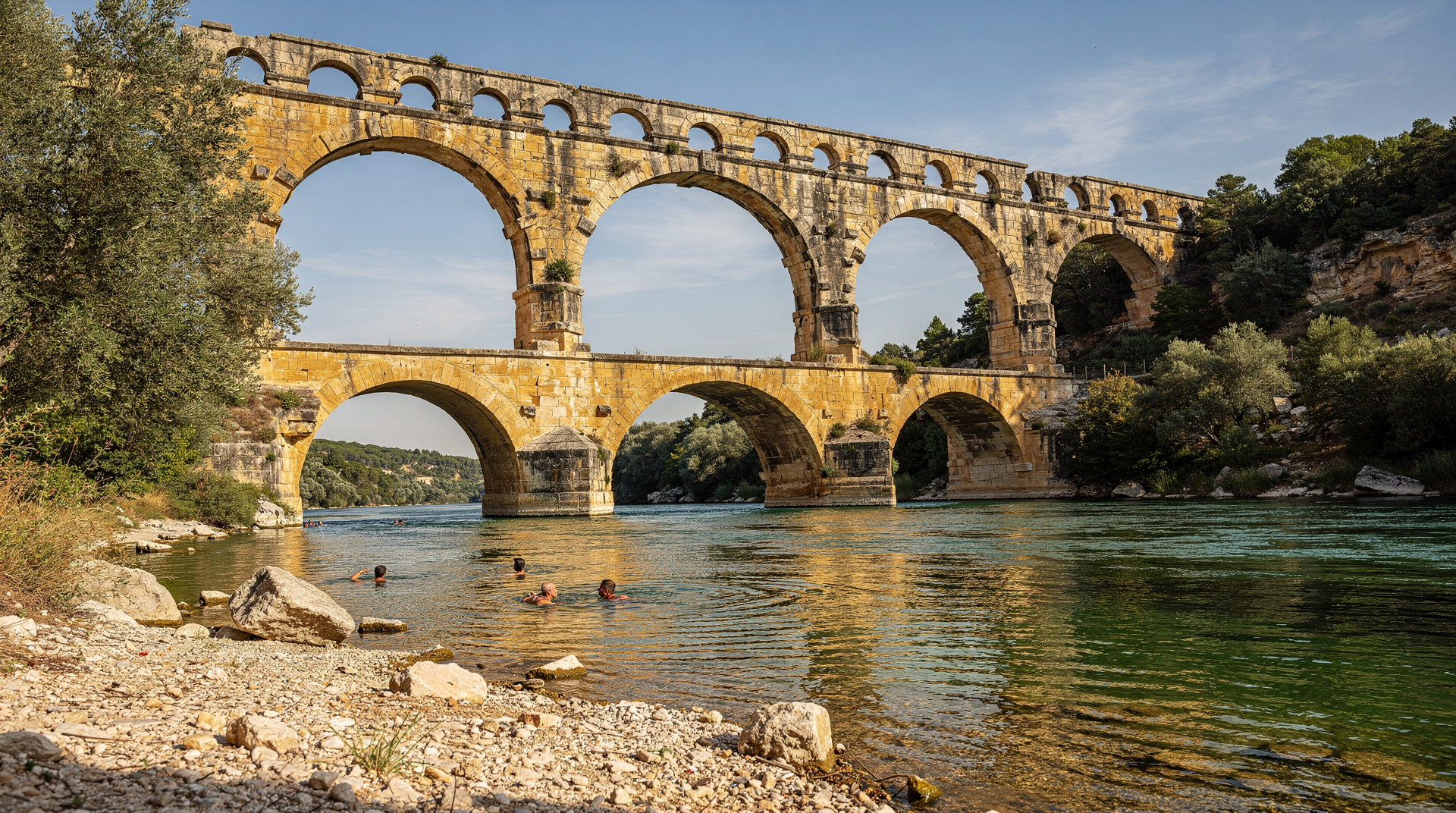
The Gardon river below the aqueduct — clear and shallow enough to wade at most times, deeper and faster after rain — has a different quality in the evening. In June, swimmers who have been there all day are leaving; the river becomes quieter. The light begins its transformation from the overhead white of afternoon to the low lateral gold of evening.
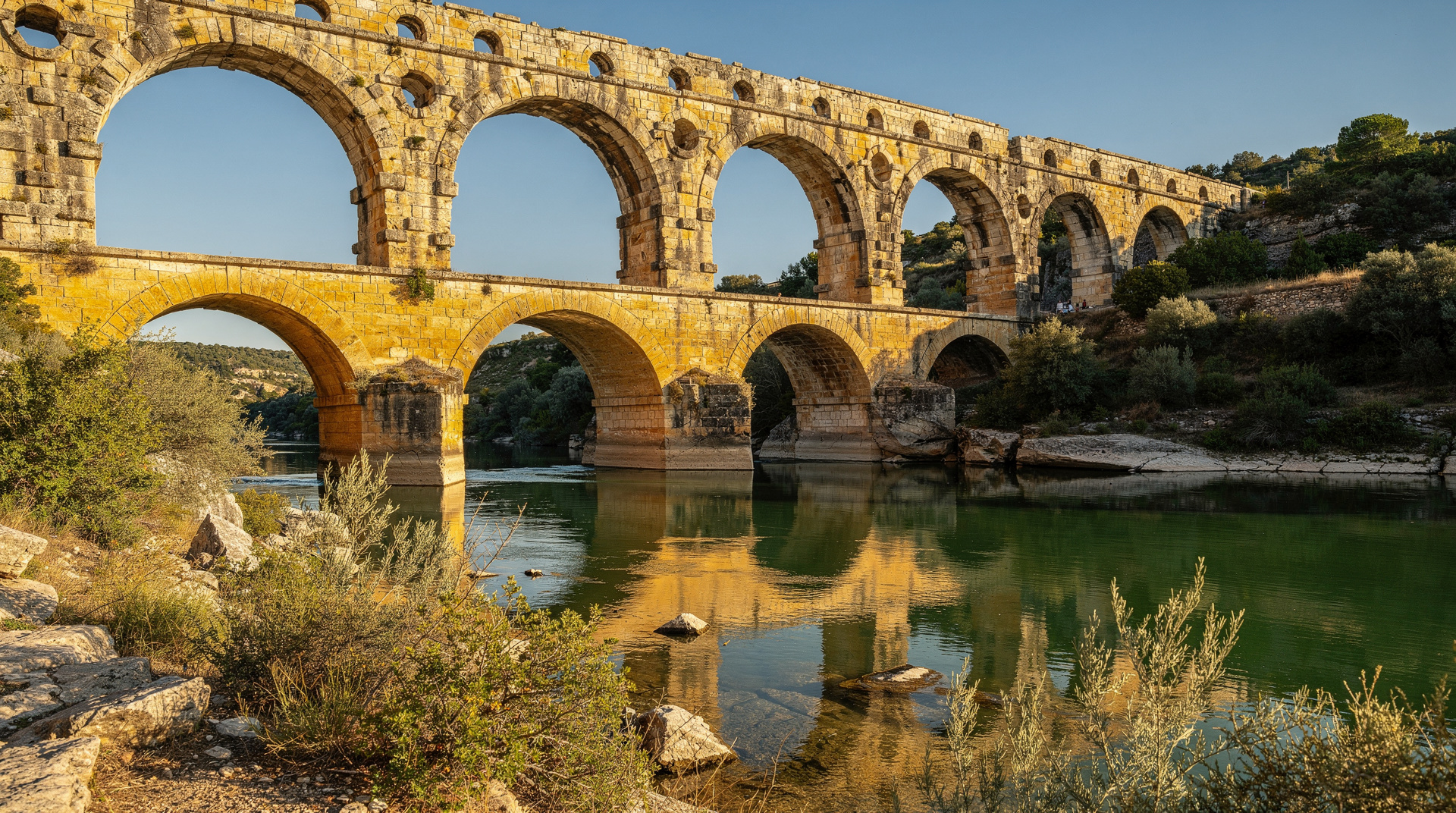
At 19:15, the limestone of the aqueduct turns. This is the thing. The honey-coloured stone, already warm in the midday sun, deepens in the evening light to something closer to amber. The shadow thrown by the upper tier on the lower tier shifts and lengthens. The reflections in the river change character. The whole structure, which has been impressive all day, becomes briefly extraordinary.
We watched this from the gravel beach below the downstream side of the aqueduct, sitting on the stones, with the river making its sound between us and the arches. There were perhaps twenty people within sight. We were not speaking much.
On two thousand years
The Pont du Gard carried water for approximately 400 years, from its construction in the 1st century CE until the Roman administrative system that maintained it collapsed in the 5th century. After that, the aqueduct was used as a bridge and partially quarried for building stone, which is why the upper tier’s foundations are somewhat irregular and one of the lower arch spandrels shows clear medieval stone removal.
The aqueduct channel at the top level had a gradient of 34 centimetres over the 275-metre span — an engineering precision that produces the 1:3000 slope necessary to move water by gravity alone without either running too fast (erosion) or too slow (calcification). The Roman engineers got this right without modern surveying instruments across a 50-kilometre canal. This is the thing to hold in mind while looking at it.
The water it delivered reached Nîmes, 50 kilometres distant, where it filled the public baths, fountains, and cisterns of a city of 50,000 people. The aqueduct was not a monument. It was infrastructure, built to exacting standards and maintained by specialists for four centuries. That it survives as a monument is an accident of durability.
The light on the stone and what it suggests
Standing under the arches in the evening light — the lower level of arches, through which pedestrians walk on the original Roman road surface — the stone is close enough to touch. The limestone is not smooth; it has a granular surface and its internal colour varies from pale cream in the shadow sections to deep honey in the light. The blocks are enormous: the largest weigh six tonnes, placed without mortar, held by the precision of the Roman arch geometry and gravity.
The light at 19:30 came through the arches at a low angle, catching the texture of the stone and casting shadows across the arch curves that moved as the sun descended. The river sound was constant. Above us, the upper tier rose in the same light.
There are moments in travel where the combination of place, time, light, and scale produces something that photographs fail to capture. This was one. We tried the photographs anyway. They are decent. They show an aqueduct lit in warm evening light. They do not show what it felt like to be standing underneath it.
The river at swimming level
The Gardon river below the Pont du Gard is, in the right conditions, one of the most pleasant swimming rivers in southern France. In summer, the water is clear (the Gardon drains limestone karstic terrain upstream), around 18–22°C, and shallow enough in the sections closest to the aqueduct to allow confident wading and swimming in currents that are manageable for competent swimmers. After heavy rain, the Gardon can rise rapidly and swimming is prohibited — check the conditions at the site entrance.
The gravel beaches on both banks below the aqueduct are the conventional swimming spots. The right bank (the Remoulins side) has more organised facilities; the left bank (the Vers-Pont-du-Gard side) is slightly quieter and produces a better angle for looking at the lower arch level from the water.
Swimming while looking up at a 2,000-year-old aqueduct is a specific experience. We recommend it without qualification.
Other times to see it differently
Golden hour is our recommendation, but it is not the only atmospheric window. Early morning, before the site opens to the public at 9:00, the light comes from the opposite direction and hits the upstream face of the aqueduct rather than the downstream side we describe above — a colder, more architectural quality than the warmth of evening.
In winter, the site closes earlier and the golden-hour window shifts to mid-afternoon; the low winter sun at this latitude produces a similarly long, raking light for a good part of the day, not just the final hour, and the river is usually empty of swimmers. Night illumination events (Les Nuits de Pierre Feu, seasonal, ticketed) run on selected summer and autumn evenings, projecting light shows onto the stone after dark — a different and more theatrical experience from the natural golden-hour approach we prefer, but worth knowing about if the dates align with a visit.
Fitting it into a wider trip
The golden-hour approach works best when the rest of the day is planned around it. If you are staying in Marseille, our Pont du Gard day trip guide lays out the practical version, and the broader day trips from Marseille overview helps you decide whether the aqueduct deserves a full day or a shared one. Because the evening return is the point, it is worth reading do you need a car in Provence before you commit to a plan that depends on public transport.
Pairing the aqueduct with a city works well. A morning in Avignon or in Arles leaves the late afternoon free for the river and the stone, and the Arles Roman monuments guide makes a natural companion if the Roman theme appeals to you. For a longer stay, the Provence road trip itinerary and the Marseille and Provence itinerary both leave room for an unhurried evening like the one we describe here.
If the season is right, the same slow, late-light approach suits the lavender plateaus too: see our lavender season diary for how that played out.
Getting there
Pont du Gard is approximately 25 minutes by car from Nîmes and 35 minutes from Avignon. From Marseille, the drive is around 1 hour 30 minutes via the A7 and A9. There is no direct public transport to the site itself, though regional buses connect Nîmes and Avignon to the Remoulins village, from which the Pont is 3 km by foot.
The site opens from 9:00. The parking costs around EUR 10 per car. The museum is included in the entry fee (around EUR 10 per adult); the Pont itself is visible and accessible from the riverbanks on both sides from the car park approach, without paying entry, though the museum and site facilities require a ticket.
For the golden hour strategy: arrive around 16:00, when the worst of the midday crowd is beginning to thin. Walk the site, visit the museum (allow 90 minutes for the Ludo interactive section if coming with children), swim in the Gardon if the water level allows. Stay for the golden hour without any particular agenda. Leave around 20:00.
This is the correct way to do the Pont du Gard. It is also the way that most day-trip coaches and packages do not offer, because it requires staying longer than the morning-coach-to-afternoon-return schedule allows. The combination with Nîmes or Avignon — a morning in the city, afternoon at the Pont — solves the timing problem by making the late afternoon Pont du Gard the natural second half of the day rather than the rushed conclusion.
See our Pont du Gard destination guide for full visiting details, seasonal information, and combination day trip options. The Avignon and Nîmes guides cover the nearby cities that pair naturally with a Pont du Gard visit. If you are building a longer Provence itinerary around the aqueduct, our why Provence needs more than a day piece makes the wider case, and Van Gogh pilgrimage in Arles pairs well as a third stop on the same trip.
Frequently asked questions about Pont du Gard at golden hour — an atmospheric short piece
Is the Pont du Gard free to visit? The riverbanks and views of the aqueduct itself are accessible without a ticket. Parking costs around EUR 10 per car, and the museum (around EUR 10 per adult) requires a separate ticket if you want the interpretive exhibits.
Can you swim near the Pont du Gard? Yes, in the Gardon river directly below the aqueduct, when water levels allow — it is one of the more pleasant river swims in southern France in summer, though swimming is prohibited after heavy rain when the river rises.
Top experiences
Bookable activities with verified prices and instant confirmation on GetYourGuide.