Camargue day trip from Marseille: flamingos, horses, and salt marshes
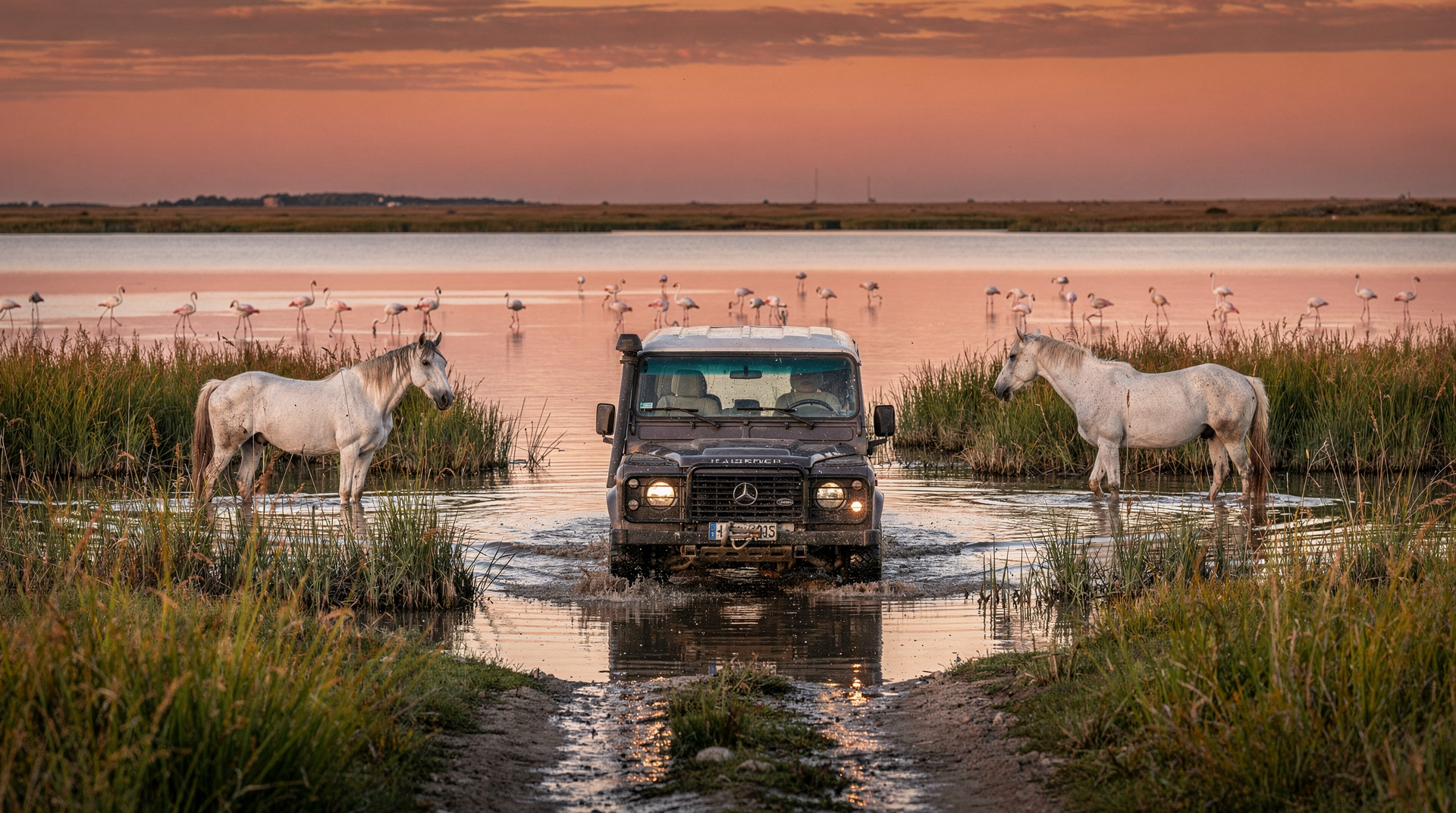
Camargue: 4x4 safari from Saintes-Maries-de-la-Mer
Is the Camargue worth a day trip from Marseille?
Yes — if you have a car. The drive to Saintes-Maries-de-la-Mer takes about 1h30. The flamingos at Pont de Gau bird park are the single best wildlife encounter in the south of France. Add Aigues-Mortes for medieval architecture. Bring mosquito repellent for summer visits.
The Camargue: where the Rhône meets the Mediterranean
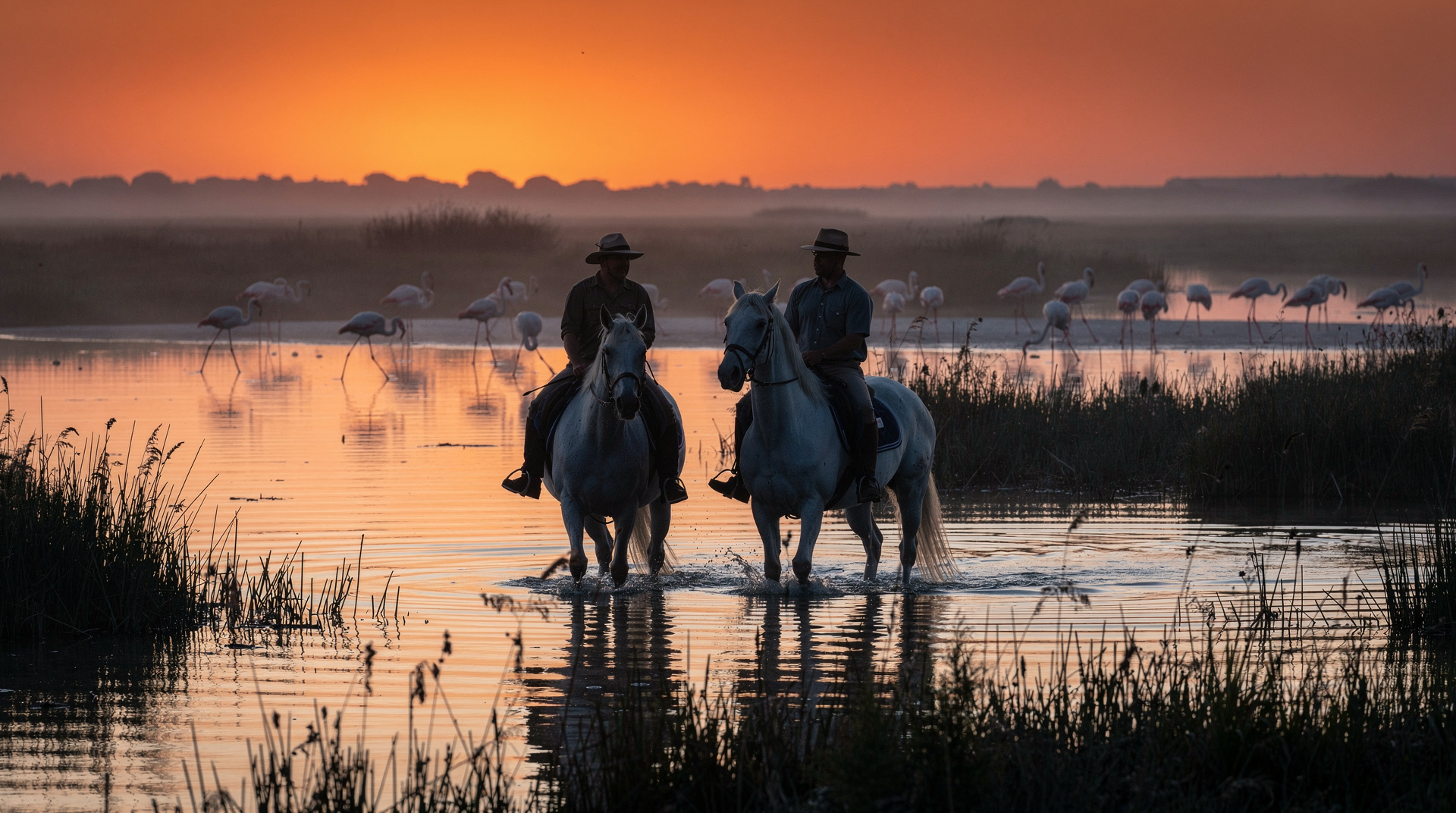
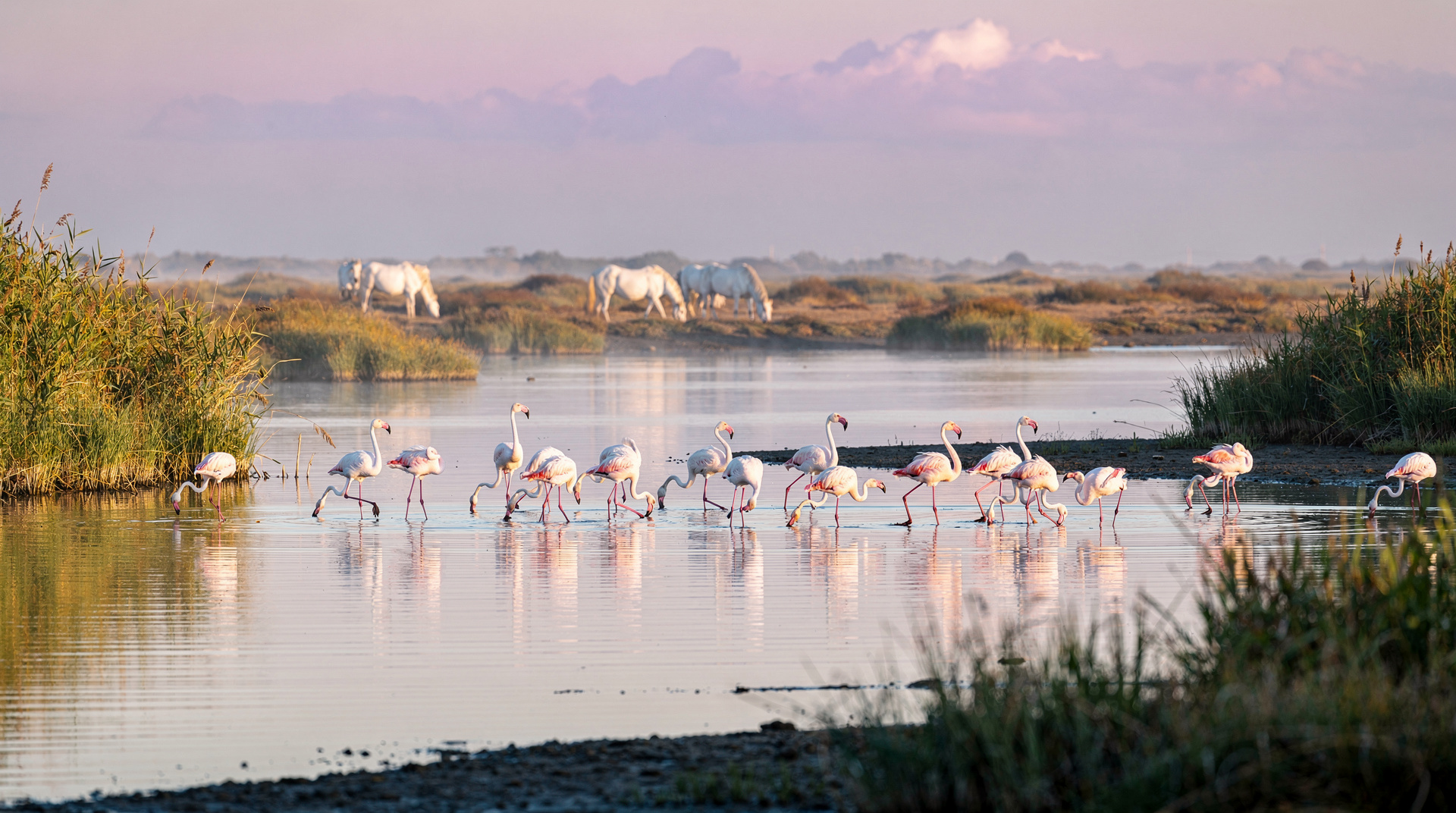
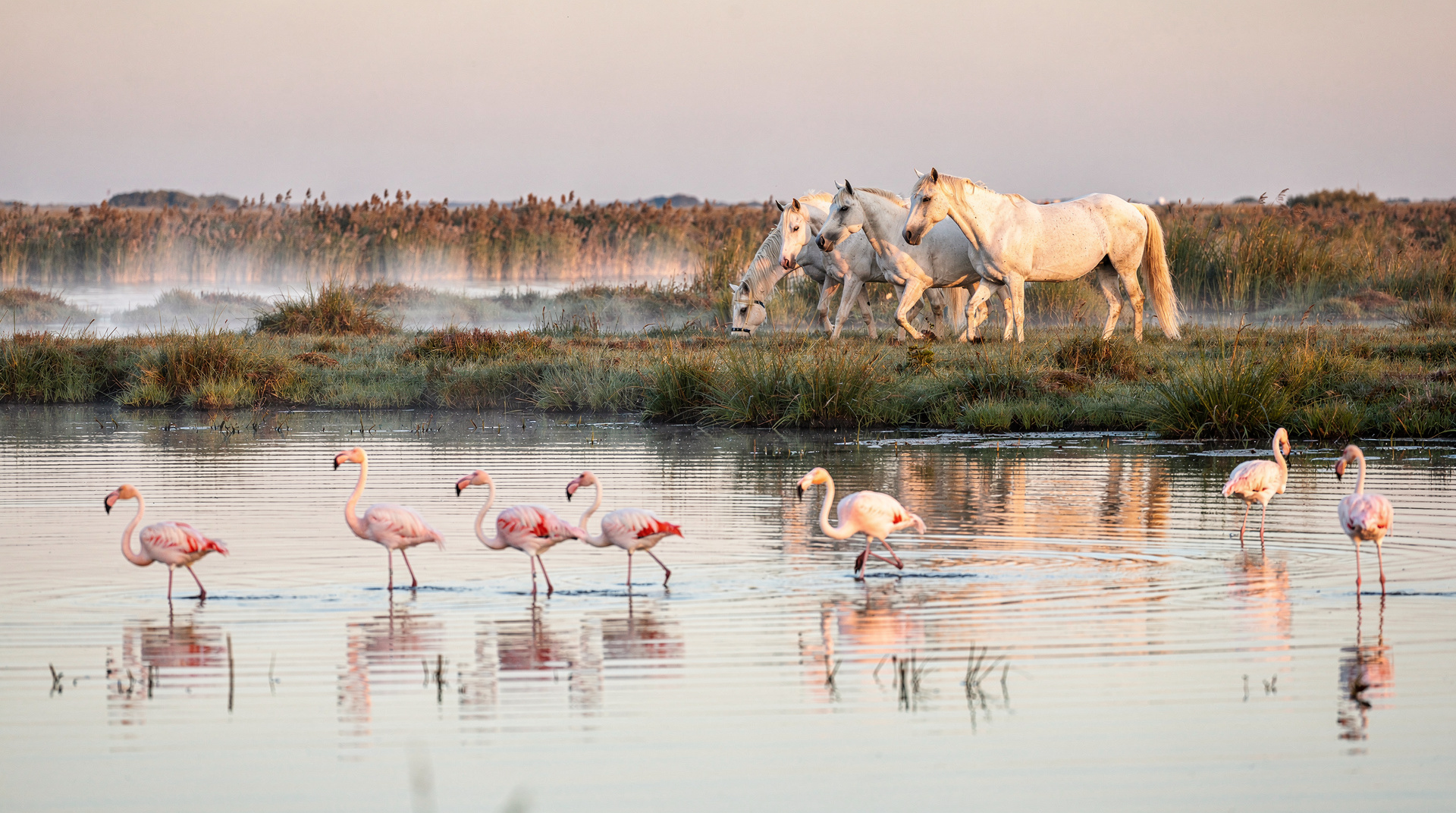
The Camargue is Europe’s largest river delta and one of its most distinctive landscapes. Where the Rhône branches into the Mediterranean, it has built over millennia a flat, windswept wetland of salt marshes, lagoons, reed beds, and sand bars. White horses graze in shallow water. Pink flamingos feed in the brackish lagoons by the thousands. Black bulls roam the grasslands managed by gardians — the Camargue cowboys who have worked this land for generations.
It is the landscape least like any other in Provence — no hills, no perched villages, no lavender. Instead, a vast flat sky, a horizon wider than anywhere else in the south of France, and a particular quality of light over the water that has attracted painters and photographers for a century.
As a day trip from Marseille, the Camargue rewards anyone willing to make the 1h30 drive. The logistics are simple, the wildlife is genuine, and the medieval salt-marsh city of Aigues-Mortes makes an excellent second stop on the return route.
| At a glance | |
|---|---|
| Where | Saintes-Maries-de-la-Mer, around 127 km / 1h30 drive from Marseille |
| Cost | Around EUR 8.50 bird park entry, EUR 8-10 Aigues-Mortes walls, EUR 20-70 horseback riding |
| Time needed | Full day (around 10-11 hours door to door) |
| Getting there | Car required — no practical public transport option |
| Best time | Spring and autumn for wildlife photography; winter for flamingo density; avoid midday heat in summer |
Getting there from Marseille
A car is required. There is no practical public transport from Marseille to Saintes-Maries-de-la-Mer or the main Camargue attractions.
Drive time: Approximately 1h30 from Marseille to Saintes-Maries-de-la-Mer (127 km).
Route: From Marseille, take the A55 motorway west toward Arles. At the Arles junction, take the D570 south through the Camargue delta. The road runs through the heart of the park — you will likely see flamingos, white horses, and black bulls from the car window before you even reach Saintes-Maries.
Alternative via Arles: If combining with Arles (which adds about 45 minutes to the day), drive north on the A7 to Arles first, spend 3-4 hours in the Roman city, then take the D570 south into the Camargue.
Pont de Gau Ornithological Park: the priority stop
The Parc Ornithologique du Pont de Gau is 5 km north of Saintes-Maries-de-la-Mer on the D570. It is the single best place in France to see pink flamingos at close range — trails through reed beds and salt marsh bring you within 20-30 metres of feeding flamingos, and the heron, egret, avocet, stork, and migrant bird populations are extraordinary.
Practical information (2026):
- Open daily: April-September 9:00-18:00; October-March 10:00-17:00
- Entry: EUR 8.50 adult, EUR 5.50 children (5-12 years)
- Allow 1.5-2 hours for the trails
- Best bird viewing: early morning and late afternoon (birds are more active and light is better for photography)
- The flamingos are resident year-round — you do not need to visit in a specific season
Winter note: Flamingo numbers are actually highest in winter, when the shallow lagoons concentrate them. If you visit between November and February, flamingo sightings are almost guaranteed.
Saintes-Maries-de-la-Mer
The main town of the Camargue sits at the southern tip of the delta, directly on the Mediterranean coast. It is a pilgrimage town — the Black Madonna (Sara) is venerated here as the patron saint of the Roma people, and the annual gypsy pilgrimage in May is one of the most distinctive religious gatherings in France.
Outside the pilgrimage season, Saintes-Maries is a small beach resort with a distinctive character: white-washed houses, a Romanesque fortified church (12th century, with a rooftop viewpoint), a long sandy beach, and a clear sense of being at the edge of something — the sea to the south, the flat reed-bed expanse to the north.
What to do: Walk along the main beach (long, sandy, less crowded than the Riviera beaches). Visit the Notre-Dame-de-la-Mer church and climb to the rooftop battlements (view over the entire flat delta). Eat a gardian-style lunch (Camargue bull, rice from the local paddies, tapenade).
Parking in Saintes-Maries: The town has large car parks on the northern edge (free and paid) that connect to the centre by foot. In July and August the town itself is busy; arrive before 10:00 or after 16:00.
Horseback riding in the Camargue
Riding a white Camargue horse through the salt marshes is the iconic Camargue activity and genuinely one of the most memorable experiences in the south of France. Multiple equestrian centres operate north of Saintes-Maries offering 1-hour to half-day rides through the wetlands.
Booking: Horse rides can fill up in summer. Book ahead through GYG operators or directly with equestrian centres. Rides range from EUR 20-25 per person for 1 hour to EUR 50-70 for a half-day. No riding experience required for the standard marsh trail rides.
Timing: Morning rides (8:00-10:00) have the best light and the most active wildlife. Afternoon rides (15:00-17:00) avoid the midday heat and often see flamingos returning to feed.
Aigues-Mortes: the medieval salt-marsh city
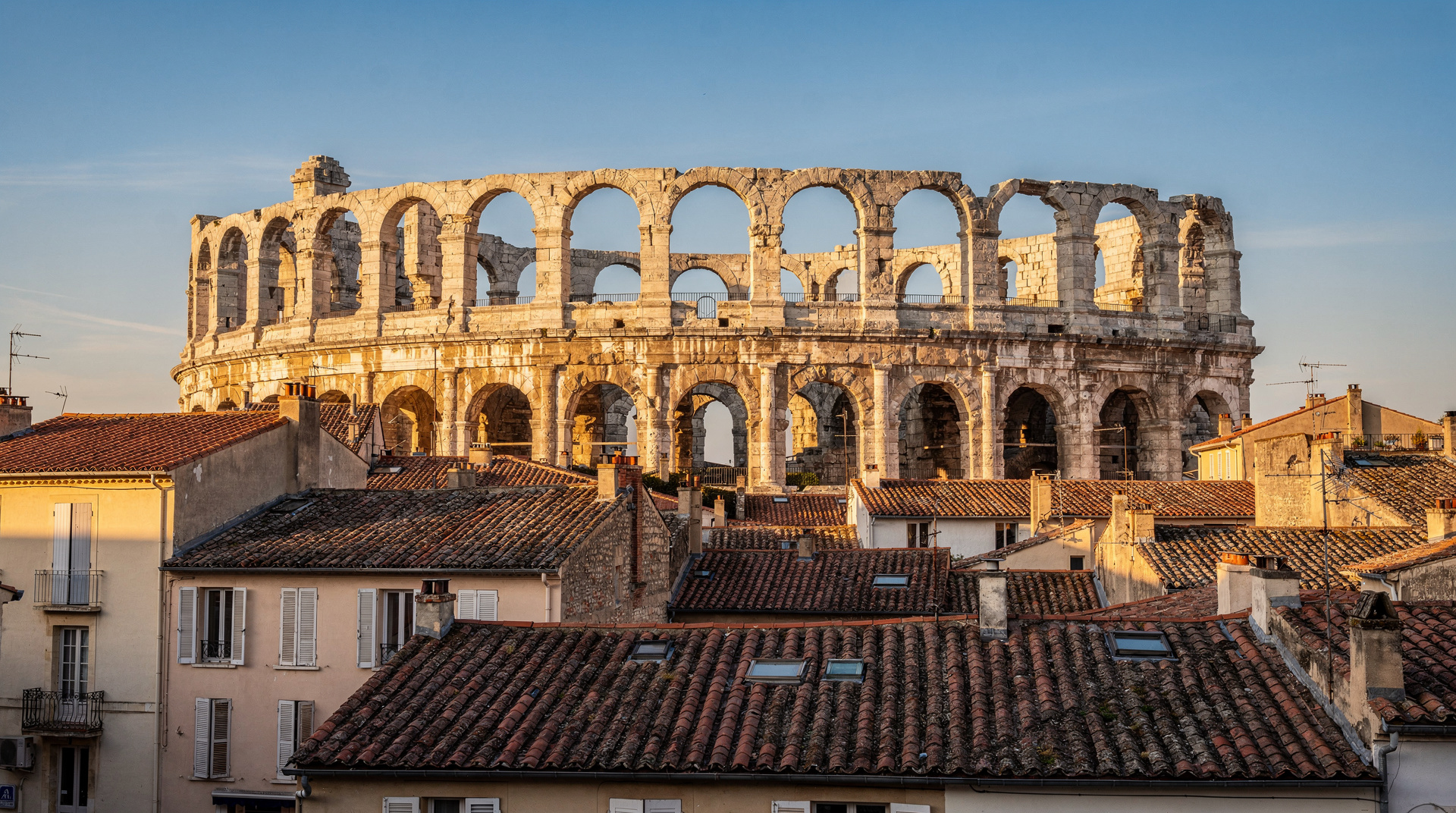
On the return route from Saintes-Maries (30 minutes northwest on the D58), Aigues-Mortes is one of the best-preserved medieval walled cities in France. The full circuit of intact 13th-century walls and towers can be walked in 45 minutes — the view from the Tour de Constance over the salt pans and the flat Camargue landscape is exceptional.
The town inside the walls is small but has excellent restaurants, a natural salt shop (the pink sea salt from the Camargue Salins du Midi is a local specialty), and a central square (Place Saint-Louis) with cafés that feels genuinely medieval in proportion.
Entry to the walls: Approximately EUR 8-10 adult to access the Tour de Constance and the wall circuit. The streets inside are free.
Salt pans at sunset: The Salins du Midi salt pans south of Aigues-Mortes are known for their pink colour (from algae) and the flamingos that feed in them. The best photography is late afternoon when the light reflects off the pink water. Guided tours of the salt works are available in summer.
The mosquito reality
No guide to the summer Camargue is honest without this: the mosquitoes are significant, particularly near the reed beds and lagoons, and particularly at dawn and dusk. In July and August, visiting the Camargue without effective repellent is a mistake.
What works: DEET-based repellent (at least 30-40% concentration) applied to all exposed skin and reapplied every 2-3 hours. Long sleeves and trousers in the early morning and evening.
When it is less of an issue: Late morning to early afternoon (10:00-14:00), when heat reduces mosquito activity. Coastal areas (the beach at Saintes-Maries) are better than the inland marshes.
The Pont de Gau bird park is relatively mosquito-tolerant in the middle of the day — trails are through open reed beds with some breeze. The interior marsh rides are the most exposed.
A practical day plan
07:30 — Leave Marseille (A55 west toward Arles).
09:00 — Arrive at Pont de Gau Ornithological Park. Walk the flamingo and heron trails (1.5-2 hours).
11:00 — Continue 5 km south to Saintes-Maries-de-la-Mer. Park in the north car park.
11:00-12:00 — Notre-Dame-de-la-Mer church visit, rooftop view.
12:00-13:30 — Lunch in Saintes-Maries (gardian bull, Camargue rice).
13:30-15:00 — Beach walk or horseback ride (if pre-booked for this time slot).
15:30 — Drive northwest to Aigues-Mortes (30 min).
15:30-17:00 — Wall circuit and Tour de Constance in Aigues-Mortes.
17:00 — Drive back to Marseille (~1h30, arrive ~18:30).
Making the plan work in practice
A day like this is a long one, and it goes better when you treat the timings above as a skeleton rather than a contract. The bird park is the one stop worth protecting: if the morning slips, shorten lunch or the beach walk rather than rushing the trails. Flamingos reward patience, and the best moments often come when you stand still at a viewing point and let the birds forget you are there.
Pack for exposure rather than for the city. The delta is flat and open, so there is little shade on the trails, and the wind can be strong near the coast. A hat, sunglasses, sunscreen, water, and comfortable closed shoes matter more here than anywhere in Marseille itself. If you plan to ride, wear long trousers and shoes with a small heel; if you plan to photograph birds, a zoom lens makes a bigger difference than any other piece of kit.
Drivers should also keep the return leg in mind. The road back toward the motorway can be slow when everyone leaves the coast at the same time on a summer evening, so leaving Aigues-Mortes a little earlier than planned is a sensible habit. Our guide to getting around Marseille covers what to do with the car once you are back in the city, and the Marseille airport to city guide is useful if you are collecting a rental on arrival.
Who this day suits, and who it does not
The Camargue suits travellers who like open landscapes, birds, animals, and slow, observational days. It is a good fit for families with children who enjoy animals, for photographers, and for anyone who has already done the classic Calanques and wants something entirely different. Families will find more ideas in our guide to Marseille with kids.
It suits less well anyone who wants a day of cafés, shopping, and museums, or who dislikes long drives. If your time in the region is short, you may prefer the sea-and-village mix of a Cassis day trip or a more urban day in Aix-en-Provence.
Building the Camargue into a longer stay
The Camargue works best as one piece of a wider trip. If you have a few days, it pairs naturally with Arles and the nearby Les Baux-de-Provence, and our Les Baux and Saint-Rémy day trip shows how to link them. For art lovers, the Van Gogh in Arles guide explains why the light of this corner of Provence mattered so much to the painter.
Planning a longer stay with a car? The Marseille and Provence 5-day itinerary and the Provence road trip itinerary both show where a Camargue day fits between other stops. If you are still deciding how long to stay overall, see how many days to spend in Marseille. For a first-person account, read our Camargue horseback day story, and for an idea of how the wider region rewards slower travel, why Provence needs more than a day.
What each season offers
Spring (March-May): Migrant birds arrive, flamingo numbers build, temperatures comfortable, mosquitoes minimal. Best wildlife photography conditions. The annual gypsy pilgrimage in late May brings large crowds to Saintes-Maries.
Summer (June-August): Peak flamingo numbers, hot and sunny, mosquitoes significant, beach at Saintes-Maries crowded. Go very early or late afternoon to avoid heat.
Autumn (September-November): Bird migration at its peak, cooler temperatures, mosquitoes dropping off. Excellent photography conditions with lower crowds.
Winter (December-February): Flamingos at maximum density in the lagoons, extraordinary light, no mosquitoes, very few tourists. The Camargue is at its wildest and most otherworldly in winter. This is the underrated season.
For a full regional guide to the Camargue including cultural context and overnight options, see our Camargue destination guide.
Camargue versus Marseille’s other day trips
The Camargue is the flattest, wettest, and most wildlife-focused of Marseille’s day-trip options — a genuinely different landscape from anywhere else covered in our day trips from Marseille overview. Compared with the Roman ruins and Van Gogh trail of an Arles day trip, the Camargue is about nature rather than culture, though the two combine well if you have a car and are willing to extend the day (see the route note above).
Compared with a hilltop-village day like Aix-en-Provence, the Camargue requires more driving and rewards patience with wildlife rather than architecture. If you are deciding between the two, the honest answer is: choose the Camargue for flamingos and horses, choose Arles or Aix for a walkable historic town. The do you need a car in Provence guide is essential reading before committing to this trip, since a car is not optional here.
Frequently asked questions about the Camargue day trip
Can I visit the Camargue without a car from Marseille?
Not practically. There is no direct train or reliable bus route to Saintes-Maries-de-la-Mer or the Pont de Gau bird park from Marseille. A car, an organised tour with pickup, or a rental for the day are the only realistic options — see the do you need a car in Provence guide for rental logistics.
Is one day enough to see the Camargue properly?
One day covers the highlights well — the bird park, Saintes-Maries, and Aigues-Mortes as outlined in the plan above. For a more relaxed pace with time for a longer horseback ride or a boat trip through the delta, an overnight stay near Saintes-Maries or in Arles allows a second day dedicated to the interior marshes.
Top experiences
Bookable activities with verified prices and instant confirmation on GetYourGuide.