Moustiers-Sainte-Marie
Moustiers-Sainte-Marie guide — the star suspended between two cliffs, faïence pottery tradition, Notre-Dame-de-Beauvoir chapel, and Verdon gorge base.
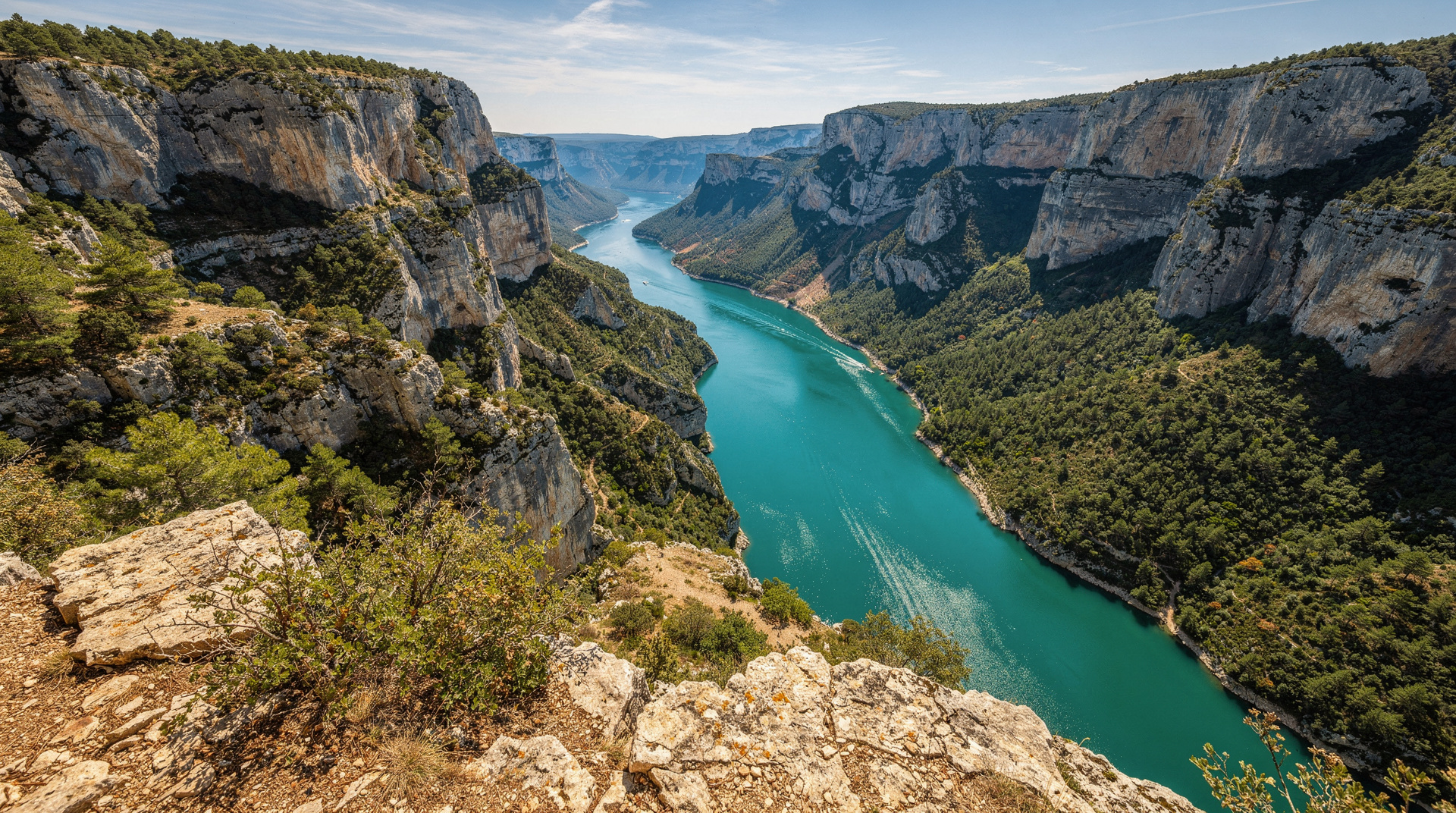
The Gorges du Verdon from Moustiers-Sainte-Marie: tour & transport
Duration: 3.5 hours
Quick facts
- Distance from Marseille
- ~2 h by car
- Distance from Verdon lake
- 10 min to Pont du Galetas (Sainte-Croix lake)
- The star
- 135-metre chain, star weighs 150 kg; 11th star in history, gilded
- Notre-Dame-de-Beauvoir chapel
- 262 steps; free; 12th-century Romanesque, classified monument
- Faïence
- Multiple workshops open for visits in the village
The village between the cliffs
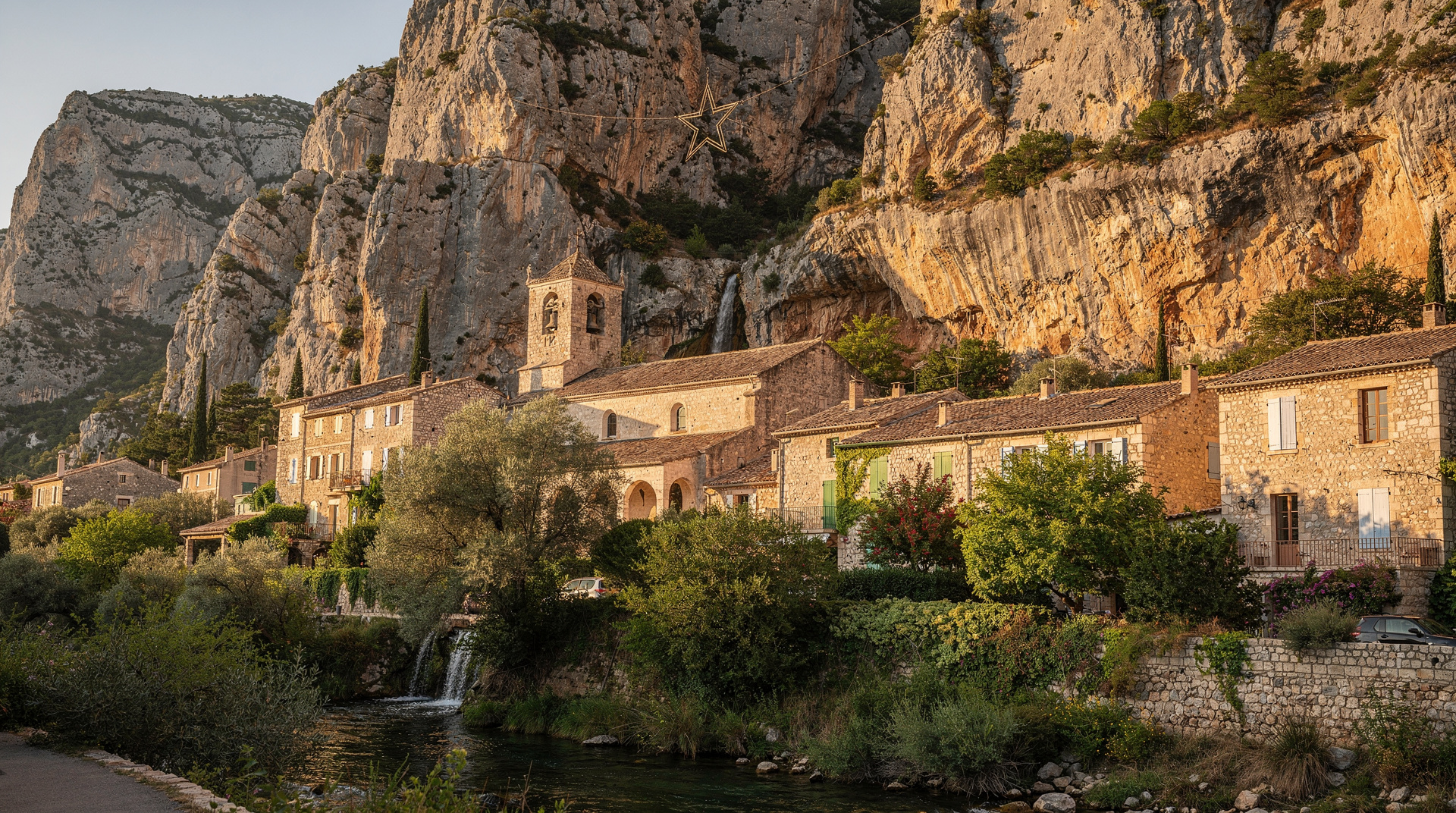
Moustiers-Sainte-Marie sits at the foot of a cliff wall in the pre-Alps above the Verdon plateau, at the point where two limestone escarpments part to reveal the village and a narrow waterfall cascading down from the heights. Between the two cliff faces, 135 metres above the village rooftops, hangs a gold star on a chain — suspended there, according to legend, since a crusading knight of Blacas made a vow to hang it in honour of the Virgin Mary if he returned alive from captivity.
The current star is the eleventh in the village’s history. It measures 1.25 metres and weighs 150 kilograms. The chain is 135 metres long. No one is entirely sure when the first star was hung — different historical versions give different dates — but the star has been the village’s defining image for centuries.
Moustiers is classified among France’s Most Beautiful Villages (Les Plus Beaux Villages de France) and earns it: the proportions of the village, the cliff backdrop, the stone architecture, and the sound of the stream that runs through the centre are genuinely harmonious in a way that photographed villages often are not in reality.
| At a glance | |
|---|---|
| Where | Haute-Provence, Alpes-de-Haute-Provence, gateway to the Verdon Gorge |
| Cost | Village is free to walk; faïence pieces from around EUR 20–30 upward; chapel free |
| Time needed | Half a day as a Verdon stopover, or 1–2 nights to use it as a base |
| Getting there | Car only in practice — around 2 h from Marseille via the A51 and D952 |
| Best time | May–June (lavender approaching bloom) and September–October (light, fewer crowds) |
Getting here from Marseille
By car: Approximately 2 hours via the A51 toward Aix-en-Provence, then the D952 east through Riez and Greoux-les-Bains to Moustiers. The final approach through the Verdon plateau landscape is itself part of the experience — lavender fields (June), limestone outcrops, and wide skies.
Parking is available on the village outskirts; the centre is pedestrian-only. In summer, the approach road and parking areas fill by 10:00 — arrive early or plan for a walk from the lower car parks.
Moustiers functions best as a base rather than a day-trip destination from Marseille — the 2-hour drive each way limits the time available at the gorge itself. Consider an overnight stay to unlock the full Verdon experience.
Notre-Dame-de-Beauvoir chapel
The chapel crowns the cliff above Moustiers, reached by 262 stone steps cut into the hillside. The path climbs through holm oak and wild herbs, passing a series of ex-voto plaques, and emerges at the 12th-century Romanesque chapel on a ledge with the village below and the plateau stretching to the horizon.
The chapel was classified as a Historical Monument in 1921. The interior is small and dark, typically containing a small number of ex-votos — votive offerings left by pilgrims in thanksgiving. The exterior loggia and the view from the cliff edge are the destination: Moustiers below, the Sainte-Croix lake visible to the west, and the profile of the Verdon limestone walls in the distance.
Practical: The climb takes 20–30 minutes at a moderate pace. Appropriate footwear is important — the stone steps are worn and can be slippery after rain. The chapel is free and open daily (hours vary; the exterior path is accessible at all times). Early morning is the best time for both light and relative solitude.
The star and the legend
The legend of the star gives several versions depending on the source. The most common: a knight of the Blacas family, taken prisoner during a Crusade, vowed to hang a golden star between the two cliffs of his village if he returned safely. He did; the star appeared. Whether this specific event happened is unverifiable — what is certain is that a star has hung between the cliffs for centuries, a detail distinctive enough that multiple European travellers noted it as a curiosity from the 15th century onward.
The eleventh star (the current one, gilded with fine gold) was installed after one of its predecessors fell during a storm. The chain is maintained by the municipality; periodic inspections require temporary removal. If the star is absent on your visit — this happens rarely and briefly — it will be back.
Faïence pottery
Moustiers-Sainte-Marie was one of the most important centres of French faïence production from the 17th century onward — tin-glazed earthenware decorated with hunting scenes, grotesques, and mythological figures in the style that spread across Provence and is now synonymous with the village. At its peak, the town had twelve workshops producing for the French nobility and the export market.
The tradition died out in the 19th century and was revived in the 20th. Today, several workshops in the village continue producing authentic faïence — pieces decorated by hand in the historic motifs, fired with traditional glazes. Prices range from EUR 20–30 for a small decorative piece to several hundred euros for large platters and complete table services.
Multiple workshops offer open visits where you can watch the decoration process. This is not a tourist demonstration — the artisans are working production, and the observation is incidental. The quality of the work is genuinely high; faïence from Moustiers is one of the more honest Provençal souvenirs, with a direct connection to the place’s actual history.
Moustiers as a Verdon base
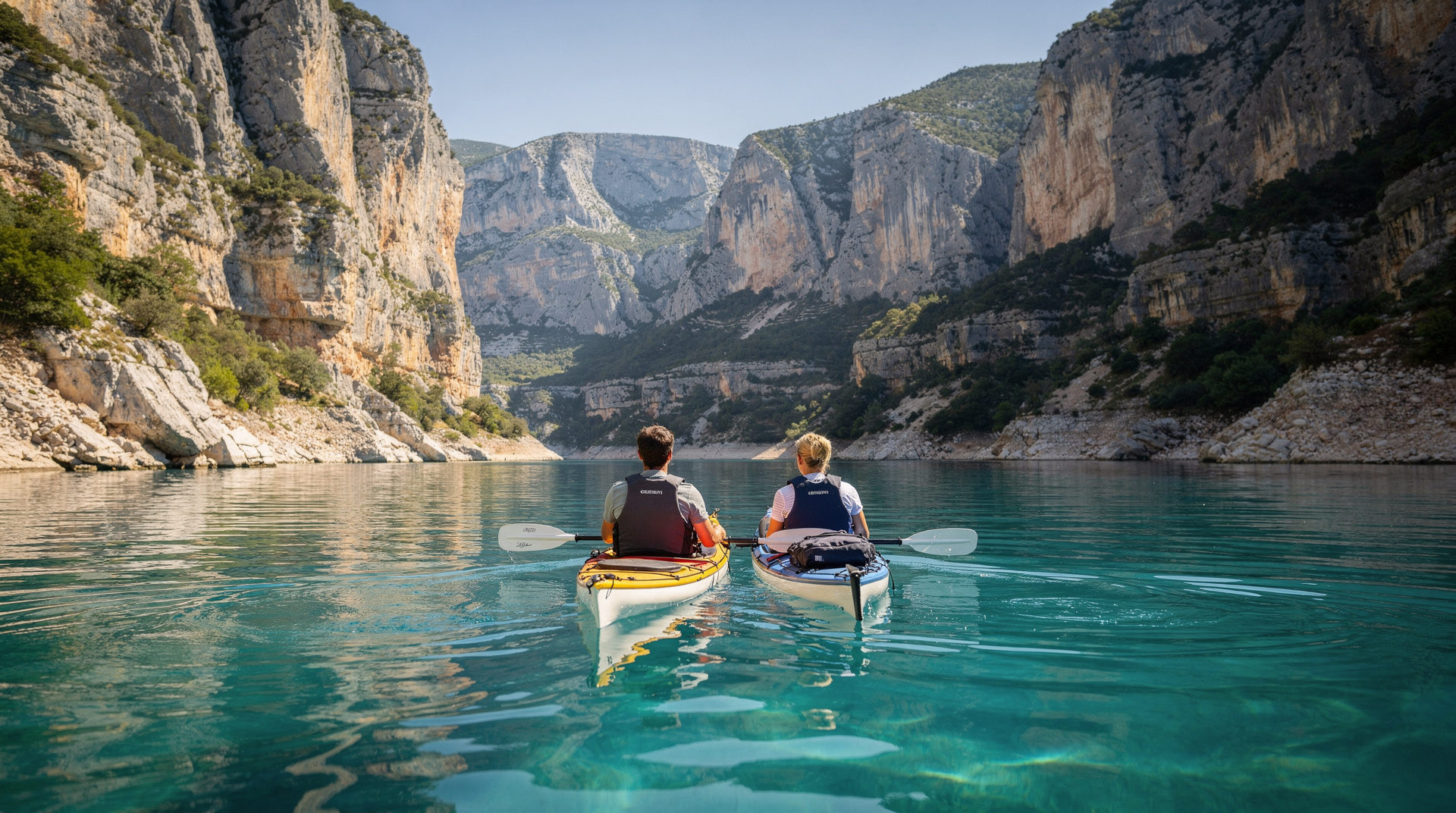
The practical reason to stay in Moustiers is proximity to the Verdon Gorge and the Sainte-Croix lake. The Pont du Galetas, where kayaks can be rented and the lower gorge entered, is 10 minutes south by car. The Route des Crêtes viewpoints are 15–20 minutes east. Moustiers’s own character — evening aperitif in the village square, dinner at one of the small restaurants, the sound of water through the night — rewards the overnight stay independently of the gorge logistics.
Practical notes:
- Accommodation in summer: book 2–3 months in advance for July–August. The village has a limited number of rooms and they fill early.
- The village has basic services: bakeries, a pharmacy, several restaurants (range from simple salads to proper Provençal cuisine), and the faïence workshops.
- No supermarket in the village. Riez (20 minutes west) has basic supplies. Castellane (40 minutes east) has full services.
For the full context of the gorge itself, see our Verdon Gorge guide. For planning the Verdon as a day trip from Aix, see day trips from Marseille.
The village in detail
The Moustiers centre is crossed by a stream (the Maire) that descends from the cliffs and rushes through the village between the houses — the sound of moving water is a constant background, audible even from the upper lanes. Two stone bridges cross the Maire through the village; the lower one, next to the main church, is the social meeting point of the village in the evenings.
The church: The Romanesque church of Notre-Dame-de-l’Assomption (not to be confused with the hilltop chapel) dates from the 11th–12th century. Its tower is one of the defining architectural elements of the village silhouette. The interior is small and atmospheric; the cloister attached to it (now ruined) was part of a larger medieval priory.
The Place de l’Eglise: The square in front of the church is the heart of the village’s social life — café tables, the fountain, the morning light striking the cliff face. This is where you eat breakfast, have a coffee, or sit after the chapel hike.
Shopping: Moustiers has more faïence shops than any other category of commerce. Quality ranges from factory-produced souvenir plates to genuinely hand-decorated pieces by working artisans. Distinguishing them requires looking at the underside (hand-decorated pieces are always signed and often dated) and asking directly about the production method.
Food in Moustiers
The village has a cluster of restaurants concentrated around the Place de l’Eglise and the Rue de la Bourgade. Cuisine is predominantly Provençal with mountain influences: lamb, truffles (when in season, November–February), wild boar, and the local spring vegetables. Several restaurants offer tasting menus emphasising the Haute-Provence larder.
La Treille Muscate: A long-standing village restaurant with a terrace on the Place de l’Eglise; reliable Provençal cooking at reasonable prices. In summer, reserve for dinner.
Practical logistics: The village has two bakeries (one closes in winter), a small épicerie, and a pharmacy. There is no supermarket within 20 minutes. For a multi-day stay, stock up in Riez or Castellane on arrival.
Lavender fields on the approach
The plateau between Riez and Moustiers is part of the Valensole lavender-growing area — one of the most extensive lavender landscapes in Provence. From late June to mid-July, the plateau fields turn the blue-purple colour that is associated with Haute-Provence. Arriving at Moustiers via Riez during lavender season, the approach road crosses multiple fields in full bloom; the combination of lavender colour and the dramatic cliff backdrop of Moustiers appearing in the distance is one of the iconic Provence visual sequences.
This makes the Verdon-Moustiers itinerary in late June or early July particularly rewarding — the gorge, the lake, the lavender, and the cliff village in a single geographic zone. See our lavender fields guide for timing details on the Valensole plateau, or our lavender season guide for the wider regional bloom window. Travellers building a longer loop sometimes combine Moustiers with a Provence lavender route rather than a single day trip.
Moustiers by season
| Month | Conditions | Crowds |
|---|---|---|
| April–May | Mild, wild asparagus season, fields greening | Light |
| Late June–mid July | Lavender bloom on the approach plateau, warm | Heavy, especially weekends |
| August | Hot, village and car parks at capacity | Very heavy |
| September | Warm days, harvest atmosphere, lake still swimmable | Moderate |
| October | Cooler, russet plateau colours, truffle season begins | Light |
| November–February | Cold, quiet, truffle markets active | Very light |
Kayaking and the lake
Beyond the Pont du Galetas rental point, the Verdon kayaking guide covers routes into the lower gorge on the Sainte-Croix lake — a good half-day addition for those basing themselves in Moustiers rather than driving in from Marseille or Aix for a single day.
Truffles and the Haute-Provence kitchen
Moustiers-Sainte-Marie sits in the truffle territory of Haute-Provence. The black truffle (Tuber melanosporum) grows in the garrigue and oak woodland of the surrounding plateau — in the right conditions, in partnership with oak and hazelnut roots in alkaline, well-drained limestone soils. The Verdon plateau provides all of these.
Truffle markets in the area run from late November through February in the villages around Moustiers. The Aups truffle market (40 km south, in the Var) is one of the most important in France, running every Thursday morning during the season. Several Moustiers restaurants feature truffle menus during this period — typically incorporating the local truffle into egg dishes, pasta, and the regional style of risotto using Camargue red rice.
The spring and summer menus shift to the Haute-Provence pantry of thyme, rosemary, wild asparagus (in April), and the abundant summer vegetables of the plateau gardens.
Practical information for Moustiers
Getting to Moustiers without a car: Buses from Digne-les-Bains and from Manosque connect to Moustiers in summer (check Zou! Provence bus network for schedules). These services are infrequent — typically 1–2 buses per day — and not practical for day tripping. Moustiers is a destination that effectively requires either a car or an organised tour with transport.
The parking situation: In July and August the lower car park at the village entrance fills by 09:30 on most days. A second car park further down the approach road takes the overflow. In shoulder season (May–June, September–October) parking is manageable. The 10-minute walk from the car park to the village centre is gentle and well-signed.
How long to spend: A half-day in Moustiers (chapel climb, village walk, faïence shopping, lunch on the square) is adequate as a transit point to the Verdon. An overnight gives you access to early morning light on the cliff face, the quieter village atmosphere before the day-tripper buses arrive, and time for a sunset aperitif when the golden light hits the star above the cliffs. Those who stay two nights can add a full gorge day.
Best months: May and June for the full Verdon experience with lavender approaching bloom. September for harvest atmosphere, cleaner autumn light, and the quieter village after August crowds. October for the truffle approach season and the russet colours of the plateau oak woodland.
Frequently asked questions about Moustiers-Sainte-Marie
Is Moustiers-Sainte-Marie worth an overnight, or is a stopover enough?
A half-day stopover covers the star, the chapel climb and a walk through the village, and works fine if the Verdon Gorge is the main event. An overnight is worth it if you want early morning light on the cliff face without the day-tripper buses, a relaxed dinner on the Place de l’Eglise, and time to add a kayaking morning on the Sainte-Croix lake.
Can I do Moustiers and the Gorges du Verdon in one day from Marseille?
Yes, but it is a long day: around 2 hours each way by car, leaving roughly 4–5 hours on site for the village and a partial gorge visit (the Route des Crêtes viewpoints or a short kayak). It is doable but rushed — see our day trips from Marseille guide for a realistic timing breakdown, or consider an overnight if your schedule allows.
Top experiences
Bookable activities with verified prices and instant confirmation on GetYourGuide.