Les Baux-de-Provence
Les Baux-de-Provence guide — clifftop village, ruined medieval château, and the Carrières des Lumières immersive light show in an old bauxite quarry.
Les Baux-de-Provence: Carrières des Lumières entry ticket
Quick facts
- Distance from Marseille
- ~1 h 15 by car via A7 and D17
- Carrières des Lumières 2026
- Picasso and Frida Kahlo double show (from February 13)
- Château des Baux
- EUR 10–12 adult, open daily year-round
- Parking
- Park in lower town (paid); village centre is pedestrian only
The village on the edge of the rock
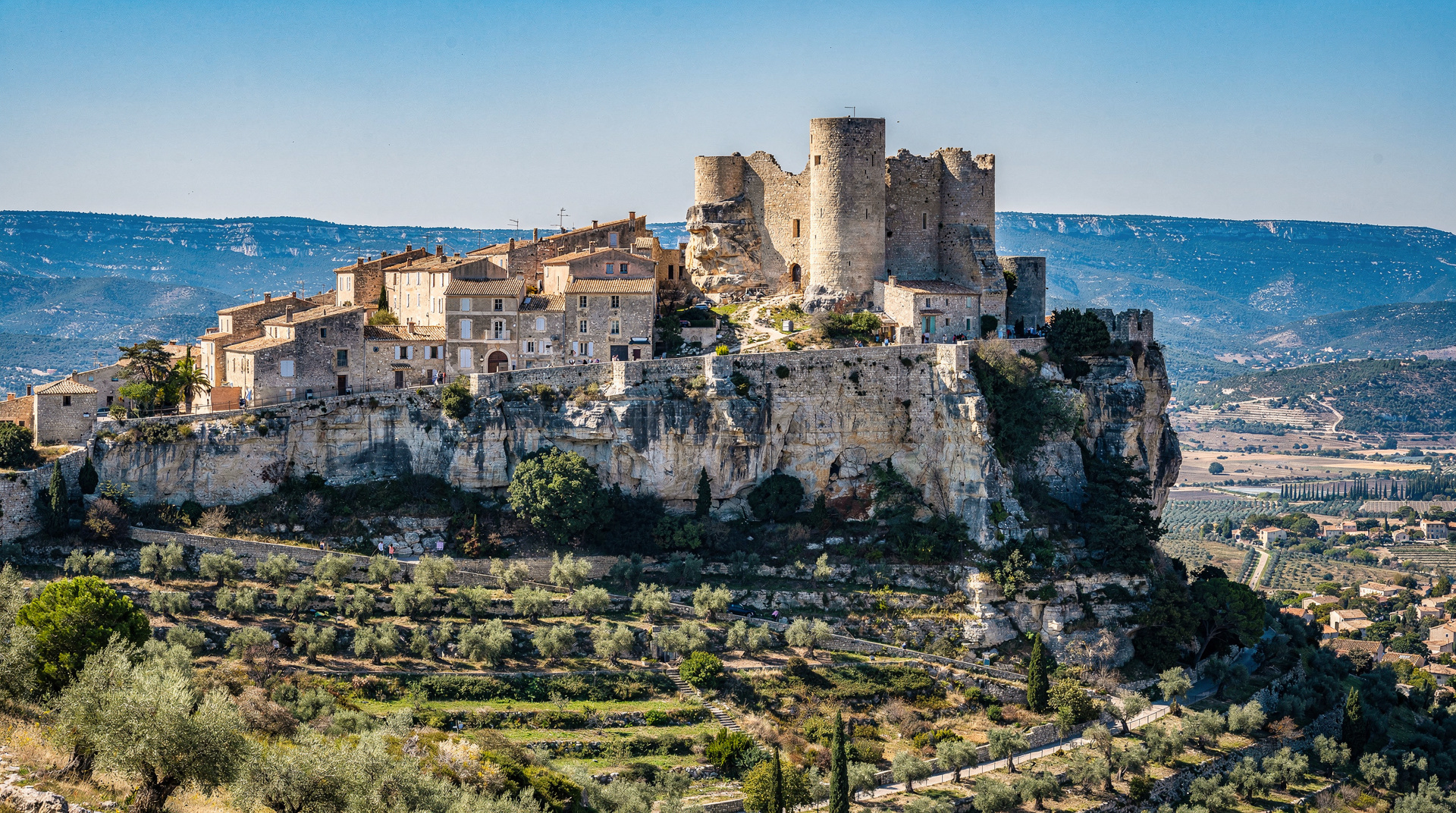
Les Baux-de-Provence occupies a narrow spur of the Alpilles limestone ridge, perched at 200 metres above the olive groves and wheat fields of the Baux valley. The village proper is medieval and compact — a single main lane (Grande Rue) climbing through 16th-century stone houses, Renaissance chapels, and artisan shops toward the ruined château at the summit. At both ends, the limestone ridge drops away in sheer cliffs.
| At a glance | |
|---|---|
| Where | Alpilles ridge, ~1 h 15 from Marseille, ~25 min from Arles |
| Cost | Château around EUR 10–12; Carrières des Lumières around EUR 14–16 |
| Time needed | Half a day for both sights; a full day if combining with Saint-Rémy or Arles |
| Getting there | Car only — no practical bus or train connection |
| Best time | April–June and September–October; avoid July–August midday crowds |
The name “baux” derives from the Provençal word for rocky spur, and in a geological twist, the mineral bauxite was first identified here in 1821 and named after the location. The quarry that yielded it was worked for 150 years, then abandoned — and then, in 2012, converted into the Carrières des Lumières, which is now the primary reason most visitors come.
Getting here from Marseille
Les Baux-de-Provence has no practical public transport connection. A car is required.
By car from Marseille: approximately 1 hour 15 via the A7 autoroute toward Avignon, then the D17 into the Alpilles. The route via Saint-Rémy-de-Provence (D5) offers better scenery if you are combining both villages.
Parking: The village itself is entirely pedestrian. The paid car parks are at the base of the spur — Parking des Carrières (near the Carrières des Lumières), Parking du Château (for the château approach), and Parking de la Pitié. In July–August these fill by 10:00. Arrive before 09:30 or after 17:00.
Les Baux combines naturally with Saint-Rémy-de-Provence (10 km north) or with a stop in Arles (20 km west). Most day tours from Marseille combine all three.
The Carrières des Lumières
The former bauxite quarry at the base of the Les Baux spur is now one of France’s most visited immersive art sites. The quarry’s interior — vast cathedral-like chambers, stone walls rising 14 metres, irregular pillars and vaulted ceilings — functions as a 360-degree projection surface. Each year a new show projects the work of a major artist across the entire space, accompanied by a full musical score.
2026 exhibition: “Picasso, l’art en mouvement” and “Frida Kahlo, en plein cœur” — a double programme launched February 13, 2026. The Picasso show draws on more than 450 works, spanning from Les Demoiselles d’Avignon to Guernica, with the projections designed specifically for the quarry’s stone surfaces. The Frida Kahlo exhibition runs from July 4, 2026, adding an immersive exploration of her life and paintings to the programme.
Previous years have featured Klimt, Van Gogh, Cézanne, and Monet — the programming is consistent and high-quality.
Practical notes:
- Open daily year-round. Hours vary by season — typically 09:30–19:30 in summer. Check the official site for exact hours.
- Entry around EUR 14–16 adult (verify on arrival or official site). Under 7 free.
- Shows run on a loop approximately every hour; you enter and exit at any point.
- The interior temperature is constant at around 12–14°C year-round — bring a layer regardless of the exterior temperature.
- Photography without flash is permitted and the results are remarkable.
- Booking in advance is strongly recommended in July–August and on weekends.
The experience is genuinely different from a museum. You stand in a cathedral-sized cave while Picasso’s Guernica is projected across the floor, walls, and ceiling at 5 metres high. The scale changes the relationship with the work in a way that a print or screen cannot replicate.
The Château des Baux
The ruined château at the top of the spur is the medieval fortress of the lords of Baux — one of the most powerful dynasties in medieval Provence, who ruled their own principality from this rock. The château was dismantled by Louis XIII in 1632 after the lords of Baux (Calvinist) refused to submit; it has been slowly crumbling since.
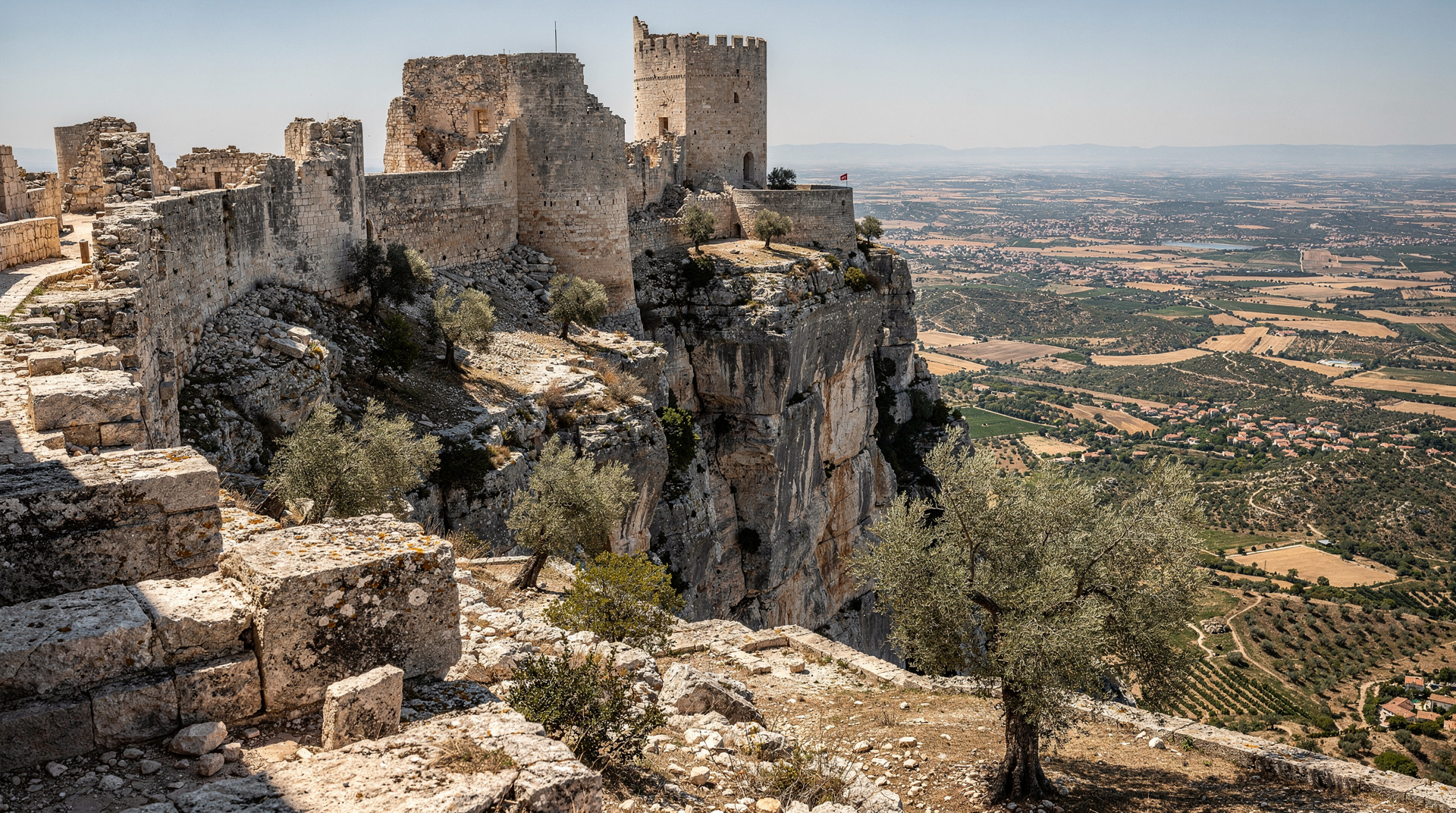
What remains is extensive: towers, great halls, a donjon, chapels, and the fortified walls along the cliff edge, all now open as an archaeological site. The plateau at the summit — 7 hectares of rocky ruins — offers the most complete panorama of the Alpilles massif and the Baux valley available from any public viewpoint.
Entry around EUR 10–12 adult (includes audio guide and occasional trebuchet demonstrations in summer). Open daily; hours vary. Allow 1.5 hours.
The view: From the château’s highest point, you see north to Avignon on a clear day, south to the Camargue and the glint of the Étang de Berre, and west across the Alpilles ridge toward Saint-Rémy. This is the main reason to make the climb beyond the village.
The village itself
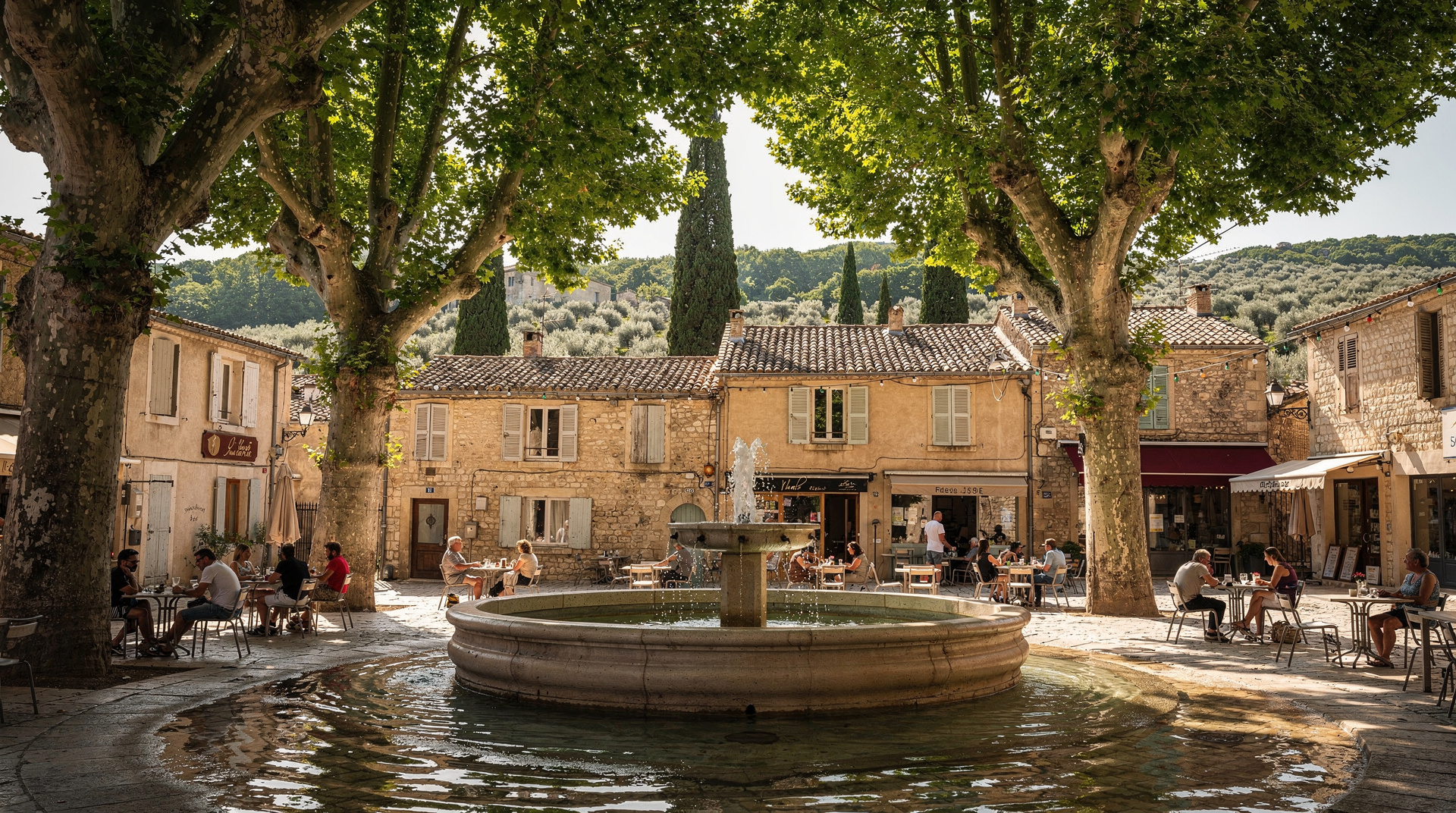
The Grande Rue through Les Baux is unambiguously a tourist circuit — shops selling olive oil, lavender sachets, santons, and local wines occupy most of the ground floor of the medieval houses. In July–August the crowd density is high and the atmosphere shifts toward that of a theme park. In April, May, early June, September, and October, the village is pleasant in itself.
The medieval architecture merits slow attention even in busy periods: the Hôtel de Manville (now the town hall), the 16th-century Renaissance houses with their oriel windows, and the Romanesque chapel of Saint-Blaise (with a small olive-oil interpretation display inside) are worth time beyond the souvenir shops.
The Carrières des Lumières + Château des Baux combination takes most of a day. If you are combining Les Baux with Saint-Rémy, treat one as the morning and the other as the afternoon rather than trying to rush both in equal measure.
Wine and olive oil
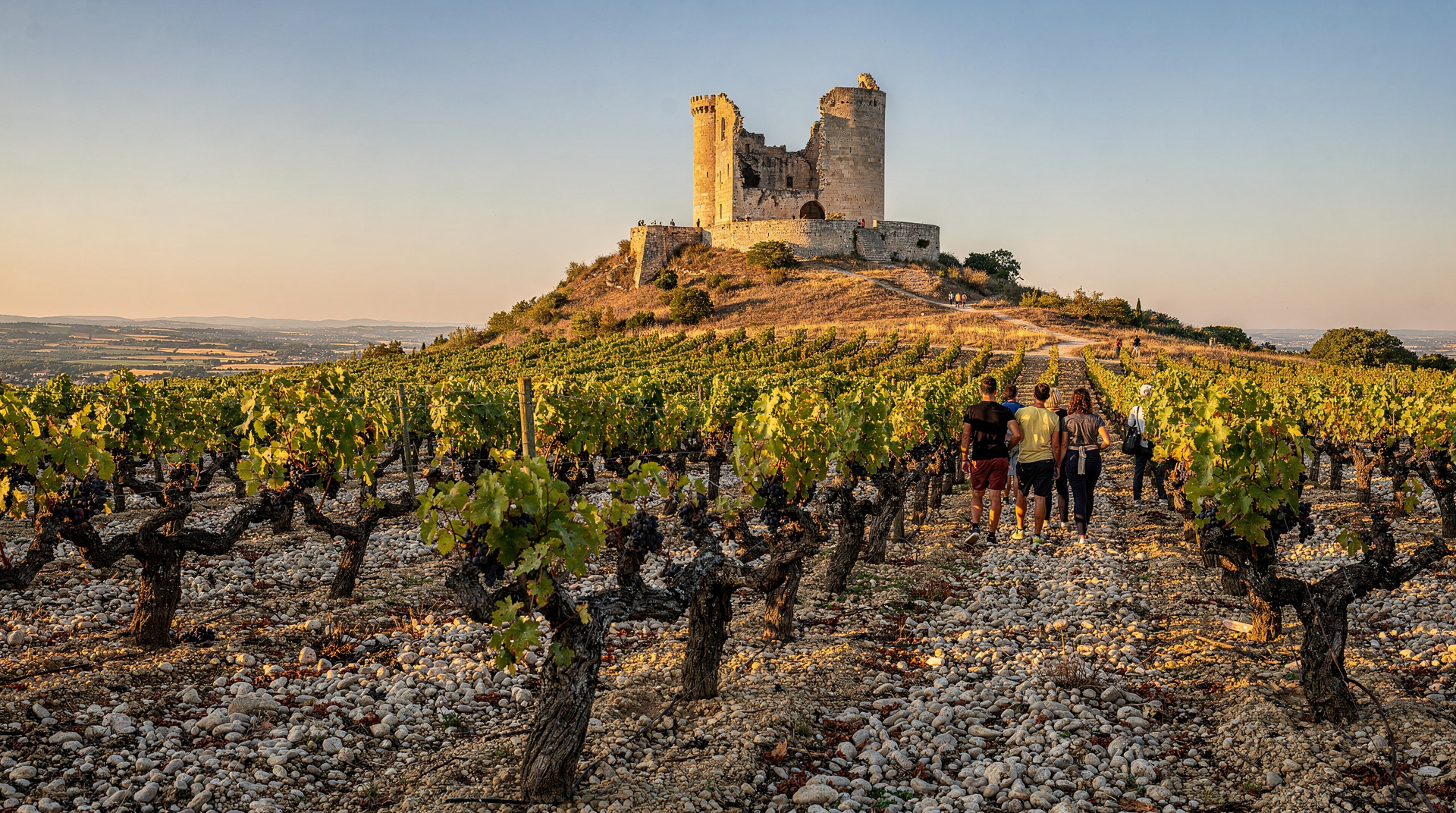
The Baux-de-Provence AOC covers the limestone terroir of the Alpilles — olive oils and wines from the valley are among the most distinctive in Provence. Several domaines in the valley (Mas de la Dame, Château Romanin, Mas Sainte-Berthe) are open for tastings with or without appointment. The olive oils of the Baux valley have their own AOC (Huile d’Olive des Baux-de-Provence) and are worth seeking out.
Several tour operators offer wine and olive oil tastings combined with a Les Baux visit, departing from Marseille or Avignon. See our related tour options for structured half-day and full-day itineraries.
Practical information for Les Baux-de-Provence
Timing and crowds: July and August see the highest visitor density. A weekday visit in those months is noticeably more manageable than a weekend. April, May, early June, and September are the best months: warm enough for the outdoor château visit, cooler for the Carrières (which maintain a constant 12–14°C regardless of exterior temperature).
Eating in Les Baux: Restaurants in the village itself tend to price for captive tourist audiences. The Auberge de la Benvengudo and similar establishments outside the village in the valley are better quality and more honest in pricing. For a simple lunch, the square at the base of the spur has a boulangerie and a café appropriate for a sandwich and a glass of Baux-de-Provence rosé.
The bauxite geology: The name connection between the village and the mineral is not a marketing invention — the Baux de Provence ridge is the type location for bauxite, the aluminium ore first described here in 1821 by French mineralogist Pierre Berthier, who named it after the village. The quarry from which bauxite was extracted for a century became the Carrières des Lumières. The geology you see in the quarry walls — the ochre-red aluminium-rich rock, the irregular cavities and formations — is the actual bauxite deposit that gave the mineral its name.
Road conditions: The D27 and D78 approaching Les Baux from Saint-Rémy are narrow in sections. In July–August, the approach roads become slow with visitor traffic. Sat-nav routing via the D78 from the south (from Fontvieille) avoids the main flow on the D27.
Les Baux combined with Arles: Arles is 20 km southwest. If you have a car and are approaching from Marseille via the A54, stopping at Arles first (morning) and then driving north to Les Baux (afternoon) uses the geography well and avoids backtracking. See our Arles guide.
The Alpilles light
The landscape around Les Baux — the white limestone outcrops, the silver-green olive groves, the terraced vineyards of Les Baux AOC — has a specific quality of light that has attracted painters since the 19th century. Van Gogh painted the Alpilles extensively during his time in Saint-Rémy. The light in May and September (horizontal, warm, with long shadows on the white rock) is the most evocative.
The Carrières des Lumières exploits a related quality: the quarry’s stone walls, with their irregular surface and varying ochre tones, make a projection surface that no constructed building can replicate. When Picasso’s Guernica is projected at full wall height across the quarry floor and ceiling simultaneously, the stone gives the image a texture and depth that a flat screen cannot.
Carrières des Lumières vs Château des Baux: which comes first?
Both are worth doing if you have half a day, but if time is tight, prioritise deliberately.
| Carrières des Lumières | Château des Baux | |
|---|---|---|
| Time needed | 45–60 min | 1.5 hours |
| Cost | Around EUR 14–16 | Around EUR 10–12 |
| Best for | Photography, families, rainy-day option | Views, ruins, history |
| Weather dependence | None (indoor, constant 12–14°C) | Outdoor — best on a clear day |
| Crowds | Loop format absorbs crowds well | Can feel exposed and busy midday in summer |
Do the Carrières first if you arrive midday in summer heat, then the château in the cooler late afternoon when the light is better for the view north to Avignon and south to the Camargue.
Nearby villages worth combining
Les Baux rarely justifies a standalone trip from Marseille. Saint-Rémy-de-Provence and Arles are the two natural pairings, and both have Van Gogh connections that complement the Alpilles landscape he painted. If you are staying in Avignon, Les Baux is a comfortable half-day loop that also takes in Saint-Rémy.
Travellers extending south into the Camargue can treat Les Baux as a scenic stop on the way rather than a separate outing. For the broader logistics of stringing several Provence day trips together, see the day trips from Marseille guide and whether you need a car in Provence.
Frequently asked questions about Les Baux-de-Provence
Can you visit Les Baux-de-Provence without a car?
Not practically. There is no train station and no regular bus service to the village. Organised day tours from Marseille, Avignon, or Aix-en-Provence are the realistic car-free option, and most combine Les Baux with Arles and/or Saint-Rémy-de-Provence.
Is the Château des Baux included with the Carrières des Lumières ticket?
No. They are two separate paid attractions at different points on the spur — the Carrières at the base, the château at the summit — each with its own entry fee (roughly EUR 14–16 for the Carrières, EUR 10–12 for the château).
Honest assessment
Les Baux has a high tourist-to-substance ratio in peak season. The Carrières des Lumières is genuinely excellent — it justifies the visit on its own terms. The château has good ruins and exceptional views. The village is attractive but commercially intense. The combination of all three in one half-day from a nearby base (Saint-Rémy, Arles, or Avignon) is the right way to approach it. A standalone day trip from Marseille solely to Les Baux leaves several hours to fill — combine it with Saint-Rémy and/or Arles to make the drive worthwhile.
Top experiences
Bookable activities with verified prices and instant confirmation on GetYourGuide.